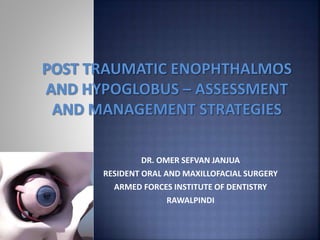
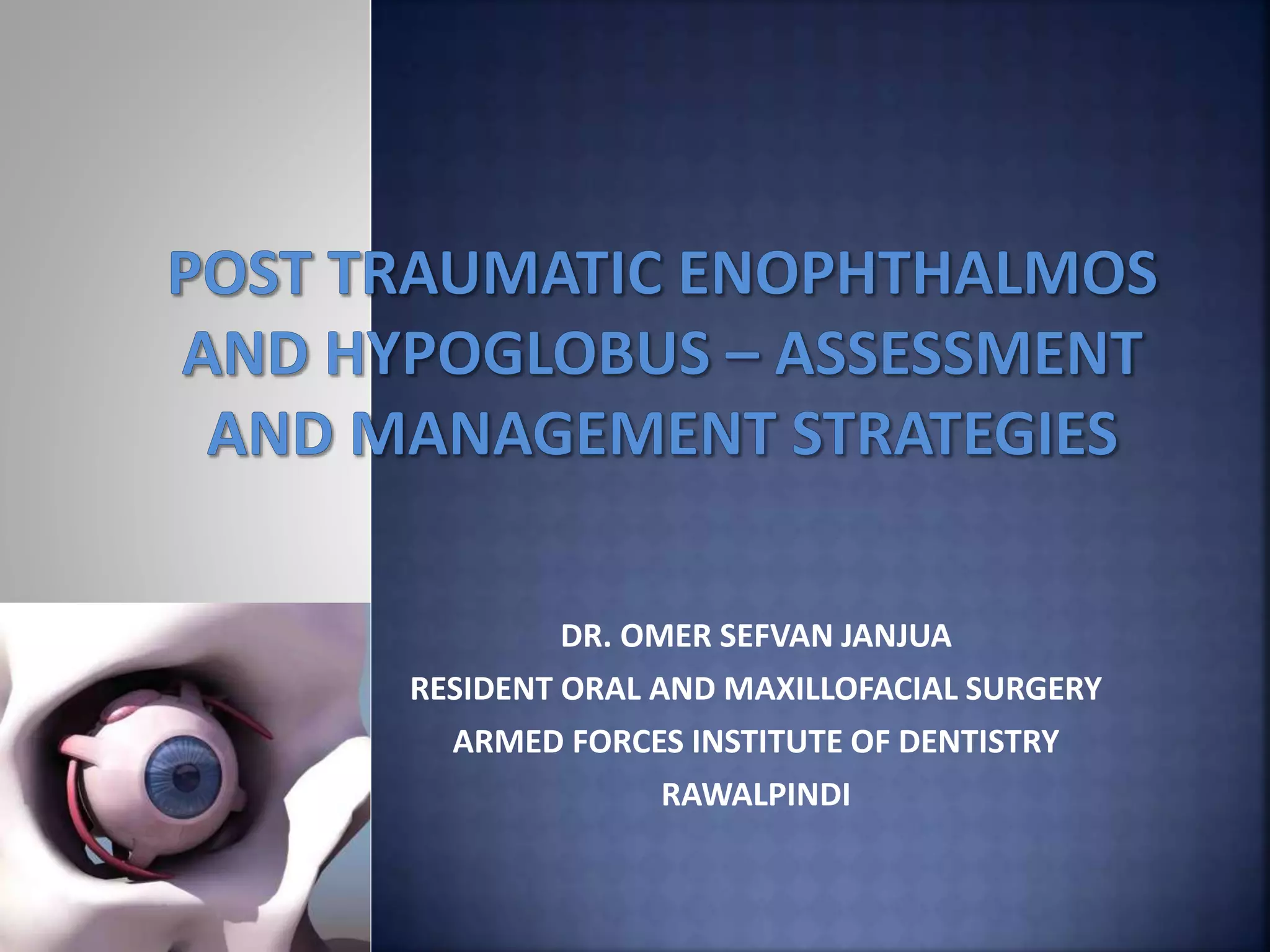
DR. OMER SEFVAN JANJUA
RESIDENT ORAL AND MAXILLOFACIAL SURGERY
ARMED FORCES INSTITUTE OF DENTISTRY
RAWALPINDI
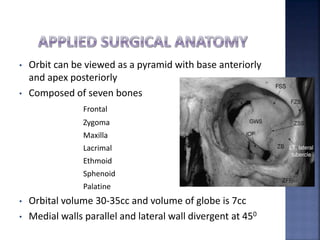
• Orbit can be viewed as a pyramid with base anteriorly
and apex posteriorly
• Composed of seven bones
Frontal
Zygoma
Maxilla
Lacrimal
Ethmoid
Sphenoid
Palatine
• Orbital volume 30-35cc and volume of globe is 7cc
• Medial walls parallel and lateral wall divergent at 450
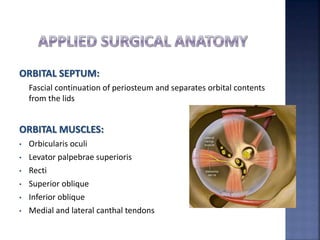
ORBITAL SEPTUM:
Fascial continuation of periosteum and separates orbital contents
from the lids
ORBITAL MUSCLES:
• Orbicularis oculi
• Levator palpebrae superioris
• Recti
• Superior oblique
• Inferior oblique
• Medial and lateral canthal tendons
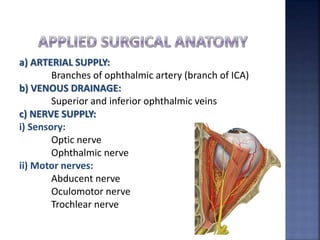
a) ARTERIAL SUPPLY:
Branches of ophthalmic artery (branch of ICA)
b) VENOUS DRAINAGE:
Superior and inferior ophthalmic veins
c) NERVE SUPPLY:
i) Sensory:
Optic nerve
Ophthalmic nerve
ii) Motor nerves:
Abducent nerve
Oculomotor nerve
Trochlear nerve
• Inferior orbital fissure 20mm from rim
• Superior orbital fissure 35 from FZ
• Anterior ethmoidal foramen 24mm from rim
• Posterior ethmoidal foramen 12mm from Anterior ethmoidal
foramen
• Optic canal 42mm from anterior lacrimal crest
45mm from inferior orbital rim
45mm from supra-orbital notch
6mm from posterior ethmoidal
foramen
• FZ suture 1cm above the outer canthus
• Dissections can be carried out 35mm within the orbit safely
These distances are in intact adult orbits, they can be different in
traumatic events and pediatric patients !!
• Retro positioning of the globe in its three dimensional
relationship in the orbit
• Should always be assessed in relation to the contra-
lateral eye
• It is an unsightly deformity which can be impossible to
correct completely
• Regarded as the most common and serious sequalae
of complex orbital trauma.
• Sunken eye
• Narrowing of palpebral width with pseudo-ptosis of
the upper lid
• Supra tarsal hollowing
• Hooding of the eye
• Decreased anterior projection of the globe
• Lid retraction of the opposite eye
• Paresthesia of the infraorbital nerve
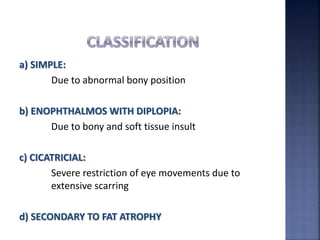
a) SIMPLE:
Due to abnormal bony position
b) ENOPHTHALMOS WITH DIPLOPIA:
Due to bony and soft tissue insult
c) CICATRICIAL:
Severe restriction of eye movements due to
extensive scarring
d) SECONDARY TO FAT ATROPHY
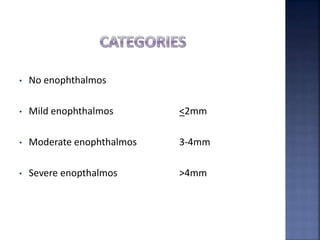
• No enophthalmos
• Mild enophthalmos <2mm
• Moderate enophthalmos 3-4mm
• Severe enopthalmos >4mm
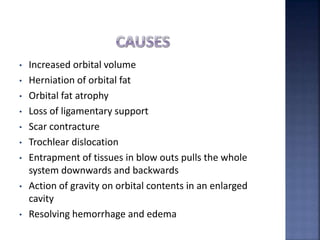
• Increased orbital volume
• Herniation of orbital fat
• Orbital fat atrophy
• Loss of ligamentary support
• Scar contracture
• Trochlear dislocation
• Entrapment of tissues in blow outs pulls the whole
system downwards and backwards
• Action of gravity on orbital contents in an enlarged
cavity
• Resolving hemorrhage and edema
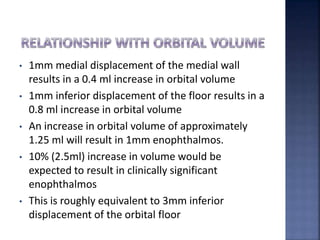
• 1mm medial displacement of the medial wall
results in a 0.4 ml increase in orbital volume
• 1mm inferior displacement of the floor results in a
0.8 ml increase in orbital volume
• An increase in orbital volume of approximately
1.25 ml will result in 1mm enophthalmos.
• 10% (2.5ml) increase in volume would be
expected to result in clinically significant
enophthalmos
• This is roughly equivalent to 3mm inferior
displacement of the orbital floor
ASSESS
• Visual acuity
• Eyelids and periorbital regions
• Extra-ocular movements
• Pupillary light reactivity
• Globe projection
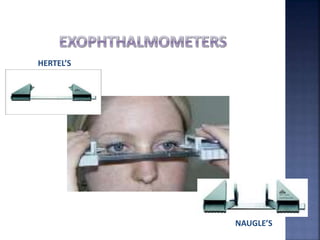
• Measure enophthalmos with Hertel’s or Naugle’s
exophthalmometer
• Vertical dystopia with clear ruler
• Paresthesias
• Canthal positions
• Eye and ZMC symmetry in all three planes
HERTEL’S
NAUGLE’S
• OM 150 and 300
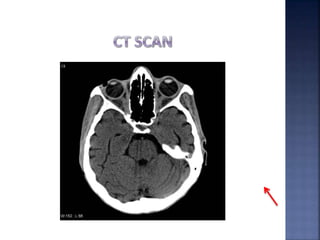
• CT (axial/coronal) 3-5mm slices
• 3D CT
• MRI + 3D Reconstruction
• Co-localization of CT on MRI
• Sinuscopy
• Computer assisted planning and surgery
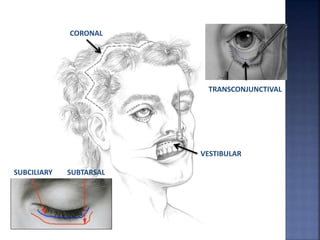
• Subciliary / Subtarsal
• Transconjunctival with / without lateral canthotomy
• Infra orbital
• Lateral nasal approach for medial wall
• Lateral eyebrow
• Coronal
• Endoscopic Intra sinus
CORONAL
SUBCILIARY SUBTARSAL
TRANSCONJUNCTIVAL
VESTIBULAR
• Enophthalmos of 2mm or more present for 2 weeks
• Positive forced duction test (FDT)
• Volume expansion on CT scan
• Herniation of orbital contents in the maxillary antrum
• Combined medial and inferior wall fracture
• Isolated medial wall fracture with displacement >3-
5mm
• Isolated floor fracture with displacement > 3mm
Early intervention is always beneficial as late intervention gives
poor results because of extensive scarring and muscle
shortening !!
• Restore anatomy
• Restore orbital volume
• Preserve vision
• Improve eye movements
• Restore esthetics
ENOPHTHALMOS WITH ISOLATED ORBITAL FRACTURES
• Expose the fracture site
• Free all the entrapped and herniated tissue
• Wide subperiosteal exposure
• Find a fixed base posterior to the globe
• Reconstruct the defect with graft or plate
• Graft or plate should fit passively and must be fixed to
the base or rim with plates/screws
• Graft must be placed behind the globe axis to push it
forward
• Assess with FDT again before closure
• Close in layers
ASSOCIATED ZMC FRACTURES
• Expose the fracture sites
• Reduce the displaced ZMC and the fractured rims to
their accurate anatomical positions
• Rigidly fix ZMC (3 point fixation)
• Free any herniated tissue
• Graft/plate any defects
• Perform FDT before closure
• Close in layers
ENOPHTHALMOS ASSOCIATED WITH DIPLOPIA
• Correct enopthalmos as explained
• If diplopia is not corrected simultaneously, perform
strabismus surgery after 6 months
STRABISMUS SURGERY
• Repositioning of muscle insertions onto sclera
• Weakening of the opposing muscles
SECONDARY REPAIR
• Refracture ZMC, restore its exact anatomical position
and perform 3 point rigid fixation to restore orbital
volume
• Free the globe and perform FDT
• Wedge shaped graft can be placed on the floor with its
thick portion placed posteriorly to create a ramping
effect on the globe
ENOPHTHALMOS ASSOCIATED WITH BLIND EYE
• Good results can be obtained by using a
magnifying lens in the spectacles
• Vertical prisms can be used to camouflage vertical
dystopia
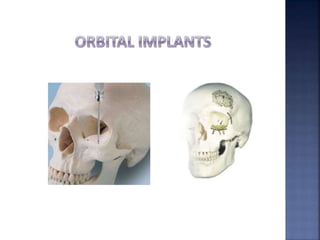
a) AUTOLOGOUS BONE
Iliac crest
Split rib
Calvaria
Anterior antral wall
Buccal or lingual cortices of mandible
b) AUTOLOGOUS CARTILAGE
Auricular cartilage
Septal cartilage
c) HOMOGRAFTS
Lyodura
Zenoderm
Irradiated cartilage
Banked cadaveric bone
d) ALLOPLASTS:
MMA
Silicone polymers
Teflon
Nylon
Gelatin film
Porous polyethylene (Medpor)
Polydioxanone plates
Polyglactin  Polylactide plates and mesh
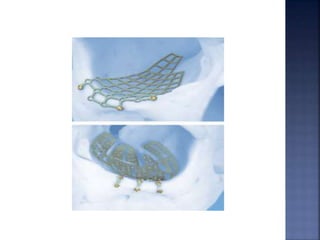
Metal sheets and meshes (Titanium)
• Lowering of the eyeball
• Can occur alone but usually associated with
enophthalmos
• It is assessed by placing a clear ruler in front of the
eyeballs
It is affected by;
• Bony support
• Ligamentous support
• Volume of the orbit
• Volume of the orbital fat and extra-ocular muscles
• Equator of the globe runs from lateral orbital rim to
posterior lacrimal crest
• Can be improved by correcting the position of ZMC
• Correction requires bone about 1cm wide and equal to
the length of inferior rim
• Bone should be placed directly below the equator to
uplift it
• Failure to correct properly in the initial setting thus
requiring secondary repair
• Iatrogenic damage to the globe
• Optic nerve compression
• Graft resorption and recurrence of enophthalmos
• Dacryocystitis
• Infection/extrusion of the graft/plate
• Foreign body reaction
• Tissue sagging owing to inadequate closure
• Scarring, ectropion or scleral show
• Orbital volume expansion of 1cc produces enophthalmos of
0.8mm
• Vertical dystopia of 1cm can be accomodated and tolerated
by brain
• Defects should always be over corrected several mm
• Orbital fractures should always be repaired after ZMC
• Usually 20-30% resorption occurs in case of autologous
grafts
• Fixation of graft decreases resorption
• If 2 or more walls are fractured, titanium mesh should be
used
• If both, bone and muscle surgeries are required, perform
muscle surgery after bony surgery
• In enophthalmos, graft should be placed behind the globe
and in hypoglobus should be below the globe
• Principles of Oral and Maxillofacial Surgery by Peterson
• Oral and Maxillofacial Surgery by Peter Ward Booth
• Oral and Maxillofacial Trauma by Raymond J Fonseca
• Facial Plastic, Reconstructive and Trauma Surgery by Robert W
Dolan
• Facial trauma by Seth R Thaller and Scott McDonald
• Oral and Maxillofacial Surgery by Fonseca, Marciani and Turvey
THANK YOU
“A SURGEON IS KNOWN BY THE SCAR HE LEAVES”
(Unknown)

post traumatic enophthalmos and hypoglobus

  • 1.
    DR. OMER SEFVANJANJUA RESIDENT ORAL AND MAXILLOFACIAL SURGERY ARMED FORCES INSTITUTE OF DENTISTRY RAWALPINDI
  • 2.
    • Orbit canbe viewed as a pyramid with base anteriorly and apex posteriorly • Composed of seven bones Frontal Zygoma Maxilla Lacrimal Ethmoid Sphenoid Palatine • Orbital volume 30-35cc and volume of globe is 7cc • Medial walls parallel and lateral wall divergent at 450
  • 3.
    ORBITAL SEPTUM: Fascial continuationof periosteum and separates orbital contents from the lids ORBITAL MUSCLES: • Orbicularis oculi • Levator palpebrae superioris • Recti • Superior oblique • Inferior oblique • Medial and lateral canthal tendons
  • 4.
    a) ARTERIAL SUPPLY: Branchesof ophthalmic artery (branch of ICA) b) VENOUS DRAINAGE: Superior and inferior ophthalmic veins c) NERVE SUPPLY: i) Sensory: Optic nerve Ophthalmic nerve ii) Motor nerves: Abducent nerve Oculomotor nerve Trochlear nerve
  • 5.
    • Inferior orbitalfissure 20mm from rim • Superior orbital fissure 35 from FZ • Anterior ethmoidal foramen 24mm from rim • Posterior ethmoidal foramen 12mm from Anterior ethmoidal foramen • Optic canal 42mm from anterior lacrimal crest 45mm from inferior orbital rim 45mm from supra-orbital notch 6mm from posterior ethmoidal foramen • FZ suture 1cm above the outer canthus • Dissections can be carried out 35mm within the orbit safely These distances are in intact adult orbits, they can be different in traumatic events and pediatric patients !!
  • 6.
    • Retro positioningof the globe in its three dimensional relationship in the orbit • Should always be assessed in relation to the contra- lateral eye • It is an unsightly deformity which can be impossible to correct completely • Regarded as the most common and serious sequalae of complex orbital trauma.
  • 7.
    • Sunken eye •Narrowing of palpebral width with pseudo-ptosis of the upper lid • Supra tarsal hollowing • Hooding of the eye • Decreased anterior projection of the globe • Lid retraction of the opposite eye • Paresthesia of the infraorbital nerve
  • 8.
    a) SIMPLE: Due toabnormal bony position b) ENOPHTHALMOS WITH DIPLOPIA: Due to bony and soft tissue insult c) CICATRICIAL: Severe restriction of eye movements due to extensive scarring d) SECONDARY TO FAT ATROPHY
  • 9.
    • No enophthalmos •Mild enophthalmos <2mm • Moderate enophthalmos 3-4mm • Severe enopthalmos >4mm
  • 10.
    • Increased orbitalvolume • Herniation of orbital fat • Orbital fat atrophy • Loss of ligamentary support • Scar contracture • Trochlear dislocation • Entrapment of tissues in blow outs pulls the whole system downwards and backwards • Action of gravity on orbital contents in an enlarged cavity • Resolving hemorrhage and edema
  • 11.
    • 1mm medialdisplacement of the medial wall results in a 0.4 ml increase in orbital volume • 1mm inferior displacement of the floor results in a 0.8 ml increase in orbital volume • An increase in orbital volume of approximately 1.25 ml will result in 1mm enophthalmos. • 10% (2.5ml) increase in volume would be expected to result in clinically significant enophthalmos • This is roughly equivalent to 3mm inferior displacement of the orbital floor
  • 12.
    ASSESS • Visual acuity •Eyelids and periorbital regions • Extra-ocular movements • Pupillary light reactivity • Globe projection • Measure enophthalmos with Hertel’s or Naugle’s exophthalmometer • Vertical dystopia with clear ruler • Paresthesias • Canthal positions • Eye and ZMC symmetry in all three planes
  • 13.
  • 14.
    • OM 150and 300 • CT (axial/coronal) 3-5mm slices • 3D CT • MRI + 3D Reconstruction • Co-localization of CT on MRI • Sinuscopy • Computer assisted planning and surgery
  • 17.
    • Subciliary /Subtarsal • Transconjunctival with / without lateral canthotomy • Infra orbital • Lateral nasal approach for medial wall • Lateral eyebrow • Coronal • Endoscopic Intra sinus
  • 18.
  • 19.
    • Enophthalmos of2mm or more present for 2 weeks • Positive forced duction test (FDT) • Volume expansion on CT scan • Herniation of orbital contents in the maxillary antrum • Combined medial and inferior wall fracture • Isolated medial wall fracture with displacement >3- 5mm • Isolated floor fracture with displacement > 3mm Early intervention is always beneficial as late intervention gives poor results because of extensive scarring and muscle shortening !!
  • 20.
    • Restore anatomy •Restore orbital volume • Preserve vision • Improve eye movements • Restore esthetics
  • 21.
    ENOPHTHALMOS WITH ISOLATEDORBITAL FRACTURES • Expose the fracture site • Free all the entrapped and herniated tissue • Wide subperiosteal exposure • Find a fixed base posterior to the globe • Reconstruct the defect with graft or plate • Graft or plate should fit passively and must be fixed to the base or rim with plates/screws • Graft must be placed behind the globe axis to push it forward • Assess with FDT again before closure • Close in layers
  • 22.
    ASSOCIATED ZMC FRACTURES •Expose the fracture sites • Reduce the displaced ZMC and the fractured rims to their accurate anatomical positions • Rigidly fix ZMC (3 point fixation) • Free any herniated tissue • Graft/plate any defects • Perform FDT before closure • Close in layers
  • 23.
    ENOPHTHALMOS ASSOCIATED WITHDIPLOPIA • Correct enopthalmos as explained • If diplopia is not corrected simultaneously, perform strabismus surgery after 6 months STRABISMUS SURGERY • Repositioning of muscle insertions onto sclera • Weakening of the opposing muscles
  • 24.
    SECONDARY REPAIR • RefractureZMC, restore its exact anatomical position and perform 3 point rigid fixation to restore orbital volume • Free the globe and perform FDT • Wedge shaped graft can be placed on the floor with its thick portion placed posteriorly to create a ramping effect on the globe
  • 25.
    ENOPHTHALMOS ASSOCIATED WITHBLIND EYE • Good results can be obtained by using a magnifying lens in the spectacles • Vertical prisms can be used to camouflage vertical dystopia
  • 26.
    a) AUTOLOGOUS BONE Iliaccrest Split rib Calvaria Anterior antral wall Buccal or lingual cortices of mandible b) AUTOLOGOUS CARTILAGE Auricular cartilage Septal cartilage c) HOMOGRAFTS Lyodura Zenoderm Irradiated cartilage Banked cadaveric bone
  • 27.
    d) ALLOPLASTS: MMA Silicone polymers Teflon Nylon Gelatinfilm Porous polyethylene (Medpor) Polydioxanone plates Polyglactin Polylactide plates and mesh Metal sheets and meshes (Titanium)
  • 30.
    • Lowering ofthe eyeball • Can occur alone but usually associated with enophthalmos • It is assessed by placing a clear ruler in front of the eyeballs
  • 31.
    It is affectedby; • Bony support • Ligamentous support • Volume of the orbit • Volume of the orbital fat and extra-ocular muscles
  • 32.
    • Equator ofthe globe runs from lateral orbital rim to posterior lacrimal crest • Can be improved by correcting the position of ZMC • Correction requires bone about 1cm wide and equal to the length of inferior rim • Bone should be placed directly below the equator to uplift it
  • 33.
    • Failure tocorrect properly in the initial setting thus requiring secondary repair • Iatrogenic damage to the globe • Optic nerve compression • Graft resorption and recurrence of enophthalmos • Dacryocystitis • Infection/extrusion of the graft/plate • Foreign body reaction • Tissue sagging owing to inadequate closure • Scarring, ectropion or scleral show
  • 34.
    • Orbital volumeexpansion of 1cc produces enophthalmos of 0.8mm • Vertical dystopia of 1cm can be accomodated and tolerated by brain • Defects should always be over corrected several mm • Orbital fractures should always be repaired after ZMC • Usually 20-30% resorption occurs in case of autologous grafts • Fixation of graft decreases resorption • If 2 or more walls are fractured, titanium mesh should be used • If both, bone and muscle surgeries are required, perform muscle surgery after bony surgery • In enophthalmos, graft should be placed behind the globe and in hypoglobus should be below the globe
  • 35.
    • Principles ofOral and Maxillofacial Surgery by Peterson • Oral and Maxillofacial Surgery by Peter Ward Booth • Oral and Maxillofacial Trauma by Raymond J Fonseca • Facial Plastic, Reconstructive and Trauma Surgery by Robert W Dolan • Facial trauma by Seth R Thaller and Scott McDonald • Oral and Maxillofacial Surgery by Fonseca, Marciani and Turvey
  • 36.
    THANK YOU “A SURGEONIS KNOWN BY THE SCAR HE LEAVES” (Unknown)