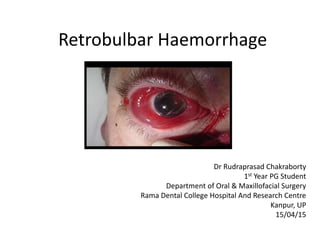
Retrobulbar Haemorrhage
Dr Rudraprasad Chakraborty
1st Year PG Student
Department of Oral & Maxillofacial Surgery
Rama Dental College Hospital And Research Centre
Kanpur, UP
15/04/15
Inclusions
• Introduction
• Etiology
• Relevant Anatomy
• Clinical Features
• Treatment
Introduction
Massive retrobulbar hemorrhage in the posterior
region of the muscle cone, triggered by vessel
disruption, leads to progressive exophthalmus with
concurrent pupil dilatation, reduced vision and
increased intraocular pressure.
(Ord 1981; Ord and El Altar 1982)
Retrobulbar hemorrhage may occur spontaneously
or as a result of trauma, peribulbar or retrobulbar
injections, or surgery.
A Retrobulbar hemorrhage is a space-occupying
lesion of the orbit leading to forward displacement
of these structures as intraorbital volume and
pressure increases.
Neurological damage is caused by direct compression,
by bony fragments or by an indirect compression of
the nerves caused by hemorrhage
(Rowe and Williams 1985)
Etiology
Spontaneous :
Orbital vascular abnormality
Uncontrolled hypertension
Coagulopathy
Septicemia
Vigorous activity
Post Traumatic :
Orbital Fractures
High Level Midfacial Fracture
Le Fort III Fracture
Post Anaesthesia :
Retrobulbar injection
Peribulbar injection
Sub-Tenon’s injection(episcleral )
Post Operative :
Facial /Orbital Fracture, Repair
Blepheroplasty
Endoscopic Sinus Surgery
Other surgeries:
Strabismus surgery, Glaucoma valve implant,
Dacryocystectomy, Coil embolization of Dural Sinus Fistula, ICA
Aneurysm Repair, Third Molar Extraction
Etiology
Spontaneous Retrobulbar Hemorrhage
Rare; Largest Report Describes 115 cases over 24 years of Period
Orbital Vascular Anomaly :
Orbital varix,
Lymphangioma
Arterio-venous malformation
Underlying Systemic Abnormality :
Coagulopathy
Uncontrolled hypertension
Septicemia
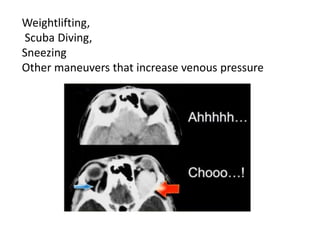
Weightlifting,
Scuba Diving,
Sneezing
Other maneuvers that increase venous pressure
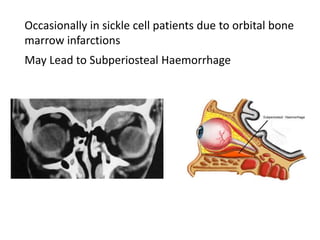
Occasionally in sickle cell patients due to orbital bone
marrow infarctions
May Lead to Subperiosteal Haemorrhage
Post Anaesthetic
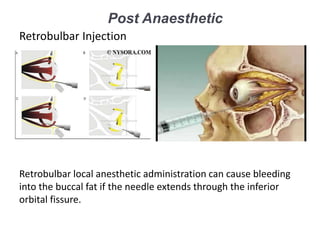
Retrobulbar Injection
Retrobulbar local anesthetic administration can cause bleeding
into the buccal fat if the needle extends through the inferior
orbital fissure.
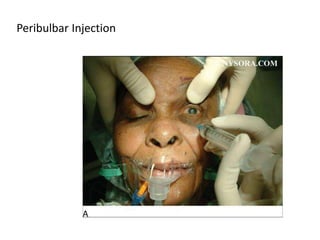
Peribulbar Injection
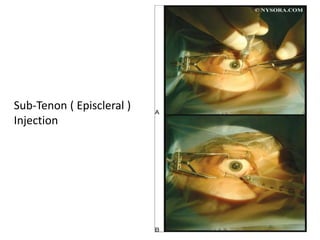
Sub-Tenon ( Episcleral )
Injection
Post-Traumatic
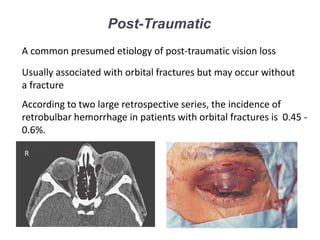
A common presumed etiology of post-traumatic vision loss
Usually associated with orbital fractures but may occur without
a fracture
According to two large retrospective series, the incidence of
retrobulbar hemorrhage in patients with orbital fractures is 0.45 -
0.6%.
R
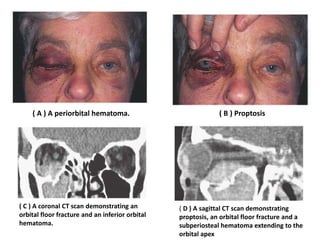
( A ) A periorbital hematoma. ( B ) Proptosis
( C ) A coronal CT scan demonstrating an
orbital floor fracture and an inferior orbital
hematoma.
( D ) A sagittal CT scan demonstrating
proptosis, an orbital floor fracture and a
subperiosteal hematoma extending to the
orbital apex
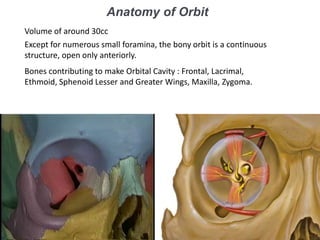
Anatomy of Orbit
Volume of around 30cc
Except for numerous small foramina, the bony orbit is a continuous
structure, open only anteriorly.
Bones contributing to make Orbital Cavity : Frontal, Lacrimal,
Ethmoid, Sphenoid Lesser and Greater Wings, Maxilla, Zygoma.
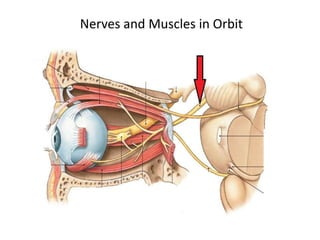
Nerves and Muscles in Orbit
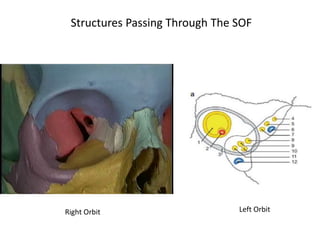
Right Orbit Left Orbit
Structures Passing Through The SOF
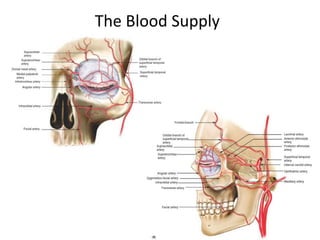
The Blood Supply
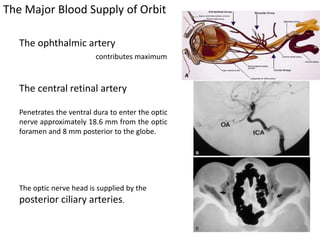
The Major Blood Supply of Orbit
The ophthalmic artery
contributes maximum
The central retinal artery
Penetrates the ventral dura to enter the optic
nerve approximately 18.6 mm from the optic
foramen and 8 mm posterior to the globe.
The optic nerve head is supplied by the
posterior ciliary arteries.
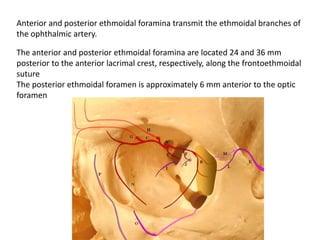
Anterior and posterior ethmoidal foramina transmit the ethmoidal branches of
the ophthalmic artery.
The anterior and posterior ethmoidal foramina are located 24 and 36 mm
posterior to the anterior lacrimal crest, respectively, along the frontoethmoidal
suture
The posterior ethmoidal foramen is approximately 6 mm anterior to the optic
foramen
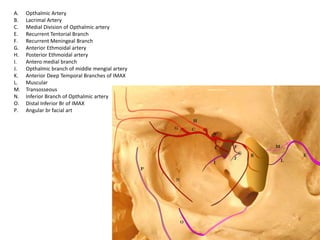
A. Opthalmic Artery
B. Lacrimal Artery
C. Medial Division of Opthalmic artery
E. Recurrent Tentorial Branch
F. Recurrent Meningeal Branch
G. Anterior Ethmoidal artery
H. Posterior Ethmoidal artery
I. Antero medial branch
J. Opthalmic branch of middle mengial artery
K. Anterior Deep Temporal Branches of IMAX
L. Muscular
M. Transosseous
N. Inferior Branch of Opthalmic artery
O. Distal Inferior Br of IMAX
P. Angular br facial art
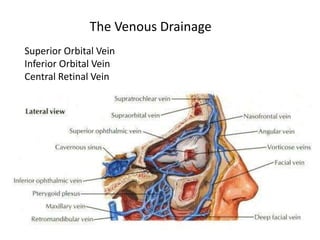
The Venous Drainage
Superior Orbital Vein
Inferior Orbital Vein
Central Retinal Vein
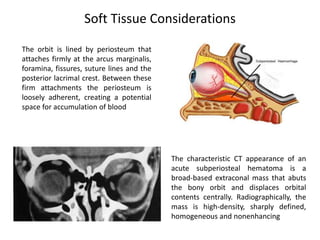
Soft Tissue Considerations
The orbit is lined by periosteum that
attaches firmly at the arcus marginalis,
foramina, fissures, suture lines and the
posterior lacrimal crest. Between these
firm attachments the periosteum is
loosely adherent, creating a potential
space for accumulation of blood
The characteristic CT appearance of an
acute subperiosteal hematoma is a
broad-based extraconal mass that abuts
the bony orbit and displaces orbital
contents centrally. Radiographically, the
mass is high-density, sharply defined,
homogeneous and nonenhancing
All mechanisms relate to increased intraorbital pressure and volume:
Ischemic optic neuropathy from compression or stretching of the
small nutrient vessels
Direct compressive optic neuropathy
Central retinal artery occlusion
Retinal vascular ischemia
Resulting In :
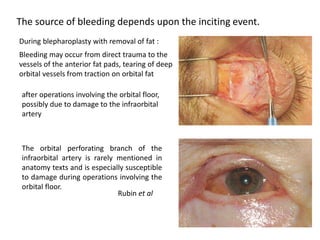
The source of bleeding depends upon the inciting event.
During blepharoplasty with removal of fat :
Bleeding may occur from direct trauma to the
vessels of the anterior fat pads, tearing of deep
orbital vessels from traction on orbital fat
after operations involving the orbital floor,
possibly due to damage to the infraorbital
artery
The orbital perforating branch of the
infraorbital artery is rarely mentioned in
anatomy texts and is especially susceptible
to damage during operations involving the
orbital floor.
Rubin et al
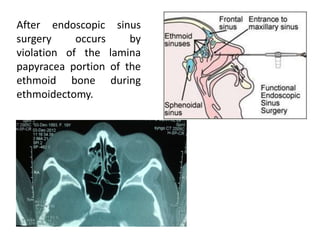
After endoscopic sinus
surgery occurs by
violation of the lamina
papyracea portion of the
ethmoid bone during
ethmoidectomy.
Sign and symptoms
Massive retrobulbar hemorrhage in the posterior region of the muscle cone, triggered by
vessel disruption, leads to progressive exophthalmus with concurrent pupil dilatation,
reduced vision and increased intraocular pressure.
(Ord 1981; Ord and El Altar 1982)
The following are typical signs of an intraorbital hemorrhage with or without orbital
fracture (Doden and Schnaudigel 1978):
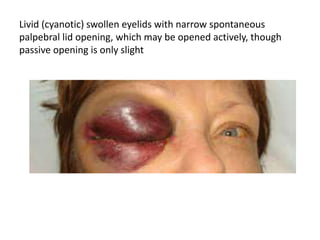
Livid (cyanotic) swollen eyelids with narrow spontaneous
palpebral lid opening, which may be opened actively, though
passive opening is only slight
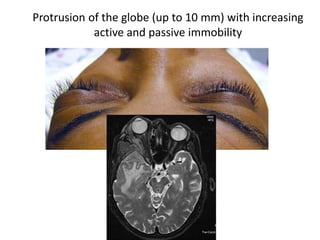
Protrusion of the globe (up to 10 mm) with increasing
active and passive immobility
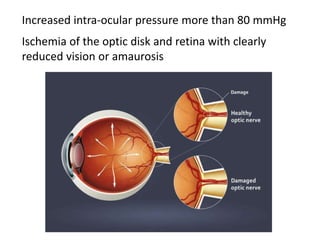
Ischemia of the optic disk and retina with clearly
reduced vision or amaurosis
Increased intra-ocular pressure more than 80 mmHg
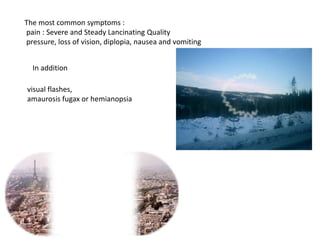
The most common symptoms :
pain : Severe and Steady Lancinating Quality
pressure, loss of vision, diplopia, nausea and vomiting
In addition
visual flashes,
amaurosis fugax or hemianopsia
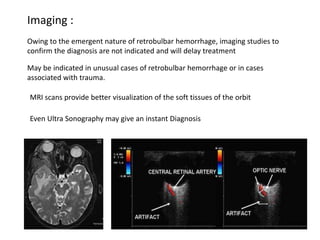
Imaging :
May be indicated in unusual cases of retrobulbar hemorrhage or in cases
associated with trauma.
MRI scans provide better visualization of the soft tissues of the orbit
Even Ultra Sonography may give an instant Diagnosis
Owing to the emergent nature of retrobulbar hemorrhage, imaging studies to
confirm the diagnosis are not indicated and will delay treatment
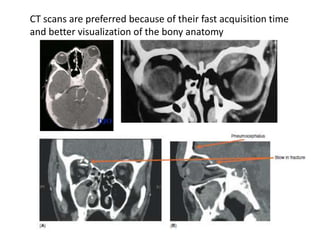
CT scans are preferred because of their fast acquisition time
and better visualization of the bony anatomy
Therapeutic Options
Once the diagnosis is made, therapy should begin immediately.
Optic nerve damage was proportional to the duration of
occlusion of CRA
Occlusion of 105 min or longer produced irreversible optic
nerve damage
Occlusion greater that 240 min produced near total optic nerve
atrophy
Treatment is aimed at lowering intraorbital or intraocular pressure
and protecting the optic nerve from damage
Rapid surgical intervention remains the mainstay of treatment
Medical Treatment
The medical treatments for retrobulbar hemorrhage are controversial.
Medical treatment should not delay surgical treatment
Medical treatment options include :
Oxygen therapy………(95% O2, 5% CO2) may decrease the ischemic insult by dilating
intraocular vessels.
Mannitol 20% IV ……. The hyperosmotic agent, rapid IV infusion of 1.5 - 2 g/kg over
30 min, with the first 12.5 g over the first 3 min.
Acetazolamide …….. The carbonic anhydrase inhibitor, 500 mg IV, Also lowers
intraocular pressure
Steroids ……. Methylprednisolone, 100 mg, decrease inflammation and edema and
provide some neuroprotection to the optic nerve by stabilizing cell
membranes
Topical β-blockers ……. Decrease intraocular pressure by lowering aqueous humor
secretion.
Therapies aimed primarly at reducing intraocular pressure, such as
acetazolamide and topical β-blockers, do not address the elevated orbital
pressure and do not improve the blood supply to the proximal optic nerve.
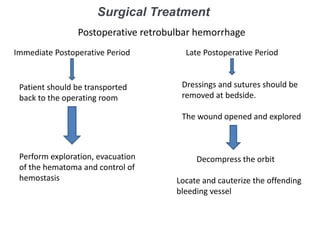
Surgical Treatment
Postoperative retrobulbar hemorrhage
Dressings and sutures should be
removed at bedside.
The wound opened and explored
Decompress the orbit
Locate and cauterize the offending
bleeding vessel
Immediate Postoperative Period
Patient should be transported
back to the operating room
Perform exploration, evacuation
of the hematoma and control of
hemostasis
Late Postoperative Period
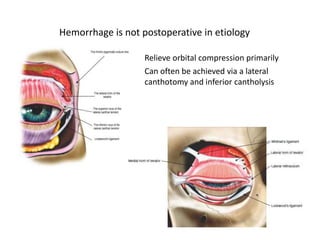
Hemorrhage is not postoperative in etiology
Relieve orbital compression primarily
Can often be achieved via a lateral
canthotomy and inferior cantholysis
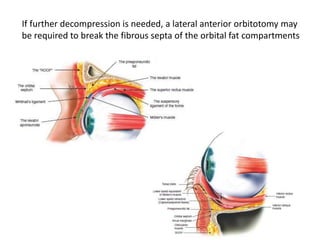
If further decompression is needed, a lateral anterior orbitotomy may
be required to break the fibrous septa of the orbital fat compartments
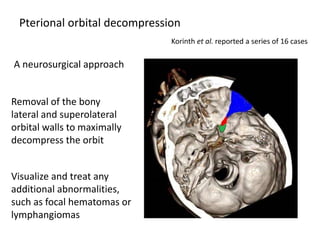
Pterional orbital decompression
Korinth et al. reported a series of 16 cases
A neurosurgical approach
Removal of the bony
lateral and superolateral
orbital walls to maximally
decompress the orbit
Visualize and treat any
additional abnormalities,
such as focal hematomas or
lymphangiomas
The patient must be closely followed with serial
examinations
Pupillary light reflexes
Visual acuity
Intraocular pressure
Fundoscopy.
The head of the bed may be elevated to decrease arterial
pressure.
The lateral canthotomy and cantholysis may be repaired days
later to allow for further drainage in the event of additional
hemorrhage or it may be allowed to heal spontaneously
Referrence Books
Thank You

Retrobulbar haemorrhage

  • 1.
    Retrobulbar Haemorrhage Dr RudraprasadChakraborty 1st Year PG Student Department of Oral & Maxillofacial Surgery Rama Dental College Hospital And Research Centre Kanpur, UP 15/04/15
  • 2.
    Inclusions • Introduction • Etiology •Relevant Anatomy • Clinical Features • Treatment
  • 3.
    Introduction Massive retrobulbar hemorrhagein the posterior region of the muscle cone, triggered by vessel disruption, leads to progressive exophthalmus with concurrent pupil dilatation, reduced vision and increased intraocular pressure. (Ord 1981; Ord and El Altar 1982) Retrobulbar hemorrhage may occur spontaneously or as a result of trauma, peribulbar or retrobulbar injections, or surgery.
  • 4.
    A Retrobulbar hemorrhageis a space-occupying lesion of the orbit leading to forward displacement of these structures as intraorbital volume and pressure increases. Neurological damage is caused by direct compression, by bony fragments or by an indirect compression of the nerves caused by hemorrhage (Rowe and Williams 1985)
  • 5.
    Etiology Spontaneous : Orbital vascularabnormality Uncontrolled hypertension Coagulopathy Septicemia Vigorous activity Post Traumatic : Orbital Fractures High Level Midfacial Fracture Le Fort III Fracture
  • 6.
    Post Anaesthesia : Retrobulbarinjection Peribulbar injection Sub-Tenon’s injection(episcleral ) Post Operative : Facial /Orbital Fracture, Repair Blepheroplasty Endoscopic Sinus Surgery Other surgeries: Strabismus surgery, Glaucoma valve implant, Dacryocystectomy, Coil embolization of Dural Sinus Fistula, ICA Aneurysm Repair, Third Molar Extraction Etiology
  • 7.
    Spontaneous Retrobulbar Hemorrhage Rare;Largest Report Describes 115 cases over 24 years of Period Orbital Vascular Anomaly : Orbital varix, Lymphangioma Arterio-venous malformation Underlying Systemic Abnormality : Coagulopathy Uncontrolled hypertension Septicemia
  • 8.
  • 9.
    Occasionally in sicklecell patients due to orbital bone marrow infarctions May Lead to Subperiosteal Haemorrhage
  • 10.
    Post Anaesthetic Retrobulbar Injection Retrobulbarlocal anesthetic administration can cause bleeding into the buccal fat if the needle extends through the inferior orbital fissure.
  • 11.
  • 12.
  • 13.
    Post-Traumatic A common presumedetiology of post-traumatic vision loss Usually associated with orbital fractures but may occur without a fracture According to two large retrospective series, the incidence of retrobulbar hemorrhage in patients with orbital fractures is 0.45 - 0.6%. R
  • 14.
    ( A )A periorbital hematoma. ( B ) Proptosis ( C ) A coronal CT scan demonstrating an orbital floor fracture and an inferior orbital hematoma. ( D ) A sagittal CT scan demonstrating proptosis, an orbital floor fracture and a subperiosteal hematoma extending to the orbital apex
  • 15.
    Anatomy of Orbit Volumeof around 30cc Except for numerous small foramina, the bony orbit is a continuous structure, open only anteriorly. Bones contributing to make Orbital Cavity : Frontal, Lacrimal, Ethmoid, Sphenoid Lesser and Greater Wings, Maxilla, Zygoma.
  • 16.
  • 17.
    Right Orbit LeftOrbit Structures Passing Through The SOF
  • 18.
  • 19.
    The Major BloodSupply of Orbit The ophthalmic artery contributes maximum The central retinal artery Penetrates the ventral dura to enter the optic nerve approximately 18.6 mm from the optic foramen and 8 mm posterior to the globe. The optic nerve head is supplied by the posterior ciliary arteries.
  • 20.
    Anterior and posteriorethmoidal foramina transmit the ethmoidal branches of the ophthalmic artery. The anterior and posterior ethmoidal foramina are located 24 and 36 mm posterior to the anterior lacrimal crest, respectively, along the frontoethmoidal suture The posterior ethmoidal foramen is approximately 6 mm anterior to the optic foramen
  • 21.
    A. Opthalmic Artery B.Lacrimal Artery C. Medial Division of Opthalmic artery E. Recurrent Tentorial Branch F. Recurrent Meningeal Branch G. Anterior Ethmoidal artery H. Posterior Ethmoidal artery I. Antero medial branch J. Opthalmic branch of middle mengial artery K. Anterior Deep Temporal Branches of IMAX L. Muscular M. Transosseous N. Inferior Branch of Opthalmic artery O. Distal Inferior Br of IMAX P. Angular br facial art
  • 22.
    The Venous Drainage SuperiorOrbital Vein Inferior Orbital Vein Central Retinal Vein
  • 23.
    Soft Tissue Considerations Theorbit is lined by periosteum that attaches firmly at the arcus marginalis, foramina, fissures, suture lines and the posterior lacrimal crest. Between these firm attachments the periosteum is loosely adherent, creating a potential space for accumulation of blood The characteristic CT appearance of an acute subperiosteal hematoma is a broad-based extraconal mass that abuts the bony orbit and displaces orbital contents centrally. Radiographically, the mass is high-density, sharply defined, homogeneous and nonenhancing
  • 24.
    All mechanisms relateto increased intraorbital pressure and volume: Ischemic optic neuropathy from compression or stretching of the small nutrient vessels Direct compressive optic neuropathy Central retinal artery occlusion Retinal vascular ischemia Resulting In :
  • 25.
    The source ofbleeding depends upon the inciting event. During blepharoplasty with removal of fat : Bleeding may occur from direct trauma to the vessels of the anterior fat pads, tearing of deep orbital vessels from traction on orbital fat after operations involving the orbital floor, possibly due to damage to the infraorbital artery The orbital perforating branch of the infraorbital artery is rarely mentioned in anatomy texts and is especially susceptible to damage during operations involving the orbital floor. Rubin et al
  • 26.
    After endoscopic sinus surgeryoccurs by violation of the lamina papyracea portion of the ethmoid bone during ethmoidectomy.
  • 27.
    Sign and symptoms Massiveretrobulbar hemorrhage in the posterior region of the muscle cone, triggered by vessel disruption, leads to progressive exophthalmus with concurrent pupil dilatation, reduced vision and increased intraocular pressure. (Ord 1981; Ord and El Altar 1982) The following are typical signs of an intraorbital hemorrhage with or without orbital fracture (Doden and Schnaudigel 1978):
  • 28.
    Livid (cyanotic) swolleneyelids with narrow spontaneous palpebral lid opening, which may be opened actively, though passive opening is only slight
  • 29.
    Protrusion of theglobe (up to 10 mm) with increasing active and passive immobility
  • 30.
    Ischemia of theoptic disk and retina with clearly reduced vision or amaurosis Increased intra-ocular pressure more than 80 mmHg
  • 31.
    The most commonsymptoms : pain : Severe and Steady Lancinating Quality pressure, loss of vision, diplopia, nausea and vomiting In addition visual flashes, amaurosis fugax or hemianopsia
  • 32.
    Imaging : May beindicated in unusual cases of retrobulbar hemorrhage or in cases associated with trauma. MRI scans provide better visualization of the soft tissues of the orbit Even Ultra Sonography may give an instant Diagnosis Owing to the emergent nature of retrobulbar hemorrhage, imaging studies to confirm the diagnosis are not indicated and will delay treatment
  • 33.
    CT scans arepreferred because of their fast acquisition time and better visualization of the bony anatomy
  • 34.
    Therapeutic Options Once thediagnosis is made, therapy should begin immediately. Optic nerve damage was proportional to the duration of occlusion of CRA Occlusion of 105 min or longer produced irreversible optic nerve damage Occlusion greater that 240 min produced near total optic nerve atrophy Treatment is aimed at lowering intraorbital or intraocular pressure and protecting the optic nerve from damage Rapid surgical intervention remains the mainstay of treatment
  • 35.
    Medical Treatment The medicaltreatments for retrobulbar hemorrhage are controversial. Medical treatment should not delay surgical treatment Medical treatment options include : Oxygen therapy………(95% O2, 5% CO2) may decrease the ischemic insult by dilating intraocular vessels. Mannitol 20% IV ……. The hyperosmotic agent, rapid IV infusion of 1.5 - 2 g/kg over 30 min, with the first 12.5 g over the first 3 min. Acetazolamide …….. The carbonic anhydrase inhibitor, 500 mg IV, Also lowers intraocular pressure
  • 36.
    Steroids ……. Methylprednisolone,100 mg, decrease inflammation and edema and provide some neuroprotection to the optic nerve by stabilizing cell membranes Topical β-blockers ……. Decrease intraocular pressure by lowering aqueous humor secretion. Therapies aimed primarly at reducing intraocular pressure, such as acetazolamide and topical β-blockers, do not address the elevated orbital pressure and do not improve the blood supply to the proximal optic nerve.
  • 37.
    Surgical Treatment Postoperative retrobulbarhemorrhage Dressings and sutures should be removed at bedside. The wound opened and explored Decompress the orbit Locate and cauterize the offending bleeding vessel Immediate Postoperative Period Patient should be transported back to the operating room Perform exploration, evacuation of the hematoma and control of hemostasis Late Postoperative Period
  • 38.
    Hemorrhage is notpostoperative in etiology Relieve orbital compression primarily Can often be achieved via a lateral canthotomy and inferior cantholysis
  • 39.
    If further decompressionis needed, a lateral anterior orbitotomy may be required to break the fibrous septa of the orbital fat compartments
  • 40.
    Pterional orbital decompression Korinthet al. reported a series of 16 cases A neurosurgical approach Removal of the bony lateral and superolateral orbital walls to maximally decompress the orbit Visualize and treat any additional abnormalities, such as focal hematomas or lymphangiomas
  • 41.
    The patient mustbe closely followed with serial examinations Pupillary light reflexes Visual acuity Intraocular pressure Fundoscopy. The head of the bed may be elevated to decrease arterial pressure. The lateral canthotomy and cantholysis may be repaired days later to allow for further drainage in the event of additional hemorrhage or it may be allowed to heal spontaneously
  • 42.
  • 43.

Editor's Notes

  • #9 True spontaneous hemorrhage in the absence of any known precipitating factor is rare
  • #31 Amaurosis fugax is a transient loss of vision in one eye due to a temporary insufficiency of blood flow to the retina. It occurs when a piece of plaque in a carotid artery breaks off and travels to the retinal artery in the eye, in patients with carotid artery disease