ORBITAL FRACTURES
 INTODUCTION
 SURGICAL ANATOMY
 BIOMECHANICS OF ORBITAL FRACTURE
 ETIOLOGY AND EPIDEMIOLOGY
 FACTURE PATTERN
 CLASSIFICATION
 CLINICAL PRESENTATION
 DIAGNOSIS & IMAGING
 MANAGEMENT
 COMPLICATIONS
 RECENT TRENDS
 Its is a four sided pyramid
with its apex at the optic
foramina
 Paired bony cavities, housing
and protecting globe.
 Orbital Growth
By 5 yrs - 85% by
Puberty - 100%
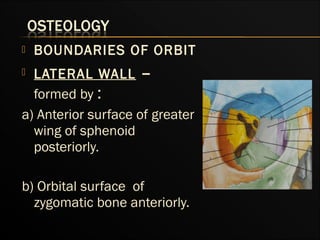
 BOUNDARIES OF ORBIT
 LATERAL WALL –
formed by :
a) Anterior surface of greater
wing of sphenoid
posteriorly.
b) Orbital surface of
zygomatic bone anteriorly.
 Frontal and zygomatic
bone
 FZ suture - Narrowest
and weakest
 The lateral wall is almost
devoid of foramina, so its
anterior portion can be
broached without serious
haemorrhage
MEDIAL WALL –
a) Orbital plate of the
ethmoid bone.
b) Anteriorly - continues as
the lacrimal bone which is
weakened by the
nasolacrimal canal passing
through the fossa.
c)Posteriorly – optic foramen
in sphenoid bone
 Poorly defined and merges
posteriorly with lacrimal
bone.
 Displacement in this
region results in deformity
of naso orbital valley and
displacement of canthal
ligament.
 ROOF :
 Orbital part of frontal bone.
 Posteriorly - lesser wing of
sphenoid
 The junction of the roof with
the medial wall is in close
proximity to the cribriform
plate of the ethmoid.
 Penetration of the
duramater will allow
cerebrospinal fluid to
escape into either the orbit
or the nose, or both cavities.
 Infraorbital foramen to midpoint
of inferior orbital fissure : 24mm
 Anterior lacrimal crest to medial
aspect of optic canal :42mm
 FZ suture to superior orbital
fissure : 35mm
 Supraorbital notch to superior
orbital fissure : 40mm
 Supra orbital notch to superior
aspect of optic canal : 45mm
 The lamina papyracea (or orbital lamina) is a
smooth, oblong bone plate which forms the lateral
 surface of the labyrinth of theethmoid bone in the 
skull.
 The plate covers in the middle and posterior 
ethmoidal cells and forms a large part of the medial
wall of the orbit.
 It articulates above with the orbital plate of the 
frontal bone, below with the maxilla and the 
orbital process of palatine bone, in front with the 
lacrimal, and behind with the sphenoid.
 Its name lamina papyracea is a literal description, as
this part of the ethmoid bone is paper-thin and
fractures easily. A fracture here could cause
entrapment of the medial rectus muscle.
SUPERIOR OBLIQUE
INFERIOR OBLIQUE
INFERIOR OBLIQUE
 Fractures produced by the  limited to the anterior
part of
Buckling mechanism the orbital floor
 Hydraulic-type fractures  Involving Anterior &
Posterior were much larger parts of the
Floor as well as
the Medial Wall of the Orbit
 The Average Energy required to fracture the orbital floor
BUCKLING MECHANISM - 1.54 J
HYDRAULIC MECHANISM - 1.22 J
Ahmad, Fateh; et al..
Journal of Craniofacial Surgery. 17(3):438-441, May 2006.
2006 Muntaz B. Habal, MD
Pure and impure
A 3-mm downward
displacement of the entire
floor
Orbital volume that is
increased by 1.5 cm3
a 5%
increase
Producing 1-1.5 mm of
Enophthalmos
1957 by Smith & Regan
 A blow-in fracture is an inwardly displaced
fracture of the orbital rim or wall resulting in
decreased orbital volume.
 Described by dingman and natvig in 1964.
 Antonyshyn et al noted proptosis because of
decrease orbital volume in 41 cases.
CHILDREN UP TO
AGE 7
ORBITAL ROOF FRACTURE
- larger cranium
- lack of frontal sinus
pneumatization
ORBITAL FLOOR FRACTURE
Occurs primarily in older
Children
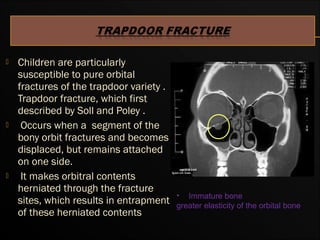
 Children are particularly
susceptible to pure orbital
fractures of the trapdoor variety .
Trapdoor fracture, which first
described by Soll and Poley .
 Occurs when a segment of the
bony orbit fractures and becomes
displaced, but remains attached
on one side.
 It makes orbitral contents
herniated through the fracture
sites, which results in entrapment
of these herniated contents
• Immature bone
greater elasticity of the orbital bone
 Superior rim
 Lateral 3rd
( lacrimal
recess)
 Central 3rd
(supraorbital
nerve)
 Medial 3rd
(frontal sinus)
 Inferior rim
 Central 3rd
(infraorbital
nerve)
 Medial 3rd
(inferior oblique
origin)
Rowe and Wiliams
Medial rim
Medial canthal ligament
Lacrimal passage
Lateral rim
Lateral canthal ligament
Suspensory ligament
 Roof
 Anterior cranial fossa, superior rectus, frontal sinus.
 Floor
 Antrum, inferior rectus/inferior oblque, infraorbital
nerves and vessels.
 Medial wall
 Ethmoidal sinus, medial rectus, suspensory ligament.
 Lateral wall
 Superior orbital fissure and associated structures
1. No treatment
2. Indirect reduction with
a. no fixation
b. temporary support
3. Direct reduction and fixation
4. Immediate reconstruction by grafting
5. Delayed reconstruction by osteotomy or grafting.
Circumorbital
Ecchymosis
Subconjunctival
Haemorrhageorbital emphysema
 Lang (1888) – Expanded orbit
 Bite et al (1985), Manson et al (1986), Whitehouse et al
(1994) – Orbital expansion was the primary reason for
enophthalmos & not the fat atrophy..
 It has been shown that a 0.8–1 ml increase of bony
orbital volume corresponds to 1 mm on the Hertel
exopthalmometer (Lee & Chiu 1993; Ploder et al.
2002).
37
 Is defined as a retro position
of the globe in its three-
dimensional relationship in
the orbit and should be
assessed in relation to the
contra lateral eye and facial
structures
 Hertels
exophthalmometer is
used to determine the
degree of enophthalmos
 more than 3mm is
indicative of surgery.
 The effusion of blood into and around extra-ocular
muscles interferes with their delicate action required to
maintain co-ordination of the eye movement.
 Binocular – neurogenic injury or restricted motility.
 Monocular-one eye – detached lens
 Traumatic diplopia can result by –
 Physical interference:
1. Extravasation of blood into and around the muscles
and oedema
2. Impingement of bony spicules
3. Displacement of the inferior oblique muscle
 Koornneef & Zonneveld found that
entrapment of IR ms is not the major cause
of diplopia. They found that impaired globe
motility is caused by connective tissue
derangement inside the orbit
 Tessier – oculomotor imbalance
40
Proptosis
Ptosis
Increased
inter-canthal distance
TELECANTHUS
Ocular Level
 If fracture occurs above
whitnall’s tubercle
 Bone displaced downwards
along with upper eyelid
 Physical sign - hooding of globe
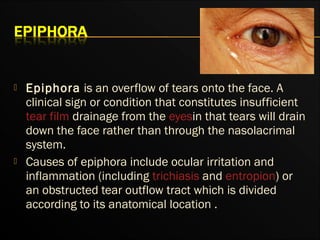
 Epiphora is an overflow of tears onto the face. A
clinical sign or condition that constitutes insufficient 
tear film drainage from the eyesin that tears will drain
down the face rather than through the nasolacrimal
system.
 Causes of epiphora include ocular irritation and
inflammation (including trichiasis and entropion) or
an obstructed tear outflow tract which is divided
according to its anatomical location .
  Another cause could be poor reconstruction of the
nasolacrimal duct system after trauma to the area.
Cause of trauma could be facial fractures (including
nasoethmoid fractures or maxillary Le Fort fractures),
and soft tissue trauma involving the nose and/or the
eyelid. This condition is often frustrating or irritating
48
49
50
 Plain radiography.
PNS
AP skull and PA skull view.
 Computed Tomography.
 MRI
Floor Fracture Trap Door Fracture
Roof Fracture
 History
 Complete General Physical Examination
 Palpation of the Bony walls of the orbit
and other associated structures
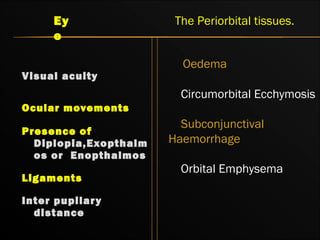
Visual acuity
Ocular movements
Presence of
Diplopia,Exopthalm
os or Enopthalmos
Ligaments
Inter pupilary
distance
Oedema
Circumorbital Ecchymosis
Subconjunctival
Haemorrhage
Orbital Emphysema
The Periorbital tissues.Ey
e
Surgery should be performed within 2 weeks after
the edema around the eye has decreased.
In children, callus is formed on the bone
fracture in 7 days, which makes it difficult to
reduce fractures accurately.
Hence, facial bone fractures should be operated
on earlier in children than in adults.
 1957 : Converse & Smith – should be corrected ..within 1st
three weeks.
 1974 : Puttermann – proposed conservative management – if
diplopia persists for >4 months do contralateral eye muscle
surgery.
 Dulley & Fells criteria – 2 wks of observation for diplopia with
corticosteroids and physiotherapy. Surgical Intervene if
enophtholmous >3mm, Diplopia persists, large herniation
 Dortzbeck - >2mm enopthalmous, Persistent diplopia for
>2wks.
d
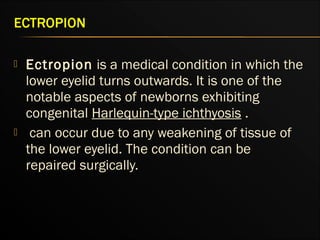
 Ectropion is a medical condition in which the
lower eyelid turns outwards. It is one of the
notable aspects of newborns exhibiting
congenital Harlequin-type ichthyosis .
 can occur due to any weakening of tissue of
the lower eyelid. The condition can be
repaired surgically.
Placement of anterior
maxillary wall graft
Placement of
Ballon Catheter
 Titanium
 Silicone
 Polyethylene
 Teflon
 Bioactive glass implants
 Polydioxanone
 Polylactide
 Polyglycolic acid
 Vicrylmesh - polyglactin-910
Complex orbital fractures required more than one
material for reconstruction.
additional bone chips can be introduced to fill up
the gaps and to tune projection by comparing the
reconstruction with unaffected orbit.
In terms of anatomic accuracy , Ti meshes are
preferred –over autologous bones grafts, but in
terms of function autologous bones grafts are
preffered
 In case of larger defects is often restricted by
limited access to the internal orbit and bears the
risk of iatrogenic damage to the periorbital tissue.
 Retrobulbar Hemorrhage
 Superior orbital fissure syndrome
 Orbital apex syndrome
Loss of vision as a complication
of Maxillo- facial trauma
occurs in  3-12%
The blindness due to
Retrobulbar Haemorrhage
 48- 50%
 Proptosis
 Subconjunctival edema
& ecchymosis
 Dialating pupil
 Loss of direct light reflex
 Opthalmoplegia
 Increased intraoccular
pressure
 Constriction of retinal
arterioles
 Cherry red macular spot
 Globe hard on palpation
Diagnosis and treatment of Retrobulbar Haematomas following blunt orbit
trauma  
Int J Oral Maxillofac Surg 2005
Mar;34(2):127-31
Immediate action
Remove any sutures in the area, for pressure relief
Surgical decompression….
Medication  
Mannitol  1g/Kg as 20% infusion
                                                     Osmotic diuretic
                                                     Contra-indicated in congestive
cardiac Failure.
                      Acetazolamide      500mg IV
                                                   
                     Dexamethasone    8mg
                     Papaverine          40mg smooth muscle relaxant
                     Dextran   40         500mls IV improves perfusion
IF NO RESPONSE TILL 48 HRS STEROIDS TO BE DISCONTINUED…
Consider Surgical decompression….
 Objective – decompression of orbit.
 If retro bulbar hemorrhage arises after surgery which
involved access to orbital floor, same incisions may be
used for evacuation of blood from extra conal space.
 If this approach is unsuccessful antrum is approached
,any pack on balloon is defected, and roof is inspected
for any spicules free of periosteum and it is picked up .
After creation of adequate space, suction may be
applied.
 For intraconal space: Incision in placed
above and below lateral canthal ligament,
dividing the orbital septum – provides access
to inter muscular septum between inferior and
lateral rectus muscle
 By banks in 1967
 An instructive example of precise anatomic
localization of a lesion by neurologic sign.
SIGN AND SYPTOMS
 Gross and persistent oedema
 Proptosis and subconjuctival ecchymosis.
 Dilation of pupil, ptosis
 Radiological evidence of reduction in the
dimensions of the superior orbital fissure.
 Combination of superior orbital fissure syndrome
and optic nerve injury
 Etiology: bony compression of optic nerve and
superior orbital fissure
 Symptoms: loss of direct light reflex
 maintenance of consensual reflex
Fracture types can be evaluated and repaired
endoscopically without the need for an extensive
eyelid incision.
It offers improved visualization, anatomic fracture
repair, no risk of postoperative eyelid complications,
and good clinical results.
Facial Plast Surg 2004;
STEREOLITHOGRAPHY
Stereolithography is an
industrial process
which uses data
generated from
computer-assisted
design (CAD) to
generate three-
dimensional models.
Journal of Oral and Maxillofacial Surgery
Volume 63, Issue 2, February 2005, Pages 200-208
Computer-assisted
reconstruction of
orbital floor based on
cone beam
tomography
bjoms.2005.06.031
Christoph Zizelmann et al..
BJOMS Jan 2007 (Vol. 45, Issue 1, Pages 79-80)
A straight titanium plate size 1.0mm to 1.3mm is cut lengthwise to be
inserted into one of the channels.
The implant is sized and cut with heavy scissors to fit the defect. The straight plate is inserted into one of the
channels.
The MEDPOR Channel Implant and straight plate are shaped to conform to the
size and configuration of the orbital floor.
The implant is positioned on solid bone (if available). It is advanced carefully so as
not to pinch or incarcerate orbital soft tissue.
Once positioned, the plate is cut to the appropriate length so it can be secured
to solid bone with a 4, 5, or 6mm screw.
The screw secures the plate and the MEDPOR Channel Implant in position.
 Accuracy of reconstruction is a prerequisite for
anatomical positioning of the eye ball in order to
prevent functional disorders.
 The management of orbital fractures and their
complications will be benefited from a
multidisciplinary approach.
 Hence the continued relationship between Cranio
-Maxillofacial Surgeons, Plastic Surgeons & the
Ophthalmic Surgeons, will contribute to the
progression of orbital reconstruction techniques.
 Fonseca – Trauma vol 2
 Trauma and Esthetic reconstuction – Peter Ward Booth
 Surgical approaches to facial skeleton – Ellis .
 Rowe and William’s Maxillofacial Injuries – Vol 1 and 2 -1994
 Oral & Maxillofacial Surgery Clinics of North America – Orbital Trauma
THANK YOU
An executive is a person who
always decides; sometimes he
decides correctly, but he always
decides.

Orbital fractures ih

  • 2.
  • 3.
     INTODUCTION  SURGICALANATOMY  BIOMECHANICS OF ORBITAL FRACTURE  ETIOLOGY AND EPIDEMIOLOGY  FACTURE PATTERN  CLASSIFICATION  CLINICAL PRESENTATION  DIAGNOSIS & IMAGING  MANAGEMENT  COMPLICATIONS  RECENT TRENDS
  • 4.
     Its isa four sided pyramid with its apex at the optic foramina  Paired bony cavities, housing and protecting globe.  Orbital Growth By 5 yrs - 85% by Puberty - 100%
  • 7.
     BOUNDARIES OFORBIT  LATERAL WALL – formed by : a) Anterior surface of greater wing of sphenoid posteriorly. b) Orbital surface of zygomatic bone anteriorly.
  • 8.
     Frontal andzygomatic bone  FZ suture - Narrowest and weakest  The lateral wall is almost devoid of foramina, so its anterior portion can be broached without serious haemorrhage
  • 9.
    MEDIAL WALL – a)Orbital plate of the ethmoid bone. b) Anteriorly - continues as the lacrimal bone which is weakened by the nasolacrimal canal passing through the fossa. c)Posteriorly – optic foramen in sphenoid bone
  • 10.
     Poorly definedand merges posteriorly with lacrimal bone.  Displacement in this region results in deformity of naso orbital valley and displacement of canthal ligament.
  • 11.
     ROOF : Orbital part of frontal bone.  Posteriorly - lesser wing of sphenoid  The junction of the roof with the medial wall is in close proximity to the cribriform plate of the ethmoid.  Penetration of the duramater will allow cerebrospinal fluid to escape into either the orbit or the nose, or both cavities.
  • 12.
     Infraorbital foramento midpoint of inferior orbital fissure : 24mm  Anterior lacrimal crest to medial aspect of optic canal :42mm  FZ suture to superior orbital fissure : 35mm  Supraorbital notch to superior orbital fissure : 40mm  Supra orbital notch to superior aspect of optic canal : 45mm
  • 13.
     The lamina papyracea (or orbitallamina) is a smooth, oblong bone plate which forms the lateral  surface of the labyrinth of theethmoid bone in the  skull.  The plate covers in the middle and posterior  ethmoidal cells and forms a large part of the medial wall of the orbit.
  • 14.
     It articulatesabove with the orbital plate of the  frontal bone, below with the maxilla and the  orbital process of palatine bone, in front with the  lacrimal, and behind with the sphenoid.  Its name lamina papyracea is a literal description, as this part of the ethmoid bone is paper-thin and fractures easily. A fracture here could cause entrapment of the medial rectus muscle.
  • 17.
  • 18.
  • 22.
     Fractures producedby the  limited to the anterior part of Buckling mechanism the orbital floor  Hydraulic-type fractures  Involving Anterior & Posterior were much larger parts of the Floor as well as the Medial Wall of the Orbit  The Average Energy required to fracture the orbital floor BUCKLING MECHANISM - 1.54 J HYDRAULIC MECHANISM - 1.22 J Ahmad, Fateh; et al.. Journal of Craniofacial Surgery. 17(3):438-441, May 2006. 2006 Muntaz B. Habal, MD
  • 27.
    Pure and impure A3-mm downward displacement of the entire floor Orbital volume that is increased by 1.5 cm3 a 5% increase Producing 1-1.5 mm of Enophthalmos 1957 by Smith & Regan
  • 28.
     A blow-infracture is an inwardly displaced fracture of the orbital rim or wall resulting in decreased orbital volume.  Described by dingman and natvig in 1964.  Antonyshyn et al noted proptosis because of decrease orbital volume in 41 cases.
  • 29.
    CHILDREN UP TO AGE7 ORBITAL ROOF FRACTURE - larger cranium - lack of frontal sinus pneumatization ORBITAL FLOOR FRACTURE Occurs primarily in older Children
  • 30.
     Children areparticularly susceptible to pure orbital fractures of the trapdoor variety . Trapdoor fracture, which first described by Soll and Poley .  Occurs when a segment of the bony orbit fractures and becomes displaced, but remains attached on one side.  It makes orbitral contents herniated through the fracture sites, which results in entrapment of these herniated contents • Immature bone greater elasticity of the orbital bone
  • 32.
     Superior rim Lateral 3rd ( lacrimal recess)  Central 3rd (supraorbital nerve)  Medial 3rd (frontal sinus)  Inferior rim  Central 3rd (infraorbital nerve)  Medial 3rd (inferior oblique origin) Rowe and Wiliams Medial rim Medial canthal ligament Lacrimal passage Lateral rim Lateral canthal ligament Suspensory ligament
  • 33.
     Roof  Anteriorcranial fossa, superior rectus, frontal sinus.  Floor  Antrum, inferior rectus/inferior oblque, infraorbital nerves and vessels.  Medial wall  Ethmoidal sinus, medial rectus, suspensory ligament.  Lateral wall  Superior orbital fissure and associated structures
  • 34.
    1. No treatment 2.Indirect reduction with a. no fixation b. temporary support 3. Direct reduction and fixation 4. Immediate reconstruction by grafting 5. Delayed reconstruction by osteotomy or grafting.
  • 36.
  • 37.
     Lang (1888)– Expanded orbit  Bite et al (1985), Manson et al (1986), Whitehouse et al (1994) – Orbital expansion was the primary reason for enophthalmos & not the fat atrophy..  It has been shown that a 0.8–1 ml increase of bony orbital volume corresponds to 1 mm on the Hertel exopthalmometer (Lee & Chiu 1993; Ploder et al. 2002). 37
  • 38.
     Is definedas a retro position of the globe in its three- dimensional relationship in the orbit and should be assessed in relation to the contra lateral eye and facial structures  Hertels exophthalmometer is used to determine the degree of enophthalmos  more than 3mm is indicative of surgery.
  • 39.
     The effusionof blood into and around extra-ocular muscles interferes with their delicate action required to maintain co-ordination of the eye movement.  Binocular – neurogenic injury or restricted motility.  Monocular-one eye – detached lens  Traumatic diplopia can result by –  Physical interference: 1. Extravasation of blood into and around the muscles and oedema 2. Impingement of bony spicules 3. Displacement of the inferior oblique muscle
  • 40.
     Koornneef &Zonneveld found that entrapment of IR ms is not the major cause of diplopia. They found that impaired globe motility is caused by connective tissue derangement inside the orbit  Tessier – oculomotor imbalance 40
  • 41.
  • 42.
  • 45.
     If fractureoccurs above whitnall’s tubercle  Bone displaced downwards along with upper eyelid  Physical sign - hooding of globe
  • 46.
     Epiphora is anoverflow of tears onto the face. A clinical sign or condition that constitutes insufficient  tear film drainage from the eyesin that tears will drain down the face rather than through the nasolacrimal system.  Causes of epiphora include ocular irritation and inflammation (including trichiasis and entropion) or an obstructed tear outflow tract which is divided according to its anatomical location .
  • 47.
      Another causecould be poor reconstruction of the nasolacrimal duct system after trauma to the area. Cause of trauma could be facial fractures (including nasoethmoid fractures or maxillary Le Fort fractures), and soft tissue trauma involving the nose and/or the eyelid. This condition is often frustrating or irritating
  • 48.
  • 49.
  • 50.
  • 52.
     Plain radiography. PNS APskull and PA skull view.  Computed Tomography.  MRI
  • 54.
    Floor Fracture TrapDoor Fracture
  • 55.
  • 57.
     History  CompleteGeneral Physical Examination  Palpation of the Bony walls of the orbit and other associated structures
  • 58.
    Visual acuity Ocular movements Presenceof Diplopia,Exopthalm os or Enopthalmos Ligaments Inter pupilary distance Oedema Circumorbital Ecchymosis Subconjunctival Haemorrhage Orbital Emphysema The Periorbital tissues.Ey e
  • 60.
    Surgery should beperformed within 2 weeks after the edema around the eye has decreased. In children, callus is formed on the bone fracture in 7 days, which makes it difficult to reduce fractures accurately. Hence, facial bone fractures should be operated on earlier in children than in adults.
  • 61.
     1957 :Converse & Smith – should be corrected ..within 1st three weeks.  1974 : Puttermann – proposed conservative management – if diplopia persists for >4 months do contralateral eye muscle surgery.  Dulley & Fells criteria – 2 wks of observation for diplopia with corticosteroids and physiotherapy. Surgical Intervene if enophtholmous >3mm, Diplopia persists, large herniation  Dortzbeck - >2mm enopthalmous, Persistent diplopia for >2wks.
  • 63.
  • 65.
     Ectropion is a medicalcondition in which the lower eyelid turns outwards. It is one of the notable aspects of newborns exhibiting congenital Harlequin-type ichthyosis .  can occur due to any weakening of tissue of the lower eyelid. The condition can be repaired surgically.
  • 67.
    Placement of anterior maxillarywall graft Placement of Ballon Catheter
  • 71.
     Titanium  Silicone Polyethylene  Teflon  Bioactive glass implants
  • 72.
     Polydioxanone  Polylactide Polyglycolic acid  Vicrylmesh - polyglactin-910
  • 73.
    Complex orbital fracturesrequired more than one material for reconstruction. additional bone chips can be introduced to fill up the gaps and to tune projection by comparing the reconstruction with unaffected orbit.
  • 74.
    In terms ofanatomic accuracy , Ti meshes are preferred –over autologous bones grafts, but in terms of function autologous bones grafts are preffered  In case of larger defects is often restricted by limited access to the internal orbit and bears the risk of iatrogenic damage to the periorbital tissue.
  • 76.
     Retrobulbar Hemorrhage Superior orbital fissure syndrome  Orbital apex syndrome
  • 77.
    Loss of visionas a complication of Maxillo- facial trauma occurs in  3-12% The blindness due to Retrobulbar Haemorrhage  48- 50%
  • 78.
     Proptosis  Subconjunctivaledema & ecchymosis  Dialating pupil  Loss of direct light reflex  Opthalmoplegia  Increased intraoccular pressure  Constriction of retinal arterioles  Cherry red macular spot  Globe hard on palpation
  • 79.
    Diagnosis and treatmentof Retrobulbar Haematomas following blunt orbit trauma   Int J Oral Maxillofac Surg 2005 Mar;34(2):127-31
  • 80.
    Immediate action Remove anysutures in the area, for pressure relief Surgical decompression…. Medication   Mannitol  1g/Kg as 20% infusion                                                      Osmotic diuretic                                                      Contra-indicated in congestive cardiac Failure.                       Acetazolamide      500mg IV                                                                          Dexamethasone    8mg                      Papaverine          40mg smooth muscle relaxant                      Dextran   40         500mls IV improves perfusion IF NO RESPONSE TILL 48 HRS STEROIDS TO BE DISCONTINUED… Consider Surgical decompression….
  • 81.
     Objective –decompression of orbit.  If retro bulbar hemorrhage arises after surgery which involved access to orbital floor, same incisions may be used for evacuation of blood from extra conal space.  If this approach is unsuccessful antrum is approached ,any pack on balloon is defected, and roof is inspected for any spicules free of periosteum and it is picked up . After creation of adequate space, suction may be applied.
  • 82.
     For intraconalspace: Incision in placed above and below lateral canthal ligament, dividing the orbital septum – provides access to inter muscular septum between inferior and lateral rectus muscle
  • 83.
     By banksin 1967  An instructive example of precise anatomic localization of a lesion by neurologic sign. SIGN AND SYPTOMS  Gross and persistent oedema  Proptosis and subconjuctival ecchymosis.  Dilation of pupil, ptosis  Radiological evidence of reduction in the dimensions of the superior orbital fissure.
  • 84.
     Combination ofsuperior orbital fissure syndrome and optic nerve injury  Etiology: bony compression of optic nerve and superior orbital fissure  Symptoms: loss of direct light reflex  maintenance of consensual reflex
  • 86.
    Fracture types canbe evaluated and repaired endoscopically without the need for an extensive eyelid incision. It offers improved visualization, anatomic fracture repair, no risk of postoperative eyelid complications, and good clinical results. Facial Plast Surg 2004;
  • 87.
    STEREOLITHOGRAPHY Stereolithography is an industrialprocess which uses data generated from computer-assisted design (CAD) to generate three- dimensional models. Journal of Oral and Maxillofacial Surgery Volume 63, Issue 2, February 2005, Pages 200-208
  • 88.
    Computer-assisted reconstruction of orbital floorbased on cone beam tomography bjoms.2005.06.031 Christoph Zizelmann et al.. BJOMS Jan 2007 (Vol. 45, Issue 1, Pages 79-80)
  • 89.
    A straight titaniumplate size 1.0mm to 1.3mm is cut lengthwise to be inserted into one of the channels.
  • 90.
    The implant issized and cut with heavy scissors to fit the defect. The straight plate is inserted into one of the channels.
  • 91.
    The MEDPOR ChannelImplant and straight plate are shaped to conform to the size and configuration of the orbital floor.
  • 92.
    The implant ispositioned on solid bone (if available). It is advanced carefully so as not to pinch or incarcerate orbital soft tissue.
  • 93.
    Once positioned, theplate is cut to the appropriate length so it can be secured to solid bone with a 4, 5, or 6mm screw.
  • 94.
    The screw securesthe plate and the MEDPOR Channel Implant in position.
  • 95.
     Accuracy ofreconstruction is a prerequisite for anatomical positioning of the eye ball in order to prevent functional disorders.  The management of orbital fractures and their complications will be benefited from a multidisciplinary approach.  Hence the continued relationship between Cranio -Maxillofacial Surgeons, Plastic Surgeons & the Ophthalmic Surgeons, will contribute to the progression of orbital reconstruction techniques.
  • 96.
     Fonseca –Trauma vol 2  Trauma and Esthetic reconstuction – Peter Ward Booth  Surgical approaches to facial skeleton – Ellis .  Rowe and William’s Maxillofacial Injuries – Vol 1 and 2 -1994  Oral & Maxillofacial Surgery Clinics of North America – Orbital Trauma
  • 97.
    THANK YOU An executiveis a person who always decides; sometimes he decides correctly, but he always decides.

Editor's Notes

  • #5 
  • #8 Oculomotor nerve (CN lII) Trochlear nerve (CN IV) Abducens nerve (CN VI) Ophthalmic division of trigeminal nerve Ophthalmic vein
  • #9 Infraorbital branch V2 Orbitalis muscle Communication b/w inferior opthalmic vein & pterygoid plexus of vein….1.0 cm below the suture and 3.0 mm inside the rim - impalpable prominence termed the Whitnall orbital tubercle
  • #17 e annulus of Zinn, also known as the annular tendon or common tendinous ring, is a ring of fibrous tissue surrounding theoptic nerve at its entrance at the apex of the orbit. It is the origin for four of the seven extraocular muscles, omitting the inferior oblique muscle.[1]
  • #18 Intorsion depression and abduction
  • #19 extorsion elevation and abduction
  • #20 Lateral rectus abduction Medial rectus adduction
  • #22 "buckling theory" proposes that the force transmitted through the rigid orbital rim directly to the thin floor , causes the floor to fracture, usually leaving the rim intact. The "retropulsion" theory, advanced by Smith and Regan, refers to a fracture of the orbital floor caused by sudden increase in intra-orbital pressure; a fracture may result from the hydraulic forces generated in the closed orbital cavity. Blows from a fist, for instance, or objects larger than the horizontal diameter of the orbit, are the most frequent cause of this type of fracture
  • #25 Classification and epidemiology of orbital fractures diagnosed by computed tomography …Juan Marcelo Reyes, María Fernanda García Vargas, Jonathan Rosenvasser, María Asunción Arocena, Ana Josefina Medina, Jorge Funes
  • #28 Pure-orbital rim and other wall remain intaact Impure –concominant fracture of the rim
  • #34 Oculomotor nerve (CN lII) Trochlear nerve (CN IV) Abducens nerve (CN VI) Ophthalmic division of trigeminal nerve Ophthalmic vein
  • #37 Periorbital tissue Extravasation of blood into and around the muscles and oedema
  • #38 Incse in size,decrease in orbital content,and disruption of the ligamentous structure.
  • #39 ecchymosis - has a more delayed onset may arise from a fracture in the roof of the orbit or track into the orbit from hemorrhage originating in the anterior
  • #40 Is due toorbital floor fracture --- displacement of globe --- disturbance to inferior rectus and inferior oblique muscle.
  • #42 (levator and superior tarsal muscles , damage to the superior cervical sympathetic ganglion or damage to thenerve (3rd cranial nerve (oculomotor nerve) Levator resection Müller muscle resection. Eye proptosis is a condition resulting in forward displacement and entrapment of the eye from behind by the eyelids. The condition is also known as eye dislocation and eye luxation. .rapture of rectus muscle
  • #43 Medial palpebral ligament is more readily disturbed if the frontal process of maxilla is # and avulsion. Inferior displacement of the bone to which the ligament is attached will result in a mongoloid slant.detachment of medial canthal ligament associated with naso ethmoidal injuries can lead to traumatic telecanthus
  • #44 Changes in the inclination of palpebral fissure due to datachment of canthal ligament.
  • #45 By pulling the tarsus of lid
  • #60 Positive means orbital floor fracture or in trapdoor type injuries
  • #62 1984 : Smith – Volkmann’s contracture
  • #64 Over inftraorbital rim 4.5 mm inferior to grey line. Transconjuctival-approach through conjuctiva parallel to grey line inferior to tarsal palte. Killian and lynch inscion formedial wall.
  • #65 The incision for a subciliary approach is made approximately 2 mm inferior to the lashes, along the entire length of the lid (Fig. 2-13). The incision may be extended laterally approximately 1 to 1,5 cm in a natural crease if more exposure is necessary. Subcutaneous dissection of skin, leaving pretarsal portion of orbicularis muscle attached to the tarsus. Dissection 4 to 6 mm inferiorly in this plane is adequate. Use of scissors to dissect through orbicularis oculi muscle over lateral orbital rim to identify periosteum. Incision through the bridge of orbicularis oculi muscle.
  • #67 Placement of incision within confines of eyebrow hair. The incision is made through skin and subcutaneous tissue to the level of the periosteum in one stroke. Incision through periosteum along lateral orbital rim and subperiosteal dissection into lacrimal fossa. Because of the concavity just behind the orbital rim in this area, the periosteal elevator is oriented laterally as dissection proceeds posteriorly.
  • #69 The first plate is placed across the frontozygomatic fracture area.We recommend a minimum of a 5-hole plate with one hole spanning the fracture line. The plate should be properly adapted. When looking through the lower eyelid incision, the orbital rim plate should be properly adapted. Use a minimum of a 5-hole plate with the extra hole spanning the fracture line. Some surgeons recommend placement of a plate to reduce and fixate the lateral wall of the orbit between the greater wing of the sphenoid and the zygoma. This helps to guarantee a proper reduction of this fracture. It can only be used if there is no comminution of the lateral wall of the orbit. Placement of this plate is difficult because of necessary globe retraction. 
  • #72 Do not resorb
  • #79 Paralysis or weakness of eye muscles
  • #81 Anhydrase inhibitor
  • #84 Oculomotor nerve (CN lII) Trochlear nerve (CN IV) Abducens nerve (CN VI) Ophthalmic division of trigeminal nerve Ophthalmic vein
  • #90 The MEDPOR Microplate Channel Implant is removed from the sterile package.
  • #91 The implant is sized and cut with heavy scissors to fit the defect.
  • #92 The MEDPOR Channel Implant and straight plate are shaped to conform to the size and configuration of the orbital floor.
  • #93 The implant is positioned on solid bone (if available). It is advanced carefully so as not to pinch or incarcerate orbital soft tissue.
  • #94 Once positioned, the plate is cut to the appropriate length so it can be secured to solid bone with a 4, 5, or 6mm screw.
  • #95 The screw secures the plate and the MEDPOR Channel Implant in position.