Introductions to Scientific
Research Reports (A-IMRaD)
DR RUBEENA GUL
ASSOCIATE PROF
COMMUNITY MEDICINE DEPART
KHYBER MEDICAL COLLEGE
THE WRITING PROCESS
2
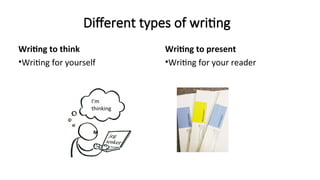
Different types of writing
Writing to think
•Writing for yourself
Writing to present
•Writing for your reader
I’m
thinking
Writing to think
• Develop thoughts
– Creative thinking
• Text meant for yourself
• Personal language
– Spelling is unimportant
• Unsystematic and messy
Writing to present
• Text meant to be read by
others
• Thinking about the reader
• Critical thinking
• Precise and formal language
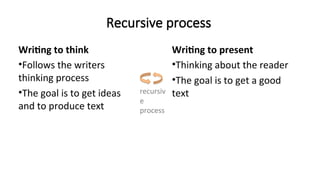
Recursive process
Writing to think
•Follows the writers
thinking process
•The goal is to get ideas
and to produce text
Writing to present
•Thinking about the reader
•The goal is to get a good
text
recursiv
e
process
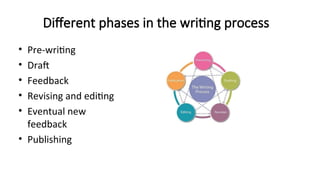
Different phases in the writing process
• Pre-writing
• Draft
• Feedback
• Revising and editing
• Eventual new
feedback
• Publishing
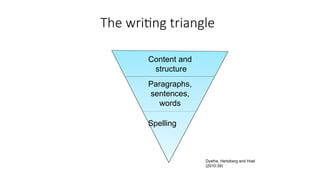
The writing triangle
Dysthe, Hertzberg and Hoel
(2010:39)
Content and
structure
Paragraphs,
sentences,
words
Spelling
TECHNICAL WRITING
Why do we need technical writing?
• Document our work and report our findings
• Communicate with other scholars, user groups and the public
• Take part in the dialogue in the discipline
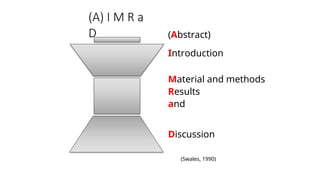
Structuring academic texts
(A) I M R a
D (Abstract)
Introduction
Material and methods
Results
and
Discussion
(Swales, 1990)
What is an IMRaD report?
• “IMRaD” format refers to a paper that is structured by four main sections:
1.Introduction
2.Methods
3.Results
4.Discussion
• This format is often used for lab reports as well as for reporting any
planned, systematic research in the social sciences, natural sciences, or
engineering and computer sciences.
Introduction – Make a case for your research
• The introduction explains why this research is important or necessary.
• Begin by describing the problem or situation that motivates the
research.
• Move to discussing the current state of research in the field;
• then reveal a “gap” or problem in the field.
Continue. . .
• Finally, explain how the present research is a solution to that problem
or gap.
• If the study has hypotheses, they are presented at the end of the
introduction.
Methods – What did you do?
• The methods section tells readers how you conducted your
study.
• It includes information about your population, sample,
methods, and equipment.
• The “gold standard” of the methods section is that it should
enable readers to duplicate your study.
Continue. . . .
• Methods sections typically use subheadings;
• They are written in past tense, and they use a lot of passive voice.
• This is typically the least read section of an IMRaD report.
Results – What did you find?
• In this section, you present your findings.
• Typically, the Results section contains only the findings,
• not any explanation of or commentary on the findings.
• Results sections are usually written in the past tense.
• Make sure all tables and figures are labeled and numbered separately.
• Captions go above tables and beneath figures.
Discussion – What does it mean?
• In this section, you summarize your main findings,
• comment on those findings
• connect them to other research.
• You also discuss limitations of your study,
• use these limitations as reasons to suggest additional, future research.
Abstract – Summarize the entire study
• The abstract for the report comes at the beginning of the paper.
• [but ] you should write it after you have drafted the full report.
• The abstract provides a very short overview of the entire paper, including:
• a sentence or two about the report’s purpose and importance,
Continue. . .
• a sentence or two about your methods,
• a few sentences that present the main findings,
• and a sentence or two about the implications of your findings.
Reporting versus Commenting on your
Findings
• In the Results section, you simply report your findings.
• In the Discussion section, you comment on them.
Report (Results section)
• Refer to your table or figure and state the main trend or finding.
e.g. Table 2 shows that more adult males were smoking daily than females.
• support the trends with data
e.g. the average difference between. . .
Continue. . .
• (If needed) Note any additional, secondary trends and support them with
data
e.g. In addition…. Figure 1 also shows….
• (If needed) Note any exceptions to your main trends or unexpected
outcomes
e.g. however. . .
Comment (Discussion Section)
• (if needed) provide an explanation
e.g. a feasible explanation is. . . OR can be explained by. . .
• (if needed) compare to other research
e.g. X is consistent with X’s findings. . . OR in contrast Y was found. . .
• State the bottom line: what does the data mean?
e.g. These findings overall suggest…. These data indicate….
Common problems in IMRaD drafts
• The Abstract does not provide a clear statement of the main findings.
• The Introduction does not communicate clearly why the research is
important.
• The Methods section is not detailed enough or is disorganized.
• The Results section provides comments and explanations instead of simply
reporting results.
Thanks

ARTICLE WRITING steps using IMRaD technical writing

  • 1.
    Introductions to Scientific ResearchReports (A-IMRaD) DR RUBEENA GUL ASSOCIATE PROF COMMUNITY MEDICINE DEPART KHYBER MEDICAL COLLEGE
  • 2.
  • 3.
    Different types ofwriting Writing to think •Writing for yourself Writing to present •Writing for your reader I’m thinking
  • 4.
    Writing to think •Develop thoughts – Creative thinking • Text meant for yourself • Personal language – Spelling is unimportant • Unsystematic and messy
  • 5.
    Writing to present •Text meant to be read by others • Thinking about the reader • Critical thinking • Precise and formal language
  • 6.
    Recursive process Writing tothink •Follows the writers thinking process •The goal is to get ideas and to produce text Writing to present •Thinking about the reader •The goal is to get a good text recursiv e process
  • 7.
    Different phases inthe writing process • Pre-writing • Draft • Feedback • Revising and editing • Eventual new feedback • Publishing
  • 8.
    The writing triangle Dysthe,Hertzberg and Hoel (2010:39) Content and structure Paragraphs, sentences, words Spelling
  • 9.
  • 10.
    Why do weneed technical writing? • Document our work and report our findings • Communicate with other scholars, user groups and the public • Take part in the dialogue in the discipline
  • 11.
  • 12.
    (A) I MR a D (Abstract) Introduction Material and methods Results and Discussion (Swales, 1990)
  • 13.
    What is anIMRaD report? • “IMRaD” format refers to a paper that is structured by four main sections: 1.Introduction 2.Methods 3.Results 4.Discussion • This format is often used for lab reports as well as for reporting any planned, systematic research in the social sciences, natural sciences, or engineering and computer sciences.
  • 14.
    Introduction – Makea case for your research • The introduction explains why this research is important or necessary. • Begin by describing the problem or situation that motivates the research. • Move to discussing the current state of research in the field; • then reveal a “gap” or problem in the field.
  • 15.
    Continue. . . •Finally, explain how the present research is a solution to that problem or gap. • If the study has hypotheses, they are presented at the end of the introduction.
  • 16.
    Methods – Whatdid you do? • The methods section tells readers how you conducted your study. • It includes information about your population, sample, methods, and equipment. • The “gold standard” of the methods section is that it should enable readers to duplicate your study.
  • 17.
    Continue. . .. • Methods sections typically use subheadings; • They are written in past tense, and they use a lot of passive voice. • This is typically the least read section of an IMRaD report.
  • 18.
    Results – Whatdid you find? • In this section, you present your findings. • Typically, the Results section contains only the findings, • not any explanation of or commentary on the findings. • Results sections are usually written in the past tense. • Make sure all tables and figures are labeled and numbered separately. • Captions go above tables and beneath figures.
  • 19.
    Discussion – Whatdoes it mean? • In this section, you summarize your main findings, • comment on those findings • connect them to other research. • You also discuss limitations of your study, • use these limitations as reasons to suggest additional, future research.
  • 20.
    Abstract – Summarizethe entire study • The abstract for the report comes at the beginning of the paper. • [but ] you should write it after you have drafted the full report. • The abstract provides a very short overview of the entire paper, including: • a sentence or two about the report’s purpose and importance,
  • 21.
    Continue. . . •a sentence or two about your methods, • a few sentences that present the main findings, • and a sentence or two about the implications of your findings.
  • 22.
    Reporting versus Commentingon your Findings • In the Results section, you simply report your findings. • In the Discussion section, you comment on them.
  • 23.
    Report (Results section) •Refer to your table or figure and state the main trend or finding. e.g. Table 2 shows that more adult males were smoking daily than females. • support the trends with data e.g. the average difference between. . .
  • 24.
    Continue. . . •(If needed) Note any additional, secondary trends and support them with data e.g. In addition…. Figure 1 also shows…. • (If needed) Note any exceptions to your main trends or unexpected outcomes e.g. however. . .
  • 25.
    Comment (Discussion Section) •(if needed) provide an explanation e.g. a feasible explanation is. . . OR can be explained by. . . • (if needed) compare to other research e.g. X is consistent with X’s findings. . . OR in contrast Y was found. . . • State the bottom line: what does the data mean? e.g. These findings overall suggest…. These data indicate….
  • 26.
    Common problems inIMRaD drafts • The Abstract does not provide a clear statement of the main findings. • The Introduction does not communicate clearly why the research is important. • The Methods section is not detailed enough or is disorganized. • The Results section provides comments and explanations instead of simply reporting results.
  • 27.