Reduction Techniques For
Zygomatic fractures. Which
comes when?
Dr.Ayesha MaqsoodDr.Ayesha Maqsood
BDS, FCPSBDS, FCPS
Assistant Professor, Oral & Maxillofacial SurgeryAssistant Professor, Oral & Maxillofacial Surgery
Margalla Institute of Health Sciences & affiliatedMargalla Institute of Health Sciences & affiliated
hospitals,Rawalpindi.hospitals,Rawalpindi.
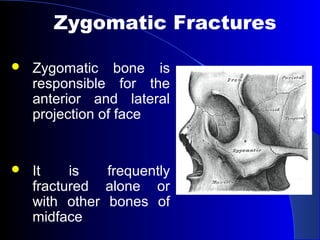
 Zygomatic bone is
responsible for the
anterior and lateral
projection of face
 It is frequently
fractured alone or
with other bones of
midface
Zygomatic Fractures
 Zygomatic fractures cause
disruption along the
following articulations
 Zygomaticofrontal suture
 Infraorbital rim
 Zygomaticomaxillary
buttress
 Zygomatic arch
 Zygomaticosphenoid
suture
Zygomatic Fractures
Zygoma may be fractured in a variety of
patterns,a wide variety of treatment
recommendations have evolved
From minimal reduction maneuvers
performed without fixation to complicated
types of open reduction involving multiple
exposure and fixation points
Zygomatic Fractures
Mechanism of injuryMechanism of injury
Direct blow on prominent part
Relative inbending at area of impaction
Relative outbending at weak areas such as
the arch,ZM suture,ZF suture
Fractures are usually displaced posteriorly&
inferiorly or medially
More violent blow causes posterior& lateral
displacement
• Depressed malar eminenceDepressed malar eminence
• EnophthalmosEnophthalmos
• Infraorbital paresthesiaInfraorbital paresthesia
• DiplopiaDiplopia
• Inability to open the mouthInability to open the mouth
Indications for
surgery
TreatmentTreatment
• as soon as possible
• Little delay  Settling of periorbital edema
 proper zygomatic bone examination
• Sight threatening injuries  Retrobulbar
hemorrhage may require urgent surgery
Methods ofMethods of
ReductionReduction
• Temporal fossa (Gillies approach)
• Intra oral (Keen approach)
• Percutaneous
•Malar hook approach
•Carrol Girard screw approach
• Lateral eyebrow (Dingman approach)
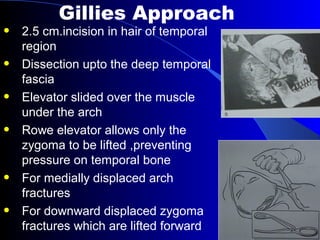
Gillies Approach
• 2.5 cm.incision in hair of temporal
region
• Dissection upto the deep temporal
fascia
• Elevator slided over the muscle
under the arch
• Rowe elevator allows only the
zygoma to be lifted ,preventing
pressure on temporal bone
• For medially displaced arch
fractures
• For downward displaced zygoma
fractures which are lifted forward
Vestibular(Keen Approach)Vestibular(Keen Approach)
• Incision in the buccal sulcus
• Elevator placed under the
zygomatic bone or arch
• Allows safe & direct approach to
entire facial surface of midfacial
skeleton
• For reduction of medially &
posteriorally displaced zygomatic
fractures
• The displaced segments are lifted
upward and laterally
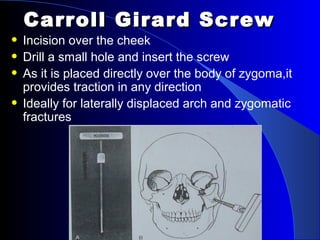
Carroll Girard ScrewCarroll Girard Screw
• Incision over the cheek
• Drill a small hole and insert the screw
• As it is placed directly over the body of zygoma,it
provides traction in any direction
• Ideally for laterally displaced arch and zygomatic
fractures
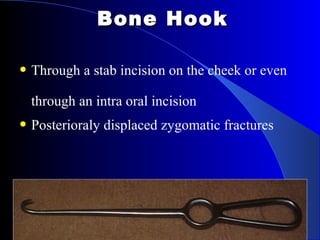
Bone HookBone Hook
• Through a stab incision on the cheek or even
through an intra oral incision
• Posterioraly displaced zygomatic fractures
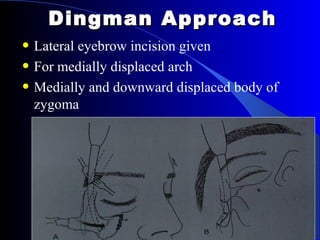
Dingman ApproachDingman Approach
• Lateral eyebrow incision given
• For medially displaced arch
• Medially and downward displaced body of
zygoma
Endoscopically assisted
reduction
• Endoscopic approaches may be used
to identify the arch &zygomatic
fractures and they could be reduced
using any technique
Conclusion
• A simple arch fracture such as a medially
displaced one ,may be managed by elevation
alone because periosteal continuity will prevent
displacement.
• No technique suitable for laterally displaced
arch or zygomatic body because insufficient
periosteal continuity will not maintain reduction
Cont……
Conclusion
• Appx. 25% of zygomatic fractures are with
minimal displacement ,which are best
managed by closed reduction
• Incomplete fractures at Z.F suture are also
amenable to closed reduction
• For an unstable fracture the closed redution
may be used as part of open reduction
Thank youThank you

zygomatic reduction,which comes when

  • 1.
    Reduction Techniques For Zygomaticfractures. Which comes when? Dr.Ayesha MaqsoodDr.Ayesha Maqsood BDS, FCPSBDS, FCPS Assistant Professor, Oral & Maxillofacial SurgeryAssistant Professor, Oral & Maxillofacial Surgery Margalla Institute of Health Sciences & affiliatedMargalla Institute of Health Sciences & affiliated hospitals,Rawalpindi.hospitals,Rawalpindi.
  • 2.
     Zygomatic boneis responsible for the anterior and lateral projection of face  It is frequently fractured alone or with other bones of midface Zygomatic Fractures
  • 3.
     Zygomatic fracturescause disruption along the following articulations  Zygomaticofrontal suture  Infraorbital rim  Zygomaticomaxillary buttress  Zygomatic arch  Zygomaticosphenoid suture Zygomatic Fractures
  • 4.
    Zygoma may befractured in a variety of patterns,a wide variety of treatment recommendations have evolved From minimal reduction maneuvers performed without fixation to complicated types of open reduction involving multiple exposure and fixation points Zygomatic Fractures
  • 5.
    Mechanism of injuryMechanismof injury Direct blow on prominent part Relative inbending at area of impaction Relative outbending at weak areas such as the arch,ZM suture,ZF suture Fractures are usually displaced posteriorly& inferiorly or medially More violent blow causes posterior& lateral displacement
  • 6.
    • Depressed malareminenceDepressed malar eminence • EnophthalmosEnophthalmos • Infraorbital paresthesiaInfraorbital paresthesia • DiplopiaDiplopia • Inability to open the mouthInability to open the mouth Indications for surgery
  • 7.
    TreatmentTreatment • as soonas possible • Little delay  Settling of periorbital edema  proper zygomatic bone examination • Sight threatening injuries  Retrobulbar hemorrhage may require urgent surgery
  • 9.
    Methods ofMethods of ReductionReduction •Temporal fossa (Gillies approach) • Intra oral (Keen approach) • Percutaneous •Malar hook approach •Carrol Girard screw approach • Lateral eyebrow (Dingman approach)
  • 10.
    Gillies Approach • 2.5cm.incision in hair of temporal region • Dissection upto the deep temporal fascia • Elevator slided over the muscle under the arch • Rowe elevator allows only the zygoma to be lifted ,preventing pressure on temporal bone • For medially displaced arch fractures • For downward displaced zygoma fractures which are lifted forward
  • 11.
    Vestibular(Keen Approach)Vestibular(Keen Approach) •Incision in the buccal sulcus • Elevator placed under the zygomatic bone or arch • Allows safe & direct approach to entire facial surface of midfacial skeleton • For reduction of medially & posteriorally displaced zygomatic fractures • The displaced segments are lifted upward and laterally
  • 12.
    Carroll Girard ScrewCarrollGirard Screw • Incision over the cheek • Drill a small hole and insert the screw • As it is placed directly over the body of zygoma,it provides traction in any direction • Ideally for laterally displaced arch and zygomatic fractures
  • 13.
    Bone HookBone Hook •Through a stab incision on the cheek or even through an intra oral incision • Posterioraly displaced zygomatic fractures
  • 14.
    Dingman ApproachDingman Approach •Lateral eyebrow incision given • For medially displaced arch • Medially and downward displaced body of zygoma
  • 15.
    Endoscopically assisted reduction • Endoscopicapproaches may be used to identify the arch &zygomatic fractures and they could be reduced using any technique
  • 16.
    Conclusion • A simplearch fracture such as a medially displaced one ,may be managed by elevation alone because periosteal continuity will prevent displacement. • No technique suitable for laterally displaced arch or zygomatic body because insufficient periosteal continuity will not maintain reduction Cont……
  • 17.
    Conclusion • Appx. 25%of zygomatic fractures are with minimal displacement ,which are best managed by closed reduction • Incomplete fractures at Z.F suture are also amenable to closed reduction • For an unstable fracture the closed redution may be used as part of open reduction
  • 18.