1103/12/1703/12/17 Dr YounasDr Younas
2203/12/1703/12/17 Dr YounasDr Younas
3303/12/1703/12/17 Dr YounasDr Younas
MANAGEMENT OFMANAGEMENT OF
GUNSHOT INJURIESGUNSHOT INJURIES
Dr. MUHAMMAD YOUNASDr. MUHAMMAD YOUNAS
TMO ORAL SURGURYTMO ORAL SURGURY
03/12/17 Dr Younas 5
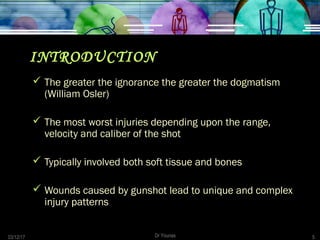
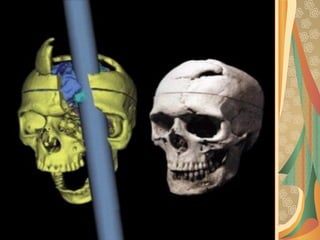
INTRODUCTION
 The greater the ignorance the greater the dogmatism
(William Osler)
 The most worst injuries depending upon the range,
velocity and caliber of the shot
 Typically involved both soft tissue and bones
 Wounds caused by gunshot lead to unique and complex
injury patterns
03/12/17 Dr Younas6
PHYSICS OF THE GUNSHOT WOUNDS
 Wounding capacity depends upon kinetic energy
impact
 K.E =
 Wounding power
 Velocity determine the wounding capacity
 Injury caused by a bullet is directly proportional to
the amount of energy transferred and to the actual
energy expended
2
2
1
mv
2
)( exitimpact VVmP −=
03/12/17 Dr Younas7
MECHANISM OF GUNSHOT INJURIES
 Components of projectile wounding
1. Penetration (transfer destructive energy to
surrounding tissue)
2. Permanent cavity formation
3. Temporary cavity formation
4. Fragmentation (primary, secondary)
03/12/17 Dr Younas8
FACTORS AFFECTING THE DEGREE
OF INJURIES
 Velocity of bullet
 Size of bullet
 Drag and retardation
 Composition of bullet (single, multiple)
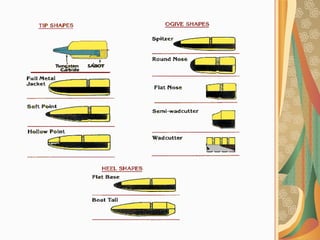
 shape of the bullet
 Extent of cavitations that occurs
 Deviation (yaws)
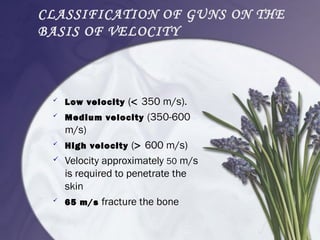
CLASSIFICATION OF GUNS ON THE
BASIS OF VELOCITY
 Low velocity (< 350 m/s).
 Medium velocity (350-600
m/s)
 High velocity (> 600 m/s)
 Velocity approximately 50 m/s
is required to penetrate the
skin
 65 m/s fracture the bone
03/12/17 Dr Younas 10
03/12/17 Dr Younas 11
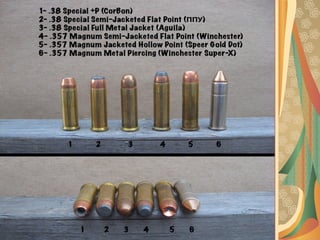
Rifle has high velocity
Piston has medium velocity
(hand gun)
Revolver has low velocity
03/12/17 Dr Younas 13
COMPOSITION OF BULLET
Shape and consistency of
bullet determine the nature of
wound
Bullet alloy composition 2%
tin, 6% antimony and 92%
lead
03/12/1703/12/17 Dr YounasDr Younas 1515
FIREARM TERMENOLOGYFIREARM TERMENOLOGY
 BALLISTICSBALLISTICS (science of projectile motion)(science of projectile motion)
 Relating to or characteristic of the motion of objects moving underRelating to or characteristic of the motion of objects moving under
their own momentum and the force of gravity; "ballistic missile"their own momentum and the force of gravity; "ballistic missile"
 Handguns (pistol, revolvers)Handguns (pistol, revolvers)
 RiflesRifles
 ShotgunsShotguns
 Yaw (oscillation around the long axis of the bullet)Yaw (oscillation around the long axis of the bullet)
03/12/1703/12/17 Dr YounasDr Younas 1616
CLASSIFICATION OF GUNSHOTCLASSIFICATION OF GUNSHOT
WOUNDSWOUNDS
1.1. Based on the velocity (energy transferred)Based on the velocity (energy transferred)
 Low energy transfer woundsLow energy transfer wounds
 High energy transfer woundsHigh energy transfer wounds
 Middle energy transfer woundsMiddle energy transfer wounds
03/12/17 Dr Younas 17
03/12/1703/12/17 Dr YounasDr Younas 1818
CLASSIFICATION OF GUNSHOTCLASSIFICATION OF GUNSHOT
WOUNDSWOUNDS
2.2. Simplest classification schemeSimplest classification scheme
A.A. Penetrating woundsPenetrating wounds
 low velocity projectilelow velocity projectile
 embedded in the tissueembedded in the tissue
 small point of entrysmall point of entry
 Examples handguns bullet (release energyExamples handguns bullet (release energy
100-500J)100-500J)
B.B. Perforating woundsPerforating wounds
 High velocity (high energy transfer wounds)High velocity (high energy transfer wounds)
 Exit wound larger than entryExit wound larger than entry
 In and outIn and out
 Examples rifles bullet woundsExamples rifles bullet wounds
03/12/1703/12/17 Dr YounasDr Younas 1919
C.C. Avulsive woundsAvulsive wounds
 Loss of tissueLoss of tissue
 Irregular fragments from bombsIrregular fragments from bombs
grenadesgrenades
3.3. Gugala and Lindsey classificationGugala and Lindsey classification
1.1. High or low energy woundsHigh or low energy wounds
2.2. Involvement of vital structure (neuralInvolvement of vital structure (neural
and vascular)and vascular)
3.3. Wound type (non-penetrating,Wound type (non-penetrating,
penetrating, perforating)penetrating, perforating)
4.4. Fracture (intra-articular and extra-Fracture (intra-articular and extra-
articular)articular)
5.5. contaminationcontamination
CLASSIFICATION OF GUNSHOTCLASSIFICATION OF GUNSHOT
WOUNDSWOUNDS
03/12/17 Dr Younas 20
Avulsive wounds
03/12/17 Dr Younas 21
03/12/17 Dr Younas 22
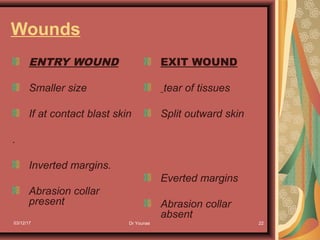
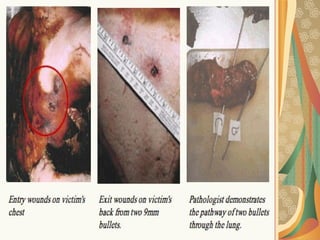
Wounds
ENTRY WOUND
Smaller size
If at contact blast skin
.
Inverted margins.
Abrasion collar
present
EXIT WOUND
tear of tissues
Split outward skin
Everted margins
Abrasion collar
absent
03/12/17 Dr Younas 23
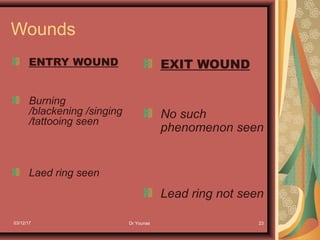
Wounds
ENTRY WOUND
Burning
/blackening /singing
/tattooing seen
Laed ring seen
EXIT WOUND
No such
phenomenon seen
Lead ring not seen
03/12/17 Dr Younas 24
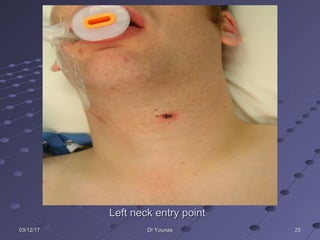
252503/12/1703/12/17 Dr YounasDr Younas
Left neck entry pointLeft neck entry point
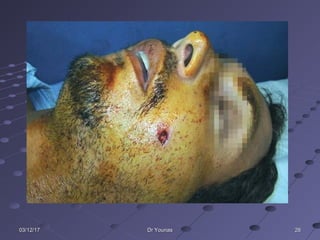
262603/12/1703/12/17 Dr YounasDr Younas
03/12/1703/12/17 Dr YounasDr Younas 2727
MANAGEMENTMANAGEMENT
General principles (ATLS protocol)General principles (ATLS protocol)
 Rule out (look for)Rule out (look for)
 multiple injurymultiple injury
 inspection of entrance and exit point (multiple)inspection of entrance and exit point (multiple)
 Penetrating, perforating, avulsive woundsPenetrating, perforating, avulsive wounds
03/12/1703/12/17 Dr YounasDr Younas 2828
MANAGEMENTMANAGEMENT
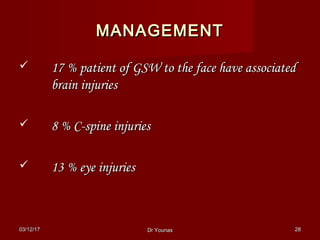
 17 % patient of GSW to the face have associated17 % patient of GSW to the face have associated
brain injuriesbrain injuries
 8 % C-spine injuries8 % C-spine injuries
 13 % eye injuries13 % eye injuries
03/12/1703/12/17 Dr YounasDr Younas 2929
EMERGENCY TREATMENT OREMERGENCY TREATMENT OR
IMMIDIATE POST TRAMATIC PHASEIMMIDIATE POST TRAMATIC PHASE
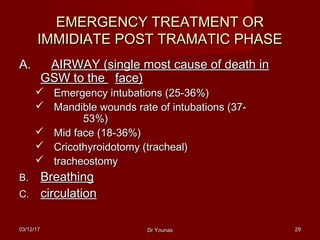
A.A. AIRWAY (single most cause of death inAIRWAY (single most cause of death in
GSW to theGSW to the face)face)
 Emergency intubations (25-36%)Emergency intubations (25-36%)
 Mandible wounds rate of intubations (37-Mandible wounds rate of intubations (37-
53%)53%)
 Mid face (18-36%)Mid face (18-36%)
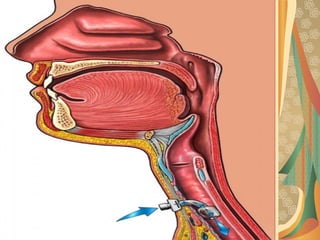
 Cricothyroidotomy (tracheal)Cricothyroidotomy (tracheal)
 tracheostomytracheostomy
B.B. BreathingBreathing
C.C. circulationcirculation
03/12/1703/12/17 Dr YounasDr Younas 3030
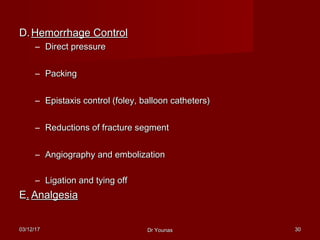
D.D. Hemorrhage ControlHemorrhage Control
– Direct pressureDirect pressure
– PackingPacking
– Epistaxis control (foley, balloon catheters)Epistaxis control (foley, balloon catheters)
– Reductions of fracture segmentReductions of fracture segment
– Angiography and embolizationAngiography and embolization
– Ligation and tying offLigation and tying off
EE.. AnalgesiaAnalgesia
03/12/17 Dr Younas 31
03/12/17 Dr Younas 32
03/12/17 Dr Younas 33
IMMAGING
 Plain Radiographs
1. C-spine views
2. Chest radiograph
3. PA view of face
4. Lateral view of face
5. PNS (water) view
 CT scan
 3-D CT scan
 CT-Angiography
 ultrasonography
03/12/17 Dr Younas 34
03/12/17 Dr Younas 35
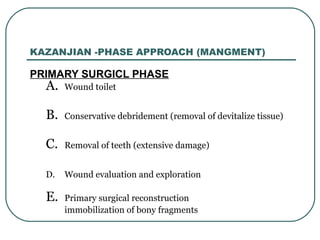
KAZANJIAN -PHASE APPROACH (MANGMENT)
PRIMARY SURGICL PHASE
A. Wound toilet
B. Conservative debridement (removal of devitalize tissue)
C. Removal of teeth (extensive damage)
D. Wound evaluation and exploration
E. Primary surgical reconstruction
immobilization of bony fragments
03/12/17 Dr Younas 36
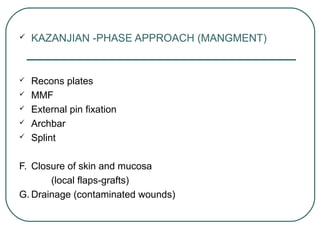
 KAZANJIAN -PHASE APPROACH (MANGMENT)
 Recons plates
 MMF
 External pin fixation
 Archbar
 Splint
F. Closure of skin and mucosa
(local flaps-grafts)
G. Drainage (contaminated wounds)
03/12/17 Dr Younas 37
CONTAMINATION
• All gunshot wounds are contaminated
• Missile fragment, bullet, lodged in tissue leads to abscess
formation
• Intra-articular bullet fragments and bullet near to nerves
should removed
• Projectiles from gunshot are not sterile
• Prophylactic antibiotics plus tetanus prophylaxis indicated
383803/12/1703/12/17 Dr YounasDr Younas
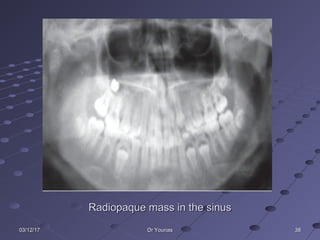
Radiopaque mass in the sinusRadiopaque mass in the sinus
03/12/17 Dr Younas 39
(KAZANJIAN -PHASE APPROACH
(MANGMENT)
 IMMIDIATE POST OP PHASE
Reassure sympathetic nursing
Special feeding device
Saliva shield
Mouth washes
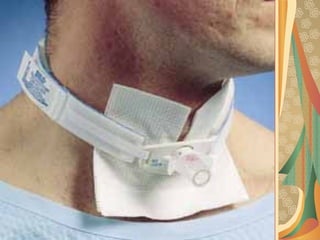
Tracheostomy care
03/12/17 Dr Younas 40
KAZANJIAN -PHASE APPROACH (MANGMENT
 RECONSTRUCTIVE PHASE
First surgery reduce later reconstruction
Skin grafting (immediate)
Bone grafting
Mid face (immediate/primary reconstruction)
Mandible (late reconstruction) but mandibular segment
is maintained with plate
Teeth prosthesis (late)
03/12/17 Dr Younas 41
FUNCTIONAL RECONSTRUCTION
 Ridge augmentation
 Dental implants
 Scar revision
03/12/17 Dr Younas 42
03/12/17 Dr Younas 43
GOALS OF RECONSTRUCTION
• Restoration of function
• Rebuilding of facial feature and improvement of
appearance
• Preparation of patient to re enter in society
• Improvement of psychodynamics
03/12/17 Dr Younas 44
03/12/17 Dr Younas 45
EARLY RECONSTRUCTION
ADVANTAGES
 Early stabilization and support of soft tissue
 Decrease scar contracture
 No secondary surgery
 No long term facial deformity
DISADVANTAGES
 Infection
 Lack of tissue for proper covering
 Long operating time
 Loss of bone graft
03/12/17 Dr Younas 46
DELAYED RECONSTRUCTION
 ADVANTAGES
 Satisfactory result in appearance and function
 less chance of infection
 Implant can be placed
 Patient afford second surgery
 Decrease chance of failure of reconstruction
DISADVANTAGES
 Loss of facial deformity
 Scar revision
03/12/1703/12/17 Dr YounasDr Younas 4747
GRAFT SOURCESGRAFT SOURCES
BONE GRAFT SOURCESBONE GRAFT SOURCES
RibsRibs
Illiac graftIlliac graft
fibulafibula
CalvariumCalvarium
Alloplastic bone materialAlloplastic bone material
03/12/17 Dr Younas 48
ASSESSMENT OF PATIENT FOR
RECONSTRUCTION
1. Hard tissue defect
 Radiographs for assessment of extent of defect
 Site of defect
 Size of defect
2.Position of residual fragments
3.Assessment of soft tissue bed
Dr Younas 4903/12/17
DIFFERENT FLAPS
 Pedicle flaps
A. Local flaps
1. mucosal
2. skin
3. fats
B. Distant flaps
1. fasciocutaneous
2. myocutaneous
 Free flaps (totally removed
Dr Younas 5003/12/17
SPECIALIZED SRUCTURE DAMAGE
1. Facial nerve (3-6%) GSW
a. Contaminated wounds repair delayed for 48-72 hrs
b. Repair should be made in initial surgical procedure.
c. should not be delayed more than a months
2. Salivary duct
a. Repaired or ligated (intravenuse catheter or
polymericsilicone tubing
Dr Younas 5103/12/17
MANAGEMENT OF SALIVARY FISTULAE:
(A Classification of Reported Methods in the Literature)
1. Diversion of secretion into the mouth
A. Reconstructive methods
 Delayed primary repair of duct
 Reconstruction of duct with vein graft
 Mucosal flaps
 Suture of proximal duct to buccal mucosa
Dr Younas 5203/12/17
B. Formation of a controlled internal fistula
 T-tube or catheter drainage into the mouth
 Drainage of proximal duct by a catheter
C. gland removal
D. Local therapy to the fistula
 Excision
 Cauterization
Dr Younas 5303/12/17
2. Depression of secretion
A. Surgical approaches
 Duct ligation
 Sectioning of the auricotemporal or Jacobsen's nerve
B. Conservative approaches
 Administering nothing orally to the patient until the fistula closes
 Drugs: atropine or Pro-banthine
 Radiotherapy
 Repeated aspiration and pressure dressing
03/12/1703/12/17 Dr YounasDr Younas 5454
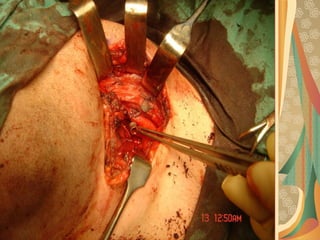
PENETRATING NECK INJURIESPENETRATING NECK INJURIES
 GSW of the face may be associated with entrance andGSW of the face may be associated with entrance and
exit wound in the neck.exit wound in the neck.
 MONSANS Zones of the neck.MONSANS Zones of the neck.
Zone 1;area from clavicle to cricoidZone 1;area from clavicle to cricoid
cartilage (mortality 12 %)cartilage (mortality 12 %)
 ContentsContents
– A.A. carotid arteriescarotid arteries
– B.B. subclavian arteries and veinssubclavian arteries and veins
– C.C. internal jugular veinsinternal jugular veins
– D.D. thoracic duck, esophagusthoracic duck, esophagus
– E.E. thyroid gland, tracheathyroid gland, trachea
– F.F. brachiocephalic trunk etcbrachiocephalic trunk etc
03/12/17 Dr Younas 55
03/12/1703/12/17 Dr YounasDr Younas 5656
ZONE-2ZONE-2
 Area from cricoid cartilag to the angle of mandibleArea from cricoid cartilag to the angle of mandible
 ContentsContents
 Common carotid arteriesCommon carotid arteries
 Internal and external carotid arteriesInternal and external carotid arteries
 Internal jugular veinsInternal jugular veins
 LarynxLarynx
 Cranial nerves X, IXCranial nerves X, IX
03/12/1703/12/17 Dr YounasDr Younas 5757
ZONE-3 (From Skull Base To TheZONE-3 (From Skull Base To The
Angle Of Mandible)Angle Of Mandible)
ContentsContents
– Carotid arteriesCarotid arteries
– Internal jugular veinsInternal jugular veins
– Cranial nervesCranial nerves
Mandibular fractures accompanied by injuries to zone-3Mandibular fractures accompanied by injuries to zone-3
03/12/17 Dr Younas 58
Airgun pellet deep to external carotid artery
03/12/17 Dr Younas 59
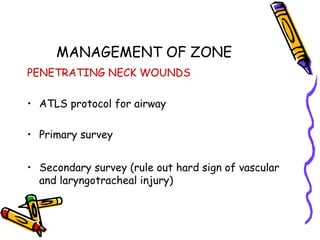
MANAGEMENT OF ZONE
PENETRATING NECK WOUNDS
• ATLS protocol for airway
• Primary survey
• Secondary survey (rule out hard sign of vascular
and laryngotracheal injury)
03/12/17 Dr Younas 60
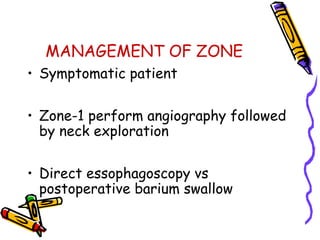
MANAGEMENT OF ZONE
• Symptomatic patient
• Zone-1 perform angiography followed
by neck exploration
• Direct essophagoscopy vs
postoperative barium swallow
03/12/17 Dr Younas 61
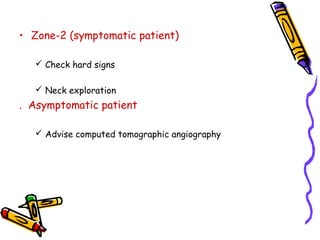
• Zone-2 (symptomatic patient)
 Check hard signs
 Neck exploration
. Asymptomatic patient
 Advise computed tomographic angiography
03/12/17 Dr Younas 62
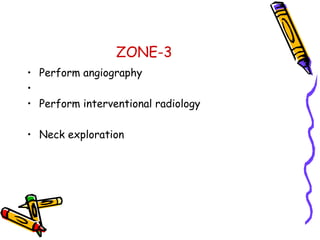
ZONE-3
• Perform angiography
•
• Perform interventional radiology
• Neck exploration
03/12/17 Dr Younas 63
CHYLE LEAK
MANAGEMENT
Intra-operative
Apply continues positive pressure
Ligation of thoracic duct
Sclerosing agent
post op
High output > 400-500cc/d
Re-exploration of neck
Trendelenburg’s position
Sclerosing agent
03/12/17 Dr Younas 64
Low output
Aspiration
Dressing
Diet of medium chain triglycerides
03/12/17 Dr Younas 65
THANKS……

Gun shot injury

  • 1.
  • 2.
  • 3.
  • 4.
    MANAGEMENT OFMANAGEMENT OF GUNSHOTINJURIESGUNSHOT INJURIES Dr. MUHAMMAD YOUNASDr. MUHAMMAD YOUNAS TMO ORAL SURGURYTMO ORAL SURGURY
  • 5.
    03/12/17 Dr Younas5 INTRODUCTION  The greater the ignorance the greater the dogmatism (William Osler)  The most worst injuries depending upon the range, velocity and caliber of the shot  Typically involved both soft tissue and bones  Wounds caused by gunshot lead to unique and complex injury patterns
  • 6.
    03/12/17 Dr Younas6 PHYSICSOF THE GUNSHOT WOUNDS  Wounding capacity depends upon kinetic energy impact  K.E =  Wounding power  Velocity determine the wounding capacity  Injury caused by a bullet is directly proportional to the amount of energy transferred and to the actual energy expended 2 2 1 mv 2 )( exitimpact VVmP −=
  • 7.
    03/12/17 Dr Younas7 MECHANISMOF GUNSHOT INJURIES  Components of projectile wounding 1. Penetration (transfer destructive energy to surrounding tissue) 2. Permanent cavity formation 3. Temporary cavity formation 4. Fragmentation (primary, secondary)
  • 8.
    03/12/17 Dr Younas8 FACTORSAFFECTING THE DEGREE OF INJURIES  Velocity of bullet  Size of bullet  Drag and retardation  Composition of bullet (single, multiple)  shape of the bullet  Extent of cavitations that occurs  Deviation (yaws)
  • 9.
    CLASSIFICATION OF GUNSON THE BASIS OF VELOCITY  Low velocity (< 350 m/s).  Medium velocity (350-600 m/s)  High velocity (> 600 m/s)  Velocity approximately 50 m/s is required to penetrate the skin  65 m/s fracture the bone
  • 10.
  • 11.
  • 12.
    Rifle has highvelocity Piston has medium velocity (hand gun) Revolver has low velocity
  • 13.
  • 14.
    COMPOSITION OF BULLET Shapeand consistency of bullet determine the nature of wound Bullet alloy composition 2% tin, 6% antimony and 92% lead
  • 15.
    03/12/1703/12/17 Dr YounasDrYounas 1515 FIREARM TERMENOLOGYFIREARM TERMENOLOGY  BALLISTICSBALLISTICS (science of projectile motion)(science of projectile motion)  Relating to or characteristic of the motion of objects moving underRelating to or characteristic of the motion of objects moving under their own momentum and the force of gravity; "ballistic missile"their own momentum and the force of gravity; "ballistic missile"  Handguns (pistol, revolvers)Handguns (pistol, revolvers)  RiflesRifles  ShotgunsShotguns  Yaw (oscillation around the long axis of the bullet)Yaw (oscillation around the long axis of the bullet)
  • 16.
    03/12/1703/12/17 Dr YounasDrYounas 1616 CLASSIFICATION OF GUNSHOTCLASSIFICATION OF GUNSHOT WOUNDSWOUNDS 1.1. Based on the velocity (energy transferred)Based on the velocity (energy transferred)  Low energy transfer woundsLow energy transfer wounds  High energy transfer woundsHigh energy transfer wounds  Middle energy transfer woundsMiddle energy transfer wounds
  • 17.
  • 18.
    03/12/1703/12/17 Dr YounasDrYounas 1818 CLASSIFICATION OF GUNSHOTCLASSIFICATION OF GUNSHOT WOUNDSWOUNDS 2.2. Simplest classification schemeSimplest classification scheme A.A. Penetrating woundsPenetrating wounds  low velocity projectilelow velocity projectile  embedded in the tissueembedded in the tissue  small point of entrysmall point of entry  Examples handguns bullet (release energyExamples handguns bullet (release energy 100-500J)100-500J) B.B. Perforating woundsPerforating wounds  High velocity (high energy transfer wounds)High velocity (high energy transfer wounds)  Exit wound larger than entryExit wound larger than entry  In and outIn and out  Examples rifles bullet woundsExamples rifles bullet wounds
  • 19.
    03/12/1703/12/17 Dr YounasDrYounas 1919 C.C. Avulsive woundsAvulsive wounds  Loss of tissueLoss of tissue  Irregular fragments from bombsIrregular fragments from bombs grenadesgrenades 3.3. Gugala and Lindsey classificationGugala and Lindsey classification 1.1. High or low energy woundsHigh or low energy wounds 2.2. Involvement of vital structure (neuralInvolvement of vital structure (neural and vascular)and vascular) 3.3. Wound type (non-penetrating,Wound type (non-penetrating, penetrating, perforating)penetrating, perforating) 4.4. Fracture (intra-articular and extra-Fracture (intra-articular and extra- articular)articular) 5.5. contaminationcontamination CLASSIFICATION OF GUNSHOTCLASSIFICATION OF GUNSHOT WOUNDSWOUNDS
  • 20.
    03/12/17 Dr Younas20 Avulsive wounds
  • 21.
  • 22.
    03/12/17 Dr Younas22 Wounds ENTRY WOUND Smaller size If at contact blast skin . Inverted margins. Abrasion collar present EXIT WOUND tear of tissues Split outward skin Everted margins Abrasion collar absent
  • 23.
    03/12/17 Dr Younas23 Wounds ENTRY WOUND Burning /blackening /singing /tattooing seen Laed ring seen EXIT WOUND No such phenomenon seen Lead ring not seen
  • 24.
  • 25.
    252503/12/1703/12/17 Dr YounasDrYounas Left neck entry pointLeft neck entry point
  • 26.
  • 27.
    03/12/1703/12/17 Dr YounasDrYounas 2727 MANAGEMENTMANAGEMENT General principles (ATLS protocol)General principles (ATLS protocol)  Rule out (look for)Rule out (look for)  multiple injurymultiple injury  inspection of entrance and exit point (multiple)inspection of entrance and exit point (multiple)  Penetrating, perforating, avulsive woundsPenetrating, perforating, avulsive wounds
  • 28.
    03/12/1703/12/17 Dr YounasDrYounas 2828 MANAGEMENTMANAGEMENT  17 % patient of GSW to the face have associated17 % patient of GSW to the face have associated brain injuriesbrain injuries  8 % C-spine injuries8 % C-spine injuries  13 % eye injuries13 % eye injuries
  • 29.
    03/12/1703/12/17 Dr YounasDrYounas 2929 EMERGENCY TREATMENT OREMERGENCY TREATMENT OR IMMIDIATE POST TRAMATIC PHASEIMMIDIATE POST TRAMATIC PHASE A.A. AIRWAY (single most cause of death inAIRWAY (single most cause of death in GSW to theGSW to the face)face)  Emergency intubations (25-36%)Emergency intubations (25-36%)  Mandible wounds rate of intubations (37-Mandible wounds rate of intubations (37- 53%)53%)  Mid face (18-36%)Mid face (18-36%)  Cricothyroidotomy (tracheal)Cricothyroidotomy (tracheal)  tracheostomytracheostomy B.B. BreathingBreathing C.C. circulationcirculation
  • 30.
    03/12/1703/12/17 Dr YounasDrYounas 3030 D.D. Hemorrhage ControlHemorrhage Control – Direct pressureDirect pressure – PackingPacking – Epistaxis control (foley, balloon catheters)Epistaxis control (foley, balloon catheters) – Reductions of fracture segmentReductions of fracture segment – Angiography and embolizationAngiography and embolization – Ligation and tying offLigation and tying off EE.. AnalgesiaAnalgesia
  • 31.
  • 32.
  • 33.
    03/12/17 Dr Younas33 IMMAGING  Plain Radiographs 1. C-spine views 2. Chest radiograph 3. PA view of face 4. Lateral view of face 5. PNS (water) view  CT scan  3-D CT scan  CT-Angiography  ultrasonography
  • 34.
  • 35.
    03/12/17 Dr Younas35 KAZANJIAN -PHASE APPROACH (MANGMENT) PRIMARY SURGICL PHASE A. Wound toilet B. Conservative debridement (removal of devitalize tissue) C. Removal of teeth (extensive damage) D. Wound evaluation and exploration E. Primary surgical reconstruction immobilization of bony fragments
  • 36.
    03/12/17 Dr Younas36  KAZANJIAN -PHASE APPROACH (MANGMENT)  Recons plates  MMF  External pin fixation  Archbar  Splint F. Closure of skin and mucosa (local flaps-grafts) G. Drainage (contaminated wounds)
  • 37.
    03/12/17 Dr Younas37 CONTAMINATION • All gunshot wounds are contaminated • Missile fragment, bullet, lodged in tissue leads to abscess formation • Intra-articular bullet fragments and bullet near to nerves should removed • Projectiles from gunshot are not sterile • Prophylactic antibiotics plus tetanus prophylaxis indicated
  • 38.
    383803/12/1703/12/17 Dr YounasDrYounas Radiopaque mass in the sinusRadiopaque mass in the sinus
  • 39.
    03/12/17 Dr Younas39 (KAZANJIAN -PHASE APPROACH (MANGMENT)  IMMIDIATE POST OP PHASE Reassure sympathetic nursing Special feeding device Saliva shield Mouth washes Tracheostomy care
  • 40.
    03/12/17 Dr Younas40 KAZANJIAN -PHASE APPROACH (MANGMENT  RECONSTRUCTIVE PHASE First surgery reduce later reconstruction Skin grafting (immediate) Bone grafting Mid face (immediate/primary reconstruction) Mandible (late reconstruction) but mandibular segment is maintained with plate Teeth prosthesis (late)
  • 41.
    03/12/17 Dr Younas41 FUNCTIONAL RECONSTRUCTION  Ridge augmentation  Dental implants  Scar revision
  • 42.
  • 43.
    03/12/17 Dr Younas43 GOALS OF RECONSTRUCTION • Restoration of function • Rebuilding of facial feature and improvement of appearance • Preparation of patient to re enter in society • Improvement of psychodynamics
  • 44.
  • 45.
    03/12/17 Dr Younas45 EARLY RECONSTRUCTION ADVANTAGES  Early stabilization and support of soft tissue  Decrease scar contracture  No secondary surgery  No long term facial deformity DISADVANTAGES  Infection  Lack of tissue for proper covering  Long operating time  Loss of bone graft
  • 46.
    03/12/17 Dr Younas46 DELAYED RECONSTRUCTION  ADVANTAGES  Satisfactory result in appearance and function  less chance of infection  Implant can be placed  Patient afford second surgery  Decrease chance of failure of reconstruction DISADVANTAGES  Loss of facial deformity  Scar revision
  • 47.
    03/12/1703/12/17 Dr YounasDrYounas 4747 GRAFT SOURCESGRAFT SOURCES BONE GRAFT SOURCESBONE GRAFT SOURCES RibsRibs Illiac graftIlliac graft fibulafibula CalvariumCalvarium Alloplastic bone materialAlloplastic bone material
  • 48.
    03/12/17 Dr Younas48 ASSESSMENT OF PATIENT FOR RECONSTRUCTION 1. Hard tissue defect  Radiographs for assessment of extent of defect  Site of defect  Size of defect 2.Position of residual fragments 3.Assessment of soft tissue bed
  • 49.
    Dr Younas 4903/12/17 DIFFERENTFLAPS  Pedicle flaps A. Local flaps 1. mucosal 2. skin 3. fats B. Distant flaps 1. fasciocutaneous 2. myocutaneous  Free flaps (totally removed
  • 50.
    Dr Younas 5003/12/17 SPECIALIZEDSRUCTURE DAMAGE 1. Facial nerve (3-6%) GSW a. Contaminated wounds repair delayed for 48-72 hrs b. Repair should be made in initial surgical procedure. c. should not be delayed more than a months 2. Salivary duct a. Repaired or ligated (intravenuse catheter or polymericsilicone tubing
  • 51.
    Dr Younas 5103/12/17 MANAGEMENTOF SALIVARY FISTULAE: (A Classification of Reported Methods in the Literature) 1. Diversion of secretion into the mouth A. Reconstructive methods  Delayed primary repair of duct  Reconstruction of duct with vein graft  Mucosal flaps  Suture of proximal duct to buccal mucosa
  • 52.
    Dr Younas 5203/12/17 B.Formation of a controlled internal fistula  T-tube or catheter drainage into the mouth  Drainage of proximal duct by a catheter C. gland removal D. Local therapy to the fistula  Excision  Cauterization
  • 53.
    Dr Younas 5303/12/17 2.Depression of secretion A. Surgical approaches  Duct ligation  Sectioning of the auricotemporal or Jacobsen's nerve B. Conservative approaches  Administering nothing orally to the patient until the fistula closes  Drugs: atropine or Pro-banthine  Radiotherapy  Repeated aspiration and pressure dressing
  • 54.
    03/12/1703/12/17 Dr YounasDrYounas 5454 PENETRATING NECK INJURIESPENETRATING NECK INJURIES  GSW of the face may be associated with entrance andGSW of the face may be associated with entrance and exit wound in the neck.exit wound in the neck.  MONSANS Zones of the neck.MONSANS Zones of the neck. Zone 1;area from clavicle to cricoidZone 1;area from clavicle to cricoid cartilage (mortality 12 %)cartilage (mortality 12 %)  ContentsContents – A.A. carotid arteriescarotid arteries – B.B. subclavian arteries and veinssubclavian arteries and veins – C.C. internal jugular veinsinternal jugular veins – D.D. thoracic duck, esophagusthoracic duck, esophagus – E.E. thyroid gland, tracheathyroid gland, trachea – F.F. brachiocephalic trunk etcbrachiocephalic trunk etc
  • 55.
  • 56.
    03/12/1703/12/17 Dr YounasDrYounas 5656 ZONE-2ZONE-2  Area from cricoid cartilag to the angle of mandibleArea from cricoid cartilag to the angle of mandible  ContentsContents  Common carotid arteriesCommon carotid arteries  Internal and external carotid arteriesInternal and external carotid arteries  Internal jugular veinsInternal jugular veins  LarynxLarynx  Cranial nerves X, IXCranial nerves X, IX
  • 57.
    03/12/1703/12/17 Dr YounasDrYounas 5757 ZONE-3 (From Skull Base To TheZONE-3 (From Skull Base To The Angle Of Mandible)Angle Of Mandible) ContentsContents – Carotid arteriesCarotid arteries – Internal jugular veinsInternal jugular veins – Cranial nervesCranial nerves Mandibular fractures accompanied by injuries to zone-3Mandibular fractures accompanied by injuries to zone-3
  • 58.
    03/12/17 Dr Younas58 Airgun pellet deep to external carotid artery
  • 59.
    03/12/17 Dr Younas59 MANAGEMENT OF ZONE PENETRATING NECK WOUNDS • ATLS protocol for airway • Primary survey • Secondary survey (rule out hard sign of vascular and laryngotracheal injury)
  • 60.
    03/12/17 Dr Younas60 MANAGEMENT OF ZONE • Symptomatic patient • Zone-1 perform angiography followed by neck exploration • Direct essophagoscopy vs postoperative barium swallow
  • 61.
    03/12/17 Dr Younas61 • Zone-2 (symptomatic patient)  Check hard signs  Neck exploration . Asymptomatic patient  Advise computed tomographic angiography
  • 62.
    03/12/17 Dr Younas62 ZONE-3 • Perform angiography • • Perform interventional radiology • Neck exploration
  • 63.
    03/12/17 Dr Younas63 CHYLE LEAK MANAGEMENT Intra-operative Apply continues positive pressure Ligation of thoracic duct Sclerosing agent post op High output > 400-500cc/d Re-exploration of neck Trendelenburg’s position Sclerosing agent
  • 64.
    03/12/17 Dr Younas64 Low output Aspiration Dressing Diet of medium chain triglycerides
  • 65.
    03/12/17 Dr Younas65 THANKS……