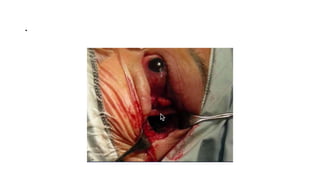
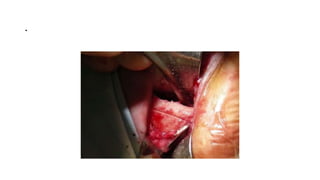
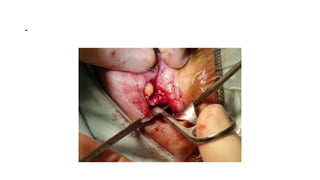
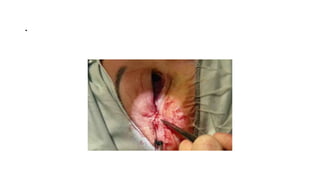
ORBITAL SURGERY
PRESENTER: DR. IDDI NDYABAWE
MODULATOR: DR. AMPAIRE ANNE
DEPARTMENT OF OPHTHALMOLOGY
MAKCHS
October 2021
Outline of presentation
• Surgical Spaces
• Orbitotomy
• Orbital Decompression
• Postoperative Care for Orbital Surgery
• Special Surgical Techniques in the Orbit
• Complications of Orbital Surgery
.
.
.
.
.
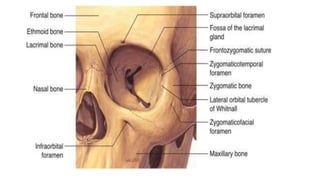
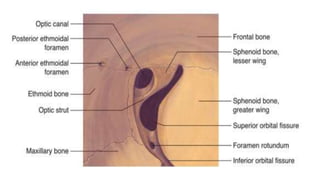
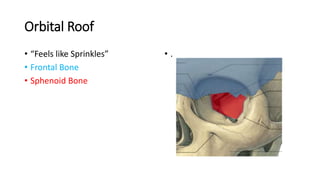
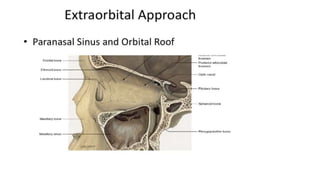
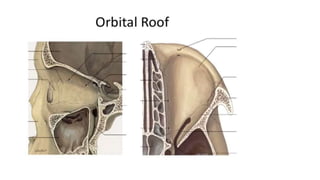
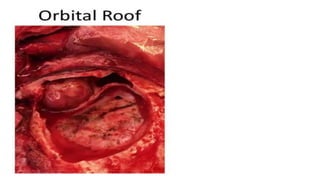
Orbital Roof
• “Feels like Sprinkles”
• Frontal Bone
• Sphenoid Bone
• .
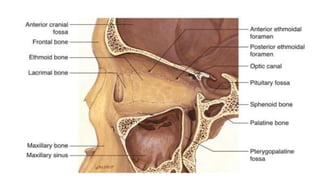
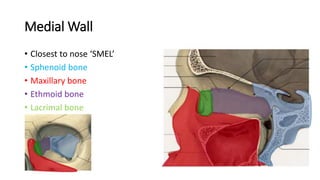
Medial Wall
• Closest to nose ‘SMEL’
• Sphenoid bone
• Maxillary bone
• Ethmoid bone
• Lacrimal bone
• .
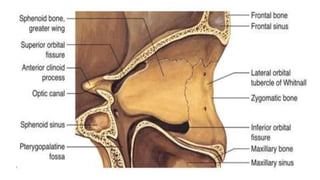
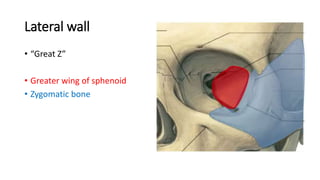
Lateral wall
• “Great Z”
• Greater wing of sphenoid
• Zygomatic bone
• .
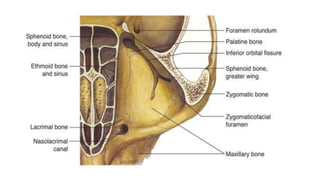
Orbital floor
• Look down to “Zip My Pants”
• Zygomatic bone
• Maxillary bone
• Palatine bone
• .
.
.
.
.
.
.
.
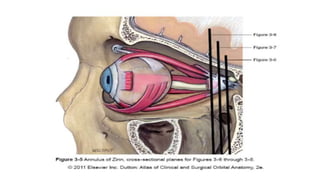
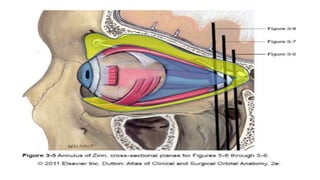
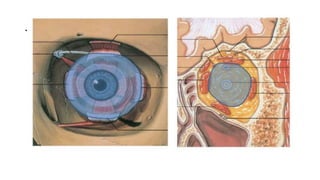
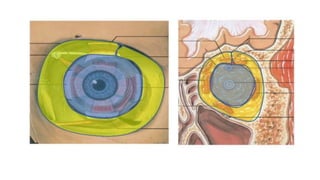
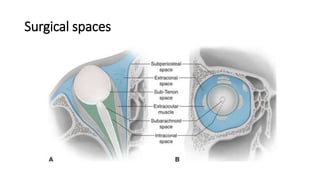
Surgical spaces
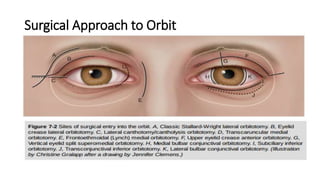
Surgical Approach to Orbit
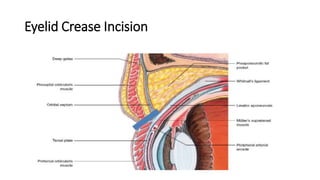
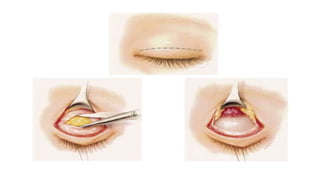
Eyelid Crease Incision
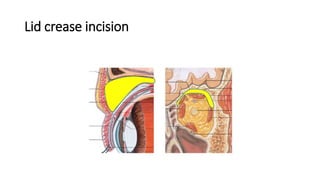
Lid crease incision
.
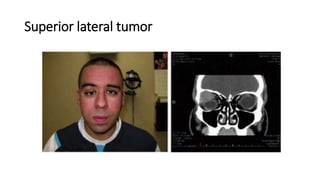
Superior lateral tumor
.
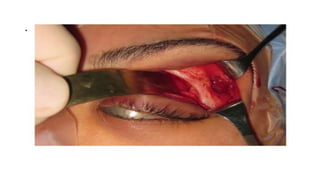
Subbrow incision
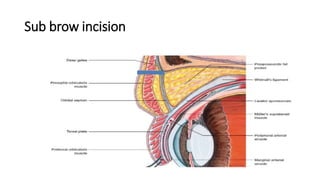
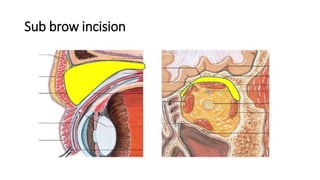
Sub brow incision
Sub brow incision
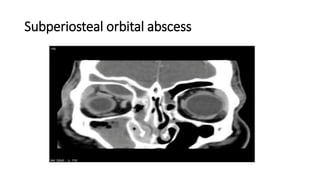
Subperiosteal orbital abscess
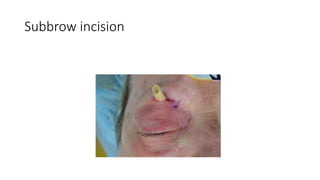
Subbrow incision
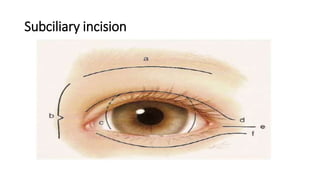
Subciliary incision
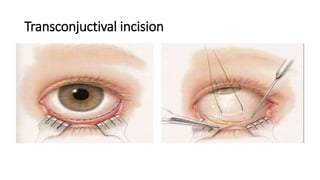
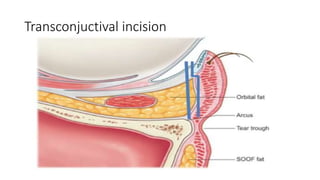
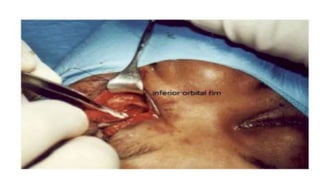
Transconjuctival incision
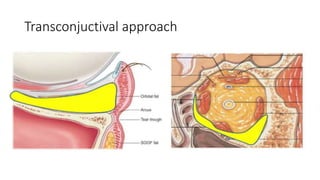
Transconjuctival approach
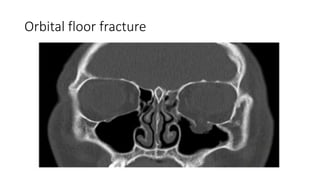
Orbital floor fracture
.
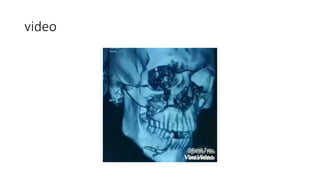
video
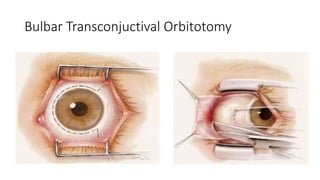
Bulbar Transconjuctival Orbitotomy
• .
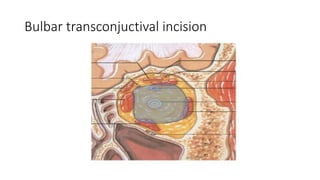
Bulbar conjunctival incision
Bulbar transconjuctival incision
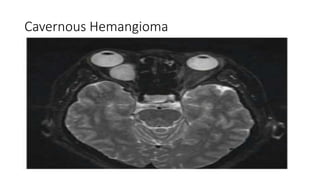
Cavernous Hemangioma
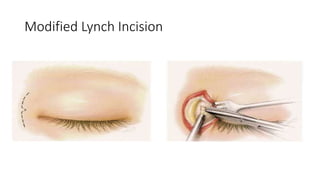
Modified Lynch Incision
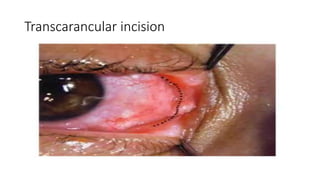
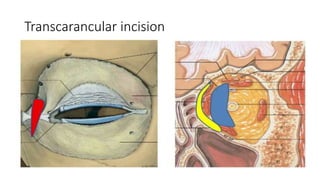
Transcarancular incision
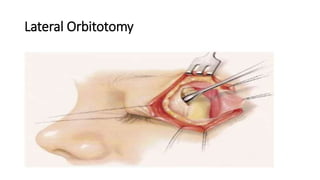
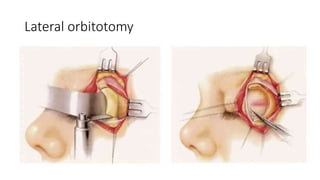
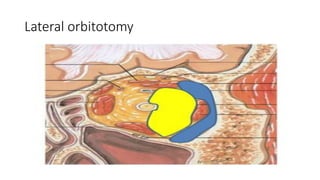
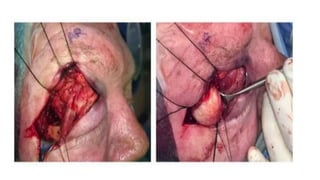
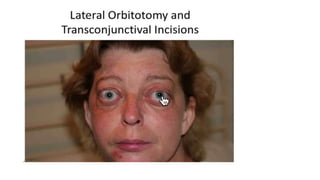
Lateral Orbitotomy
Lateral orbitotomy
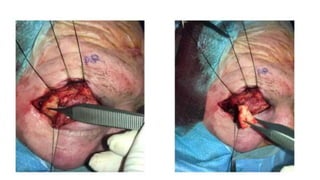
Lateral orbitotomy
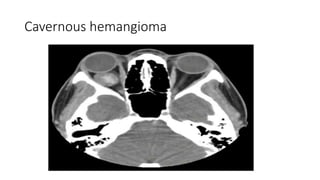
Cavernous hemangioma
.
.
.
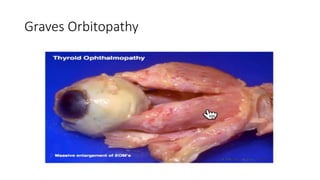
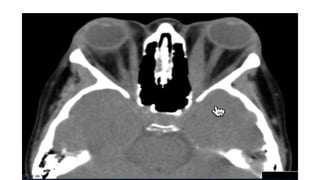
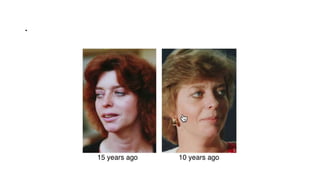
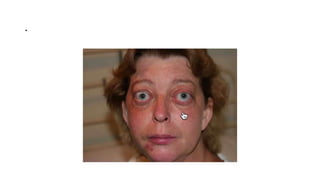
Graves Orbitopathy
.
.
.
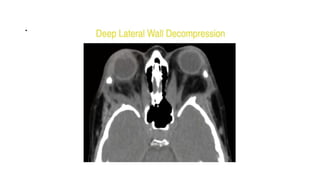
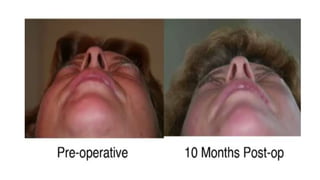
Orbital decompression
.
.
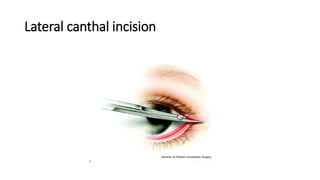
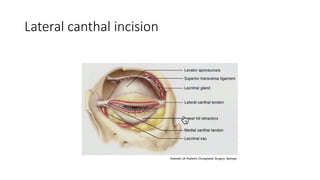
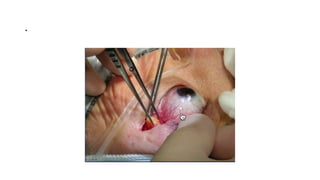
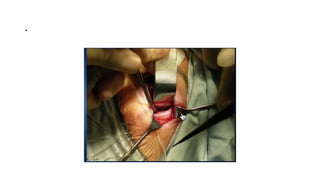
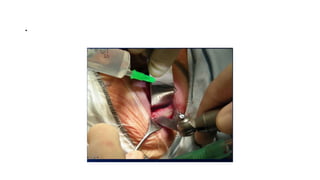
Lateral canthal incision
.
.
.
.
.
.
.
.
.
.
.
.
.
.
.
.
.
.
.
Orbital decompression
Indications
• Compressive optic neuropathy
• Globe subluxation
• Uncontrolled elevation of intraocular pressure
• Disfiguring proptosis secondary to thyroid eye disease
• Cosmesis
• Sphenoid wing meningiomas
• Large myopic globes
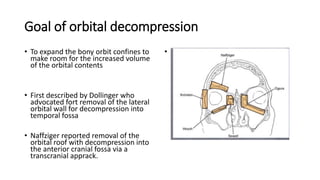
Goal of orbital decompression
• To expand the bony orbit confines to
make room for the increased volume
of the orbital contents
• First described by Dollinger who
advocated fort removal of the lateral
orbital wall for decompression into
temporal fossa
• Naffziger reported removal of the
orbital roof with decompression into
the anterior cranial fossa via a
transcranial apprack.
• .
Preoperative assessment
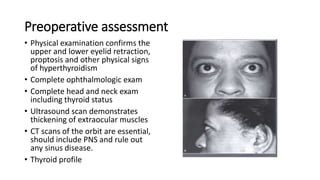
• Physical examination confirms the
upper and lower eyelid retraction,
proptosis and other physical signs
of hyperthyroidism
• Complete ophthalmologic exam
• Complete head and neck exam
including thyroid status
• Ultrasound scan demonstrates
thickening of extraocular muscles
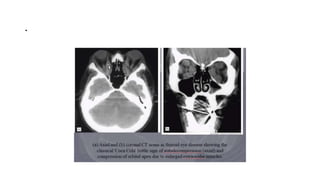
• CT scans of the orbit are essential,
should include PNS and rule out
any sinus disease.
• Thyroid profile
• .
.
Surgical techniques
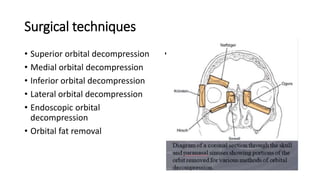
• Superior orbital decompression
• Medial orbital decompression
• Inferior orbital decompression
• Lateral orbital decompression
• Endoscopic orbital
decompression
• Orbital fat removal
• .
Superior orbital decompression
• Unroofing the entire superior orbital wall by a craniotomy
• Exposes the orbit by a frontal craniotomy
• After the optic nerve has been identified, the bony roof of the orbit is
removed from anterior to the optic foramen to the anterosuperior
orbital rim
• Superior periosteum is then incised in an H-shaped fashion and the
orbital fat allowed to herniate into the cranial vualt
.
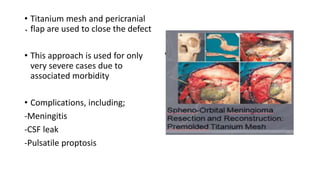
• Titanium mesh and pericranial
flap are used to close the defect
• This approach is used for only
very severe cases due to
associated morbidity
• Complications, including;
-Meningitis
-CSF leak
-Pulsatile proptosis
• .
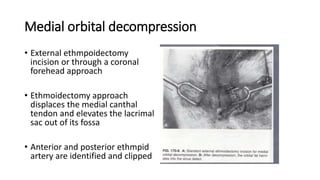
Medial orbital decompression
• External ethmpoidectomy
incision or through a coronal
forehead approach
• Ethmoidectomy approach
displaces the medial canthal
tendon and elevates the lacrimal
sac out of its fossa
• Anterior and posterior ethmpid
artery are identified and clipped
• ,
.
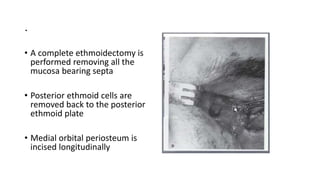
• A complete ethmoidectomy is
performed removing all the
mucosa bearing septa
• Posterior ethmoid cells are
removed back to the posterior
ethmoid plate
• Medial orbital periosteum is
incised longitudinally
• .
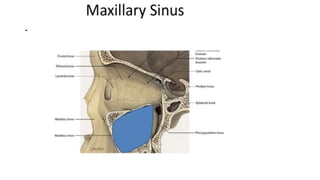
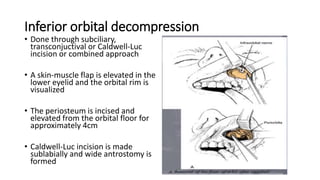
Inferior orbital decompression
• Done through subciliary,
transconjuctival or Caldwell-Luc
incision or combined approach
• A skin-muscle flap is elevated in the
lower eyelid and the orbital rim is
visualized
• The periosteum is incised and
elevated from the orbital floor for
approximately 4cm
• Caldwell-Luc incision is made
sublabially and wide antrostomy is
formed
• .
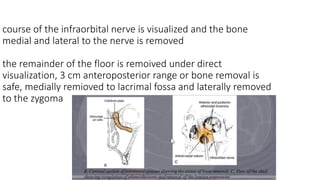
course of the infraorbital nerve is visualized and the bone
medial and lateral to the nerve is removed
the remainder of the floor is remoived under direct
visualization, 3 cm anteroposterior range or bone removal is
safe, medially remioved to lacrimal fossa and laterally removed
to the zygoma
.
• Periorbita is incised longitudinally, number of incisions determined
intraoperatively, 4 to 6 usually adequate
• Fat herniates into the defects on either side of the nerve
• Middle meatal ostium enlarged to provide for ventilation and
drainage of the sinus
Lateral orbital decompression
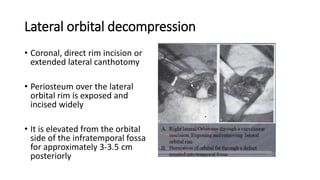
• Coronal, direct rim incision or
extended lateral canthotomy
• Periosteum over the lateral
orbital rim is exposed and
incised widely
• It is elevated from the orbital
side of the infratemporal fossa
for approximately 3-3.5 cm
posteriorly
• .
,
• Lateral orbital rim can be cut and mobilized leaving its attachment to
the periosteum to assist with closure
• Much of the lateral orbital wall can be removed (about 2.5-3.5cm)
• Periorbita is incised and fat teased out into newly created space
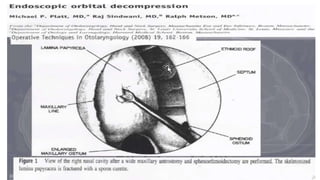
Endoscopic orbital decompression
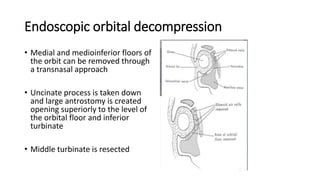
• Medial and medioinferior floors of
the orbit can be removed through
a transnasal approach
• Uncinate process is taken down
and large antrostomy is created
opening superiorly to the level of
the orbital floor and inferior
turbinate
• Middle turbinate is resected
• .
.
• Ethmoidectomy is performed and the anterior and posterior ethmoid
arteries are identified
• Medial orbital wall is exposed from the fovea ethmoidalis to the
anterior face of the sphenoid sinus
• Trocar inserted through the canine fossa can allow visualization
through the puncture while working through the nose
.
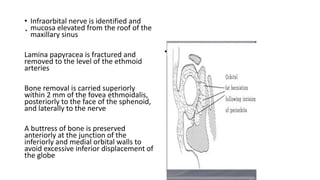
• Infraorbital nerve is identified and
mucosa elevated from the roof of the
maxillary sinus
Lamina papyracea is fractured and
removed to the level of the ethmoid
arteries
Bone removal is carried superiorly
within 2 mm of the fovea ethmoidalis,
posteriorly to the face of the sphenoid,
and laterally to the nerve
A buttress of bone is preserved
anteriorly at the junction of the
inferiorly and medial orbital walls to
avoid excessive inferior displacement of
the globe
• .
.
• Orbital periosteum is incised superiorly in a posterior to anterior
direction with a sickle knife taking care to avoid excessive penetration
with the knife
• Orbital fat protrudes into the ethmoid cavity
• Silastic splint is placed to avoid postoperative adhesions and packing
is not used
• Endoscopic approach allows a mean reduction of proptosis of 3mm.
.
Orbital fat decompression
• Orbital fat decompression or removal can be used either in isolation, or in
conjunction with other bony decompression procedures
• First described by Trokel in 1993
• This procedure involves opening the periosteum using an extended
transconjuctival approach
.
• Under direct visualization, using the bipolar cautery dissolve the fat
between and around the extraocular muscles
• 2-3mm decrease in proptosis can be expected
• A significant reduction in diplopia and an improvement in visual
acuity
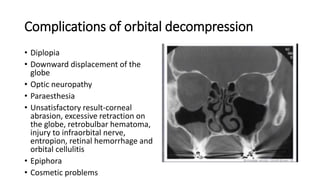
Complications of orbital decompression
• Diplopia
• Downward displacement of the
globe
• Optic neuropathy
• Paraesthesia
• Unsatisfactory result-corneal
abrasion, excessive retraction on
the globe, retrobulbar hematoma,
injury to infraorbital nerve,
entropion, retinal hemorrhage and
orbital cellulitis
• Epiphora
• Cosmetic problems
• .
Post operative care for orbital surgery
• Head elevation
• Iced compresses on the eyelids
• Systemic steroids: Tabs Prednisolone 20mg bd for 5 days
• Optional placement of a drain (removed in 24-48 hours)
• VA checked in the first 12 hours after surgery
• Systemic antibiotics: I.V Cef 1g od for 3 days, then Tabs Cefixime
400mg od for 5 days
Special surgical techniques in the orbit
• FNAB used for lymphoid lesions, secondary tumors invading the orbit
from the sinuses, suspected metastatic tumors, and blind eyes with
optic nerve tumors.
• Limitation of FNAB: not very effective for obtaining tissue from
fibrous lesions because of difficulty in successfully aspirating cells
• Procedure: using a 4cm 22- or 23-gauge needle attached to a syringe
in a pistol-grip syringe holder. Can be guided by US or CT. specimen
studied by cytologist
.
• Frontal craniotomy or frontotemporal-orbitozygomatic approach. For
meningiomas, fibrous dysplasia, hemangioma, hemangiopericytomas,
schwannomas, gliomas
Complications of orbital surgery
How can the complications be avoided?
• Complete preoperative evaluation with orbital imaging when
indicated
• Choosing the appropriate surgical approach
• Obtaining adequate exposure
• Carefully manipulating the tissues
• Employing proper instrumentation and illumination
• Maintaining good hemostasis
• Using a team approach when appropriate
.
• Decreased or lost vision. Causes:
-Excessive traction on the globe
and optic nerve
-Contusion of the optic nerve
-Postoperative infection or
hemorrhage
• Hypoesthesia in the distribution
of the infraorbital nerve, in
orbital floor decompression
• Superior division of CN 3
susceptible to injury in tumor
resection in superior orbit
• Ciliary ganglion at risk in lateral
approaches to intraconal space
Other complications of orbital surgeries
• Ptosis
• Neuroparalyitc keratopathy
• Pupillary changes
• Vitreous hemorrhage
• Retinal detachment
• Hypoesthesia of forehead
• Keratitis sicca
• CSF leak
• Infection
References
• AAO Bk 7
• Scott-Brown’s Otorhinolaryngology, Head and Neck Surgery, Vol-2, 7th edition
• Cummings, Otorhinolaryngology, Head and Neck Surgery, Vol-2, 4th edition.
• Purgason PA, Hornblass A. Complications of surgery for orbital tumors. Ophthal
Plast Reconstr Surg. 1992;8(2):88-93
• Kacker A, Kazim M, Murphy M, Trokel S, Close LG. "Balanced" orbital
decompression for severe Graves’ orbitopathy: technique with treatment
algorithm. Otolaryngol Head Neck Surg. 2003;128(2):228-235.
• Perry JD, Kadakia A, Foster JA. Transcaruncular orbital decompression for
dysthyroid optic neuropathy. Ophthal Plast Reconstr Surg. 2003;19(5):353-358.
• White WA, White WL, Shapiro PE. Combined endoscopic medial and inferior
orbital decompression with transcutaneous lateral orbital decompression in
Graves' orbitopathy. Ophthalmology. 2003;110(9):1827-1832

Orbital surgery by Dr. Iddi.pptx

  • 1.
    ORBITAL SURGERY PRESENTER: DR.IDDI NDYABAWE MODULATOR: DR. AMPAIRE ANNE DEPARTMENT OF OPHTHALMOLOGY MAKCHS October 2021
  • 2.
    Outline of presentation •Surgical Spaces • Orbitotomy • Orbital Decompression • Postoperative Care for Orbital Surgery • Special Surgical Techniques in the Orbit • Complications of Orbital Surgery
  • 3.
  • 4.
  • 5.
  • 6.
  • 7.
  • 8.
    Orbital Roof • “Feelslike Sprinkles” • Frontal Bone • Sphenoid Bone • .
  • 9.
    Medial Wall • Closestto nose ‘SMEL’ • Sphenoid bone • Maxillary bone • Ethmoid bone • Lacrimal bone • .
  • 10.
    Lateral wall • “GreatZ” • Greater wing of sphenoid • Zygomatic bone • .
  • 11.
    Orbital floor • Lookdown to “Zip My Pants” • Zygomatic bone • Maxillary bone • Palatine bone • .
  • 12.
  • 13.
  • 14.
  • 15.
  • 16.
  • 17.
  • 18.
  • 19.
  • 20.
  • 21.
  • 22.
  • 23.
  • 24.
  • 25.
  • 26.
  • 27.
  • 28.
  • 29.
  • 30.
  • 31.
  • 32.
  • 33.
  • 34.
  • 35.
  • 36.
  • 37.
  • 38.
  • 39.
  • 40.
  • 41.
  • 42.
  • 43.
  • 44.
  • 45.
  • 46.
  • 47.
  • 48.
  • 49.
  • 50.
  • 51.
  • 52.
  • 53.
  • 54.
  • 55.
  • 56.
  • 57.
  • 58.
  • 59.
  • 60.
  • 61.
  • 62.
  • 63.
  • 64.
  • 65.
  • 66.
  • 67.
  • 68.
  • 69.
  • 70.
  • 71.
  • 72.
  • 73.
  • 74.
  • 75.
  • 76.
  • 77.
  • 78.
  • 79.
  • 80.
    Orbital decompression Indications • Compressiveoptic neuropathy • Globe subluxation • Uncontrolled elevation of intraocular pressure • Disfiguring proptosis secondary to thyroid eye disease • Cosmesis • Sphenoid wing meningiomas • Large myopic globes
  • 81.
    Goal of orbitaldecompression • To expand the bony orbit confines to make room for the increased volume of the orbital contents • First described by Dollinger who advocated fort removal of the lateral orbital wall for decompression into temporal fossa • Naffziger reported removal of the orbital roof with decompression into the anterior cranial fossa via a transcranial apprack. • .
  • 82.
    Preoperative assessment • Physicalexamination confirms the upper and lower eyelid retraction, proptosis and other physical signs of hyperthyroidism • Complete ophthalmologic exam • Complete head and neck exam including thyroid status • Ultrasound scan demonstrates thickening of extraocular muscles • CT scans of the orbit are essential, should include PNS and rule out any sinus disease. • Thyroid profile • .
  • 83.
  • 84.
    Surgical techniques • Superiororbital decompression • Medial orbital decompression • Inferior orbital decompression • Lateral orbital decompression • Endoscopic orbital decompression • Orbital fat removal • .
  • 85.
    Superior orbital decompression •Unroofing the entire superior orbital wall by a craniotomy • Exposes the orbit by a frontal craniotomy • After the optic nerve has been identified, the bony roof of the orbit is removed from anterior to the optic foramen to the anterosuperior orbital rim • Superior periosteum is then incised in an H-shaped fashion and the orbital fat allowed to herniate into the cranial vualt
  • 86.
    . • Titanium meshand pericranial flap are used to close the defect • This approach is used for only very severe cases due to associated morbidity • Complications, including; -Meningitis -CSF leak -Pulsatile proptosis • .
  • 87.
    Medial orbital decompression •External ethmpoidectomy incision or through a coronal forehead approach • Ethmoidectomy approach displaces the medial canthal tendon and elevates the lacrimal sac out of its fossa • Anterior and posterior ethmpid artery are identified and clipped • ,
  • 88.
    . • A completeethmoidectomy is performed removing all the mucosa bearing septa • Posterior ethmoid cells are removed back to the posterior ethmoid plate • Medial orbital periosteum is incised longitudinally • .
  • 89.
    Inferior orbital decompression •Done through subciliary, transconjuctival or Caldwell-Luc incision or combined approach • A skin-muscle flap is elevated in the lower eyelid and the orbital rim is visualized • The periosteum is incised and elevated from the orbital floor for approximately 4cm • Caldwell-Luc incision is made sublabially and wide antrostomy is formed • .
  • 90.
    course of theinfraorbital nerve is visualized and the bone medial and lateral to the nerve is removed the remainder of the floor is remoived under direct visualization, 3 cm anteroposterior range or bone removal is safe, medially remioved to lacrimal fossa and laterally removed to the zygoma
  • 91.
    . • Periorbita isincised longitudinally, number of incisions determined intraoperatively, 4 to 6 usually adequate • Fat herniates into the defects on either side of the nerve • Middle meatal ostium enlarged to provide for ventilation and drainage of the sinus
  • 92.
    Lateral orbital decompression •Coronal, direct rim incision or extended lateral canthotomy • Periosteum over the lateral orbital rim is exposed and incised widely • It is elevated from the orbital side of the infratemporal fossa for approximately 3-3.5 cm posteriorly • .
  • 93.
    , • Lateral orbitalrim can be cut and mobilized leaving its attachment to the periosteum to assist with closure • Much of the lateral orbital wall can be removed (about 2.5-3.5cm) • Periorbita is incised and fat teased out into newly created space
  • 94.
    Endoscopic orbital decompression •Medial and medioinferior floors of the orbit can be removed through a transnasal approach • Uncinate process is taken down and large antrostomy is created opening superiorly to the level of the orbital floor and inferior turbinate • Middle turbinate is resected • .
  • 95.
    . • Ethmoidectomy isperformed and the anterior and posterior ethmoid arteries are identified • Medial orbital wall is exposed from the fovea ethmoidalis to the anterior face of the sphenoid sinus • Trocar inserted through the canine fossa can allow visualization through the puncture while working through the nose
  • 96.
    . • Infraorbital nerveis identified and mucosa elevated from the roof of the maxillary sinus Lamina papyracea is fractured and removed to the level of the ethmoid arteries Bone removal is carried superiorly within 2 mm of the fovea ethmoidalis, posteriorly to the face of the sphenoid, and laterally to the nerve A buttress of bone is preserved anteriorly at the junction of the inferiorly and medial orbital walls to avoid excessive inferior displacement of the globe • .
  • 97.
    . • Orbital periosteumis incised superiorly in a posterior to anterior direction with a sickle knife taking care to avoid excessive penetration with the knife • Orbital fat protrudes into the ethmoid cavity • Silastic splint is placed to avoid postoperative adhesions and packing is not used • Endoscopic approach allows a mean reduction of proptosis of 3mm.
  • 98.
  • 99.
    Orbital fat decompression •Orbital fat decompression or removal can be used either in isolation, or in conjunction with other bony decompression procedures • First described by Trokel in 1993 • This procedure involves opening the periosteum using an extended transconjuctival approach
  • 100.
    . • Under directvisualization, using the bipolar cautery dissolve the fat between and around the extraocular muscles • 2-3mm decrease in proptosis can be expected • A significant reduction in diplopia and an improvement in visual acuity
  • 101.
    Complications of orbitaldecompression • Diplopia • Downward displacement of the globe • Optic neuropathy • Paraesthesia • Unsatisfactory result-corneal abrasion, excessive retraction on the globe, retrobulbar hematoma, injury to infraorbital nerve, entropion, retinal hemorrhage and orbital cellulitis • Epiphora • Cosmetic problems • .
  • 102.
    Post operative carefor orbital surgery • Head elevation • Iced compresses on the eyelids • Systemic steroids: Tabs Prednisolone 20mg bd for 5 days • Optional placement of a drain (removed in 24-48 hours) • VA checked in the first 12 hours after surgery • Systemic antibiotics: I.V Cef 1g od for 3 days, then Tabs Cefixime 400mg od for 5 days
  • 103.
    Special surgical techniquesin the orbit • FNAB used for lymphoid lesions, secondary tumors invading the orbit from the sinuses, suspected metastatic tumors, and blind eyes with optic nerve tumors. • Limitation of FNAB: not very effective for obtaining tissue from fibrous lesions because of difficulty in successfully aspirating cells • Procedure: using a 4cm 22- or 23-gauge needle attached to a syringe in a pistol-grip syringe holder. Can be guided by US or CT. specimen studied by cytologist
  • 104.
    . • Frontal craniotomyor frontotemporal-orbitozygomatic approach. For meningiomas, fibrous dysplasia, hemangioma, hemangiopericytomas, schwannomas, gliomas
  • 105.
    Complications of orbitalsurgery How can the complications be avoided? • Complete preoperative evaluation with orbital imaging when indicated • Choosing the appropriate surgical approach • Obtaining adequate exposure • Carefully manipulating the tissues • Employing proper instrumentation and illumination • Maintaining good hemostasis • Using a team approach when appropriate
  • 106.
    . • Decreased orlost vision. Causes: -Excessive traction on the globe and optic nerve -Contusion of the optic nerve -Postoperative infection or hemorrhage • Hypoesthesia in the distribution of the infraorbital nerve, in orbital floor decompression • Superior division of CN 3 susceptible to injury in tumor resection in superior orbit • Ciliary ganglion at risk in lateral approaches to intraconal space
  • 107.
    Other complications oforbital surgeries • Ptosis • Neuroparalyitc keratopathy • Pupillary changes • Vitreous hemorrhage • Retinal detachment • Hypoesthesia of forehead • Keratitis sicca • CSF leak • Infection
  • 108.
    References • AAO Bk7 • Scott-Brown’s Otorhinolaryngology, Head and Neck Surgery, Vol-2, 7th edition • Cummings, Otorhinolaryngology, Head and Neck Surgery, Vol-2, 4th edition. • Purgason PA, Hornblass A. Complications of surgery for orbital tumors. Ophthal Plast Reconstr Surg. 1992;8(2):88-93 • Kacker A, Kazim M, Murphy M, Trokel S, Close LG. "Balanced" orbital decompression for severe Graves’ orbitopathy: technique with treatment algorithm. Otolaryngol Head Neck Surg. 2003;128(2):228-235. • Perry JD, Kadakia A, Foster JA. Transcaruncular orbital decompression for dysthyroid optic neuropathy. Ophthal Plast Reconstr Surg. 2003;19(5):353-358. • White WA, White WL, Shapiro PE. Combined endoscopic medial and inferior orbital decompression with transcutaneous lateral orbital decompression in Graves' orbitopathy. Ophthalmology. 2003;110(9):1827-1832