ALVEOLAR
BONE
PRESENTED BY
IQRA BATOOL
1st Year BDS
TABLE OF CONTENTS
 DEFINITION
 FUNCTIONS
 STRUCTURE
 CLINICAL CONSIDERATION
 AGE CHANGES
 CONCLUSIONS
DEFINITION
Alveolar process is that part of
maxilla and mandible that
contains the alveoli or sockets
of the teeth and supports the
teeth.
FUNCTIONS
I. Houses the tooth roots to alveoli by
insertion of Sharpeys fibers.
II. Organizes eruption of primary and
permanent teeth.
III. Contributes to absorption and
distribution of occlusal forces.
IV. Supplies vessels to the periodontal
ligament.
You can enter a subtitle here
STRUCTURE
AND
COMPONENTS
Alveolar
Bone
Alveolar
Bone Proper
Supporting
Alveolar
Bone
Bundle
Bone
Cortical
Plates
Spongy
Bone
Lamellated
Bone
ALVEOLAR BONE PROPER
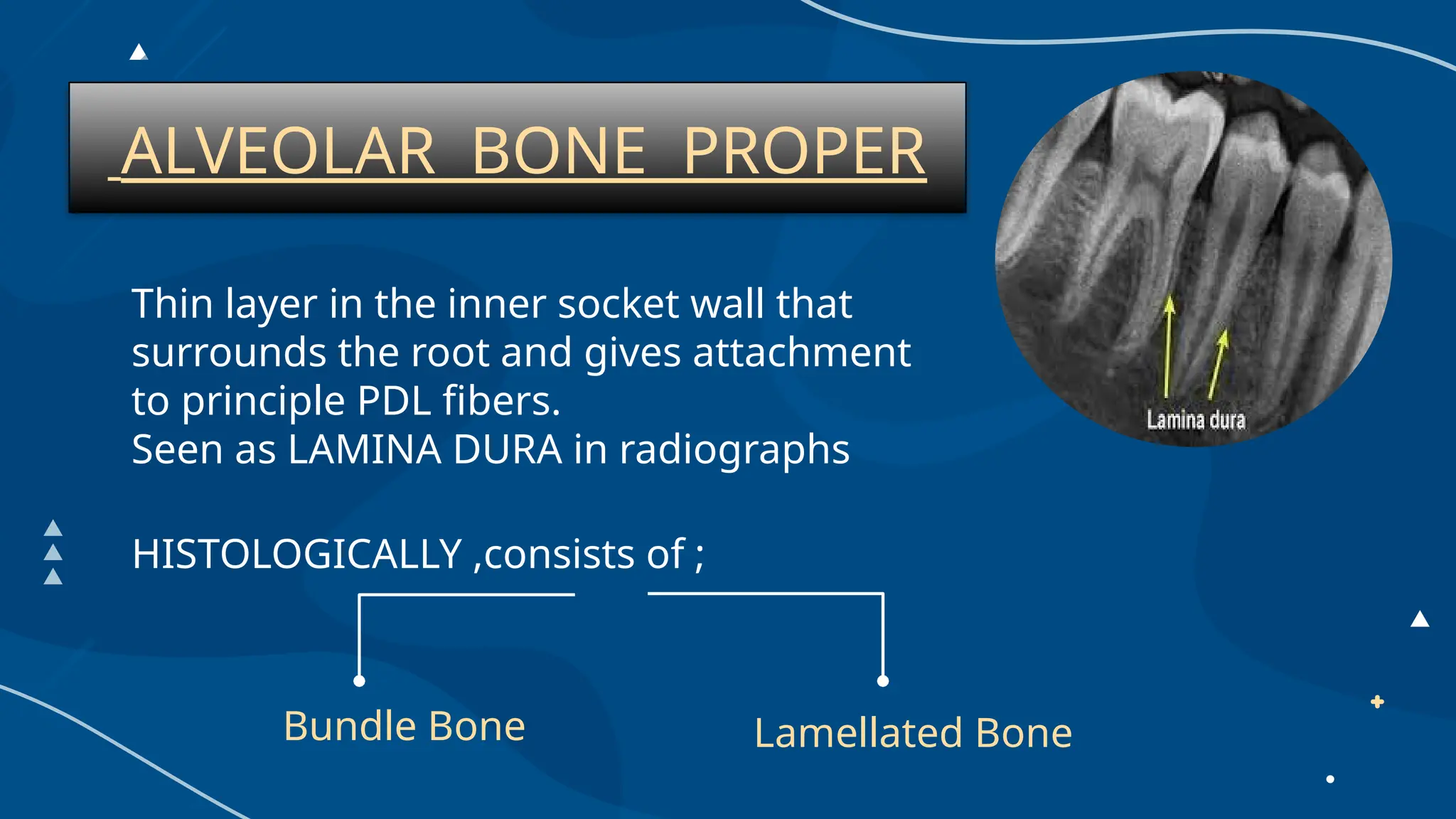
Bundle Bone
Thin layer in the inner socket wall that
surrounds the root and gives attachment
to principle PDL fibers.
Seen as LAMINA DURA in radiographs
Lamellated Bone
HISTOLOGICALLY ,consists of ;
SUPPORTING ALVEOLAR BONE
‘’ Cancellous trabeculae that
surrounds alveolar bone
proper to socket and support
the alveolus ”
It consists of 2 parts;
CORTICAL PLATES
SPONGY BONE
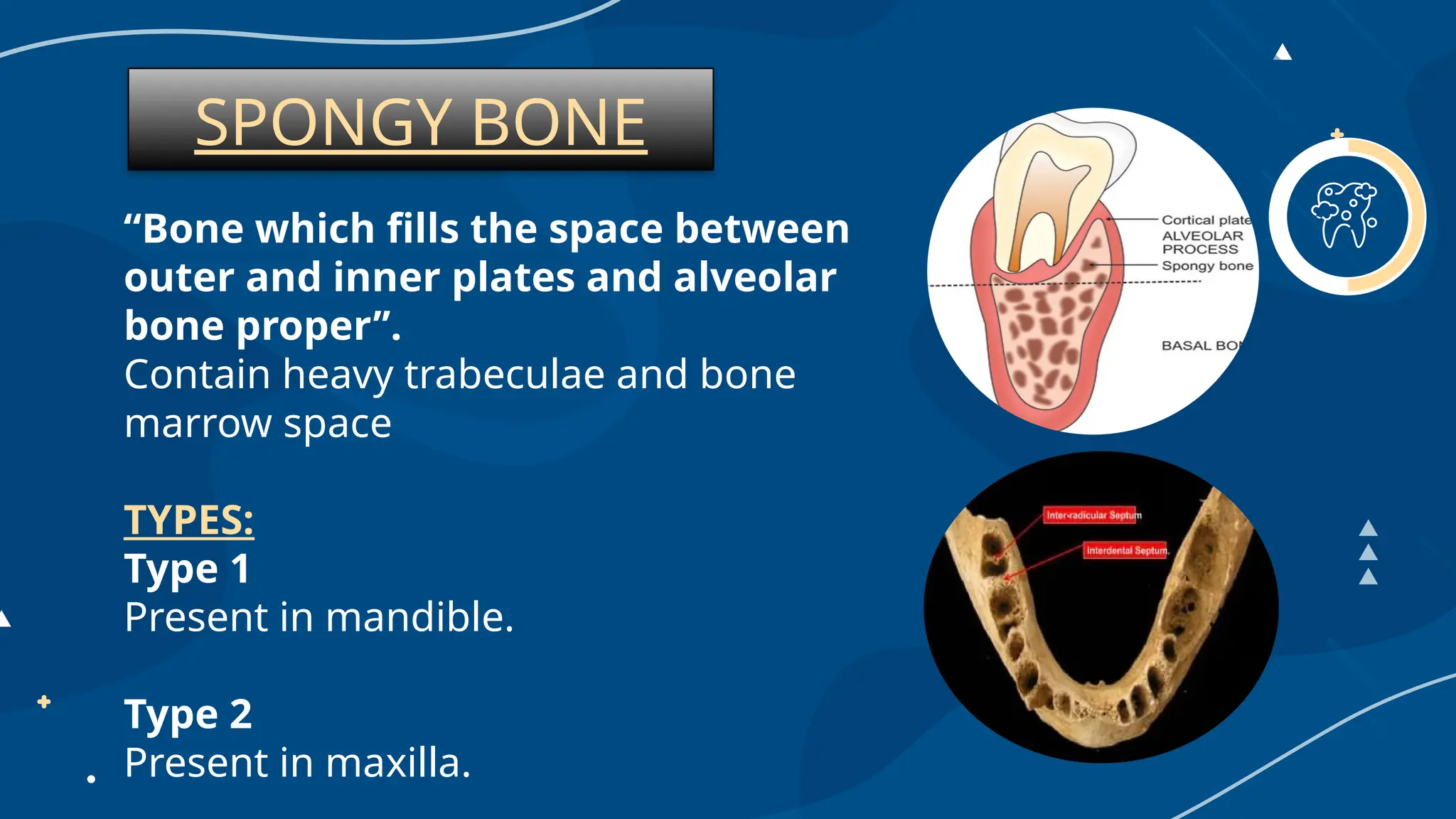
SPONGY BONE
“Bone which fills the space between
outer and inner plates and alveolar
bone proper’’.
Contain heavy trabeculae and bone
marrow space
TYPES:
Type 1
Present in mandible.
Type 2
Present in maxilla.
CORTICAL PLATE
• Made up of compact bone and
forms inner and outer plates of
alveolar process.
• Thinner in maxilla.
• Thicker mandible premolar and
molar
• Buccal thinner.
• No spongy bone in anterior teeth.
AGE CHANGES IN ALVEOLAR BONE
• Alveolar bone loss
• Marrow spaces increase
• Osteoporosis
• Maxillary sinus size increases
• Brittleness
• With time and wear,proximal contact flattened.
• Mesial migration.
• Loss of arch length.
CLINICAL CONSIDERATIONS
CONCUSION
Mercury is the closest planet to
the Sun and the smallest one in
the Solar System—it’s only a bit
larger than the Moon
Despite being red, Mars is
actually a cold place. It’s full of
iron oxide dust, which gives the
planet its reddish cast
TREATMENT A TREATMENT B
PREVALENCE
MERCURY
Mercury is the closest
planet to the Sun
SATURN
Saturn is the ringed
one and a gas giant
structure of ALVEOLAR bone iqra batool.pptx

structure of ALVEOLAR bone iqra batool.pptx

  • 1.
  • 2.
    TABLE OF CONTENTS DEFINITION  FUNCTIONS  STRUCTURE  CLINICAL CONSIDERATION  AGE CHANGES  CONCLUSIONS
  • 3.
    DEFINITION Alveolar process isthat part of maxilla and mandible that contains the alveoli or sockets of the teeth and supports the teeth.
  • 4.
    FUNCTIONS I. Houses thetooth roots to alveoli by insertion of Sharpeys fibers. II. Organizes eruption of primary and permanent teeth. III. Contributes to absorption and distribution of occlusal forces. IV. Supplies vessels to the periodontal ligament.
  • 5.
    You can entera subtitle here STRUCTURE AND COMPONENTS
  • 6.
  • 7.
    ALVEOLAR BONE PROPER BundleBone Thin layer in the inner socket wall that surrounds the root and gives attachment to principle PDL fibers. Seen as LAMINA DURA in radiographs Lamellated Bone HISTOLOGICALLY ,consists of ;
  • 9.
    SUPPORTING ALVEOLAR BONE ‘’Cancellous trabeculae that surrounds alveolar bone proper to socket and support the alveolus ” It consists of 2 parts; CORTICAL PLATES SPONGY BONE
  • 10.
    SPONGY BONE “Bone whichfills the space between outer and inner plates and alveolar bone proper’’. Contain heavy trabeculae and bone marrow space TYPES: Type 1 Present in mandible. Type 2 Present in maxilla.
  • 11.
    CORTICAL PLATE • Madeup of compact bone and forms inner and outer plates of alveolar process. • Thinner in maxilla. • Thicker mandible premolar and molar • Buccal thinner. • No spongy bone in anterior teeth.
  • 12.
    AGE CHANGES INALVEOLAR BONE • Alveolar bone loss • Marrow spaces increase • Osteoporosis • Maxillary sinus size increases • Brittleness
  • 13.
    • With timeand wear,proximal contact flattened. • Mesial migration. • Loss of arch length. CLINICAL CONSIDERATIONS
  • 14.
    CONCUSION Mercury is theclosest planet to the Sun and the smallest one in the Solar System—it’s only a bit larger than the Moon Despite being red, Mars is actually a cold place. It’s full of iron oxide dust, which gives the planet its reddish cast TREATMENT A TREATMENT B
  • 15.
    PREVALENCE MERCURY Mercury is theclosest planet to the Sun SATURN Saturn is the ringed one and a gas giant