
By/Mohamed Ahmed El –Shafie
Assistant Lecturer in ophthalmology department
KafrELShiekh University
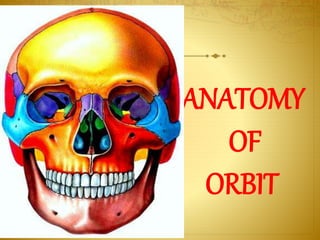
ANATOMY
OF
ORBIT
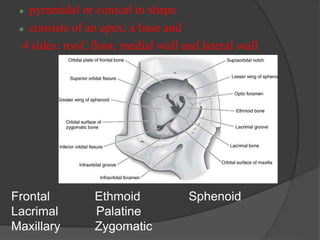
Frontal Ethmoid Sphenoid
Lacrimal Palatine
Maxillary Zygomatic
 pyramidal or conical in shape
 consists of an apex, a base and
4 sides: roof, floor, medial wall and lateral wall
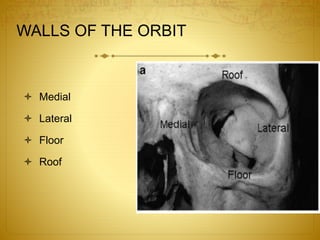
WALLS OF THE ORBIT
 Medial
 Lateral
 Floor
 Roof
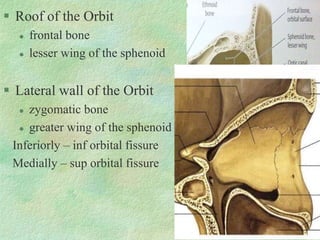
 Roof of the Orbit
 frontal bone
 lesser wing of the sphenoid
 Lateral wall of the Orbit
 zygomatic bone
 greater wing of the sphenoid
Inferiorly – inf orbital fissure
Medially – sup orbital fissure
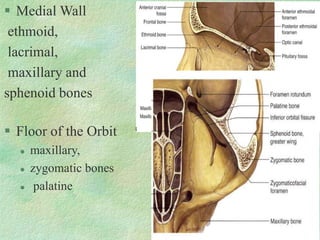
 Medial Wall
ethmoid,
lacrimal,
maxillary and
sphenoid bones
 Floor of the Orbit
 maxillary,
 zygomatic bones
 palatine
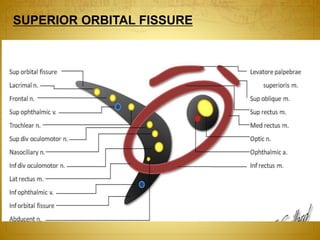
SUPERIOR ORBITAL FISSURE
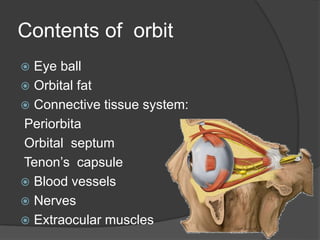
Contents of orbit
 Eye ball
 Orbital fat
 Connective tissue system:
Periorbita
Orbital septum
Tenon’s capsule
 Blood vessels
 Nerves
 Extraocular muscles
 Orbital septum:
Interconnecting / circumferential radial
webs of fascial system
support and transmit forces in trauma
Compressive optic neuropathy following
trauma
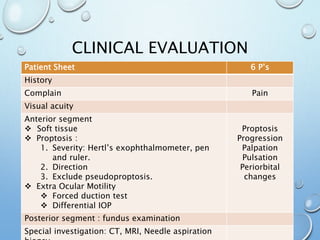
CLINICAL EVALUATION
Patient Sheet 6 P’s
History
Complain Pain
Visual acuity
Anterior segment
 Soft tissue
 Proptosis :
1. Severity: Hertl’s exophthalmometer, pen
and ruler.
2. Direction
3. Exclude pseudoproptosis.
 Extra Ocular Motility
 Forced duction test
 Differential IOP
Proptosis
Progression
Palpation
Pulsation
Periorbital
changes
Posterior segment : fundus examination
Special investigation: CT, MRI, Needle aspiration
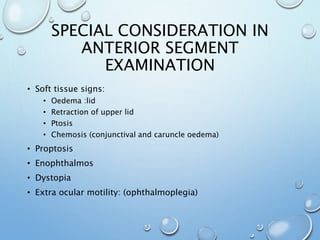
SPECIAL CONSIDERATION IN
ANTERIOR SEGMENT
EXAMINATION
• Soft tissue signs:
• Oedema :lid
• Retraction of upper lid
• Ptosis
• Chemosis (conjunctival and caruncle oedema)
• Proptosis
• Enophthalmos
• Dystopia
• Extra ocular motility: (ophthalmoplegia)
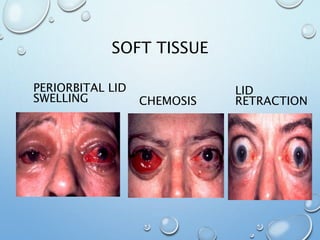
SOFT TISSUE
PERIORBITAL LID
SWELLING
LID
RETRACTIONCHEMOSIS
PROPTOSIS
• Examining A case of proptosis entails:
• Degree or severity
• Direction
• Exclude psuedoproptosis
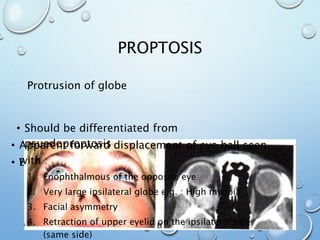
Protrusion of globe
• Apparent forward displacement of eye ball seen
with :
1. Enophthalmous of the opposite eye
2. Very large ipsilateral globe e.g. : High myopia
3. Facial asymmetry
4. Retraction of upper eyelid on the ipsilateral side
(same side)
• Should be differentiated from
psuedoproptosis
MEASUREMENT OF PROPTOSIS
• The normal distance between the apex of the
cornea and the lateral orbital rim is usually less
than 20 mm .
• A reading of 21 mm or more is regarded abnormal.
• A difference of 2 mm between 2 eyes is suspicious.
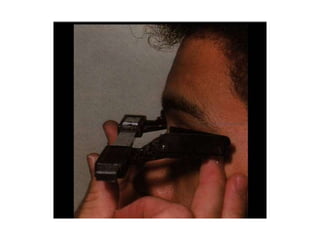
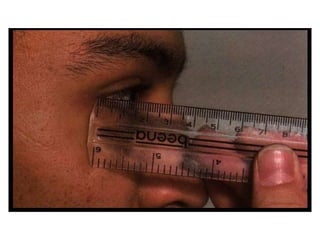
• The amount of proptosis is measured with a hertel
exophthalmometer or a plastic ruler placed at the
lateral canthus and resting on the bone.
 Axial e.g. Cavernous haemangioma
 Non Axial Displacement - outside the muscle cone
-Superior Displacement: maxillary tumor invading the
floor of the orbit
-Inferomedial displacement:dermoid cyst and lacrimal
gland tumor
-Days to weeks: inflammatory diseases. Infectious
diseases, metastatic tumors
-Months to years: dermoids
DIRECTION OF
PROPTOSIS
PROGRESSION
 Palpation
 Superonasal: Mucoceles, neurofibromas dermoids
 Superotemporal: lacrimal gland tumor- pseudo
tumor
 Pulsations
 with bruit : CCS Fistula
 without bruit: meningoencephalocoeles
ENOPHTHALMOS
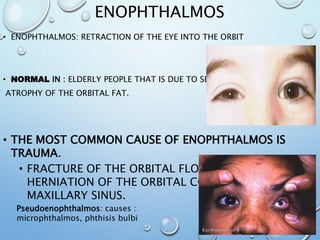
• ENOPHTHALMOS: RETRACTION OF THE EYE INTO THE ORBIT
• NORMAL IN : ELDERLY PEOPLE THAT IS DUE TO SENILE
ATROPHY OF THE ORBITAL FAT.
• THE MOST COMMON CAUSE OF ENOPHTHALMOS IS
TRAUMA.
• FRACTURE OF THE ORBITAL FLOOR RESULTS IN
HERNIATION OF THE ORBITAL CONTENT INTO THE
MAXILLARY SINUS.
Pseudoenophthalmos: causes :
microphthalmos, phthisis bulbi
If you forget clinical picture of
orbital disease try this scheme
• 6 P’S
• PAIN HISTORY
• PERIORBITAL CHANGES ANTERIOR
SEGMENT
• PROPTOSIS
• PROGRESSION
• PALPATION
• PULSATION
VISUAL AFFECTION
• CORNEAL EXPOSURE
• OPTIC NERVE COMPRESSION
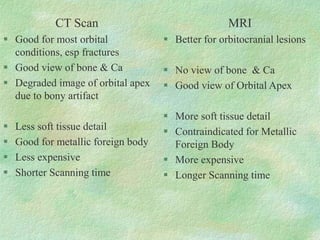
CT Scan
 Good for most orbital
conditions, esp fractures
 Good view of bone & Ca
 Degraded image of orbital apex
due to bony artifact
 Less soft tissue detail
 Good for metallic foreign body
 Less expensive
 Shorter Scanning time
MRI
 Better for orbitocranial lesions
 No view of bone & Ca
 Good view of Orbital Apex
 More soft tissue detail
 Contraindicated for Metallic
Foreign Body
 More expensive
 Longer Scanning time
ORBITAL DISEASES
1. INFLAMMATORY:
1. THYROID EYE DISEASE (ALSO CAN BE CLASSIFIED AS
ENDOCRINAL)
2. IDIOPATHIC ORBITAL INFLAMMATORY DISEASE
2. TUMORS AND CYSTS
3. INFECTION
4. TRAUMA
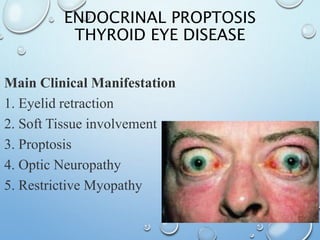
ENDOCRINAL PROPTOSIS
THYROID EYE DISEASE
Main Clinical Manifestation
1. Eyelid retraction
2. Soft Tissue involvement
3. Proptosis
4. Optic Neuropathy
5. Restrictive Myopathy
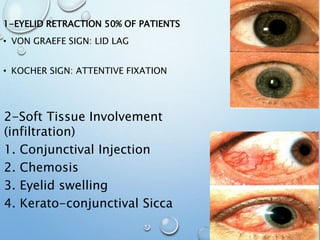
1-EYELID RETRACTION 50% OF PATIENTS
• VON GRAEFE SIGN: LID LAG
• KOCHER SIGN: ATTENTIVE FIXATION
2-Soft Tissue Involvement
(infiltration)
1. Conjunctival Injection
2. Chemosis
3. Eyelid swelling
4. Kerato-conjunctival Sicca
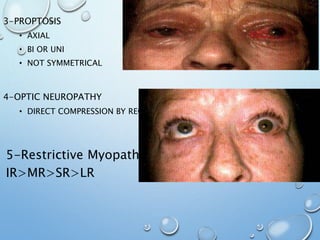
3-PROPTOSIS
• AXIAL
• BI OR UNI
• NOT SYMMETRICAL
4-OPTIC NEUROPATHY
• DIRECT COMPRESSION BY RECTI
5-Restrictive Myopathy
IR>MR>SR>LR
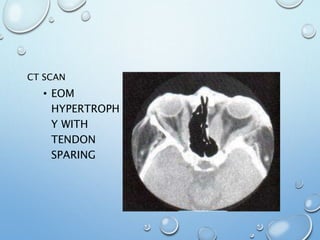
CT SCAN
• EOM
HYPERTROPH
Y WITH
TENDON
SPARING
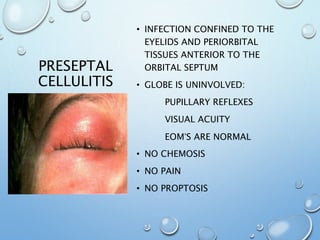
PRESEPTAL
CELLULITIS
• INFECTION CONFINED TO THE
EYELIDS AND PERIORBITAL
TISSUES ANTERIOR TO THE
ORBITAL SEPTUM
• GLOBE IS UNINVOLVED:
PUPILLARY REFLEXES
VISUAL ACUITY
EOM’S ARE NORMAL
• NO CHEMOSIS
• NO PAIN
• NO PROPTOSIS
ORBITAL CELLULITIS
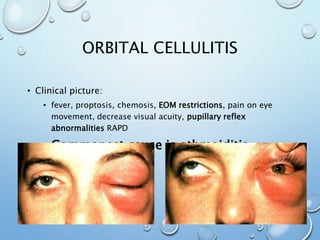
• Clinical picture:
• fever, proptosis, chemosis, EOM restrictions, pain on eye
movement, decrease visual acuity, pupillary reflex
abnormalities RAPD
• Commonest cause is ethmoiditis
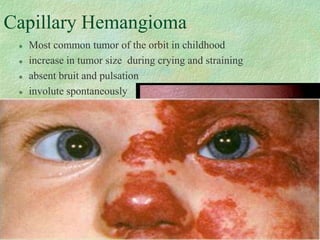
Capillary Hemangioma
 Most common tumor of the orbit in childhood
 increase in tumor size during crying and straining
 absent bruit and pulsation
 involute spontaneously
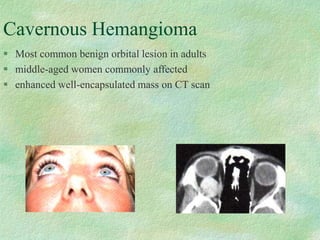
Cavernous Hemangioma
 Most common benign orbital lesion in adults
 middle-aged women commonly affected
 enhanced well-encapsulated mass on CT scan
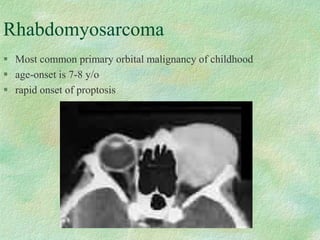
Rhabdomyosarcoma
 Most common primary orbital malignancy of childhood
 age-onset is 7-8 y/o
 rapid onset of proptosis
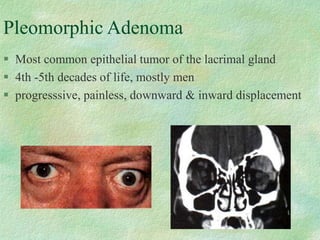
Pleomorphic Adenoma
 Most common epithelial tumor of the lacrimal gland
 4th -5th decades of life, mostly men
 progresssive, painless, downward & inward displacement
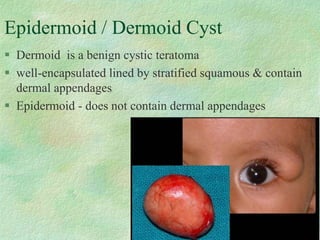
Epidermoid / Dermoid Cyst
 Dermoid is a benign cystic teratoma
 well-encapsulated lined by stratified squamous & contain
dermal appendages
 Epidermoid - does not contain dermal appendages
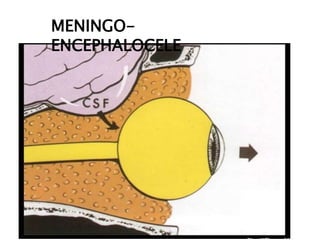
MENINGO-
ENCEPHALOCELE
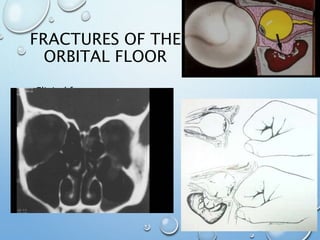
FRACTURES OF THE
ORBITAL FLOOR
• Clinical features
• Periocular changes:
ecchymosis, edema,
subcutaneous
emphysema
• Enophthalmos
• Infraorbital nerve
anesthesia
• Diplopia
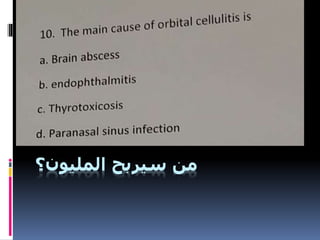
‫المليون؟‬ ‫سيربح‬ ‫من‬
THANK YOU
THANK YOU

Orbit clinical round

  • 1.
    By/Mohamed Ahmed El–Shafie Assistant Lecturer in ophthalmology department KafrELShiekh University
  • 2.
  • 3.
    Frontal Ethmoid Sphenoid LacrimalPalatine Maxillary Zygomatic  pyramidal or conical in shape  consists of an apex, a base and 4 sides: roof, floor, medial wall and lateral wall
  • 4.
    WALLS OF THEORBIT  Medial  Lateral  Floor  Roof
  • 5.
     Roof ofthe Orbit  frontal bone  lesser wing of the sphenoid  Lateral wall of the Orbit  zygomatic bone  greater wing of the sphenoid Inferiorly – inf orbital fissure Medially – sup orbital fissure
  • 6.
     Medial Wall ethmoid, lacrimal, maxillaryand sphenoid bones  Floor of the Orbit  maxillary,  zygomatic bones  palatine
  • 7.
  • 8.
    Contents of orbit Eye ball  Orbital fat  Connective tissue system: Periorbita Orbital septum Tenon’s capsule  Blood vessels  Nerves  Extraocular muscles
  • 9.
     Orbital septum: Interconnecting/ circumferential radial webs of fascial system support and transmit forces in trauma Compressive optic neuropathy following trauma
  • 10.
    CLINICAL EVALUATION Patient Sheet6 P’s History Complain Pain Visual acuity Anterior segment  Soft tissue  Proptosis : 1. Severity: Hertl’s exophthalmometer, pen and ruler. 2. Direction 3. Exclude pseudoproptosis.  Extra Ocular Motility  Forced duction test  Differential IOP Proptosis Progression Palpation Pulsation Periorbital changes Posterior segment : fundus examination Special investigation: CT, MRI, Needle aspiration
  • 11.
    SPECIAL CONSIDERATION IN ANTERIORSEGMENT EXAMINATION • Soft tissue signs: • Oedema :lid • Retraction of upper lid • Ptosis • Chemosis (conjunctival and caruncle oedema) • Proptosis • Enophthalmos • Dystopia • Extra ocular motility: (ophthalmoplegia)
  • 12.
  • 13.
    PROPTOSIS • Examining Acase of proptosis entails: • Degree or severity • Direction • Exclude psuedoproptosis Protrusion of globe • Apparent forward displacement of eye ball seen with : 1. Enophthalmous of the opposite eye 2. Very large ipsilateral globe e.g. : High myopia 3. Facial asymmetry 4. Retraction of upper eyelid on the ipsilateral side (same side) • Should be differentiated from psuedoproptosis
  • 14.
    MEASUREMENT OF PROPTOSIS •The normal distance between the apex of the cornea and the lateral orbital rim is usually less than 20 mm . • A reading of 21 mm or more is regarded abnormal. • A difference of 2 mm between 2 eyes is suspicious. • The amount of proptosis is measured with a hertel exophthalmometer or a plastic ruler placed at the lateral canthus and resting on the bone.
  • 17.
     Axial e.g.Cavernous haemangioma  Non Axial Displacement - outside the muscle cone -Superior Displacement: maxillary tumor invading the floor of the orbit -Inferomedial displacement:dermoid cyst and lacrimal gland tumor -Days to weeks: inflammatory diseases. Infectious diseases, metastatic tumors -Months to years: dermoids DIRECTION OF PROPTOSIS PROGRESSION
  • 18.
     Palpation  Superonasal:Mucoceles, neurofibromas dermoids  Superotemporal: lacrimal gland tumor- pseudo tumor  Pulsations  with bruit : CCS Fistula  without bruit: meningoencephalocoeles
  • 19.
    ENOPHTHALMOS • ENOPHTHALMOS: RETRACTIONOF THE EYE INTO THE ORBIT • NORMAL IN : ELDERLY PEOPLE THAT IS DUE TO SENILE ATROPHY OF THE ORBITAL FAT. • THE MOST COMMON CAUSE OF ENOPHTHALMOS IS TRAUMA. • FRACTURE OF THE ORBITAL FLOOR RESULTS IN HERNIATION OF THE ORBITAL CONTENT INTO THE MAXILLARY SINUS. Pseudoenophthalmos: causes : microphthalmos, phthisis bulbi
  • 20.
    If you forgetclinical picture of orbital disease try this scheme • 6 P’S • PAIN HISTORY • PERIORBITAL CHANGES ANTERIOR SEGMENT • PROPTOSIS • PROGRESSION • PALPATION • PULSATION
  • 21.
    VISUAL AFFECTION • CORNEALEXPOSURE • OPTIC NERVE COMPRESSION
  • 22.
    CT Scan  Goodfor most orbital conditions, esp fractures  Good view of bone & Ca  Degraded image of orbital apex due to bony artifact  Less soft tissue detail  Good for metallic foreign body  Less expensive  Shorter Scanning time MRI  Better for orbitocranial lesions  No view of bone & Ca  Good view of Orbital Apex  More soft tissue detail  Contraindicated for Metallic Foreign Body  More expensive  Longer Scanning time
  • 23.
    ORBITAL DISEASES 1. INFLAMMATORY: 1.THYROID EYE DISEASE (ALSO CAN BE CLASSIFIED AS ENDOCRINAL) 2. IDIOPATHIC ORBITAL INFLAMMATORY DISEASE 2. TUMORS AND CYSTS 3. INFECTION 4. TRAUMA
  • 24.
    ENDOCRINAL PROPTOSIS THYROID EYEDISEASE Main Clinical Manifestation 1. Eyelid retraction 2. Soft Tissue involvement 3. Proptosis 4. Optic Neuropathy 5. Restrictive Myopathy
  • 25.
    1-EYELID RETRACTION 50%OF PATIENTS • VON GRAEFE SIGN: LID LAG • KOCHER SIGN: ATTENTIVE FIXATION 2-Soft Tissue Involvement (infiltration) 1. Conjunctival Injection 2. Chemosis 3. Eyelid swelling 4. Kerato-conjunctival Sicca
  • 26.
    3-PROPTOSIS • AXIAL • BIOR UNI • NOT SYMMETRICAL 4-OPTIC NEUROPATHY • DIRECT COMPRESSION BY RECTI 5-Restrictive Myopathy IR>MR>SR>LR
  • 27.
    CT SCAN • EOM HYPERTROPH YWITH TENDON SPARING
  • 28.
    PRESEPTAL CELLULITIS • INFECTION CONFINEDTO THE EYELIDS AND PERIORBITAL TISSUES ANTERIOR TO THE ORBITAL SEPTUM • GLOBE IS UNINVOLVED: PUPILLARY REFLEXES VISUAL ACUITY EOM’S ARE NORMAL • NO CHEMOSIS • NO PAIN • NO PROPTOSIS
  • 29.
    ORBITAL CELLULITIS • Clinicalpicture: • fever, proptosis, chemosis, EOM restrictions, pain on eye movement, decrease visual acuity, pupillary reflex abnormalities RAPD • Commonest cause is ethmoiditis
  • 30.
    Capillary Hemangioma  Mostcommon tumor of the orbit in childhood  increase in tumor size during crying and straining  absent bruit and pulsation  involute spontaneously
  • 31.
    Cavernous Hemangioma  Mostcommon benign orbital lesion in adults  middle-aged women commonly affected  enhanced well-encapsulated mass on CT scan
  • 32.
    Rhabdomyosarcoma  Most commonprimary orbital malignancy of childhood  age-onset is 7-8 y/o  rapid onset of proptosis
  • 33.
    Pleomorphic Adenoma  Mostcommon epithelial tumor of the lacrimal gland  4th -5th decades of life, mostly men  progresssive, painless, downward & inward displacement
  • 34.
    Epidermoid / DermoidCyst  Dermoid is a benign cystic teratoma  well-encapsulated lined by stratified squamous & contain dermal appendages  Epidermoid - does not contain dermal appendages
  • 35.
  • 36.
    FRACTURES OF THE ORBITALFLOOR • Clinical features • Periocular changes: ecchymosis, edema, subcutaneous emphysema • Enophthalmos • Infraorbital nerve anesthesia • Diplopia
  • 38.
  • 39.