Pharmacognosy and Phytochemistry –II
(BP504T)
Institute of Pharmaceutical Research,
GLAUniversity, Mathura
Module I
Sonia Singh
Assistant professor
GLA University, Mathura
Objective of the
class
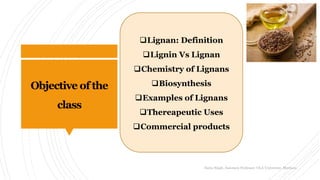
Lignan: Definition
Lignin Vs Lignan
Chemistry of Lignans
Biosynthesis
Examples of Lignans
Thereapeutic Uses
Commercial products
Sonia Singh, Assistant Professor, GLA University, Mathura
2
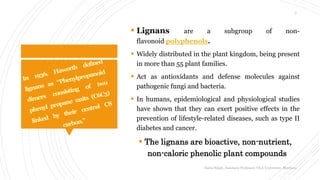
 Lignans are a subgroup of non-
flavonoid polyphenols.
 Widely distributed in the plant kingdom, being present
in more than 55 plant families.
 Act as antioxidants and defense molecules against
pathogenic fungi and bacteria.
 In humans, epidemiological and physiological studies
have shown that they can exert positive effects in the
prevention of lifestyle-related diseases, such as type II
diabetes and cancer.
 The lignans are bioactive, non-nutrient,
non-caloric phenolic plant compounds
Sonia Singh, Assistant Professor, GLA University, Mathura
3
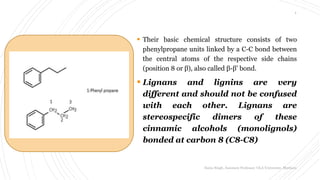
 Their basic chemical structure consists of two
phenylpropane units linked by a C-C bond between
the central atoms of the respective side chains
(position 8 or β), also called β-β’ bond.
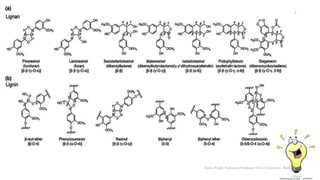
 Lignans and lignins are very
different and should not be confused
with each other. Lignans are
stereospecific dimers of these
cinnamic alcohols (monolignols)
bonded at carbon 8 (C8-C8)
Sonia Singh, Assistant Professor, GLA University, Mathura
4
Sonia Singh, Assistant Professor, GLA University, Mathura
5
Lignin is plant polymer acting as
strengthening material for plant cell wall &
matrix for cellulose micro-fibrils
• Represent a large no. of aromatic material
based on C6C3 building unit
• Lignins formed by oxidative coupling of
hyroxycinnamyl alcohol monomers by
peroxidase enzymes [p-coumaryl-, coniferyl-
and sinapyl-alcohol]
Lignans are dimeric phenylpropanes (C-18)
coupled at the central carbon of the side chain
[via their ß-carbon of the side chain]
Sonia Singh, Assistant Professor, GLA University, Mathura
6
Sonia Singh, Assistant Professor, GLA University, Mathura
7
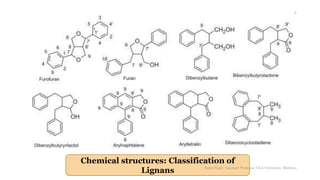
 Based on their carbon skeleton, cyclization pattern,
and the way in which oxygen is incorporated in the
molecule skeleton, they can be divided into 8
subgroups;
 Main subclasses of Lignans-
1.Furofuran,
2.Furan,
3.Dibenzylbutane,
4.Dibenzylbutyrolactol,
5.Dibenzylbutyrolactones,
6.Aryltetralin,
7.Arylnaphtalene,
8.Dibenzocyclooctadienes.
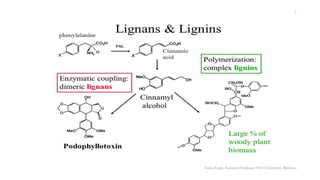
Polyphenolic substances derived from phenylalanine via
dimerization of substituted cinnamic alcohols , known as
monolignols, to a dibenzylbutane skeleton 2. This reaction is
catalysed by oxidative enzymes.
Classification of Lignans Sonia Singh, Assistant Professor, GLA University, Mathura
8
Chemical structures: Classification of
Lignans Sonia Singh, Assistant Professor, GLA University, Mathura
9
Biosynthesis of
lignans
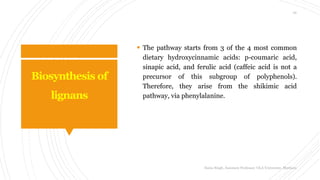
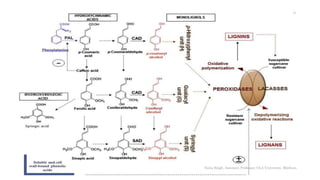
 The pathway starts from 3 of the 4 most common
dietary hydroxycinnamic acids: p-coumaric acid,
sinapic acid, and ferulic acid (caffeic acid is not a
precursor of this subgroup of polyphenols).
Therefore, they arise from the shikimic acid
pathway, via phenylalanine.
Sonia Singh, Assistant Professor, GLA University, Mathura
10
Sonia Singh, Assistant Professor, GLA University, Mathura
11
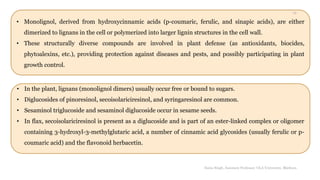
• Monolignol, derived from hydroxycinnamic acids (p-coumaric, ferulic, and sinapic acids), are either
dimerized to lignans in the cell or polymerized into larger lignin structures in the cell wall.
• These structurally diverse compounds are involved in plant defense (as antioxidants, biocides,
phytoalexins, etc.), providing protection against diseases and pests, and possibly participating in plant
growth control.
• In the plant, lignans (monolignol dimers) usually occur free or bound to sugars.
• Diglucosides of pinoresinol, secoisolariciresinol, and syringaresinol are common.
• Sesaminol triglucoside and sesaminol diglucoside occur in sesame seeds.
• In flax, secoisolariciresinol is present as a diglucoside and is part of an ester-linked complex or oligomer
containing 3-hydroxyl-3-methylglutaric acid, a number of cinnamic acid glycosides (usually ferulic or p-
coumaric acid) and the flavonoid herbacetin.
Sonia Singh, Assistant Professor, GLA University, Mathura
12
Secondary
metabolites
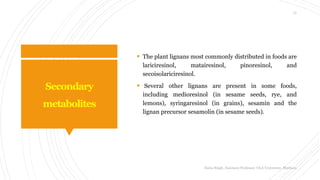
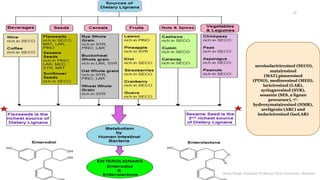
 The plant lignans most commonly distributed in foods are
lariciresinol, matairesinol, pinoresinol, and
secoisolariciresinol.
 Several other lignans are present in some foods,
including medioresinol (in sesame seeds, rye, and
lemons), syringaresinol (in grains), sesamin and the
lignan precursor sesamolin (in sesame seeds).
Sonia Singh, Assistant Professor, GLA University, Mathura
13
Sonia Singh, Assistant Professor, GLA University, Mathura
14
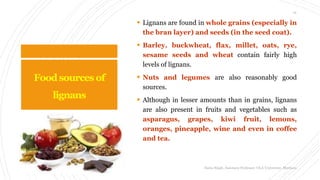
Food sources of
lignans
 Lignans are found in whole grains (especially in
the bran layer) and seeds (in the seed coat).
 Barley, buckwheat, flax, millet, oats, rye,
sesame seeds and wheat contain fairly high
levels of lignans.
 Nuts and legumes are also reasonably good
sources.
 Although in lesser amounts than in grains, lignans
are also present in fruits and vegetables such as
asparagus, grapes, kiwi fruit, lemons,
oranges, pineapple, wine and even in coffee
and tea.
Sonia Singh, Assistant Professor, GLA University, Mathura
15
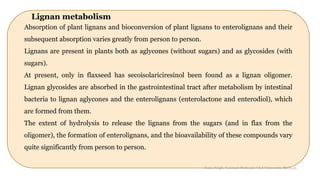
Absorption of plant lignans and bioconversion of plant lignans to enterolignans and their
subsequent absorption varies greatly from person to person.
Lignans are present in plants both as aglycones (without sugars) and as glycosides (with
sugars).
At present, only in flaxseed has secoisolariciresinol been found as a lignan oligomer.
Lignan glycosides are absorbed in the gastrointestinal tract after metabolism by intestinal
bacteria to lignan aglycones and the enterolignans (enterolactone and enterodiol), which
are formed from them.
The extent of hydrolysis to release the lignans from the sugars (and in flax from the
oligomer), the formation of enterolignans, and the bioavailability of these compounds vary
quite significantly from person to person.
Lignan metabolism
Sonia Singh, Assistant Professor, GLA University, Mathura
16
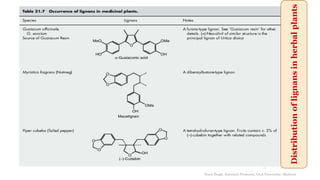
Distributionoflignansinherbalplants
Sonia Singh, Assistant Professor, GLA University, Mathura
17
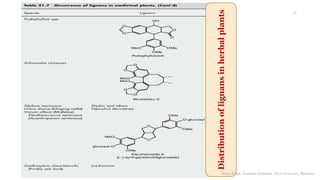
Distributionoflignansinherbalplants
Sonia Singh, Assistant Professor, GLA University, Mathura
18
secoisolariciresinol (SECO),
matairesinol
(MAT),pinoresinol
(PINO), medioresinol (MED),
lariciresinol (LAR),
syringaresinol (SYR),
sesamin (SES, a lignan
precursor), 7′-
hydroxymatairesinol (HMR),
arctigenin (ARC) and
isolariciresinol (isoLAR)
Sonia Singh, Assistant Professor, GLA University, Mathura
19
Sonia Singh, Assistant Professor, GLA University, Mathura
20
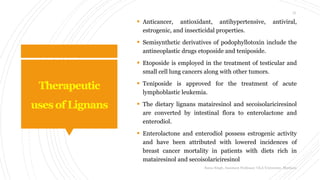
Therapeutic
uses of Lignans
 Anticancer, antioxidant, antihypertensive, antiviral,
estrogenic, and insecticidal properties.
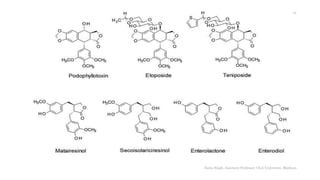
 Semisynthetic derivatives of podophyllotoxin include the
antineoplastic drugs etoposide and teniposide.
 Etoposide is employed in the treatment of testicular and
small cell lung cancers along with other tumors.
 Teniposide is approved for the treatment of acute
lymphoblastic leukemia.
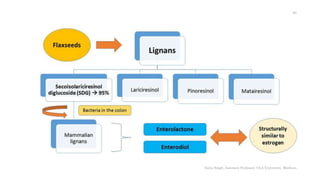
 The dietary lignans matairesinol and secoisolariciresinol
are converted by intestinal flora to enterolactone and
enterodiol.
 Enterolactone and enterodiol possess estrogenic activity
and have been attributed with lowered incidences of
breast cancer mortality in patients with diets rich in
matairesinol and secoisolariciresinol
Sonia Singh, Assistant Professor, GLA University, Mathura
21
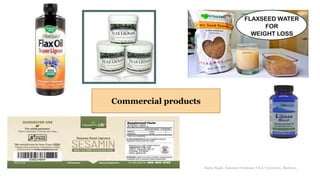
Commercial products
Sonia Singh, Assistant Professor, GLA University, Mathura
22
Sonia Singh, Assistant Professor, GLA University, Mathura
23

Lignans

  • 1.
    Pharmacognosy and Phytochemistry–II (BP504T) Institute of Pharmaceutical Research, GLAUniversity, Mathura Module I Sonia Singh Assistant professor GLA University, Mathura
  • 2.
    Objective of the class Lignan:Definition Lignin Vs Lignan Chemistry of Lignans Biosynthesis Examples of Lignans Thereapeutic Uses Commercial products Sonia Singh, Assistant Professor, GLA University, Mathura 2
  • 3.
     Lignans area subgroup of non- flavonoid polyphenols.  Widely distributed in the plant kingdom, being present in more than 55 plant families.  Act as antioxidants and defense molecules against pathogenic fungi and bacteria.  In humans, epidemiological and physiological studies have shown that they can exert positive effects in the prevention of lifestyle-related diseases, such as type II diabetes and cancer.  The lignans are bioactive, non-nutrient, non-caloric phenolic plant compounds Sonia Singh, Assistant Professor, GLA University, Mathura 3
  • 4.
     Their basicchemical structure consists of two phenylpropane units linked by a C-C bond between the central atoms of the respective side chains (position 8 or β), also called β-β’ bond.  Lignans and lignins are very different and should not be confused with each other. Lignans are stereospecific dimers of these cinnamic alcohols (monolignols) bonded at carbon 8 (C8-C8) Sonia Singh, Assistant Professor, GLA University, Mathura 4
  • 5.
    Sonia Singh, AssistantProfessor, GLA University, Mathura 5
  • 6.
    Lignin is plantpolymer acting as strengthening material for plant cell wall & matrix for cellulose micro-fibrils • Represent a large no. of aromatic material based on C6C3 building unit • Lignins formed by oxidative coupling of hyroxycinnamyl alcohol monomers by peroxidase enzymes [p-coumaryl-, coniferyl- and sinapyl-alcohol] Lignans are dimeric phenylpropanes (C-18) coupled at the central carbon of the side chain [via their ß-carbon of the side chain] Sonia Singh, Assistant Professor, GLA University, Mathura 6
  • 7.
    Sonia Singh, AssistantProfessor, GLA University, Mathura 7
  • 8.
     Based ontheir carbon skeleton, cyclization pattern, and the way in which oxygen is incorporated in the molecule skeleton, they can be divided into 8 subgroups;  Main subclasses of Lignans- 1.Furofuran, 2.Furan, 3.Dibenzylbutane, 4.Dibenzylbutyrolactol, 5.Dibenzylbutyrolactones, 6.Aryltetralin, 7.Arylnaphtalene, 8.Dibenzocyclooctadienes. Polyphenolic substances derived from phenylalanine via dimerization of substituted cinnamic alcohols , known as monolignols, to a dibenzylbutane skeleton 2. This reaction is catalysed by oxidative enzymes. Classification of Lignans Sonia Singh, Assistant Professor, GLA University, Mathura 8
  • 9.
    Chemical structures: Classificationof Lignans Sonia Singh, Assistant Professor, GLA University, Mathura 9
  • 10.
    Biosynthesis of lignans  Thepathway starts from 3 of the 4 most common dietary hydroxycinnamic acids: p-coumaric acid, sinapic acid, and ferulic acid (caffeic acid is not a precursor of this subgroup of polyphenols). Therefore, they arise from the shikimic acid pathway, via phenylalanine. Sonia Singh, Assistant Professor, GLA University, Mathura 10
  • 11.
    Sonia Singh, AssistantProfessor, GLA University, Mathura 11
  • 12.
    • Monolignol, derivedfrom hydroxycinnamic acids (p-coumaric, ferulic, and sinapic acids), are either dimerized to lignans in the cell or polymerized into larger lignin structures in the cell wall. • These structurally diverse compounds are involved in plant defense (as antioxidants, biocides, phytoalexins, etc.), providing protection against diseases and pests, and possibly participating in plant growth control. • In the plant, lignans (monolignol dimers) usually occur free or bound to sugars. • Diglucosides of pinoresinol, secoisolariciresinol, and syringaresinol are common. • Sesaminol triglucoside and sesaminol diglucoside occur in sesame seeds. • In flax, secoisolariciresinol is present as a diglucoside and is part of an ester-linked complex or oligomer containing 3-hydroxyl-3-methylglutaric acid, a number of cinnamic acid glycosides (usually ferulic or p- coumaric acid) and the flavonoid herbacetin. Sonia Singh, Assistant Professor, GLA University, Mathura 12
  • 13.
    Secondary metabolites  The plantlignans most commonly distributed in foods are lariciresinol, matairesinol, pinoresinol, and secoisolariciresinol.  Several other lignans are present in some foods, including medioresinol (in sesame seeds, rye, and lemons), syringaresinol (in grains), sesamin and the lignan precursor sesamolin (in sesame seeds). Sonia Singh, Assistant Professor, GLA University, Mathura 13
  • 14.
    Sonia Singh, AssistantProfessor, GLA University, Mathura 14
  • 15.
    Food sources of lignans Lignans are found in whole grains (especially in the bran layer) and seeds (in the seed coat).  Barley, buckwheat, flax, millet, oats, rye, sesame seeds and wheat contain fairly high levels of lignans.  Nuts and legumes are also reasonably good sources.  Although in lesser amounts than in grains, lignans are also present in fruits and vegetables such as asparagus, grapes, kiwi fruit, lemons, oranges, pineapple, wine and even in coffee and tea. Sonia Singh, Assistant Professor, GLA University, Mathura 15
  • 16.
    Absorption of plantlignans and bioconversion of plant lignans to enterolignans and their subsequent absorption varies greatly from person to person. Lignans are present in plants both as aglycones (without sugars) and as glycosides (with sugars). At present, only in flaxseed has secoisolariciresinol been found as a lignan oligomer. Lignan glycosides are absorbed in the gastrointestinal tract after metabolism by intestinal bacteria to lignan aglycones and the enterolignans (enterolactone and enterodiol), which are formed from them. The extent of hydrolysis to release the lignans from the sugars (and in flax from the oligomer), the formation of enterolignans, and the bioavailability of these compounds vary quite significantly from person to person. Lignan metabolism Sonia Singh, Assistant Professor, GLA University, Mathura 16
  • 17.
  • 18.
  • 19.
    secoisolariciresinol (SECO), matairesinol (MAT),pinoresinol (PINO), medioresinol(MED), lariciresinol (LAR), syringaresinol (SYR), sesamin (SES, a lignan precursor), 7′- hydroxymatairesinol (HMR), arctigenin (ARC) and isolariciresinol (isoLAR) Sonia Singh, Assistant Professor, GLA University, Mathura 19
  • 20.
    Sonia Singh, AssistantProfessor, GLA University, Mathura 20
  • 21.
    Therapeutic uses of Lignans Anticancer, antioxidant, antihypertensive, antiviral, estrogenic, and insecticidal properties.  Semisynthetic derivatives of podophyllotoxin include the antineoplastic drugs etoposide and teniposide.  Etoposide is employed in the treatment of testicular and small cell lung cancers along with other tumors.  Teniposide is approved for the treatment of acute lymphoblastic leukemia.  The dietary lignans matairesinol and secoisolariciresinol are converted by intestinal flora to enterolactone and enterodiol.  Enterolactone and enterodiol possess estrogenic activity and have been attributed with lowered incidences of breast cancer mortality in patients with diets rich in matairesinol and secoisolariciresinol Sonia Singh, Assistant Professor, GLA University, Mathura 21
  • 22.
    Commercial products Sonia Singh,Assistant Professor, GLA University, Mathura 22
  • 23.
    Sonia Singh, AssistantProfessor, GLA University, Mathura 23