PHYTO-TOXINS
Priyanka Goswami
CONTENT
1. Aconite
2. Curare
3. Lilly of the valley
4. Ergot
5. Poison ivy
6. Abrus
7. Belighia
8. Yew
9. Mashrooms
10. Psoralea
11. Datura
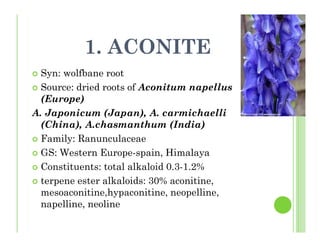
1. ACONITE
Syn: wolfbane root
Source: dried roots of Aconitum napellus
(Europe)
A. Japonicum (Japan), A. carmichaelli
(China), A.chasmanthum (India)
Family: Ranunculaceae
GS: Western Europe-spain, Himalaya
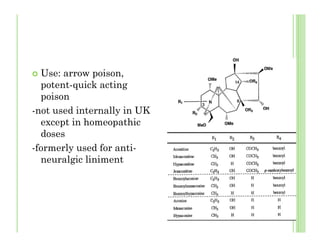
Constituents: total alkaloid 0.3-1.2%
terpene ester alkaloids: 30% aconitine,
mesoaconitine,hypaconitine, neopelline,
napelline, neoline
Use: arrow poison,
potent-quick acting
poison
-not used internally in UK
except in homeopathic
doses
-formerly used for anti-
neuralgic liniment
2. CURARE
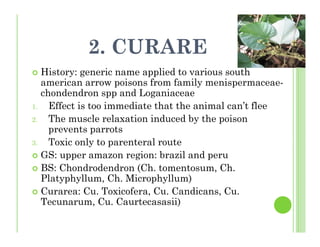
History: generic name applied to various south
american arrow poisons from family menispermaceae-
chondendron spp and Loganiaceae
1. Effect is too immediate that the animal can’t flee
2. The muscle relaxation induced by the poison
prevents parrots
3. Toxic only to parenteral route
GS: upper amazon region: brazil and peru
BS: Chondrodendron (Ch. tomentosum, Ch.
Platyphyllum, Ch. Microphyllum)
Curarea: Cu. Toxicofera, Cu. Candicans, Cu.
Tecunarum, Cu. Caurtecasasii)
2. CURARE
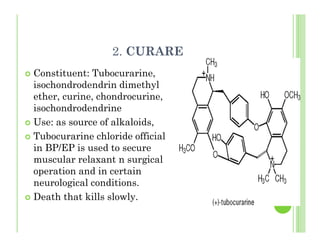
Constituent: Tubocurarine,
isochondrodendrin dimethyl
ether, curine, chondrocurine,
isochondrodendrine
Use: as source of alkaloids,
Tubocurarine chloride official
in BP/EP is used to secure
muscular relaxant n surgical
operation and in certain
neurological conditions.
Death that kills slowly.
3. LILY OF THE VALLEY
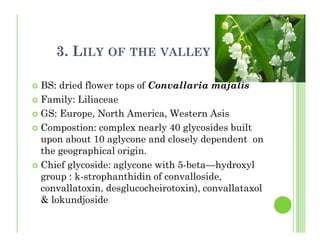
BS: dried flower tops of Convallaria majalis
Family: Liliaceae
GS: Europe, North America, Western Asis
Compostion: complex nearly 40 glycosides built
upon about 10 aglycone and closely dependent on
the geographical origin.
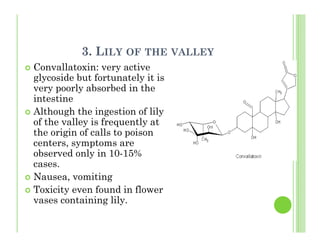
Chief glycoside: aglycone with 5-beta—hydroxyl
group : k-strophanthidin of convalloside,
convallatoxin, desglucocheirotoxin), convallataxol
& lokundjoside
3. LILY OF THE VALLEY
Convallatoxin: very active
glycoside but fortunately it is
very poorly absorbed in the
intestine
Although the ingestion of lily
of the valley is frequently at
the origin of calls to poison
centers, symptoms are
observed only in 10-15%
cases.
Nausea, vomiting
Toxicity even found in flower
vases containing lily.
4. ERGOT
BS: rye plant Claviceps purpurea
Already studied under ALKALOIDS in Semester-
VII
Refer PDF
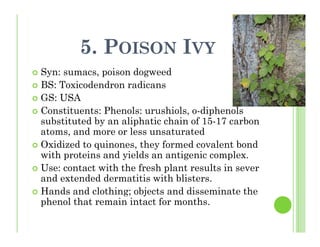
5. POISON IVY
Syn: sumacs, poison dogweed
BS: Toxicodendron radicans
GS: USA
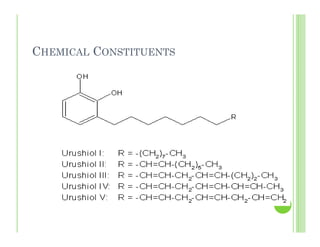
Constituents: Phenols: urushiols, o-diphenols
substituted by an aliphatic chain of 15-17 carbon
atoms, and more or less unsaturated
Oxidized to quinones, they formed covalent bond
with proteins and yields an antigenic complex.
Use: contact with the fresh plant results in sever
and extended dermatitis with blisters.
Hands and clothing; objects and disseminate the
phenol that remain intact for months.
CHEMICAL CONSTITUENTS
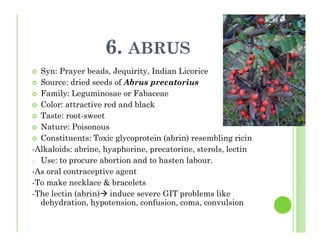
6. ABRUS
Syn: Prayer beads, Jequirity, Indian Licorice
Source: dried seeds of Abrus precatorius
Family: Leguminosae or Fabaceae
Color: attractive red and black
Taste: root-sweet
Nature: Poisonous
Constituents: Toxic glycoprotein (abrin) resembling ricin
-Alkaloids: abrine, hyaphorine, precatorine, sterols, lectin
o Use: to procure abortion and to hasten labour.
-As oral contraceptive agent
-To make necklace & bracelets
-The lectin (abrin) induce severe GIT problems like
dehydration, hypotension, confusion, coma, convulsion
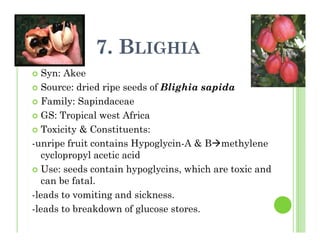
7. BLIGHIA
Syn: Akee
Source: dried ripe seeds of Blighia sapida
Family: Sapindaceae
GS: Tropical west Africa
Toxicity & Constituents:
-unripe fruit contains Hypoglycin-A & B methylene
cyclopropyl acetic acid
Use: seeds contain hypoglycins, which are toxic and
can be fatal.
-leads to vomiting and sickness.
-leads to breakdown of glucose stores.
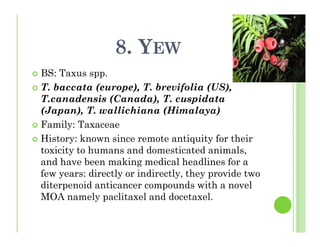
8. YEW
BS: Taxus spp.
T. baccata (europe), T. brevifolia (US),
T.canadensis (Canada), T. cuspidata
(Japan), T. wallichiana (Himalaya)
Family: Taxaceae
History: known since remote antiquity for their
toxicity to humans and domesticated animals,
and have been making medical headlines for a
few years: directly or indirectly, they provide two
diterpenoid anticancer compounds with a novel
MOA namely paclitaxel and docetaxel.
8. YEW
Constituents: saccharides, polysaccharides,
cyclitols, fatty acids, sterols, bisflavanoids,
proanthocyanidins, lignan and cyanogenetic
glycosides
Imp: tricyclic diterpene: taxane skeleton:
taxusine,, taxagifin, baccatin-III, Taxine, Taxol,
cephalomannine, taxicins.
o USE:
- spindle mitotic poison
-breast cancer
-murder, suicide attempt
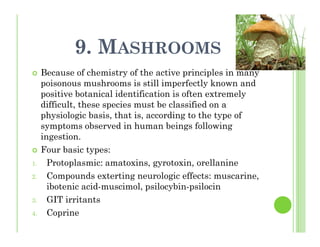
9. MASHROOMS
Because of chemistry of the active principles in many
poisonous mushrooms is still imperfectly known and
positive botanical identification is often extremely
difficult, these species must be classified on a
physiologic basis, that is, according to the type of
symptoms observed in human beings following
ingestion.
Four basic types:
1. Protoplasmic: amatoxins, gyrotoxin, orellanine
2. Compounds exterting neurologic effects: muscarine,
ibotenic acid-muscimol, psilocybin-psilocin
3. GIT irritants
4. Coprine
1. PROTOPLASMIC POISONS-AMATOXINS
Source 1: Amanita phalloides (deadly amanita)
Amanita bisporigera, Atkinson, Amanita verna, Amanita
virosa
GS: Europe
Characteristics: White spores, presence of both an annulus and
a volva, typically free gills.
Constituents: alpha,beta, gamma-amanitin
Source 2: Galerina
Characteristics: nondescript carpophores with yellowish brown
spores
Constituents: alpha,beta-amanitin
Actions: asymptomatic latent period lasting up to 24 hours
precedes violent vomiting and diarrhoea which may continue
untill death results.
-Progressive injuries to liver, kidney, heart and CNS.
TREATMENT OF POISONING
Treatment of poisoning:
Removal of toxic material from the GIT
Administration of analgesics to control pain
IV infusion of liquid to prevent dehydration and shock
Hemodialysis or hemoperfusion to eliminate toxin
Appropriate measure to maintain a brisk urine flow.
IV corticosteroids to inhibit toxin fixation in the liver
IV penicillin G or thioctic acid (alpha-lipoic acid) to
protect that organ.
Administration of cytochrome C, Vitamin C, K and B
complex and dextrose, NaCl injection
Most used: Penicillin G, chloramphenicol,
phenylbutazone, Co-trimaxazole.
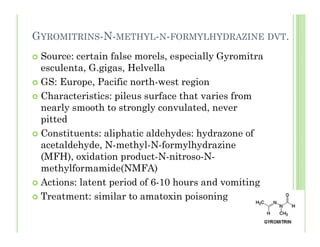
GYROMITRINS-N-METHYL-N-FORMYLHYDRAZINE DVT.
Source: certain false morels, especially Gyromitra
esculenta, G.gigas, Helvella
GS: Europe, Pacific north-west region
Characteristics: pileus surface that varies from
nearly smooth to strongly convulated, never
pitted
Constituents: aliphatic aldehydes: hydrazone of
acetaldehyde, N-methyl-N-formylhydrazine
(MFH), oxidation product-N-nitroso-N-
methylformamide(NMFA)
Actions: latent period of 6-10 hours and vomiting
Treatment: similar to amatoxin poisoning
ORELLANINE-CORTINARIN-A & B
Source: Cortinarius species
Constituents: cyclopeptides: cortinarin A & B
-cortinarin B is more toxic
Action: nephrotoxic, latent period of 3-14
days, burning thirst, GIT disturbance,
headache, pain in limbs, spasms, loss of
conciousness, liver-kidney damage
Treatment: supportive & symptomatic ---
particular attention to the maintenance of
kidney function.
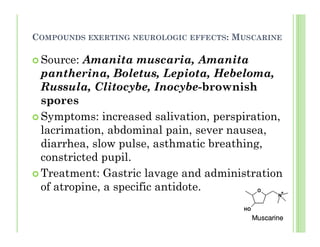
COMPOUNDS EXERTING NEUROLOGIC EFFECTS: MUSCARINE
Source: Amanita muscaria, Amanita
pantherina, Boletus, Lepiota, Hebeloma,
Russula, Clitocybe, Inocybe-brownish
spores
Symptoms: increased salivation, perspiration,
lacrimation, abdominal pain, sever nausea,
diarrhea, slow pulse, asthmatic breathing,
constricted pupil.
Treatment: Gastric lavage and administration
of atropine, a specific antidote.
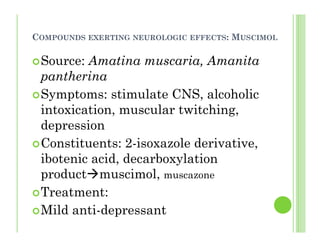
COMPOUNDS EXERTING NEUROLOGIC EFFECTS: MUSCIMOL
Source: Amatina muscaria, Amanita
pantherina
Symptoms: stimulate CNS, alcoholic
intoxication, muscular twitching,
depression
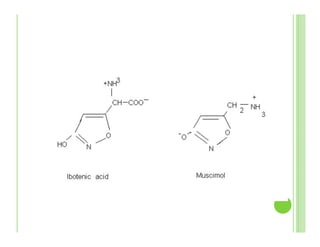
Constituents: 2-isoxazole derivative,
ibotenic acid, decarboxylation
product muscimol, muscazone
Treatment:
Mild anti-depressant
COMPOUNDS EXERTING NEUROLOGIC EFFECTS: PSILOCYBIN-
PSILOCIN
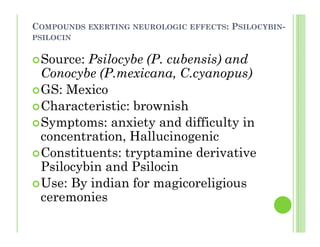
Source: Psilocybe (P. cubensis) and
Conocybe (P.mexicana, C.cyanopus)
GS: Mexico
Characteristic: brownish
Symptoms: anxiety and difficulty in
concentration, Hallucinogenic
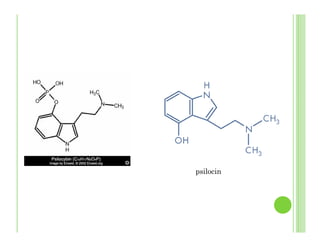
Constituents: tryptamine derivative
Psilocybin and Psilocin
Use: By indian for magicoreligious
ceremonies
psilocin
GIT IRRITANTS:
Source: Boletus satanus, Lactarius
torminosus, Paxillus involutus,
Rhodophyllus lividus, Russula emetica,
Tricholoma pardinum
Symptoms: nausea, vomiting, diarrhea
Rhodophyllus: liver toxix
Constituents: resin like compounds
Treatment: symptomatic treatment
along with bed rest, light diet
COPRINE
Source: Coprinus atramentarius
Symptoms: alcohol disulfiram syndrome,
Retarded alcohol metabolism: flushing,
palpitation, dyspnea, tachycardia,
vomiting
Characteristic: black spore
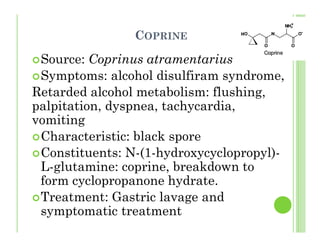
Constituents: N-(1-hydroxycyclopropyl)-
L-glutamine: coprine, breakdown to
form cyclopropanone hydrate.
Treatment: Gastric lavage and
symptomatic treatment
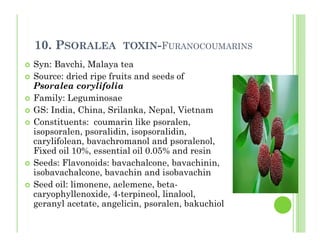
10. PSORALEA TOXIN-FURANOCOUMARINS
Syn: Bavchi, Malaya tea
Source: dried ripe fruits and seeds of
Psoralea corylifolia
Family: Leguminosae
GS: India, China, Srilanka, Nepal, Vietnam
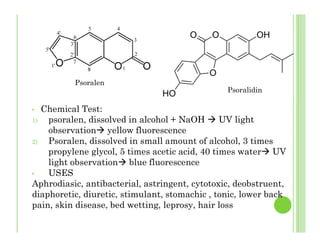
Constituents: coumarin like psoralen,
isopsoralen, psoralidin, isopsoralidin,
carylifolean, bavachromanol and psoralenol,
Fixed oil 10%, essential oil 0.05% and resin
Seeds: Flavonoids: bavachalcone, bavachinin,
isobavachalcone, bavachin and isobavachin
Seed oil: limonene, aelemene, beta-
caryophyllenoxide, 4-terpineol, linalool,
geranyl acetate, angelicin, psoralen, bakuchiol
• Chemical Test:
1) psoralen, dissolved in alcohol + NaOH UV light
observation yellow fluorescence
2) Psoralen, dissolved in small amount of alcohol, 3 times
propylene glycol, 5 times acetic acid, 40 times water UV
light observation blue fluorescence
• USES
Aphrodiasic, antibacterial, astringent, cytotoxic, deobstruent,
diaphoretic, diuretic, stimulant, stomachic , tonic, lower back
pain, skin disease, bed wetting, leprosy, hair loss
Psoralen
Psoralidin
11. DATURA
Syn: Jimson weed, Dhotara, Thorn apple
Source: dried leaves and seeds of Datura
Stramonium
Family: Solanaceae
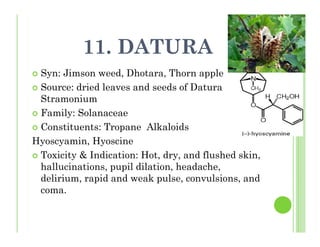
Constituents: Tropane Alkaloids
Hyoscyamin, Hyoscine
Toxicity & Indication: Hot, dry, and flushed skin,
hallucinations, pupil dilation, headache,
delirium, rapid and weak pulse, convulsions, and
coma.

Phyto toxins

  • 1.
  • 2.
    CONTENT 1. Aconite 2. Curare 3.Lilly of the valley 4. Ergot 5. Poison ivy 6. Abrus 7. Belighia 8. Yew 9. Mashrooms 10. Psoralea 11. Datura
  • 3.
    1. ACONITE Syn: wolfbaneroot Source: dried roots of Aconitum napellus (Europe) A. Japonicum (Japan), A. carmichaelli (China), A.chasmanthum (India) Family: Ranunculaceae GS: Western Europe-spain, Himalaya Constituents: total alkaloid 0.3-1.2% terpene ester alkaloids: 30% aconitine, mesoaconitine,hypaconitine, neopelline, napelline, neoline
  • 4.
    Use: arrow poison, potent-quickacting poison -not used internally in UK except in homeopathic doses -formerly used for anti- neuralgic liniment
  • 5.
    2. CURARE History: genericname applied to various south american arrow poisons from family menispermaceae- chondendron spp and Loganiaceae 1. Effect is too immediate that the animal can’t flee 2. The muscle relaxation induced by the poison prevents parrots 3. Toxic only to parenteral route GS: upper amazon region: brazil and peru BS: Chondrodendron (Ch. tomentosum, Ch. Platyphyllum, Ch. Microphyllum) Curarea: Cu. Toxicofera, Cu. Candicans, Cu. Tecunarum, Cu. Caurtecasasii)
  • 6.
    2. CURARE Constituent: Tubocurarine, isochondrodendrindimethyl ether, curine, chondrocurine, isochondrodendrine Use: as source of alkaloids, Tubocurarine chloride official in BP/EP is used to secure muscular relaxant n surgical operation and in certain neurological conditions. Death that kills slowly.
  • 7.
    3. LILY OFTHE VALLEY BS: dried flower tops of Convallaria majalis Family: Liliaceae GS: Europe, North America, Western Asis Compostion: complex nearly 40 glycosides built upon about 10 aglycone and closely dependent on the geographical origin. Chief glycoside: aglycone with 5-beta—hydroxyl group : k-strophanthidin of convalloside, convallatoxin, desglucocheirotoxin), convallataxol & lokundjoside
  • 8.
    3. LILY OFTHE VALLEY Convallatoxin: very active glycoside but fortunately it is very poorly absorbed in the intestine Although the ingestion of lily of the valley is frequently at the origin of calls to poison centers, symptoms are observed only in 10-15% cases. Nausea, vomiting Toxicity even found in flower vases containing lily.
  • 9.
    4. ERGOT BS: ryeplant Claviceps purpurea Already studied under ALKALOIDS in Semester- VII Refer PDF
  • 10.
    5. POISON IVY Syn:sumacs, poison dogweed BS: Toxicodendron radicans GS: USA Constituents: Phenols: urushiols, o-diphenols substituted by an aliphatic chain of 15-17 carbon atoms, and more or less unsaturated Oxidized to quinones, they formed covalent bond with proteins and yields an antigenic complex. Use: contact with the fresh plant results in sever and extended dermatitis with blisters. Hands and clothing; objects and disseminate the phenol that remain intact for months.
  • 11.
  • 12.
    6. ABRUS Syn: Prayerbeads, Jequirity, Indian Licorice Source: dried seeds of Abrus precatorius Family: Leguminosae or Fabaceae Color: attractive red and black Taste: root-sweet Nature: Poisonous Constituents: Toxic glycoprotein (abrin) resembling ricin -Alkaloids: abrine, hyaphorine, precatorine, sterols, lectin o Use: to procure abortion and to hasten labour. -As oral contraceptive agent -To make necklace & bracelets -The lectin (abrin) induce severe GIT problems like dehydration, hypotension, confusion, coma, convulsion
  • 13.
    7. BLIGHIA Syn: Akee Source:dried ripe seeds of Blighia sapida Family: Sapindaceae GS: Tropical west Africa Toxicity & Constituents: -unripe fruit contains Hypoglycin-A & B methylene cyclopropyl acetic acid Use: seeds contain hypoglycins, which are toxic and can be fatal. -leads to vomiting and sickness. -leads to breakdown of glucose stores.
  • 14.
    8. YEW BS: Taxusspp. T. baccata (europe), T. brevifolia (US), T.canadensis (Canada), T. cuspidata (Japan), T. wallichiana (Himalaya) Family: Taxaceae History: known since remote antiquity for their toxicity to humans and domesticated animals, and have been making medical headlines for a few years: directly or indirectly, they provide two diterpenoid anticancer compounds with a novel MOA namely paclitaxel and docetaxel.
  • 15.
    8. YEW Constituents: saccharides,polysaccharides, cyclitols, fatty acids, sterols, bisflavanoids, proanthocyanidins, lignan and cyanogenetic glycosides Imp: tricyclic diterpene: taxane skeleton: taxusine,, taxagifin, baccatin-III, Taxine, Taxol, cephalomannine, taxicins. o USE: - spindle mitotic poison -breast cancer -murder, suicide attempt
  • 16.
    9. MASHROOMS Because ofchemistry of the active principles in many poisonous mushrooms is still imperfectly known and positive botanical identification is often extremely difficult, these species must be classified on a physiologic basis, that is, according to the type of symptoms observed in human beings following ingestion. Four basic types: 1. Protoplasmic: amatoxins, gyrotoxin, orellanine 2. Compounds exterting neurologic effects: muscarine, ibotenic acid-muscimol, psilocybin-psilocin 3. GIT irritants 4. Coprine
  • 17.
    1. PROTOPLASMIC POISONS-AMATOXINS Source1: Amanita phalloides (deadly amanita) Amanita bisporigera, Atkinson, Amanita verna, Amanita virosa GS: Europe Characteristics: White spores, presence of both an annulus and a volva, typically free gills. Constituents: alpha,beta, gamma-amanitin Source 2: Galerina Characteristics: nondescript carpophores with yellowish brown spores Constituents: alpha,beta-amanitin Actions: asymptomatic latent period lasting up to 24 hours precedes violent vomiting and diarrhoea which may continue untill death results. -Progressive injuries to liver, kidney, heart and CNS.
  • 18.
    TREATMENT OF POISONING Treatmentof poisoning: Removal of toxic material from the GIT Administration of analgesics to control pain IV infusion of liquid to prevent dehydration and shock Hemodialysis or hemoperfusion to eliminate toxin Appropriate measure to maintain a brisk urine flow. IV corticosteroids to inhibit toxin fixation in the liver IV penicillin G or thioctic acid (alpha-lipoic acid) to protect that organ. Administration of cytochrome C, Vitamin C, K and B complex and dextrose, NaCl injection Most used: Penicillin G, chloramphenicol, phenylbutazone, Co-trimaxazole.
  • 19.
    GYROMITRINS-N-METHYL-N-FORMYLHYDRAZINE DVT. Source: certainfalse morels, especially Gyromitra esculenta, G.gigas, Helvella GS: Europe, Pacific north-west region Characteristics: pileus surface that varies from nearly smooth to strongly convulated, never pitted Constituents: aliphatic aldehydes: hydrazone of acetaldehyde, N-methyl-N-formylhydrazine (MFH), oxidation product-N-nitroso-N- methylformamide(NMFA) Actions: latent period of 6-10 hours and vomiting Treatment: similar to amatoxin poisoning
  • 20.
    ORELLANINE-CORTINARIN-A & B Source:Cortinarius species Constituents: cyclopeptides: cortinarin A & B -cortinarin B is more toxic Action: nephrotoxic, latent period of 3-14 days, burning thirst, GIT disturbance, headache, pain in limbs, spasms, loss of conciousness, liver-kidney damage Treatment: supportive & symptomatic --- particular attention to the maintenance of kidney function.
  • 21.
    COMPOUNDS EXERTING NEUROLOGICEFFECTS: MUSCARINE Source: Amanita muscaria, Amanita pantherina, Boletus, Lepiota, Hebeloma, Russula, Clitocybe, Inocybe-brownish spores Symptoms: increased salivation, perspiration, lacrimation, abdominal pain, sever nausea, diarrhea, slow pulse, asthmatic breathing, constricted pupil. Treatment: Gastric lavage and administration of atropine, a specific antidote.
  • 22.
    COMPOUNDS EXERTING NEUROLOGICEFFECTS: MUSCIMOL Source: Amatina muscaria, Amanita pantherina Symptoms: stimulate CNS, alcoholic intoxication, muscular twitching, depression Constituents: 2-isoxazole derivative, ibotenic acid, decarboxylation product muscimol, muscazone Treatment: Mild anti-depressant
  • 24.
    COMPOUNDS EXERTING NEUROLOGICEFFECTS: PSILOCYBIN- PSILOCIN Source: Psilocybe (P. cubensis) and Conocybe (P.mexicana, C.cyanopus) GS: Mexico Characteristic: brownish Symptoms: anxiety and difficulty in concentration, Hallucinogenic Constituents: tryptamine derivative Psilocybin and Psilocin Use: By indian for magicoreligious ceremonies
  • 25.
  • 26.
    GIT IRRITANTS: Source: Boletussatanus, Lactarius torminosus, Paxillus involutus, Rhodophyllus lividus, Russula emetica, Tricholoma pardinum Symptoms: nausea, vomiting, diarrhea Rhodophyllus: liver toxix Constituents: resin like compounds Treatment: symptomatic treatment along with bed rest, light diet
  • 27.
    COPRINE Source: Coprinus atramentarius Symptoms:alcohol disulfiram syndrome, Retarded alcohol metabolism: flushing, palpitation, dyspnea, tachycardia, vomiting Characteristic: black spore Constituents: N-(1-hydroxycyclopropyl)- L-glutamine: coprine, breakdown to form cyclopropanone hydrate. Treatment: Gastric lavage and symptomatic treatment
  • 28.
    10. PSORALEA TOXIN-FURANOCOUMARINS Syn:Bavchi, Malaya tea Source: dried ripe fruits and seeds of Psoralea corylifolia Family: Leguminosae GS: India, China, Srilanka, Nepal, Vietnam Constituents: coumarin like psoralen, isopsoralen, psoralidin, isopsoralidin, carylifolean, bavachromanol and psoralenol, Fixed oil 10%, essential oil 0.05% and resin Seeds: Flavonoids: bavachalcone, bavachinin, isobavachalcone, bavachin and isobavachin Seed oil: limonene, aelemene, beta- caryophyllenoxide, 4-terpineol, linalool, geranyl acetate, angelicin, psoralen, bakuchiol
  • 29.
    • Chemical Test: 1)psoralen, dissolved in alcohol + NaOH UV light observation yellow fluorescence 2) Psoralen, dissolved in small amount of alcohol, 3 times propylene glycol, 5 times acetic acid, 40 times water UV light observation blue fluorescence • USES Aphrodiasic, antibacterial, astringent, cytotoxic, deobstruent, diaphoretic, diuretic, stimulant, stomachic , tonic, lower back pain, skin disease, bed wetting, leprosy, hair loss Psoralen Psoralidin
  • 30.
    11. DATURA Syn: Jimsonweed, Dhotara, Thorn apple Source: dried leaves and seeds of Datura Stramonium Family: Solanaceae Constituents: Tropane Alkaloids Hyoscyamin, Hyoscine Toxicity & Indication: Hot, dry, and flushed skin, hallucinations, pupil dilation, headache, delirium, rapid and weak pulse, convulsions, and coma.