Free radicals: are compounds that have an odd (uneven)
number of electrons and therefore unbalanced and reactive
(stealing an electron from compounds they encounter to gain
stability)
Antioxidants: are compounds that offer an electron to free
radicals to neutralize their destructive nature
Source of free radicals
1- External factors
- Radiation
- U.V. light
- Cigarette smoking
2- Internal factors
- Cellular respiration
- Immune cell activity (Chronic infection and
inflammation)
Effect of free radicals
- DNA Oxidation  Mutation  Cancer
- Lipid peroxidation and protein oxidation 
(Cell wall destruction, enzyme inhibition, protein
degradation) Degenerative diseases
Degenerative diseases
- Aging
- Cardiovascular diseases
- Immune dysfunction
- Brain dysfunction (Alzheimer's Disease & Dementia)
- Cataract
- Vision loss
Body defense against free radical damage
- The enzymes: superoxide dismutase, catalase and
glutathione peroxidase
- Antioxidants synthesized in the body:
glutathione, proteins
- Antioxidants obtained from the diet:
Vitamin A , E and C
Flavonoid
Phenolic acids, resveratrol and curcuminoids
Populations who consume inadequate amount of
fresh fruits and vegetables are at a higher risk for
cancer, heart diseases and other degenerative
diseases
Vitamin E
- Fat-soluble antioxidant
- Protects fatty acids, such as those in the plasma membrane
from oxidation in chain of reaction including vitamin c and
thiols (antioxidant network)
Activity:
- Reduction the effect of ageing
- Prevention of heart diseases
- Commercially: rancidity preventive in food manufacturing
Occurrence:
- Vegetable oils: Wheat germ, sunflower, and safflower oils
- Nuts: peanuts, hazelnuts and almonds
- Green vegetable: Spanish and broccoli
- Dairy products
- Fortified breakfast cereals
Vitamin A and carotenoids
Activity:
- Important in vision, bone growth, reproduction, cell division
and cell differentiation
- Regulation of the immune system
- Promotion healthy surface lining of eyes and respiratory,
urinary and intestinal tracts  ↑ protection against bacteria
and viruses
Occurrence:
- Animal source (preformed vitamin A) retinol (active
form)
Dairy products, liver and eggs
- Plant source (provitamin A) carotenoid (converted to
retinol in body)
Fruits and vegetable (Carrots, cantaloupes, sweet potatoes
and spanish
Margarine
Vitamin C
Activity:
- Essential for the formation, growth and repair of bone, skin
and connective tissue
- Maintenance healthy teeth and gum
- Help iron absorption
- Help burns and wounds healing
- Protection of cells against damage by free radicals
N.B.
- Scurvy is sever vitamin C deficiency
- Scurvy is rare in infants because breast milk contain enough
supply of vitamin C
- Cooking can destroy some vitamin C in foods
- Pregnancy, breastfeeding, fever, surgery and smoking
increase the body requirements for vitamin C
- High doses (2 gm /day) of vitamin C are not toxic to healthy
adults
Flavonoids
- They are important in the plant for normal growth
development and defense against infection and injury.
- They partly provide plant colors of flowers, fruits and
leaves
- Their antioxidant activity is mainly due to their redox
properties
- Studies suggested their protective effect against vascular
diseases and certain cancers.
- Main flavonoids subgroups are anthocyanins, flavonols,
catchins
Occurrence:
Flowers, berries and fruits (grape, hibiscus, citrus fruits)
Phenolic acids
A significant amount of phenolic acids such as ferulic,
caffeic, p-hydroxybenzoic, p-coumaric, vanillic acids is
typical to cereals
O
HO
O
OH
ferulic acid
O
OH
O
OH
vanillic acid
Resveratrol
Occurrence:
Grapes and wine
Activity:
- Antioxidant (protective effects against a number of
cardiovascular and neurodegenerative diseases and cancer)
- Cancer chemoprotective agent
- Anti-inflammatory
- Anti-platelet
HO
OH
OH
Red wine (grape juice)
(grape seed extract) (Vitis vinifera)
Constituents:
Resveratrol, quercetin, gallic acid catchins
Action and uses:-
- Antioxidant
-Cancer chemoprotective agent
-Prevention of Alzheimer's disease
- Anti-inflammatory
- Anti-platelet
- Hypolipidemic: ↑HDL and ↓ lipoprotein oxidation↓
cardiovascular diseases
- Antihypertensive
Green and black tea (Thea sinensis)
(Camellia sinensis)
Green tea:
Made with steamed
tea leaves
Black tea:
Made with fermented
tea leaves
White tea:
Uncured and
unfermented
Oolong tea
Pu-erh tea : Made from fermented and aged leaves.
Considered a black tea, its leaves are pressed into cakes
Black tea Oolong tea Pu-erh tea White tea Green tea
Fermented Partial fermented Non- fermented
Aged leaves Young
leaves and
buds
Highest
caffeine
content
maximum amounts of
polyphenols and
antioxidants
Black tea is generally stronger in flavor than the less oxidized teas
Black tea retains its flavor for several years
Earl Grey is a black tea with bergamot oil
Green tea usually loses its flavor within a year.
The name "white tea" derives from the fine silvery-white hairs on the
unopened buds of the tea plant, which gives the plant a whitish
appearance. The beverage itself is not white or colourless but pale yellow.
Black tea
Fresh tea leaf  withering by blowing air  Fermentation (Oxidation
under controlled temperature and humidity) for months to years 
drying  sieving  grading
Oolong tea
Fresh tea leaf  withering by blowing air  partial oxidation curling
and twisting  drying
Pu-erh tea
Fresh aged leaves  partial oxidation  leaves are pressed into cakes
White tea
Fresh tea young leaf and buds  withering by blowing air  Drying (air
drying, solar drying or mechanical drying) Drying  sieving  grading
Green tea
Fresh tea leaf  withering by blowing air  Drying (air drying, solar drying,
steam or mechanical drying) Drying  sieving  grading
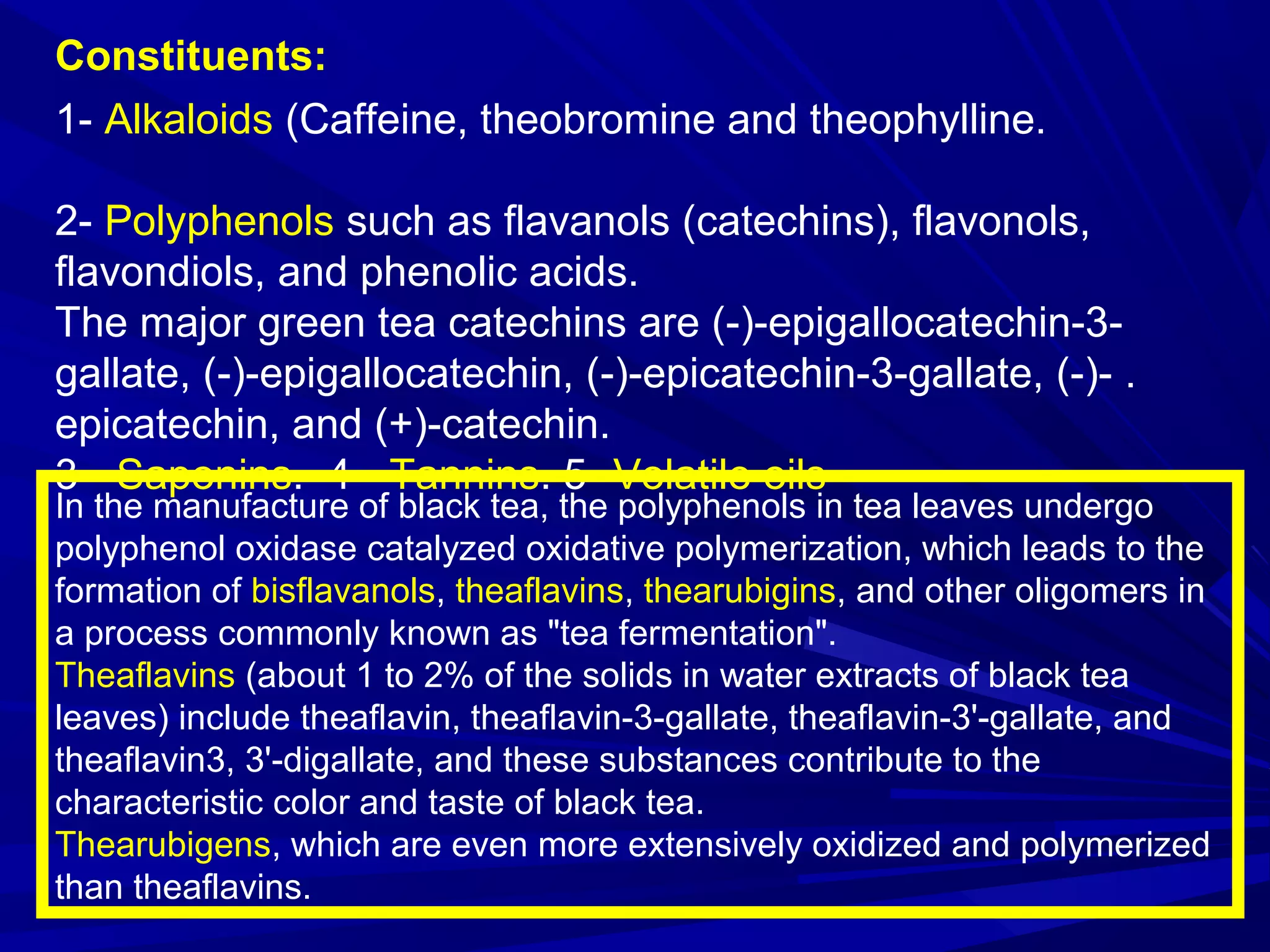
Constituents:
1- Alkaloids (Caffeine, theobromine and theophylline.
2- Polyphenols such as flavanols (catechins), flavonols,
flavondiols, and phenolic acids.
The major green tea catechins are (-)-epigallocatechin-3-
gallate, (-)-epigallocatechin, (-)-epicatechin-3-gallate, (-)- .
epicatechin, and (+)-catechin.
3- Saponins. 4- Tannins. 5- Volatile oils
In the manufacture of black tea, the polyphenols in tea leaves undergo
polyphenol oxidase catalyzed oxidative polymerization, which leads to the
formation of bisflavanols, theaflavins, thearubigins, and other oligomers in
a process commonly known as "tea fermentation".
Theaflavins (about 1 to 2% of the solids in water extracts of black tea
leaves) include theaflavin, theaflavin-3-gallate, theaflavin-3'-gallate, and
theaflavin3, 3'-digallate, and these substances contribute to the
characteristic color and taste of black tea.
Thearubigens, which are even more extensively oxidized and polymerized
than theaflavins.
1- CNS stimulant.
Caffeine > Theophylline > Theobromine
2- Mild diuretic.
Theobromine > Theophylline > Caffeine
3- Smooth muscle relaxant.
Theophylline > Theobromine > Caffeine
4- Antioxidant.
5- Antiobesity
6- Hepatoprotective
7- As a drink.
- Large dose of tea cause irritation of stomach, peptic
ulcer, constipation and nervous irritability.
Indications:
Long-term black tea
consumption
1- Decrease cardiovascular disease
incidence.
a) Tea consumption reduced LDL
cholesterol
b) Theaflavin-3-gallate, a theaflavin
derivative found in black tea, could
reduce the incorporation of cholesterol
into mixed micelles
N.B. The addition of milk prevents
vascular protective effects of tea.
2- Protect lungs from damage caused
by exposure to cigarette smoke.
3- Reduce the risk of stroke.
Long-term of green tea
consumption
1- Decrease incidence of certain
types of cancer such as bladder,
breast, lung, stomach, pancreatic,
and colorectal cancers.
2- Prevent clogging of the arteries
by improving cholesterol levels.
3- Counteract oxidative stress on
the brain, reduce risk of neurological
disorders like Alzheimer’s and
Parkinson’s diseases, reduce risk of
stroke.
Dandelion (Taraxacum officinale)
Constituents:
Sesquiterpene lactones: taraxinic acid (germacranolide)
eudesmanolides;
Bitter principle (taraxacin).
Carotenoids (traxanthin);
Choline; phytosterols; triterpenes; flavonoids; caffeic acid
Action and uses:-
- Hepatoprotective - Antioxidant
- Choleretic, Cholagogue - Laxative - Bitter
- Antihypercholesterolemia (↓LDL & TG, ↑HDL)
Mechanism of action:
- Diuretic (↓ascites)( ↓BP)
- Antirheumatic .- The high choline content of the root
"tonic" to the liver.
- Choline derivatives are known to effect parasympathetic
stimulation and vasodilation  ↓BP
- Diuretic and high levels of potassium ↓ elevated SBP
Dosage:
The root can be used at the following dosages three
times daily:
Dried root: 2 – 8 grams by infusion or decoction;
Fluid extracts (1 : 1): 4 – 8 milliliters (1 – 2 teaspoons);
Juice of fresh root: 4 – 8 milliliters (1 – 2 teaspoons);
Powdered solid extract (4 : 1): 250 – 500 milligrams.
The leaves can be used at the following dosages three
times daily:
As mild diuretic and weight loss agent
Dried leaf: 4 - 10 grams by infusion; Fluid extracts (1 : 1):
4 – 10 milliliters.
Ginseng (Panax ginseng)
Constituents:
Saponins (Ginsenosides), Flavonoids
volatile oil, peptides, proteins, and polysaccharides.
Action and uses:
- General tonic (increases performance and improves general
health, used as a tonic for treatment of exhaustion, overexertion,
neurasthenia, hypotension, general and nervous debility, especially
in old age, and mild depression)
- CNS stimulant (improves age-related depression and lack of
concentration)
- Enhances memory
- Protects neurons against ischemic damage
- Antineoplastic actions
- Immunomodulator
- Aphrodisiac actions.
- Improves carbohydrate tolerance in diabetics
- Antioxidant activity.
- Adaptogenic - Hepatoprotective
Dosage: 1-9 g.
Turmeric, Curcum (Curcuma longa(
Constituents:
- Cucuminoids (curcumin, demethoxycurcumin, bis
demethoxycurcumin)
- Volatile oils
Action and uses:-
- Hepatoprotective
- Antioxidant
- Anti-inflammatory

Herbal medicine antioxidants

  • 3.
    Free radicals: arecompounds that have an odd (uneven) number of electrons and therefore unbalanced and reactive (stealing an electron from compounds they encounter to gain stability) Antioxidants: are compounds that offer an electron to free radicals to neutralize their destructive nature
  • 4.
    Source of freeradicals 1- External factors - Radiation - U.V. light - Cigarette smoking 2- Internal factors - Cellular respiration - Immune cell activity (Chronic infection and inflammation)
  • 6.
    Effect of freeradicals - DNA Oxidation  Mutation  Cancer - Lipid peroxidation and protein oxidation  (Cell wall destruction, enzyme inhibition, protein degradation) Degenerative diseases
  • 7.
    Degenerative diseases - Aging -Cardiovascular diseases - Immune dysfunction - Brain dysfunction (Alzheimer's Disease & Dementia) - Cataract - Vision loss
  • 9.
    Body defense againstfree radical damage - The enzymes: superoxide dismutase, catalase and glutathione peroxidase - Antioxidants synthesized in the body: glutathione, proteins - Antioxidants obtained from the diet: Vitamin A , E and C Flavonoid Phenolic acids, resveratrol and curcuminoids Populations who consume inadequate amount of fresh fruits and vegetables are at a higher risk for cancer, heart diseases and other degenerative diseases
  • 12.
    Vitamin E - Fat-solubleantioxidant - Protects fatty acids, such as those in the plasma membrane from oxidation in chain of reaction including vitamin c and thiols (antioxidant network) Activity: - Reduction the effect of ageing - Prevention of heart diseases - Commercially: rancidity preventive in food manufacturing Occurrence: - Vegetable oils: Wheat germ, sunflower, and safflower oils - Nuts: peanuts, hazelnuts and almonds - Green vegetable: Spanish and broccoli - Dairy products - Fortified breakfast cereals
  • 15.
    Vitamin A andcarotenoids Activity: - Important in vision, bone growth, reproduction, cell division and cell differentiation - Regulation of the immune system - Promotion healthy surface lining of eyes and respiratory, urinary and intestinal tracts  ↑ protection against bacteria and viruses Occurrence: - Animal source (preformed vitamin A) retinol (active form) Dairy products, liver and eggs - Plant source (provitamin A) carotenoid (converted to retinol in body) Fruits and vegetable (Carrots, cantaloupes, sweet potatoes and spanish Margarine
  • 16.
    Vitamin C Activity: - Essentialfor the formation, growth and repair of bone, skin and connective tissue - Maintenance healthy teeth and gum - Help iron absorption - Help burns and wounds healing - Protection of cells against damage by free radicals N.B. - Scurvy is sever vitamin C deficiency - Scurvy is rare in infants because breast milk contain enough supply of vitamin C - Cooking can destroy some vitamin C in foods - Pregnancy, breastfeeding, fever, surgery and smoking increase the body requirements for vitamin C - High doses (2 gm /day) of vitamin C are not toxic to healthy adults
  • 17.
    Flavonoids - They areimportant in the plant for normal growth development and defense against infection and injury. - They partly provide plant colors of flowers, fruits and leaves - Their antioxidant activity is mainly due to their redox properties - Studies suggested their protective effect against vascular diseases and certain cancers. - Main flavonoids subgroups are anthocyanins, flavonols, catchins Occurrence: Flowers, berries and fruits (grape, hibiscus, citrus fruits)
  • 18.
    Phenolic acids A significantamount of phenolic acids such as ferulic, caffeic, p-hydroxybenzoic, p-coumaric, vanillic acids is typical to cereals O HO O OH ferulic acid O OH O OH vanillic acid
  • 19.
    Resveratrol Occurrence: Grapes and wine Activity: -Antioxidant (protective effects against a number of cardiovascular and neurodegenerative diseases and cancer) - Cancer chemoprotective agent - Anti-inflammatory - Anti-platelet HO OH OH
  • 20.
    Red wine (grapejuice) (grape seed extract) (Vitis vinifera)
  • 21.
    Constituents: Resveratrol, quercetin, gallicacid catchins Action and uses:- - Antioxidant -Cancer chemoprotective agent -Prevention of Alzheimer's disease - Anti-inflammatory - Anti-platelet - Hypolipidemic: ↑HDL and ↓ lipoprotein oxidation↓ cardiovascular diseases - Antihypertensive
  • 22.
    Green and blacktea (Thea sinensis) (Camellia sinensis)
  • 24.
    Green tea: Made withsteamed tea leaves Black tea: Made with fermented tea leaves White tea: Uncured and unfermented
  • 25.
  • 26.
    Pu-erh tea :Made from fermented and aged leaves. Considered a black tea, its leaves are pressed into cakes
  • 27.
    Black tea Oolongtea Pu-erh tea White tea Green tea Fermented Partial fermented Non- fermented Aged leaves Young leaves and buds Highest caffeine content maximum amounts of polyphenols and antioxidants Black tea is generally stronger in flavor than the less oxidized teas Black tea retains its flavor for several years Earl Grey is a black tea with bergamot oil Green tea usually loses its flavor within a year. The name "white tea" derives from the fine silvery-white hairs on the unopened buds of the tea plant, which gives the plant a whitish appearance. The beverage itself is not white or colourless but pale yellow.
  • 28.
    Black tea Fresh tealeaf  withering by blowing air  Fermentation (Oxidation under controlled temperature and humidity) for months to years  drying  sieving  grading Oolong tea Fresh tea leaf  withering by blowing air  partial oxidation curling and twisting  drying Pu-erh tea Fresh aged leaves  partial oxidation  leaves are pressed into cakes White tea Fresh tea young leaf and buds  withering by blowing air  Drying (air drying, solar drying or mechanical drying) Drying  sieving  grading Green tea Fresh tea leaf  withering by blowing air  Drying (air drying, solar drying, steam or mechanical drying) Drying  sieving  grading
  • 29.
    Constituents: 1- Alkaloids (Caffeine,theobromine and theophylline. 2- Polyphenols such as flavanols (catechins), flavonols, flavondiols, and phenolic acids. The major green tea catechins are (-)-epigallocatechin-3- gallate, (-)-epigallocatechin, (-)-epicatechin-3-gallate, (-)- . epicatechin, and (+)-catechin. 3- Saponins. 4- Tannins. 5- Volatile oils In the manufacture of black tea, the polyphenols in tea leaves undergo polyphenol oxidase catalyzed oxidative polymerization, which leads to the formation of bisflavanols, theaflavins, thearubigins, and other oligomers in a process commonly known as "tea fermentation". Theaflavins (about 1 to 2% of the solids in water extracts of black tea leaves) include theaflavin, theaflavin-3-gallate, theaflavin-3'-gallate, and theaflavin3, 3'-digallate, and these substances contribute to the characteristic color and taste of black tea. Thearubigens, which are even more extensively oxidized and polymerized than theaflavins.
  • 30.
    1- CNS stimulant. Caffeine> Theophylline > Theobromine 2- Mild diuretic. Theobromine > Theophylline > Caffeine 3- Smooth muscle relaxant. Theophylline > Theobromine > Caffeine 4- Antioxidant. 5- Antiobesity 6- Hepatoprotective 7- As a drink. - Large dose of tea cause irritation of stomach, peptic ulcer, constipation and nervous irritability. Indications:
  • 31.
    Long-term black tea consumption 1-Decrease cardiovascular disease incidence. a) Tea consumption reduced LDL cholesterol b) Theaflavin-3-gallate, a theaflavin derivative found in black tea, could reduce the incorporation of cholesterol into mixed micelles N.B. The addition of milk prevents vascular protective effects of tea. 2- Protect lungs from damage caused by exposure to cigarette smoke. 3- Reduce the risk of stroke.
  • 32.
    Long-term of greentea consumption 1- Decrease incidence of certain types of cancer such as bladder, breast, lung, stomach, pancreatic, and colorectal cancers. 2- Prevent clogging of the arteries by improving cholesterol levels. 3- Counteract oxidative stress on the brain, reduce risk of neurological disorders like Alzheimer’s and Parkinson’s diseases, reduce risk of stroke.
  • 33.
  • 34.
    Constituents: Sesquiterpene lactones: taraxinicacid (germacranolide) eudesmanolides; Bitter principle (taraxacin). Carotenoids (traxanthin); Choline; phytosterols; triterpenes; flavonoids; caffeic acid Action and uses:- - Hepatoprotective - Antioxidant - Choleretic, Cholagogue - Laxative - Bitter - Antihypercholesterolemia (↓LDL & TG, ↑HDL) Mechanism of action: - Diuretic (↓ascites)( ↓BP) - Antirheumatic .- The high choline content of the root "tonic" to the liver. - Choline derivatives are known to effect parasympathetic stimulation and vasodilation  ↓BP - Diuretic and high levels of potassium ↓ elevated SBP
  • 35.
    Dosage: The root canbe used at the following dosages three times daily: Dried root: 2 – 8 grams by infusion or decoction; Fluid extracts (1 : 1): 4 – 8 milliliters (1 – 2 teaspoons); Juice of fresh root: 4 – 8 milliliters (1 – 2 teaspoons); Powdered solid extract (4 : 1): 250 – 500 milligrams. The leaves can be used at the following dosages three times daily: As mild diuretic and weight loss agent Dried leaf: 4 - 10 grams by infusion; Fluid extracts (1 : 1): 4 – 10 milliliters.
  • 37.
  • 38.
    Constituents: Saponins (Ginsenosides), Flavonoids volatileoil, peptides, proteins, and polysaccharides. Action and uses: - General tonic (increases performance and improves general health, used as a tonic for treatment of exhaustion, overexertion, neurasthenia, hypotension, general and nervous debility, especially in old age, and mild depression) - CNS stimulant (improves age-related depression and lack of concentration) - Enhances memory - Protects neurons against ischemic damage - Antineoplastic actions - Immunomodulator - Aphrodisiac actions. - Improves carbohydrate tolerance in diabetics - Antioxidant activity. - Adaptogenic - Hepatoprotective Dosage: 1-9 g.
  • 40.
  • 41.
    Constituents: - Cucuminoids (curcumin,demethoxycurcumin, bis demethoxycurcumin) - Volatile oils Action and uses:- - Hepatoprotective - Antioxidant - Anti-inflammatory