Presentation
On
Alkaloids
Amity University, NOIDA
Amity Institute of Pharmacy
BY: UNNATI GARG
INTRODUCTION
 The term alkaloid is applied to naturally occurring basic compounds.
 The term is derived from ‘vegetable alkali’ (alk=alkali; oid= like).
 A true alkaloid has: a nitrogen atom as a part of hetrocyclic system; a complex
molecular structure; it manifests significant pharmacological activity and it is
restricted to the plant kingdom .
 Alkaloids have been reported in various plant parts such as: a)in whole aerial
plant (Lobelia, Tylophora, Ephedra)
b) in leaves (Datura , Belladonna , Coca)
c)in bark (Kurchi, cinchona)
d) in stem (withania) etc.
Textbook of Pharmacognosy, 2nd edition, Mohammed Ali, Pg 282
 Several alkaloids have been found in cultures of microorganisms, e.g., in
bacteria, in fungi and algae.
 The names of alkaloids have been derived from plants yielding them , from
physiological activity and from the discoverer .
 As per the chemical rules the names of all alkaloids should end in “ine”.
 Alkaloids exhibit a variety of physical and chemical properties.
 All of them possess carbon,hydrogen and nitrogen and in most cases oxygen as
elements.
Textbook of pharmacognosy, 2nd edition, Mohammed Ali, Pg 283
 They form their crystalline salts with acids like hydrochloric acid, sulfuric
acid, citric acid and tartaric acid.
 The free alkaloids are insoluble or slightly soluble in water but their salts are
freely soluble.
 However, they are soluble in non polar solvents such as ether or chloroform.
 Most of the alkaloids are crystalline solids with definite melting point, some
of them are amorphous and few are liquids.
 They are generally colorless compounds but few are coloured substances e.g.
berberine (yellow) betaine (red) etc.
 They are generally bitter in taste and optically active.
Textbook of pharmacognosy, 2nd edition, Mohammed Ali, Pg 283
CLASSIFICATION OF ALKALOIDS
Alkaloids are basic nitrogen containing compounds. They are generally
obtained from plants, animals and microorganisms and often demonstrate
a marked physiological action. Alkaloids show greatly diverse structure and
origins as well as pharmacological action. The only thing that unites all
these natural compounds under the term ‘alkaloids’ (alkali-like) is the
nitrogen atom which is present in all of them. According to
Pharmacognosy, alkaloids are broadly classified into two classes depending
upon whether the nitrogen is a part of a ring or not.
Textbook of pharmacognosy, 2nd edition, Mohammed Ali, Pg 283
In the recent past, the alkaloids have been divided into two major categories based on
the analogy that one containing a non-heterocyclic nucleus, while the other having the
heterocyclic nucleus. These two classes of alkaloids shall be discussed briefly as under.
• Non-heterocyclic Alkaloids: A few typical alkaloids having non-heterocyclic nucleus
are enumerated below:
Textbook of pharmacognosy, 2nd edition, Mohammed Ali, Pg 284
• Heterocyclic Alkaloids: Many specific alkaloids possessing heterocyclic
nucleus are stated below:
Textbook of pharmacognosy, 2nd edition, Mohammed Ali, Pg 284
Other methods of classification of alkaloids include:
Based on their pharmacological action: Alkaloids have very diverse pharmacological
actions. They are known to be adrenergic, antibiotics, poisons, stimulants, diuretics,
astringents, anti-inflammatory, anti-hypertensives, anti-mydriatics, analgesics, anti-gout,
expectorant, emetic, anti-spasmodic and many others.
Based on their taxonomy: Alkaloids can be classified based on the biological source
from which they are obtained but this generalization does not work most often.
Based on their biosynthetic origin: Biosynthetic origin here means from which
fundamental chemical building block these alkaloids are derived. For example, indole
alkaloids often come from tryptophan, pyrrolidine and tropane containing alkaloids
come from proline and ornithine, quinolizidine containing alkaloids are derived from
lysine.
Textbook of pharmacognosy, 2nd edition, Mohammed Ali, Pg 284
CHEMICAL TEST FOR ALKALOIDS
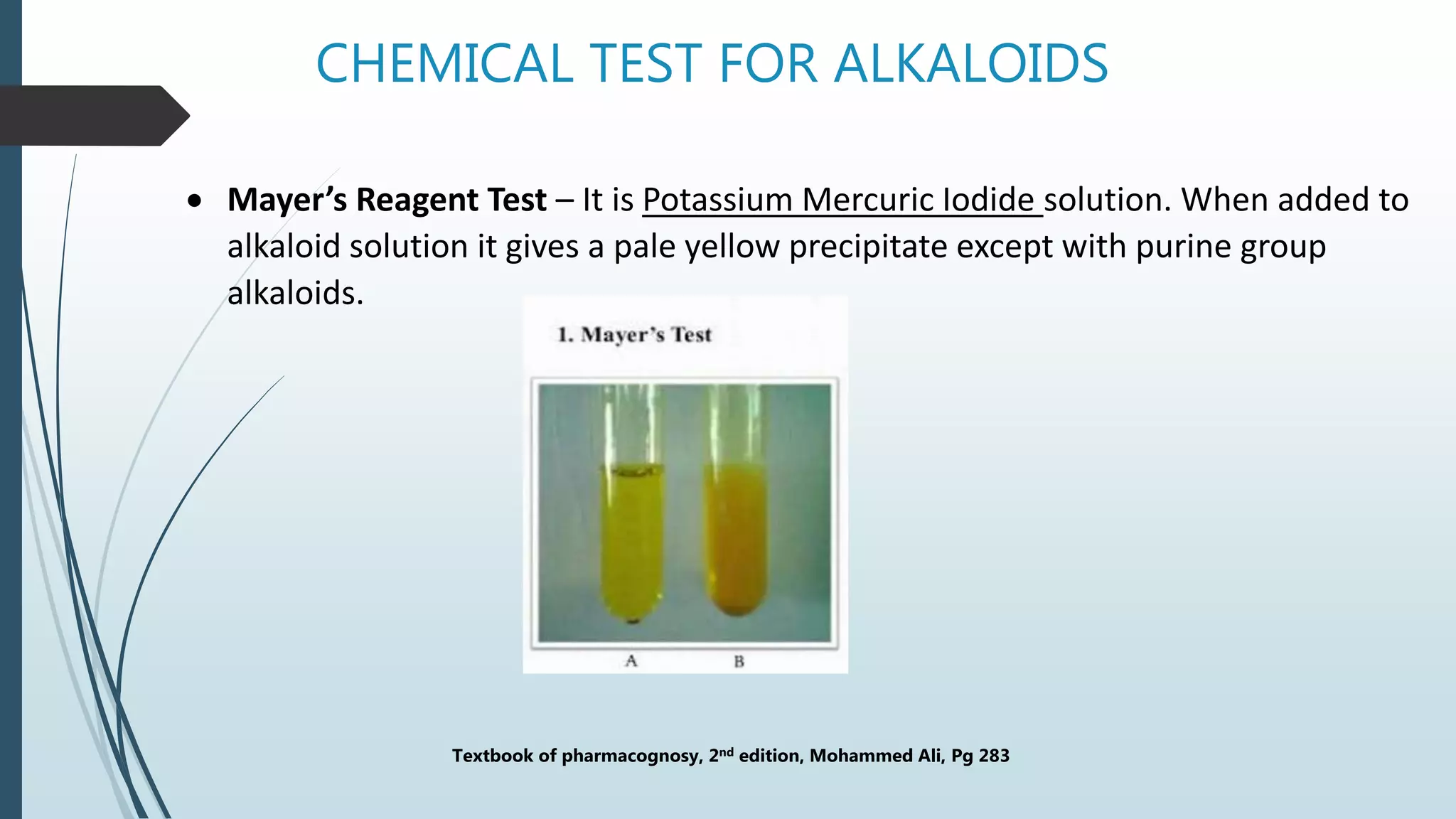
 Mayer’s Reagent Test – It is Potassium Mercuric Iodide solution. When added to
alkaloid solution it gives a pale yellow precipitate except with purine group
alkaloids.
Textbook of pharmacognosy, 2nd edition, Mohammed Ali, Pg 283
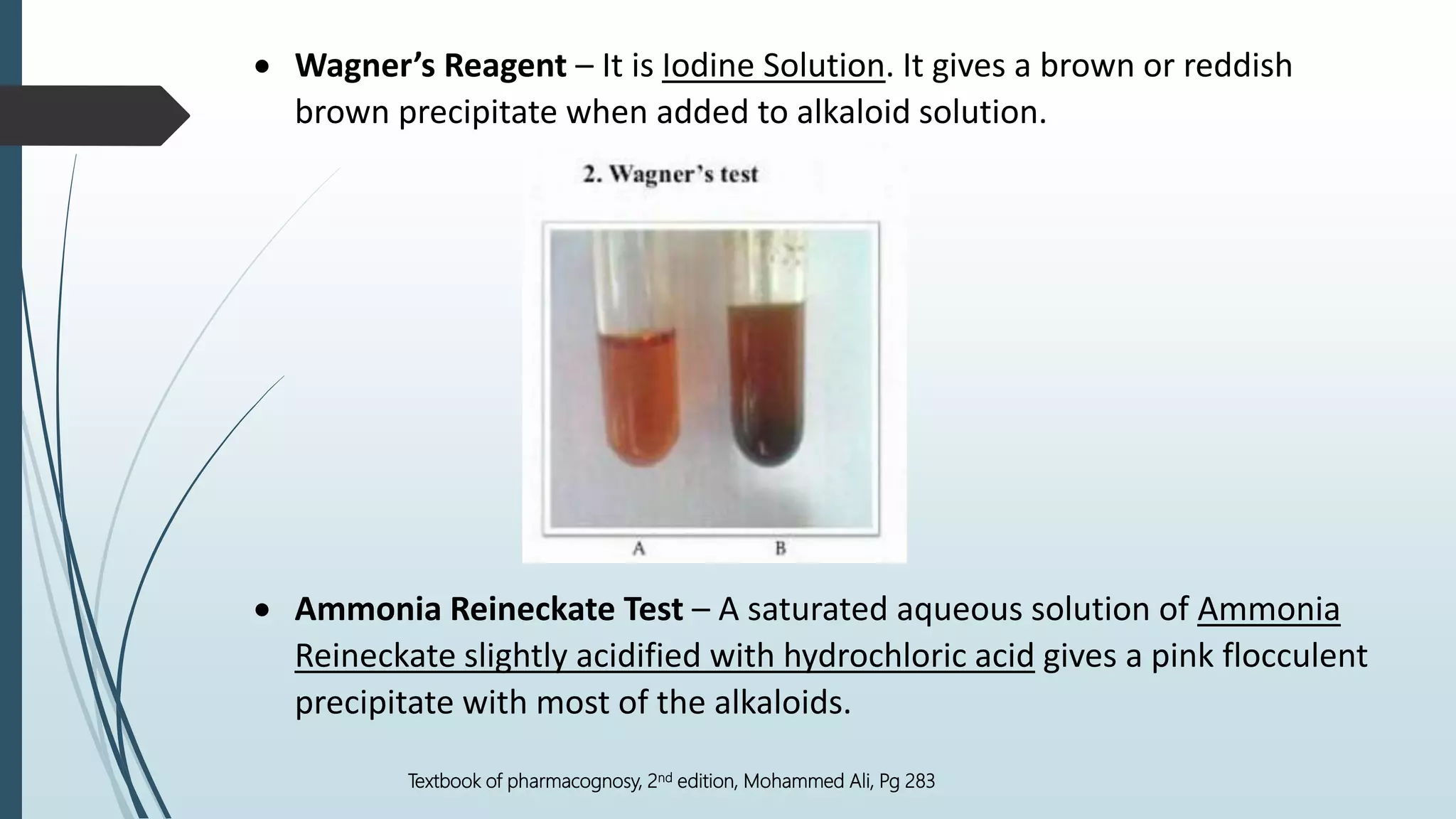
 Wagner’s Reagent – It is Iodine Solution. It gives a brown or reddish
brown precipitate when added to alkaloid solution.
 Ammonia Reineckate Test – A saturated aqueous solution of Ammonia
Reineckate slightly acidified with hydrochloric acid gives a pink flocculent
precipitate with most of the alkaloids.
Textbook of pharmacognosy, 2nd edition, Mohammed Ali, Pg 283
 Hager’s Reagent Test – It is a Saturated solution of Picric Acid in
cold water. It gives a characteristic crystalline precipitate with
many alkaloids.
 Dragendroff’s Reagent – It is Potassium iodide + Bismuth nitrate.
When this reagent is added to the alkaloid solution an orange
colour precipitate is obtained.
 Tannic Acid Test – A freshly prepared aqueous solution of Tannic
Acid (50% w/v) gives a precipitate with most of the alkaloids which
is soluble in dilute acid or ammonia solution.
Textbook of pharmacognosy, 2nd edition, Mohammed Ali, Pg 283
USES OF ALKALOIDS
 Alkaloids are capable to exhibit extensive and well marked pharmacological
activities like :
 Analgesic (cocain, morphine, codeine)
 Antihypertensive (reserpine, deserpine)
 Antimalarial (quinine, cinchonine)
 Antitumor (vinblastine)
 Antitussive (codeine, noscapine)
 Cardiac depressant (quinidine)
 Oxytocic (ergometrine, ergotamine)
 Diuretic (theobromine)
 Smooth muscle relaxant (theophylline)
Textbook of pharmacognosy, 2nd edition, Mohammed Ali, Pg 284
 Tomatin the major alkaloid of tomato acts as a repellent.
 They also acts as regulatory growth factors and, reserve substances for
nitrogen and other elemental supply.
 They occur as pigments, such as pteridine and betalains and attract animals
for pollination.
Textbook of pharmacognosy, 2nd edition, Mohammed Ali, Pg 284
EXAMPLE OF ALKALOIDS
LOBELIA
Synonyms: Lobelia herb; Indiana tobacco; Wild tobacco; Emetic herb; Asthma
weed; Bladder pod; Vomit wort
Family: Lobeliaceae
Geographical source: Indigenous to the eastern USA, Canada and Holland. It is an
erect annual herb and 30 – 90 cm high.
Cultivation and collection: Seeds of Lobelia are sown in March – April or autumn
in rich, moist, loamy soil. On germination the plants are grown to produce stems
of 30 – 50 cm in height.
Textbook of pharmacognosy, 2nd edition, Mohammed Ali, Pg 286
Uses:
 Expectorant used to treat spasmodic asthma and chronic bronchitis.
 Used as respiratory stimulant and relaxant.
 Used in gas, alcohol and narcotic poisoning.
 Help to discontinue smoking habits.
Textbook of Pharmacognosy, 2nd edition, Mohammed Ali, Pg 289
THANK YOU

Alkaloids Pharmacognosy

  • 1.
    Presentation On Alkaloids Amity University, NOIDA AmityInstitute of Pharmacy BY: UNNATI GARG
  • 2.
    INTRODUCTION  The termalkaloid is applied to naturally occurring basic compounds.  The term is derived from ‘vegetable alkali’ (alk=alkali; oid= like).  A true alkaloid has: a nitrogen atom as a part of hetrocyclic system; a complex molecular structure; it manifests significant pharmacological activity and it is restricted to the plant kingdom .  Alkaloids have been reported in various plant parts such as: a)in whole aerial plant (Lobelia, Tylophora, Ephedra) b) in leaves (Datura , Belladonna , Coca) c)in bark (Kurchi, cinchona) d) in stem (withania) etc. Textbook of Pharmacognosy, 2nd edition, Mohammed Ali, Pg 282
  • 3.
     Several alkaloidshave been found in cultures of microorganisms, e.g., in bacteria, in fungi and algae.  The names of alkaloids have been derived from plants yielding them , from physiological activity and from the discoverer .  As per the chemical rules the names of all alkaloids should end in “ine”.  Alkaloids exhibit a variety of physical and chemical properties.  All of them possess carbon,hydrogen and nitrogen and in most cases oxygen as elements. Textbook of pharmacognosy, 2nd edition, Mohammed Ali, Pg 283
  • 4.
     They formtheir crystalline salts with acids like hydrochloric acid, sulfuric acid, citric acid and tartaric acid.  The free alkaloids are insoluble or slightly soluble in water but their salts are freely soluble.  However, they are soluble in non polar solvents such as ether or chloroform.  Most of the alkaloids are crystalline solids with definite melting point, some of them are amorphous and few are liquids.  They are generally colorless compounds but few are coloured substances e.g. berberine (yellow) betaine (red) etc.  They are generally bitter in taste and optically active. Textbook of pharmacognosy, 2nd edition, Mohammed Ali, Pg 283
  • 5.
    CLASSIFICATION OF ALKALOIDS Alkaloidsare basic nitrogen containing compounds. They are generally obtained from plants, animals and microorganisms and often demonstrate a marked physiological action. Alkaloids show greatly diverse structure and origins as well as pharmacological action. The only thing that unites all these natural compounds under the term ‘alkaloids’ (alkali-like) is the nitrogen atom which is present in all of them. According to Pharmacognosy, alkaloids are broadly classified into two classes depending upon whether the nitrogen is a part of a ring or not. Textbook of pharmacognosy, 2nd edition, Mohammed Ali, Pg 283
  • 6.
    In the recentpast, the alkaloids have been divided into two major categories based on the analogy that one containing a non-heterocyclic nucleus, while the other having the heterocyclic nucleus. These two classes of alkaloids shall be discussed briefly as under. • Non-heterocyclic Alkaloids: A few typical alkaloids having non-heterocyclic nucleus are enumerated below: Textbook of pharmacognosy, 2nd edition, Mohammed Ali, Pg 284
  • 7.
    • Heterocyclic Alkaloids:Many specific alkaloids possessing heterocyclic nucleus are stated below: Textbook of pharmacognosy, 2nd edition, Mohammed Ali, Pg 284
  • 8.
    Other methods ofclassification of alkaloids include: Based on their pharmacological action: Alkaloids have very diverse pharmacological actions. They are known to be adrenergic, antibiotics, poisons, stimulants, diuretics, astringents, anti-inflammatory, anti-hypertensives, anti-mydriatics, analgesics, anti-gout, expectorant, emetic, anti-spasmodic and many others. Based on their taxonomy: Alkaloids can be classified based on the biological source from which they are obtained but this generalization does not work most often. Based on their biosynthetic origin: Biosynthetic origin here means from which fundamental chemical building block these alkaloids are derived. For example, indole alkaloids often come from tryptophan, pyrrolidine and tropane containing alkaloids come from proline and ornithine, quinolizidine containing alkaloids are derived from lysine. Textbook of pharmacognosy, 2nd edition, Mohammed Ali, Pg 284
  • 9.
    CHEMICAL TEST FORALKALOIDS  Mayer’s Reagent Test – It is Potassium Mercuric Iodide solution. When added to alkaloid solution it gives a pale yellow precipitate except with purine group alkaloids. Textbook of pharmacognosy, 2nd edition, Mohammed Ali, Pg 283
  • 10.
     Wagner’s Reagent– It is Iodine Solution. It gives a brown or reddish brown precipitate when added to alkaloid solution.  Ammonia Reineckate Test – A saturated aqueous solution of Ammonia Reineckate slightly acidified with hydrochloric acid gives a pink flocculent precipitate with most of the alkaloids. Textbook of pharmacognosy, 2nd edition, Mohammed Ali, Pg 283
  • 11.
     Hager’s ReagentTest – It is a Saturated solution of Picric Acid in cold water. It gives a characteristic crystalline precipitate with many alkaloids.  Dragendroff’s Reagent – It is Potassium iodide + Bismuth nitrate. When this reagent is added to the alkaloid solution an orange colour precipitate is obtained.  Tannic Acid Test – A freshly prepared aqueous solution of Tannic Acid (50% w/v) gives a precipitate with most of the alkaloids which is soluble in dilute acid or ammonia solution. Textbook of pharmacognosy, 2nd edition, Mohammed Ali, Pg 283
  • 12.
    USES OF ALKALOIDS Alkaloids are capable to exhibit extensive and well marked pharmacological activities like :  Analgesic (cocain, morphine, codeine)  Antihypertensive (reserpine, deserpine)  Antimalarial (quinine, cinchonine)  Antitumor (vinblastine)  Antitussive (codeine, noscapine)  Cardiac depressant (quinidine)  Oxytocic (ergometrine, ergotamine)  Diuretic (theobromine)  Smooth muscle relaxant (theophylline) Textbook of pharmacognosy, 2nd edition, Mohammed Ali, Pg 284
  • 13.
     Tomatin themajor alkaloid of tomato acts as a repellent.  They also acts as regulatory growth factors and, reserve substances for nitrogen and other elemental supply.  They occur as pigments, such as pteridine and betalains and attract animals for pollination. Textbook of pharmacognosy, 2nd edition, Mohammed Ali, Pg 284
  • 14.
    EXAMPLE OF ALKALOIDS LOBELIA Synonyms:Lobelia herb; Indiana tobacco; Wild tobacco; Emetic herb; Asthma weed; Bladder pod; Vomit wort Family: Lobeliaceae Geographical source: Indigenous to the eastern USA, Canada and Holland. It is an erect annual herb and 30 – 90 cm high. Cultivation and collection: Seeds of Lobelia are sown in March – April or autumn in rich, moist, loamy soil. On germination the plants are grown to produce stems of 30 – 50 cm in height. Textbook of pharmacognosy, 2nd edition, Mohammed Ali, Pg 286
  • 15.
    Uses:  Expectorant usedto treat spasmodic asthma and chronic bronchitis.  Used as respiratory stimulant and relaxant.  Used in gas, alcohol and narcotic poisoning.  Help to discontinue smoking habits. Textbook of Pharmacognosy, 2nd edition, Mohammed Ali, Pg 289
  • 16.