PHARMACOGNOSY AND PHYTOCHEMISTRY –II (BP504T)
INSTITUTE OF PHARMACEUTICAL RESEARCH,
GLA UNIVERSITY, MATHURA
MODULE I: OPIUM
Sonia Singh
Assistant professor
GLA University,
Mathura
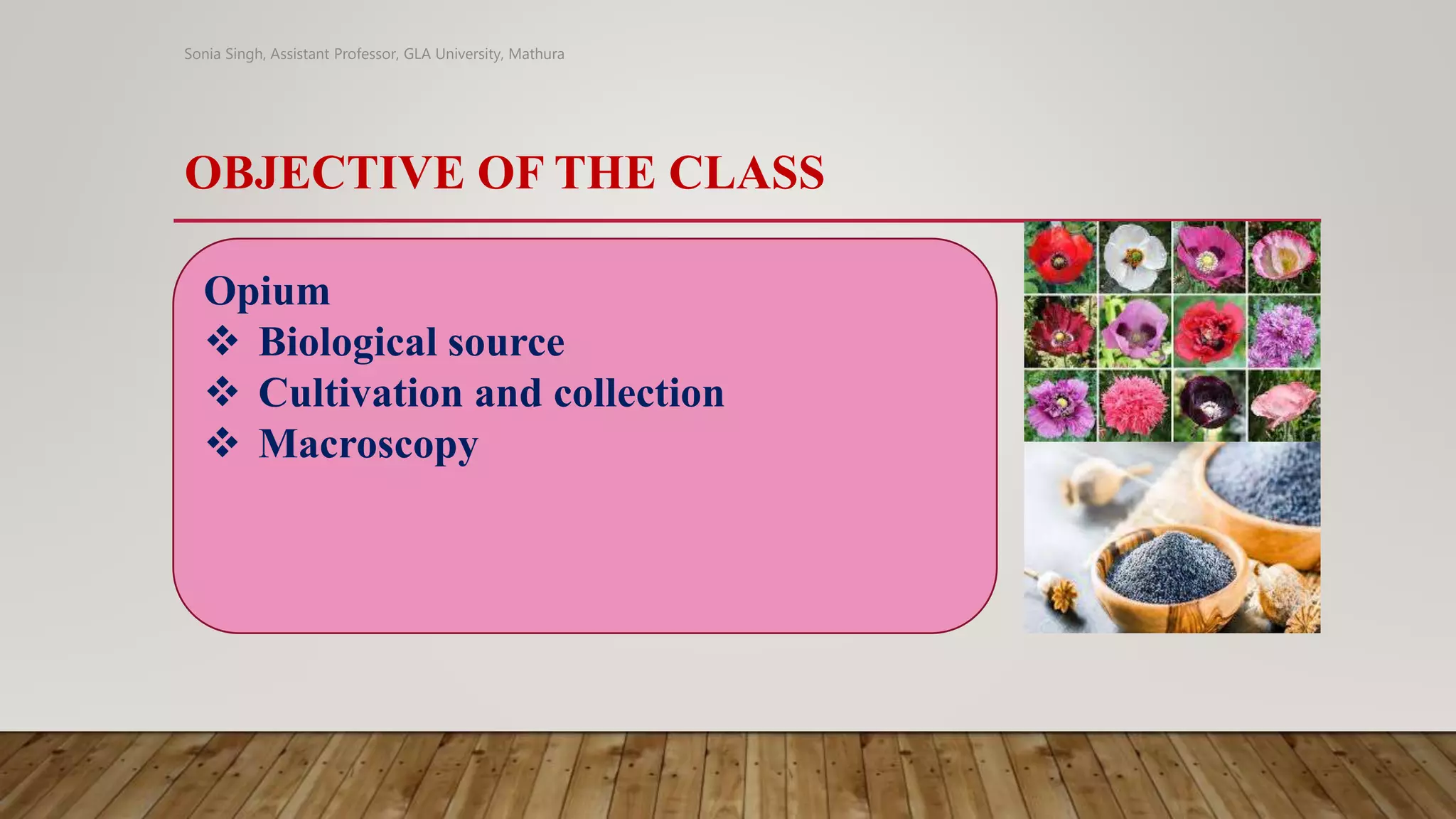
OBJECTIVE OF THE CLASS
Opium
 Biological source
 Cultivation and collection
 Macroscopy
Sonia Singh, Assistant Professor, GLA University, Mathura
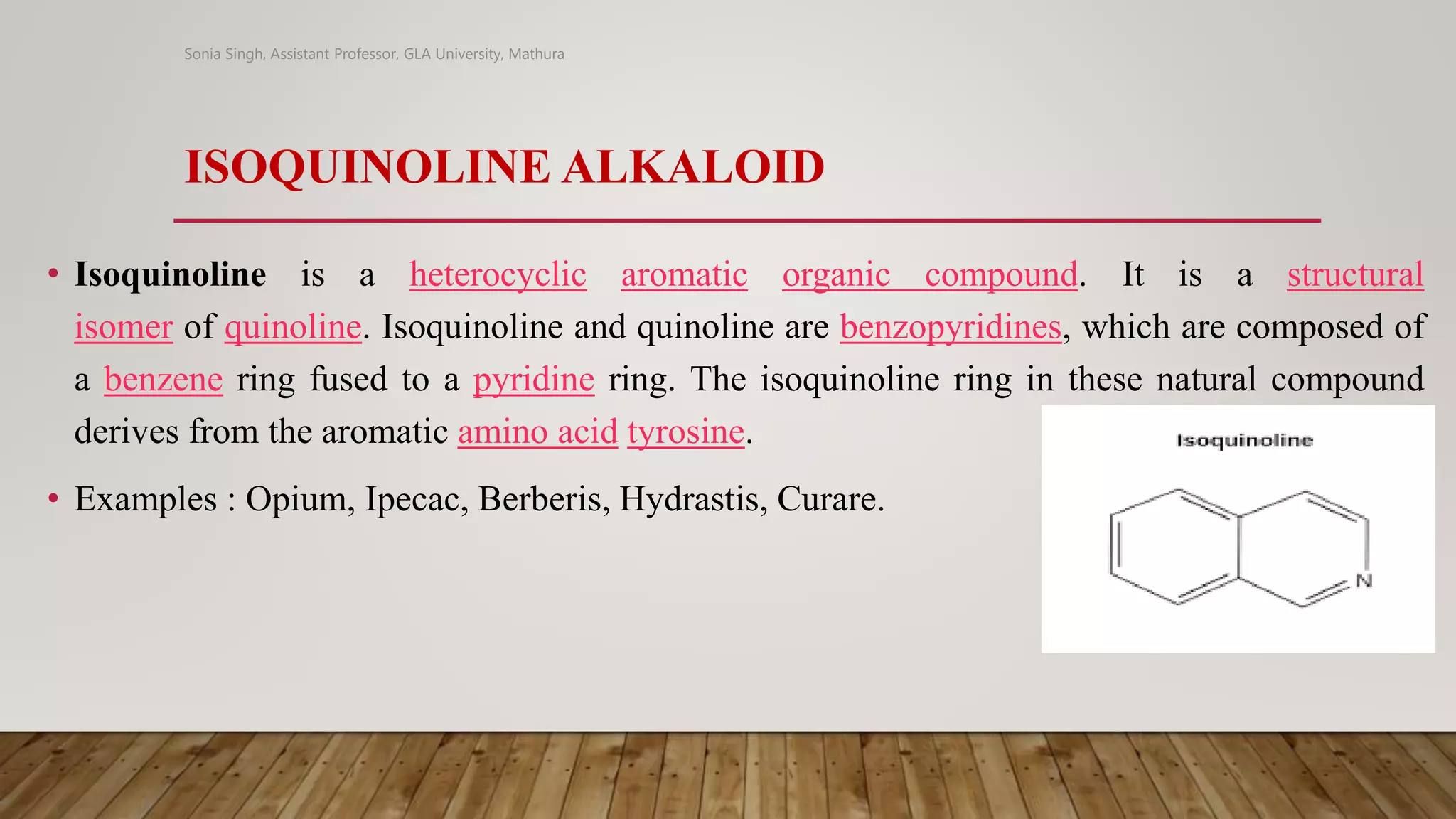
ISOQUINOLINE ALKALOID
• Isoquinoline is a heterocyclic aromatic organic compound. It is a structural
isomer of quinoline. Isoquinoline and quinoline are benzopyridines, which are composed of
a benzene ring fused to a pyridine ring. The isoquinoline ring in these natural compound
derives from the aromatic amino acid tyrosine.
• Examples : Opium, Ipecac, Berberis, Hydrastis, Curare.
Sonia Singh, Assistant Professor, GLA University, Mathura
DRIED LATEX
• Latex is the milky sap of many plants that coagulates on exposure to air. It is an
emulsion or suspension in which the aqueous phase is composed of mineral salts,
proteins, sugars, tannins & alkaloids. The oily phase is composed of oils, resins,
etc.
• Latex is usually produced in laticiferous tissues which may be:
• Laticiferous cells • Laticiferous tubes. • Laticiferous vessels (originate from
many cells): e.g. Opium
Sonia Singh, Assistant Professor, GLA University, Mathura
OPIUM
• Synonym : Poppy Latex , Gum opium
• Biological source : It is the dried latex obtained by incision from the unripe capsules of
Papaver somniferum Linn. Family - Papaveraceae , dried or partly dried by heat or
spontaneous evaporation, and worked into somewhat irregularly shaped masses (natural
opium) or moulded into masses of more uniform size and shape (manipulated opium). It
contains not less than 9.5% of morphine.
• Commercial varieties include Turkish, Persian, Indian & Yugoslavian opium.
Sonia Singh, Assistant Professor, GLA University, Mathura
HISTORICAL OVERVIEW
3400 BC
Opium poppy was cultivated in lower Mesopotamia. The Sumerians referred to it as Hul Gul, the 'joy
plant.' The Sumerians would soon pass along the plant and its euphoric effects to the Assyrians. The art
of poppy-culling would continue from the Assyrians to the Babylonians who in turn would pass their
knowledge onto the Egyptians.
460 BC
Hippocrates, "the father of medicine", dismisses the magical attributes of opium but acknowledges its
usefulness as a narcotic and styptic in treating internal diseases, diseases of women and epidemics.
330 BC
Alexander the Great introduced opium to the people of Persia and India.
1000 Ancient Indian medical work namely 'Bhavaprakasha' describes the use of Opium.
Sonia Singh, Assistant Professor, GLA University, Mathura
GEOGRAPHICAL SOURCE
• India, Pakistan, Afghanistan,
Turkey, Russia, China, Iran
Sonia Singh, Assistant Professor, GLA University, Mathura
CULTIVATION AND COLLECTION
• Being a potent narcotic drug, the cultivation are governed by respective
governments in different countries, including India.
• In India, all the activities about opium and its derivatives are controlled
under Narcotic Drugs and Psychotropic Substances Act, 1985.
• The genus Papaver has 50 different species , of which six species are found
in India: P. somniferum , P. nudicaule, P.rhoeas, P.orientale, P.argemone,
P dubium.
Sonia Singh, Assistant Professor, GLA University, Mathura
• Best climatic conditions for opium poppy are cool weather without freezing
temperature and cloudiness, and sufficient sunshine.
• Grown from November to March.
• Propagation is done by sowing the seeds.
• Requires highly fertile, well drained loamy soil with fine sand. The soil should contain
organic matter, nitrogen and should have a pH around 7.
• Thinning of plants is done periodically to get uniform growth and better development.
• Use of weedicides, manures and fertilizers.
Sonia Singh, Assistant Professor, GLA University, Mathura
• After sowing, within 3-4 months, the plant bears flowers, which are converted to
capsules within few days.
• They start attain maturity after 15-20 days.
• During the maturity period, the capsules exudes maximum latex which shows a colour
change from dark green to light green.
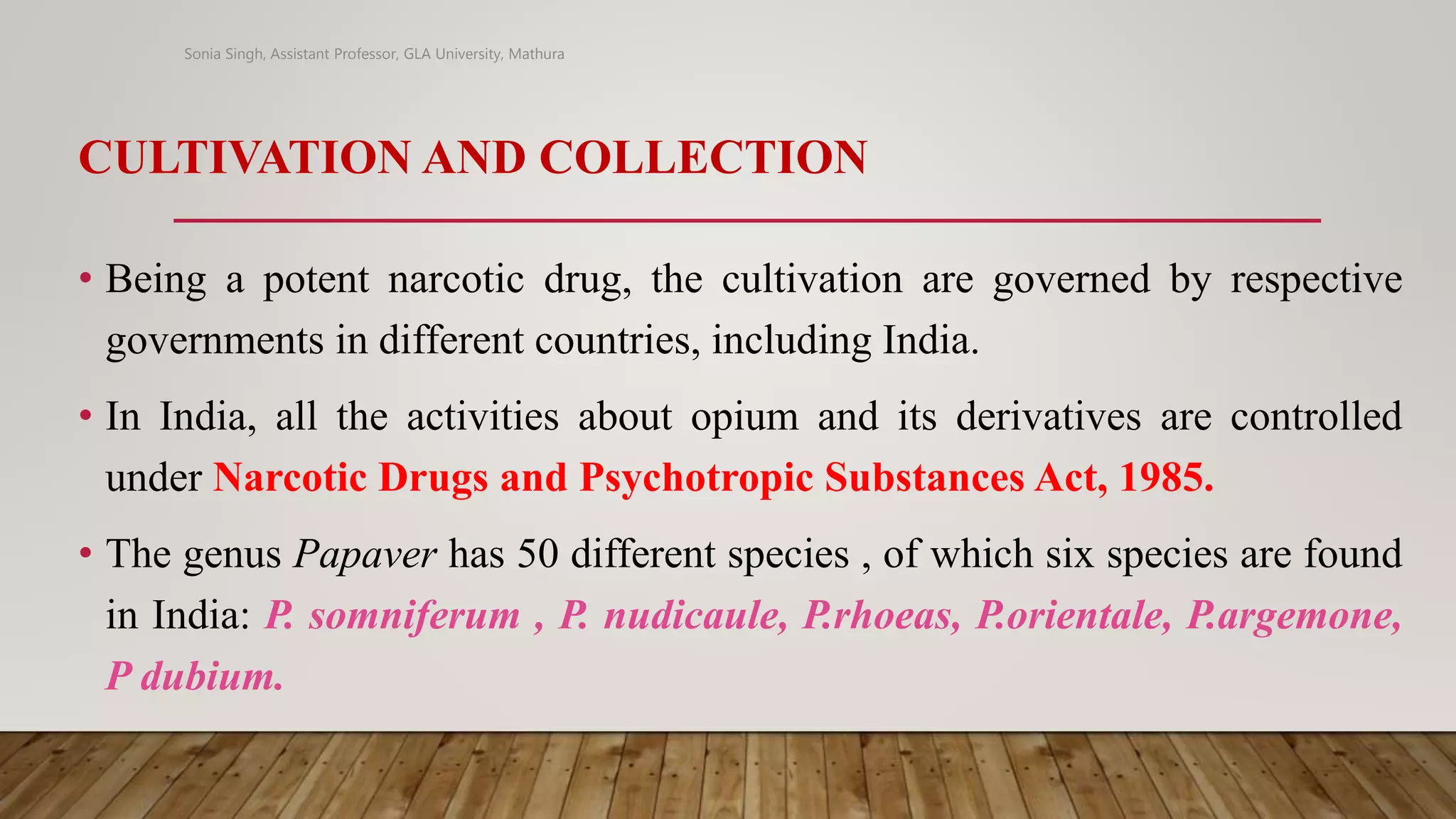
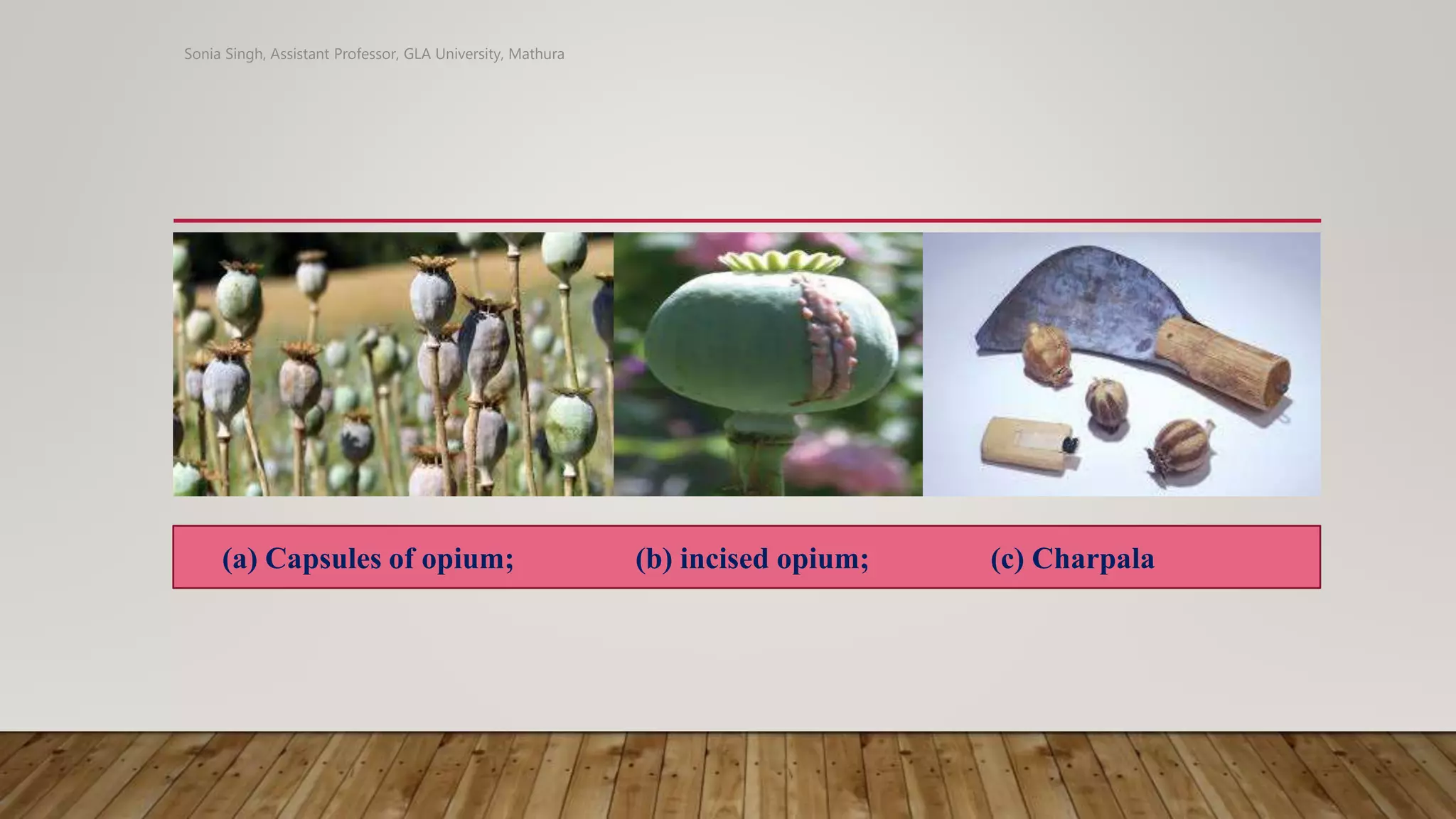
• Such capsules are incised vertically in the afternoon with the help of specific needle like
apparatus called ‘nushtur’, which penetrated maximum upto 2 mm into the capsule.
Sonia Singh, Assistant Professor, GLA University, Mathura
• Due to incisions, latex exudes out and thickens due to cold weather in night which is
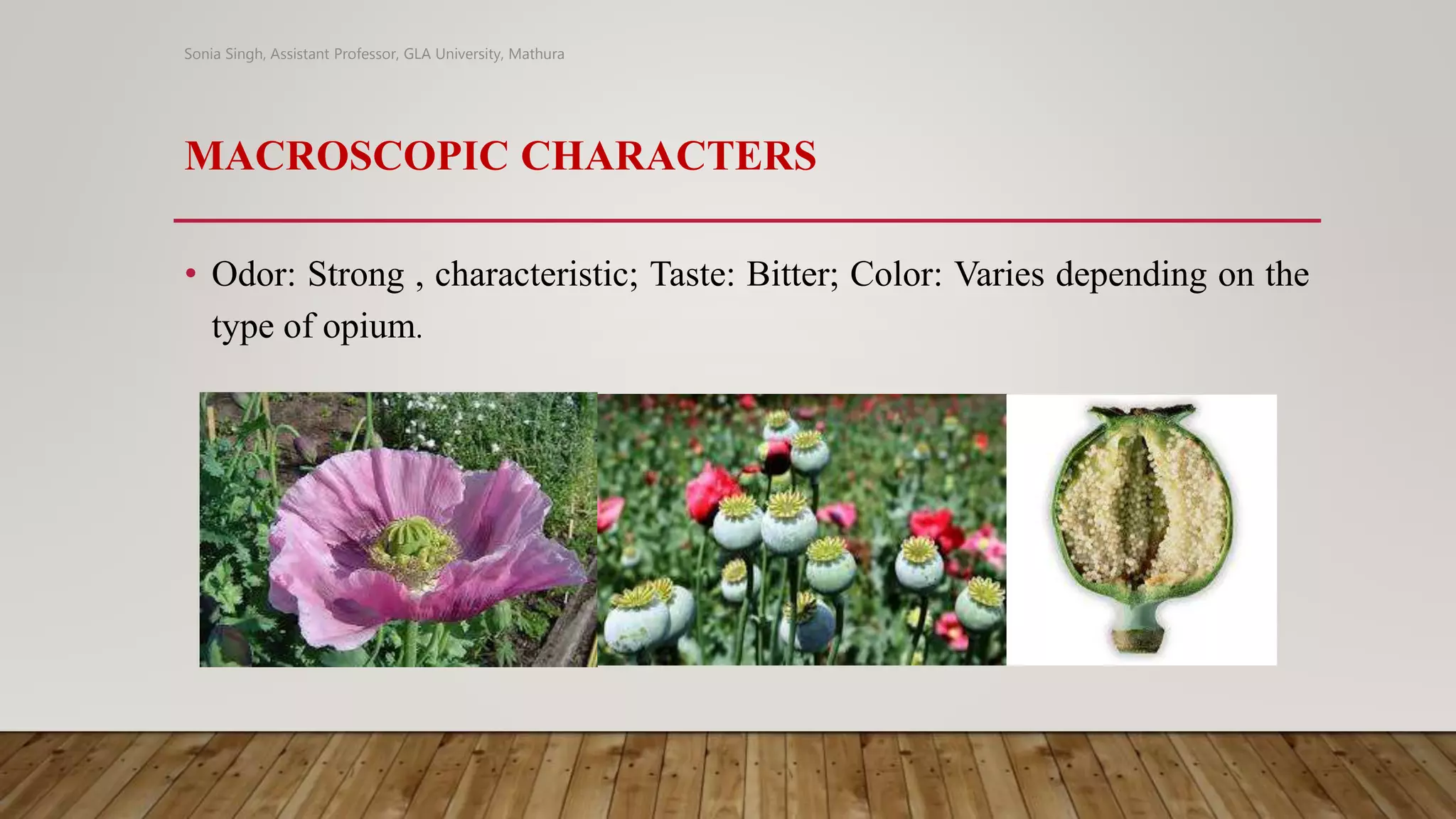
eventually scrapped and collected next morning by an iron scoop called Charpala.
• The process is repeated for about 4-5 times on the same capsules with 2 days interval.
• The incisions must remain superficial, so as to maintain the external exudation of latex.
The latex is collected in plastic containers.
• Capsules are collected and dried in open areas and further the seeds are separated by
beating.
• Processing of opium takes place at Government opium factory at Ghazipur.
Sonia Singh, Assistant Professor, GLA University, Mathura
(a) Capsules of opium; (b) incised opium; (c) Charpala
Sonia Singh, Assistant Professor, GLA University, Mathura
MACROSCOPIC CHARACTERS
• Odor: Strong , characteristic; Taste: Bitter; Color: Varies depending on the
type of opium.
Sonia Singh, Assistant Professor, GLA University, Mathura
DIFFERENT VARIETIES OF OPIUM
• Indian opium : Dark brown in colour, brittle in nature.
• Persian opium: Dark brown in colour, found in the form of brick shaped masses,
hygroscopic in nature.
• Natural Turkish or European opium: Brown or dark brown in colour, hard and
brittle, covered with poppy leaves.
• Manipulated Turkish opium: Chocolate brown or dark brown, covered with
broken poppy leaves, brittle.
• Manipulated European opium: Dark brown, covered with broken leaves with
brittle fracture.
Sonia Singh, Assistant Professor, GLA University, Mathura

Opium: Biological source, Cultivation and collection, Morphology

  • 1.
    PHARMACOGNOSY AND PHYTOCHEMISTRY–II (BP504T) INSTITUTE OF PHARMACEUTICAL RESEARCH, GLA UNIVERSITY, MATHURA MODULE I: OPIUM Sonia Singh Assistant professor GLA University, Mathura
  • 2.
    OBJECTIVE OF THECLASS Opium  Biological source  Cultivation and collection  Macroscopy Sonia Singh, Assistant Professor, GLA University, Mathura
  • 3.
    ISOQUINOLINE ALKALOID • Isoquinolineis a heterocyclic aromatic organic compound. It is a structural isomer of quinoline. Isoquinoline and quinoline are benzopyridines, which are composed of a benzene ring fused to a pyridine ring. The isoquinoline ring in these natural compound derives from the aromatic amino acid tyrosine. • Examples : Opium, Ipecac, Berberis, Hydrastis, Curare. Sonia Singh, Assistant Professor, GLA University, Mathura
  • 4.
    DRIED LATEX • Latexis the milky sap of many plants that coagulates on exposure to air. It is an emulsion or suspension in which the aqueous phase is composed of mineral salts, proteins, sugars, tannins & alkaloids. The oily phase is composed of oils, resins, etc. • Latex is usually produced in laticiferous tissues which may be: • Laticiferous cells • Laticiferous tubes. • Laticiferous vessels (originate from many cells): e.g. Opium Sonia Singh, Assistant Professor, GLA University, Mathura
  • 5.
    OPIUM • Synonym :Poppy Latex , Gum opium • Biological source : It is the dried latex obtained by incision from the unripe capsules of Papaver somniferum Linn. Family - Papaveraceae , dried or partly dried by heat or spontaneous evaporation, and worked into somewhat irregularly shaped masses (natural opium) or moulded into masses of more uniform size and shape (manipulated opium). It contains not less than 9.5% of morphine. • Commercial varieties include Turkish, Persian, Indian & Yugoslavian opium. Sonia Singh, Assistant Professor, GLA University, Mathura
  • 6.
    HISTORICAL OVERVIEW 3400 BC Opiumpoppy was cultivated in lower Mesopotamia. The Sumerians referred to it as Hul Gul, the 'joy plant.' The Sumerians would soon pass along the plant and its euphoric effects to the Assyrians. The art of poppy-culling would continue from the Assyrians to the Babylonians who in turn would pass their knowledge onto the Egyptians. 460 BC Hippocrates, "the father of medicine", dismisses the magical attributes of opium but acknowledges its usefulness as a narcotic and styptic in treating internal diseases, diseases of women and epidemics. 330 BC Alexander the Great introduced opium to the people of Persia and India. 1000 Ancient Indian medical work namely 'Bhavaprakasha' describes the use of Opium. Sonia Singh, Assistant Professor, GLA University, Mathura
  • 7.
    GEOGRAPHICAL SOURCE • India,Pakistan, Afghanistan, Turkey, Russia, China, Iran Sonia Singh, Assistant Professor, GLA University, Mathura
  • 8.
    CULTIVATION AND COLLECTION •Being a potent narcotic drug, the cultivation are governed by respective governments in different countries, including India. • In India, all the activities about opium and its derivatives are controlled under Narcotic Drugs and Psychotropic Substances Act, 1985. • The genus Papaver has 50 different species , of which six species are found in India: P. somniferum , P. nudicaule, P.rhoeas, P.orientale, P.argemone, P dubium. Sonia Singh, Assistant Professor, GLA University, Mathura
  • 9.
    • Best climaticconditions for opium poppy are cool weather without freezing temperature and cloudiness, and sufficient sunshine. • Grown from November to March. • Propagation is done by sowing the seeds. • Requires highly fertile, well drained loamy soil with fine sand. The soil should contain organic matter, nitrogen and should have a pH around 7. • Thinning of plants is done periodically to get uniform growth and better development. • Use of weedicides, manures and fertilizers. Sonia Singh, Assistant Professor, GLA University, Mathura
  • 10.
    • After sowing,within 3-4 months, the plant bears flowers, which are converted to capsules within few days. • They start attain maturity after 15-20 days. • During the maturity period, the capsules exudes maximum latex which shows a colour change from dark green to light green. • Such capsules are incised vertically in the afternoon with the help of specific needle like apparatus called ‘nushtur’, which penetrated maximum upto 2 mm into the capsule. Sonia Singh, Assistant Professor, GLA University, Mathura
  • 11.
    • Due toincisions, latex exudes out and thickens due to cold weather in night which is eventually scrapped and collected next morning by an iron scoop called Charpala. • The process is repeated for about 4-5 times on the same capsules with 2 days interval. • The incisions must remain superficial, so as to maintain the external exudation of latex. The latex is collected in plastic containers. • Capsules are collected and dried in open areas and further the seeds are separated by beating. • Processing of opium takes place at Government opium factory at Ghazipur. Sonia Singh, Assistant Professor, GLA University, Mathura
  • 12.
    (a) Capsules ofopium; (b) incised opium; (c) Charpala Sonia Singh, Assistant Professor, GLA University, Mathura
  • 13.
    MACROSCOPIC CHARACTERS • Odor:Strong , characteristic; Taste: Bitter; Color: Varies depending on the type of opium. Sonia Singh, Assistant Professor, GLA University, Mathura
  • 14.
    DIFFERENT VARIETIES OFOPIUM • Indian opium : Dark brown in colour, brittle in nature. • Persian opium: Dark brown in colour, found in the form of brick shaped masses, hygroscopic in nature. • Natural Turkish or European opium: Brown or dark brown in colour, hard and brittle, covered with poppy leaves. • Manipulated Turkish opium: Chocolate brown or dark brown, covered with broken poppy leaves, brittle. • Manipulated European opium: Dark brown, covered with broken leaves with brittle fracture. Sonia Singh, Assistant Professor, GLA University, Mathura
  • 15.
    Sonia Singh, AssistantProfessor, GLA University, Mathura