PNEUMONIA
Dr. Usman Shams
Classifications of PNEUMONIAS
• COMMUNITY ACQUIRED ACUTE
• HEALTH CARE-ASSOCIATED
• HOSPITAL ACQUIRED
• ASPIRATION
• CHRONIC
• NECROTIZING/ABSCESS FORMATION
• PNEUMONIAS in IMMUNOCOMPROMISED HOSTS
Although pneumonia is one
of the most common causes
of death, it usually does
NOT occur in healthy people
spontaneously
MORPHOLOGY
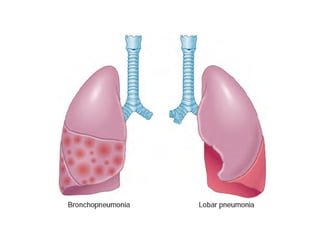
• LOBAR vs. BRONCHO
• “HEPATIZATION”, RED vs. GREY
• CONSOLIDATION
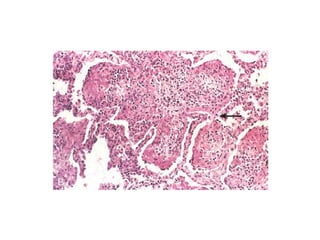
• “INFILTRATE”, XRAY vs. HISTOPATH
• Loss of “CREPITANCE”
COMMUNITY ACQUIRED, Bacterial
• STREPTOCOCCUS PNEUMONIAE
• HAEMOPHILUS INFLUENZAE (“H-Flu”)
• MORAXELLA
• STAPHYLOCOCCUS (STAPH)
• KLEBSIELLA PNEUMONIAE
• PSEUDOMONAS AERUGINOSA
• LEGIONELLA PNEUMOPHILIA
• MYCOPLASMA
STREPTOCOCCUS
• The classic LOBAR pneumonia
• Normal flora in 20% of adults
• Only 20% of victims have + blood cultures
• “Penicillins” are often 100% curative
• Vaccines are often 100% preventive
HAEMOPHILUS PNEUMONIA
• Commonest in CHILDREN <2, with otitis, URI,
meningitis, cellulitis, osteomyelitis, conjunctivitis
(pink eyes)
• PNEUMONIAS in CHILDREN <2 are often thought
of as being H Flu until proven otherwise.
• Most common pneumonia from COPD in adults
• BACTRIM (Trimethoprim-Sulfa) most common
treatment
• Vaccine available against capsulated form.
MORAXELLA CATARRHALIS
• 2nd most common COPD pneumonia, after
haemophilus
• Gram NEGATIVE coccobacillus, like H. Flu
STAPH aureus
• Most common pneumonia following viral
pneumonias
• M.R.S.A., of course, is usually NOT
“community” acquired
• IV Drug abusers
• Increased risk of complications … lung
abscess, empyema.
KLEBSIELLA PNEUMONIAE
• DEBILITATED MALNOURISHED PEOPLE
• ALCOHOLICS with pneumonia are often
thought of as having Klebsiella until proven
otherwise
• Thick, gelatinous, blood tinged sputum
PSEUDOMONAS Aeruginosa
• Usually NOT community acquired but
nosocomial
• Burns & Neutropenia
• CYSTIC FIBROSIS patients with pneumonia
are presumed to have PSEUDOMONAS until
proven otherwise
• Dangerous … invasive organism
LEGIONELLA (pneumophila)
• Often in OUTBREAKS
• Often LOBAR
• Spread by water “droplets”
• Often immunosuppressed patients …
TRANSPLANT
MYCOPLASMA
• Often in closed communities … SCHOOLS,
MILITARY CAMPS, PRISONS
COMMUNITY ACQUIRED, Viral
• CULTURES NOT HELPFUL
• Usually
– Confined to alveolar septum and
pulmonary interstitium
– Moderate amount of sputum
– No consolidation
VIRAL PNEUMONIAS
• Frequently “interstitial”, NOT alveolar
• INFLUENZA VIRUS
• RESPIRATORY SYNCITIAL VIRUS
• HUMAN METAPNEUMO VIRUS
• ADENOVIRUS
• RHINOVIRUS
• RUBEOLA
• VARICELLA
INFLUENZA VIRUS
• RNA virus … types A,B,C
• PAN-demics, type A
• Virulence factors:
– Hemagglutinin (H1-H3) … Attachment
– Neuroaminidase (N1, N2) … Release of newly formed
virions
• Antigenic drift … Has MUTATED throughout
history, many STRAINS … Avian (H5N1)
• B and C in children
• Exact strains can be ID’s by PCR
METAPNEUMO VIRUS
• Most commonly seen in extremes of ages and
immunocompromised
• 20% of paediatric outpatient URTIs
SARS
(Severe Acute Respiratry Syndrome)
• A new CORONA-VIRUS
• 2002 China outbreak
• Spread CHIEFLY in Asia
• Last infection … 2004 in lab.
• Like most viral pneumonias, interstitium
infiltrated, some giant cells often present
S
A
R
S
MORPHOLOGY
• Mucosal hyperemia and swelling,
lymphomonocytic and plasmacytic infiltration of
the submucosa
• Overproduction of mucus secretions.
• Plugging … suppurative secondary bacterial
infection.
• Tonsillitis … frequent in children
• Severe bronchiolar involvement …, organization
and fibrosis, resulting in obliterative bronchiolitis
and permanent lung damage.
HOSPITAL CARE-ASSOCIATED
• Recently described clinical entity
• Risk factors
– Hospitalization of at least 2 days within the recent
past
– Presentation from a nursing home or long-term care
facility
– Attending a hospital or hemodialysis clinic
– Recent intravenous antibiotic therapy, chemotherapy
or wound care. The most common
• Common organisms
– Methicillin-resistant Staphylococcus aureus
– P. aeruginosa.
• Higher mortality than those with community-
acquired pneumonia.
NOSOCOMIAL
• “Pulmonary infections acquired in the course of a
hospital stay.”
• Risk factors
– Severe underlying disease
– Immunosuppression
– Prolonged antibiotic therapy, or invasive access devices
such as intravascular catheters.
– Patients on mechanical ventilation
• Often life-threatening complications.
• Gram-positive cocci (mainly S. aureus and S.
pneumonia) and gram-negative rods
(Enterobacteriaceae and Pseudomonas species).
Classifications of PNEUMONIAS
• COMMUNITY ACQUIRED ACUTE
• HEALTH CARE-ASSOCIATED
• HOSPITAL ACQUIRED
• ASPIRATION
• CHRONIC
• NECROTIZING/ABSCESS FORMATION
• PNEUMONIAS in IMMUNOCOMPROMISED HOSTS
ASPIRATION PNEUMONIAS
• UNCONSCIOUS PATIENTS
• PATIENTS IN PROLONGED BEDREST
• LACK OF ABILITY TO SWALLOW OR GAG
• USUALLY CAUSED BY ASPIRATION OF GASTRIC
CONTENTS
• POSTERIOR LOBES (gravity dependent) MOST
COMMONLY INVOLVED, ESPECIALLY THE SUPERIOR
SEGMENTS OF THE LOWER LOBES
• TYPICALLY MORE THAN ONE ORGANISM IS FOUND ON
CULTURES.
• OFTEN LEAD TO ABSCESSES
• MICROASPIRATION
– GERD patients
– Leads to small, poorly formed non-necrotizing
granulomas with multinucleated foreign body
giant cell reaction.
– Usually inconsequential
LUNG ABSCESSES• ASPIRATION
• SEPTIC EMBOLIZATION
• NEOPLASIA
• FROM NEIGHBORING STRUCTURES:
– ESOPHAGUS
– SPINE
– PLEURA
– DIAPHRAGM
• ANY PNEUMONIA WHICH IS SEVERE AND
DESTRUCTIVE, AND UN-TREATED … Kleb., S. aureus
• IF NO CAUSE DETERMINED … PRIMARY CRYPTOGENIC
LUNG ABSCESSES.
• Vary in diameter from a few millimeters to large cavities
of 5 to 6 cm
• ASPIRATION … more common on the right, most often
single.
• PNEUMONIA OR BRONCHIECTASIS … usually
multiple, basal, and diffusely scattered.
• SEPTIC EMBOLI & PYEMIC ABSCESSES …multiple
and may affect any region of the lungs.
• Suppurative destruction of the lung parenchyma
within the central area of cavitation.
• Manifestations
– cough, fever, and copious amounts of foul-smelling purulent or
sanguineous sputum.
– Fever, chest pain, and weight loss
– Clubbing of the fingers and toes may appear within a few weeks
• Must be confirmed radiologically.
• In older individuals … rule out an underlying carcinoma,
(10% to 15%)
• Complications: Extension into the pleural cavity,
hemorrhage, the development of brain abscesses or
meningitis from septic emboli, and (rarely) secondary
amyloidosis (type AA).
CHRONIC Pneumonias
• USUALLY NOT persistences of the community or nosocomial
bacterial infections, but CAN BE, at least histologically
• Often SYNONYMOUS with the 4 classic systemic fungal or
granulomatous pulmonary infections infections, i.e.,
TB, Histo-, Blasto-, Coccidio-
• If you see pulmonary granulomas, think of a CHRONIC
process, often years
CHRONIC Pneumonias
•TB
•HISTO-PLASMOSIS
•BLASTO-MYCOSIS
•COCCIDIO-MYCOSIS
HISTOPLASMOSIS
• Spores in bird or bat droppings
• Mimics TB
• Histoplasma CAPSULATUM (intracellular)
• Pulmonary granulomas, often large and calcified
• Tiny organisms live in macrophages
• Ohio, Mississippi valley
• MANY other organs can be affected
• In fulminant cases … no granulomas, only
macrophages aggregates
BLASTOMYCOSIS• Spores in soil
• Mimics TB, like ALL the granulomatous lung diseases
do.
• Blastomyces DERMATIDIS
• Pulmonary granulomas, often large and calcified
• Large distinct SPHERULES (larger than coccidio)
• Ohio, Mississippi valley, Great Lakes, WORLDWIDE
• MANY other organs can be affected, especially SKIN
• In the normal host, the lung lesions of blastomycosis
are suppurative granulomas.
COCCIDIOMYCOSIS
• Spores in soil
• Mimics TB
• Coccidioides IMMITIS
• Pulmonary granulomas, often large and calcified
• Smaller spherules than blasto.
• Tiny organisms live in macrophages
• American SOUTHWEST
• MANY other organs can be affected
GRANULOMA
COMPROMISED HOSTS
• Defenses are suppressed by
– Disease
– Immunosuppressive therapy for organ or
hematopoietic stem cell transplants
– Chemotherapy for tumors
– Irradiation.
• Infectious agents
– Bacteria (P. aeruginosa, Mycobacterium species, L.
pneumophila, and Listeria monocytogenes),
– Viruses (cytomegalovirus [CMV] and herpesvirus)
– Fungi (P. jiroveci, Candida species, Aspergillus
species, the Phycomycetes, and Cryptococcus
neoformans).
HIV Patient
• 30% to 40% of hospitalizations in HIV-infected
individuals.
• Bacterial pneumonias in HIV-infected persons are
more common, more severe, and more often
associated with bacteremia than in those without HIV
infection.
• The CD4+ T-cell count determines the risk of infection
with specific organisms.
– Bacterial and tubercular infections … more than 200
cells/mm3
– Pneumocystis pneumonia … less than 200 cells/mm3
– Cytomegalovirus, fungal, and Mycobacterium avium complex
infections … less than 50 cells/mm3
PCP
Methenamine SILVER
stain for
Pneumocystis carinii*

Pneumonia

  • 1.
  • 2.
    Classifications of PNEUMONIAS •COMMUNITY ACQUIRED ACUTE • HEALTH CARE-ASSOCIATED • HOSPITAL ACQUIRED • ASPIRATION • CHRONIC • NECROTIZING/ABSCESS FORMATION • PNEUMONIAS in IMMUNOCOMPROMISED HOSTS
  • 3.
    Although pneumonia isone of the most common causes of death, it usually does NOT occur in healthy people spontaneously
  • 4.
    MORPHOLOGY • LOBAR vs.BRONCHO • “HEPATIZATION”, RED vs. GREY • CONSOLIDATION • “INFILTRATE”, XRAY vs. HISTOPATH • Loss of “CREPITANCE”
  • 10.
    COMMUNITY ACQUIRED, Bacterial •STREPTOCOCCUS PNEUMONIAE • HAEMOPHILUS INFLUENZAE (“H-Flu”) • MORAXELLA • STAPHYLOCOCCUS (STAPH) • KLEBSIELLA PNEUMONIAE • PSEUDOMONAS AERUGINOSA • LEGIONELLA PNEUMOPHILIA • MYCOPLASMA
  • 11.
    STREPTOCOCCUS • The classicLOBAR pneumonia • Normal flora in 20% of adults • Only 20% of victims have + blood cultures • “Penicillins” are often 100% curative • Vaccines are often 100% preventive
  • 13.
    HAEMOPHILUS PNEUMONIA • Commonestin CHILDREN <2, with otitis, URI, meningitis, cellulitis, osteomyelitis, conjunctivitis (pink eyes) • PNEUMONIAS in CHILDREN <2 are often thought of as being H Flu until proven otherwise. • Most common pneumonia from COPD in adults • BACTRIM (Trimethoprim-Sulfa) most common treatment • Vaccine available against capsulated form.
  • 15.
    MORAXELLA CATARRHALIS • 2ndmost common COPD pneumonia, after haemophilus • Gram NEGATIVE coccobacillus, like H. Flu
  • 16.
    STAPH aureus • Mostcommon pneumonia following viral pneumonias • M.R.S.A., of course, is usually NOT “community” acquired • IV Drug abusers • Increased risk of complications … lung abscess, empyema.
  • 17.
    KLEBSIELLA PNEUMONIAE • DEBILITATEDMALNOURISHED PEOPLE • ALCOHOLICS with pneumonia are often thought of as having Klebsiella until proven otherwise • Thick, gelatinous, blood tinged sputum
  • 18.
    PSEUDOMONAS Aeruginosa • UsuallyNOT community acquired but nosocomial • Burns & Neutropenia • CYSTIC FIBROSIS patients with pneumonia are presumed to have PSEUDOMONAS until proven otherwise • Dangerous … invasive organism
  • 19.
    LEGIONELLA (pneumophila) • Oftenin OUTBREAKS • Often LOBAR • Spread by water “droplets” • Often immunosuppressed patients … TRANSPLANT
  • 20.
    MYCOPLASMA • Often inclosed communities … SCHOOLS, MILITARY CAMPS, PRISONS
  • 21.
    COMMUNITY ACQUIRED, Viral •CULTURES NOT HELPFUL • Usually – Confined to alveolar septum and pulmonary interstitium – Moderate amount of sputum – No consolidation
  • 22.
    VIRAL PNEUMONIAS • Frequently“interstitial”, NOT alveolar
  • 24.
    • INFLUENZA VIRUS •RESPIRATORY SYNCITIAL VIRUS • HUMAN METAPNEUMO VIRUS • ADENOVIRUS • RHINOVIRUS • RUBEOLA • VARICELLA
  • 25.
    INFLUENZA VIRUS • RNAvirus … types A,B,C • PAN-demics, type A • Virulence factors: – Hemagglutinin (H1-H3) … Attachment – Neuroaminidase (N1, N2) … Release of newly formed virions • Antigenic drift … Has MUTATED throughout history, many STRAINS … Avian (H5N1) • B and C in children • Exact strains can be ID’s by PCR
  • 26.
    METAPNEUMO VIRUS • Mostcommonly seen in extremes of ages and immunocompromised • 20% of paediatric outpatient URTIs
  • 27.
    SARS (Severe Acute RespiratrySyndrome) • A new CORONA-VIRUS • 2002 China outbreak • Spread CHIEFLY in Asia • Last infection … 2004 in lab. • Like most viral pneumonias, interstitium infiltrated, some giant cells often present
  • 28.
  • 29.
    MORPHOLOGY • Mucosal hyperemiaand swelling, lymphomonocytic and plasmacytic infiltration of the submucosa • Overproduction of mucus secretions. • Plugging … suppurative secondary bacterial infection. • Tonsillitis … frequent in children • Severe bronchiolar involvement …, organization and fibrosis, resulting in obliterative bronchiolitis and permanent lung damage.
  • 30.
    HOSPITAL CARE-ASSOCIATED • Recentlydescribed clinical entity • Risk factors – Hospitalization of at least 2 days within the recent past – Presentation from a nursing home or long-term care facility – Attending a hospital or hemodialysis clinic – Recent intravenous antibiotic therapy, chemotherapy or wound care. The most common • Common organisms – Methicillin-resistant Staphylococcus aureus – P. aeruginosa. • Higher mortality than those with community- acquired pneumonia.
  • 31.
    NOSOCOMIAL • “Pulmonary infectionsacquired in the course of a hospital stay.” • Risk factors – Severe underlying disease – Immunosuppression – Prolonged antibiotic therapy, or invasive access devices such as intravascular catheters. – Patients on mechanical ventilation • Often life-threatening complications. • Gram-positive cocci (mainly S. aureus and S. pneumonia) and gram-negative rods (Enterobacteriaceae and Pseudomonas species).
  • 32.
    Classifications of PNEUMONIAS •COMMUNITY ACQUIRED ACUTE • HEALTH CARE-ASSOCIATED • HOSPITAL ACQUIRED • ASPIRATION • CHRONIC • NECROTIZING/ABSCESS FORMATION • PNEUMONIAS in IMMUNOCOMPROMISED HOSTS
  • 33.
    ASPIRATION PNEUMONIAS • UNCONSCIOUSPATIENTS • PATIENTS IN PROLONGED BEDREST • LACK OF ABILITY TO SWALLOW OR GAG • USUALLY CAUSED BY ASPIRATION OF GASTRIC CONTENTS • POSTERIOR LOBES (gravity dependent) MOST COMMONLY INVOLVED, ESPECIALLY THE SUPERIOR SEGMENTS OF THE LOWER LOBES • TYPICALLY MORE THAN ONE ORGANISM IS FOUND ON CULTURES. • OFTEN LEAD TO ABSCESSES
  • 34.
    • MICROASPIRATION – GERDpatients – Leads to small, poorly formed non-necrotizing granulomas with multinucleated foreign body giant cell reaction. – Usually inconsequential
  • 35.
    LUNG ABSCESSES• ASPIRATION •SEPTIC EMBOLIZATION • NEOPLASIA • FROM NEIGHBORING STRUCTURES: – ESOPHAGUS – SPINE – PLEURA – DIAPHRAGM • ANY PNEUMONIA WHICH IS SEVERE AND DESTRUCTIVE, AND UN-TREATED … Kleb., S. aureus • IF NO CAUSE DETERMINED … PRIMARY CRYPTOGENIC LUNG ABSCESSES.
  • 36.
    • Vary indiameter from a few millimeters to large cavities of 5 to 6 cm • ASPIRATION … more common on the right, most often single. • PNEUMONIA OR BRONCHIECTASIS … usually multiple, basal, and diffusely scattered. • SEPTIC EMBOLI & PYEMIC ABSCESSES …multiple and may affect any region of the lungs. • Suppurative destruction of the lung parenchyma within the central area of cavitation.
  • 39.
    • Manifestations – cough,fever, and copious amounts of foul-smelling purulent or sanguineous sputum. – Fever, chest pain, and weight loss – Clubbing of the fingers and toes may appear within a few weeks • Must be confirmed radiologically. • In older individuals … rule out an underlying carcinoma, (10% to 15%) • Complications: Extension into the pleural cavity, hemorrhage, the development of brain abscesses or meningitis from septic emboli, and (rarely) secondary amyloidosis (type AA).
  • 40.
    CHRONIC Pneumonias • USUALLYNOT persistences of the community or nosocomial bacterial infections, but CAN BE, at least histologically • Often SYNONYMOUS with the 4 classic systemic fungal or granulomatous pulmonary infections infections, i.e., TB, Histo-, Blasto-, Coccidio- • If you see pulmonary granulomas, think of a CHRONIC process, often years
  • 41.
  • 42.
    HISTOPLASMOSIS • Spores inbird or bat droppings • Mimics TB • Histoplasma CAPSULATUM (intracellular) • Pulmonary granulomas, often large and calcified • Tiny organisms live in macrophages • Ohio, Mississippi valley • MANY other organs can be affected • In fulminant cases … no granulomas, only macrophages aggregates
  • 45.
    BLASTOMYCOSIS• Spores insoil • Mimics TB, like ALL the granulomatous lung diseases do. • Blastomyces DERMATIDIS • Pulmonary granulomas, often large and calcified • Large distinct SPHERULES (larger than coccidio) • Ohio, Mississippi valley, Great Lakes, WORLDWIDE • MANY other organs can be affected, especially SKIN • In the normal host, the lung lesions of blastomycosis are suppurative granulomas.
  • 48.
    COCCIDIOMYCOSIS • Spores insoil • Mimics TB • Coccidioides IMMITIS • Pulmonary granulomas, often large and calcified • Smaller spherules than blasto. • Tiny organisms live in macrophages • American SOUTHWEST • MANY other organs can be affected
  • 50.
  • 51.
    COMPROMISED HOSTS • Defensesare suppressed by – Disease – Immunosuppressive therapy for organ or hematopoietic stem cell transplants – Chemotherapy for tumors – Irradiation. • Infectious agents – Bacteria (P. aeruginosa, Mycobacterium species, L. pneumophila, and Listeria monocytogenes), – Viruses (cytomegalovirus [CMV] and herpesvirus) – Fungi (P. jiroveci, Candida species, Aspergillus species, the Phycomycetes, and Cryptococcus neoformans).
  • 53.
    HIV Patient • 30%to 40% of hospitalizations in HIV-infected individuals. • Bacterial pneumonias in HIV-infected persons are more common, more severe, and more often associated with bacteremia than in those without HIV infection. • The CD4+ T-cell count determines the risk of infection with specific organisms. – Bacterial and tubercular infections … more than 200 cells/mm3 – Pneumocystis pneumonia … less than 200 cells/mm3 – Cytomegalovirus, fungal, and Mycobacterium avium complex infections … less than 50 cells/mm3
  • 54.
  • 55.

Editor's Notes

  • #3 Of course these are NOT mutually exclusive classifications, e.g., ANY pneumonia may result in an abscess. * Go back to the previous slide!
  • #4 This is the reason why after you feel so good about curing your patients pneumonia with antibiotics, you wonder if he will be back again, due to the underlying REAL reason he got the pneumonia!
  • #5 Would a classical pneumonia produce more of a restrictive pattern or obstructive? Answer: Unfair question! (could be both). Functionally it might behave like a restrictive in the pulmonary blood gas lab, but it may be a complication of an obstructive.
  • #11 Know the gram staining properties of the common community acquired pneumonia organisms.
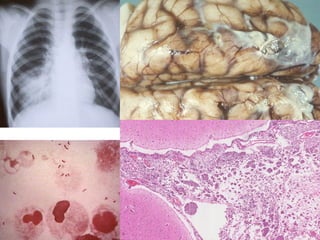
  • #13 Do the upper two images demonstrate the “lobar-ness” of the pneumonia? Ans: Yes; GRAM POSITIVE DIPLOCOCCI
  • #15 H. Flu graphics; GRAM NEGATIVE BACILLUS
  • #18 GRAM NEGATIVE
  • #20 * Go to slides 61 or 74
  • #21 * Go to slides 61 or 74
  • #23 Viral pneumonias, generally interstitial, bacterial pneumonias generally alveolar!!!
  • #24 Can you see the RLL “subtle” infiltrate? Or do you want to call the radiologist?
  • #28 Normal involves URT, new one infects lower RT.
  • #29 Corona viruses are RNA, “enveloped”, i.e., “crowned” viruses
  • #32 As soon as you step into a hospital, expect to be greeted by MRSA
  • #33 Of course these are NOT mutually exclusive classifications, e.g., ANY pneumonia may result in an abscess. * Go back to the previous slide!
  • #34 STREP, STAPH, H.FLU, PSEUDOMONAS are the most frequent secondary complicators.
  • #36 This is not a TYPE of pneumonia, but a complication of ANY pneumonia!
  • #39 An abscess can be thought of as a pneumonia in which all of the normal lung outline can no longer be seen, and there is 100% pus. Notice the increasing destruction of the alveolar framework as you progress closer to the center of the abscess.
  • #41 In this case CHRONIC means CLINICALLY CHRONIC, not PATHOLOGICALLY CHRONIC.
  • #42 “Chronic” by classification, but “granulomatous” by histology.
  • #44 Histologic differentiation from tuberculosis, sarcoidosis, and coccidioidomycosis requires identification of the 3- to 5-μm thin-walled yeast forms,
  • #45 A, Laminated Histoplasma granuloma of the lung. B, Histoplasma capsulatum yeast forms fill phagocytes in the lung of a patient with disseminated histoplasmosis, inset shows high power of pear-shaped thin-based budding yeasts (silver stain).
  • #46 Three clinical forms: pulmonary blastomycosis, disseminated blastomycosis, and a rare primary cutaneous form
  • #47 round, 5- to 15-μm yeast cell that divides by broad-based budding. It has a thick, double-contoured cell wall, and visible nuclei
  • #48 Blastomycosis. A, Rounded budding yeasts, larger than neutrophils, are present. Note the characteristic thick wall and nuclei (not seen in other fungi). B, Silver stain.
  • #50 Thick-walled, nonbudding spherules 20 to 60 μm in diameter, often filled with small endospores.
  • #51 Granulomatous reactions are commonly seen with mycobacteria, fungi, sarcoid, foreign bodies, and rarely with almost anything.
  • #52 * Really jiroveci, not carinii any more.
  • #55 PCP is the most common pneumonia in AIDS patients. It is so prevalent, many rationales consist in giving treatment for it prophylactically. An interesting tidbit is that “cotton wool” or “wooly” exudates are described BOTH radiologically as well as histologically
  • #56 *really “jiroveci” Protozoan vs. Fungi?