DR. JUAN CARLOS BECERRA MARTÍNEZ
CÁTEDRA DE MEDICINA INTERNA-MC3087
TECNOLÓGICO DE MONTERREY, CAMPUS GUADALAJARA
Definition and Classification
 Fever of unknown origin (FUO):
 Was defined by Petersdorf and Beeson in 1961 as:
○ 1.- Temperatures of >38.3°C
○ 2.- A duration of fever of >3 weeks
○ 3.- Failure to reach a diagnosis despite 1 week of inpatient
investigation.
 Durack and Street have proposed a revised
classification:
 1.- Classic FUO
 2.- Nosocomial FUO
 3.- Neutropenic FUO
 4.- FUO associated with HIV infection.
Harrison’s 18th Ed.
Definition and Classification
 Classic FUO:
 This newer definition is broader, stipulating
three outpatient visits or 3 days in the hospital
without elucidation of a cause or 1 week of
"intelligent and invasive" ambulatory
investigation.
Harrison’s 18th Ed.
Definition and Classification
 Nosocomial FUO:
 Fever >38.3°C develops on several occasions in
a hospitalized patient who is receiving acute care
and in whom infection was not manifest on
admission.
 3 days of investigation and including at least 2
days’ incubation of cultures.
Harrison’s 18th Ed.
Definition and Classification
 Neutropenic FUO:
 Temperature >38.3°C
 Neutrophil count <500/ml
 3 days of investigation
 2 days’ incubation of cultures
Harrison’s 18th Ed.
Definition and Classification
 HIV-associated FUO:
 Fever >38.3°C
 >4 weeks for outpatients or >3 days for
hospitalized patients
 HIV infection
 Appropriate investigation over 3 days, including 2
days’ incubation of cultures.
Harrison’s 18th Ed.
Classic FUO in Adults
Harrison’s 18th Ed.
Classic FUO in Adults
 Infections:
 Is the #1 cause of Classic FUO
 Tuberculosis, typhoid fever and malaria remain a leading diagnosable cause
of FUO.
 Others:
○ CMV, EBV, HIV
○ Intraabdominal abscesses
○ Osteomyelitis
○ Endocarditis
○ Prostatitis, dental abscesses, sinusitis, and cholangitis
○ Fungal diseases: histoplasmosis, paracoccidioidomycosis and
coccidioidomycosis
○ Chikungunya virus
○ Cryptococcus neoformans
○ Plasmodium
○ Babesiosis
Harrison’s 18th Ed.
Classic FUO in Adults
 Neoplasms:
 Are the next most common cause of FUO after
infections
 Noninfectious inflammatory diseases:
 Systemic rheumatologic or vasculitic diseases:
○ Polymyalgia rheumatica, lupus, and adult Still's disease
 Granulomatous diseases:
○ Sarcoidosis, Crohn's disease, and granulomatous
hepatitis.
Harrison’s 18th Ed.
Classic FUO in Adults
Harrison’s 18th Ed.
Classic FUO in Adults
Harrison’s 18th Ed.
Classic FUO in Adults
 Classic FUO in the elderly (>50 years):
 Giant-cell arteritis is the leading etiologic entity in this
category (15–20% of FUO cases)
 Tuberculosis is the most common infection causing
FUO in the elderly
 Colon cancer is an important cause of FUO with
malignancy in this age group.
Harrison’s 18th Ed.
Classic FUO in Adults
 Miscellaneous causes:
 Drug fever
 Pulmonary embolism
 Factitious fever
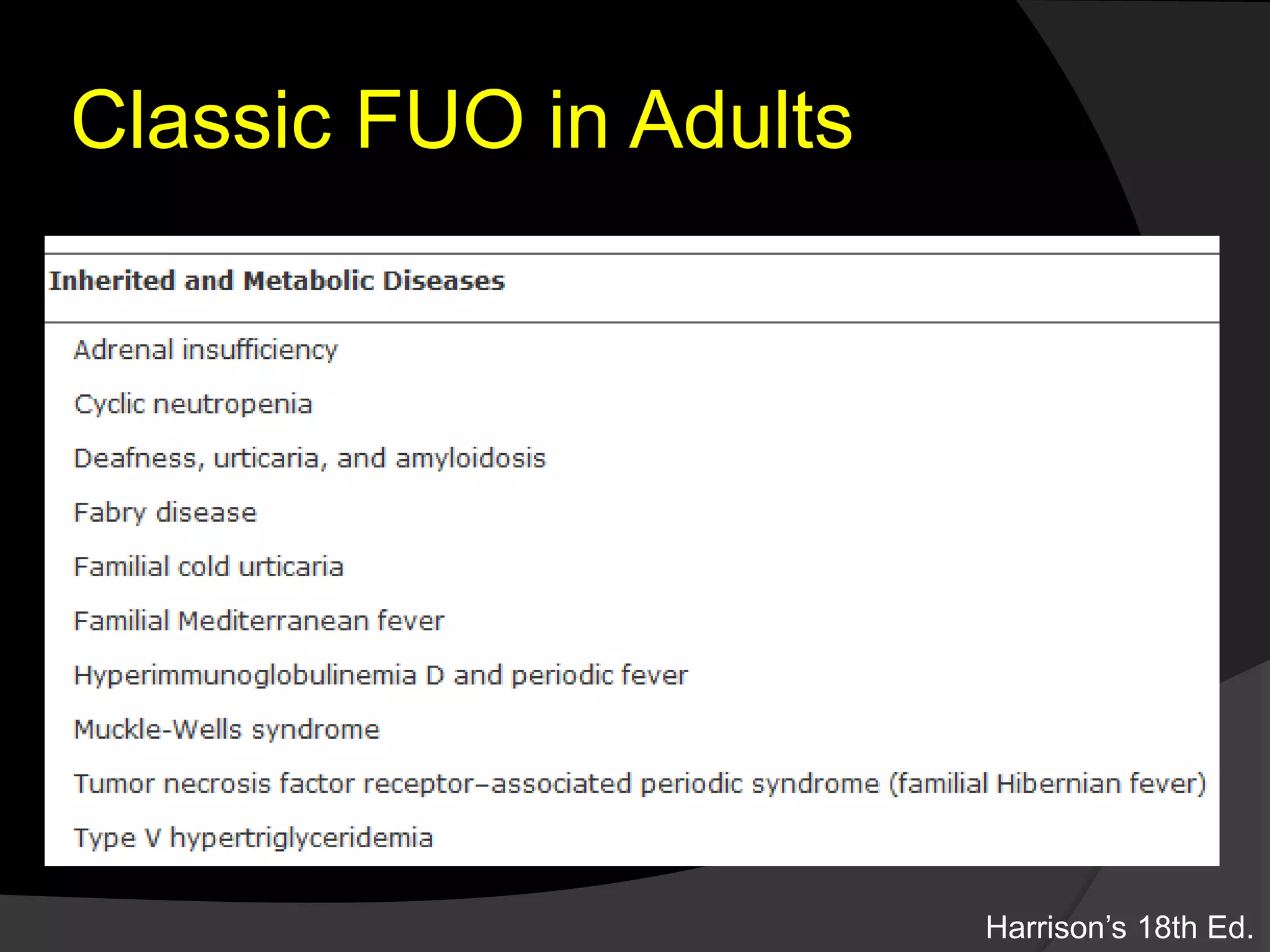
 The hereditary periodic fever síndromes:
○ Familial Mediterranean fever
○ Hyper-IgD syndrome,
○ TNF receptor–associated periodic syndrome (also known as
TRAPS or familial Hibernian fever)
○ Familial cold urticaria
○ Muckle-Wells síndrome
 Congenital lysosomal storage diseases:
○ Gaucher's and Fabry's disease.
Harrison’s 18th Ed.
Classic FUO in Adults
Harrison’s 18th Ed.
Classic FUO in Adults
Harrison’s 18th Ed.
Classic FUO in Adults
Harrison’s 18th Ed.
Classic FUO in Adults
 Drug-related etiology:
 Virtually all classes of drugs can cause fever:
○ Antimicrobial agents (b-lactam antibiotics)
○ Cardiovascular drugs (quinidine)
○ Antineoplastic drugs
○ Drugs acting on the central nervous system: phenytoin
Harrison’s 18th Ed.
Classic FUO in Adults
 It is axiomatic that, as the duration of fever
increases, the likelihood of an infectious cause
decreases.
Harrison’s 18th Ed.
Approach to
the
patient with
classic FUOAbbreviations: ANA, antinuclear antibody;
CBC, complete blood count; CMV,
cytomegalovirus; CRP, C-reactive protein;
CT, computed tomography; Diff,
differential; EBV, Epstein-Barr virus; ESR,
erythrocyte sedimentation rate; FDG,
fluorodeoxyglucose F18; NSAIDs,
nonsteroidal anti-inflammatory drugs;
PET, positron emission tomography;
PMN, polymorphonuclear leukocyte;
PPD, purified protein derivative; RF,
rheumatoid factor; SPEP, serum protein
electrophoresis; TB, tuberculosis; TIBC,
total iron-binding capacity; VDRL,
Venereal Disease Research Laboratory
test.
Harrison’s 18th Ed.
Nosocomial FUO
 More than 50% of patients with nosocomial FUO are infected:
 Intravascular lines, septic phlebitis, and prostheses.
 The best approach is to focus on sites where occult infections may be
sequestered:
 The sinuses of intubated patients or a prostatic abscess in a man with a urinary
catheter.
 Clostridium difficile colitis.
 In <25% of patients the fever has a noninfectious cause:
 Acalculous cholecystitis, deep-vein thrombophlebitis, and pulmonary embolism.
 Others: Drug fever, transfusion reactions, alcohol/drug withdrawal,
adrenal insufficiency, thyroiditis, pancreatitis, gout.
Harrison’s 18th Ed.
Nosocomial FUO
 Multiple blood, wound, and fluid cultures are
mandatory.
 20% of cases of nosocomial FUO may go
undiagnosed.
 In many hospital settings, empirical antibiotic therapy
for nosocomial FUO now includes vancomycin for
coverage of S. Aureus as well as broad-spectrum
gram-negative coverage with piperacillin/tazobactam,
ticarcillin/clavulanate, imipenem, or meropenem.
Harrison’s 18th Ed.
Neutropenic FUO
 Neutropenic patients are susceptible to focal bacterial and fungal
infections:
 Bacteremic infections,
 Infections involving catheters
 Perianal infections.
 Candida and Aspergillus infections are common. Others: Herpes
simplex virus or CMV
 50–60% of febrile neutropenic patients are infected, and 20% are
bacteremic.
 The IDSA dictates the use of vancomycin plus ceftazidime,
cefepime, or a carbapenem with or without an aminoglycoside to
provide empirical coverage for bacterial sepsis
Harrison’s 18th Ed.
HIV-Associated FUO
 HIV infection alone may be a cause of fever.
 Mycobacterium avium or M. intracellulare, tuberculosis, toxoplasmosis,
CMV infection, Pneumocystis infection, salmonellosis, cryptococcosis,
histoplasmosis, strongyloidiasis
 Non-Hodgkin's lymphoma
 Of particular importance drug fever are all possible causes of FUO.
 Blood cultures and by liver, bone marrow, and lymph node biopsies.
Chest CT should be performed to identify enlarged mediastinal nodes.
 FUO has an infectious etiology in >80% of HIV-infected patients.
Harrison’s 18th Ed.
Fever of Unknown Origin (FUO)

Fever of Unknown Origin (FUO)

  • 1.
    DR. JUAN CARLOSBECERRA MARTÍNEZ CÁTEDRA DE MEDICINA INTERNA-MC3087 TECNOLÓGICO DE MONTERREY, CAMPUS GUADALAJARA
  • 2.
    Definition and Classification Fever of unknown origin (FUO):  Was defined by Petersdorf and Beeson in 1961 as: ○ 1.- Temperatures of >38.3°C ○ 2.- A duration of fever of >3 weeks ○ 3.- Failure to reach a diagnosis despite 1 week of inpatient investigation.  Durack and Street have proposed a revised classification:  1.- Classic FUO  2.- Nosocomial FUO  3.- Neutropenic FUO  4.- FUO associated with HIV infection. Harrison’s 18th Ed.
  • 3.
    Definition and Classification Classic FUO:  This newer definition is broader, stipulating three outpatient visits or 3 days in the hospital without elucidation of a cause or 1 week of "intelligent and invasive" ambulatory investigation. Harrison’s 18th Ed.
  • 4.
    Definition and Classification Nosocomial FUO:  Fever >38.3°C develops on several occasions in a hospitalized patient who is receiving acute care and in whom infection was not manifest on admission.  3 days of investigation and including at least 2 days’ incubation of cultures. Harrison’s 18th Ed.
  • 5.
    Definition and Classification Neutropenic FUO:  Temperature >38.3°C  Neutrophil count <500/ml  3 days of investigation  2 days’ incubation of cultures Harrison’s 18th Ed.
  • 6.
    Definition and Classification HIV-associated FUO:  Fever >38.3°C  >4 weeks for outpatients or >3 days for hospitalized patients  HIV infection  Appropriate investigation over 3 days, including 2 days’ incubation of cultures. Harrison’s 18th Ed.
  • 7.
    Classic FUO inAdults Harrison’s 18th Ed.
  • 8.
    Classic FUO inAdults  Infections:  Is the #1 cause of Classic FUO  Tuberculosis, typhoid fever and malaria remain a leading diagnosable cause of FUO.  Others: ○ CMV, EBV, HIV ○ Intraabdominal abscesses ○ Osteomyelitis ○ Endocarditis ○ Prostatitis, dental abscesses, sinusitis, and cholangitis ○ Fungal diseases: histoplasmosis, paracoccidioidomycosis and coccidioidomycosis ○ Chikungunya virus ○ Cryptococcus neoformans ○ Plasmodium ○ Babesiosis Harrison’s 18th Ed.
  • 9.
    Classic FUO inAdults  Neoplasms:  Are the next most common cause of FUO after infections  Noninfectious inflammatory diseases:  Systemic rheumatologic or vasculitic diseases: ○ Polymyalgia rheumatica, lupus, and adult Still's disease  Granulomatous diseases: ○ Sarcoidosis, Crohn's disease, and granulomatous hepatitis. Harrison’s 18th Ed.
  • 10.
    Classic FUO inAdults Harrison’s 18th Ed.
  • 11.
    Classic FUO inAdults Harrison’s 18th Ed.
  • 12.
    Classic FUO inAdults  Classic FUO in the elderly (>50 years):  Giant-cell arteritis is the leading etiologic entity in this category (15–20% of FUO cases)  Tuberculosis is the most common infection causing FUO in the elderly  Colon cancer is an important cause of FUO with malignancy in this age group. Harrison’s 18th Ed.
  • 13.
    Classic FUO inAdults  Miscellaneous causes:  Drug fever  Pulmonary embolism  Factitious fever  The hereditary periodic fever síndromes: ○ Familial Mediterranean fever ○ Hyper-IgD syndrome, ○ TNF receptor–associated periodic syndrome (also known as TRAPS or familial Hibernian fever) ○ Familial cold urticaria ○ Muckle-Wells síndrome  Congenital lysosomal storage diseases: ○ Gaucher's and Fabry's disease. Harrison’s 18th Ed.
  • 14.
    Classic FUO inAdults Harrison’s 18th Ed.
  • 15.
    Classic FUO inAdults Harrison’s 18th Ed.
  • 16.
    Classic FUO inAdults Harrison’s 18th Ed.
  • 17.
    Classic FUO inAdults  Drug-related etiology:  Virtually all classes of drugs can cause fever: ○ Antimicrobial agents (b-lactam antibiotics) ○ Cardiovascular drugs (quinidine) ○ Antineoplastic drugs ○ Drugs acting on the central nervous system: phenytoin Harrison’s 18th Ed.
  • 18.
    Classic FUO inAdults  It is axiomatic that, as the duration of fever increases, the likelihood of an infectious cause decreases. Harrison’s 18th Ed.
  • 19.
    Approach to the patient with classicFUOAbbreviations: ANA, antinuclear antibody; CBC, complete blood count; CMV, cytomegalovirus; CRP, C-reactive protein; CT, computed tomography; Diff, differential; EBV, Epstein-Barr virus; ESR, erythrocyte sedimentation rate; FDG, fluorodeoxyglucose F18; NSAIDs, nonsteroidal anti-inflammatory drugs; PET, positron emission tomography; PMN, polymorphonuclear leukocyte; PPD, purified protein derivative; RF, rheumatoid factor; SPEP, serum protein electrophoresis; TB, tuberculosis; TIBC, total iron-binding capacity; VDRL, Venereal Disease Research Laboratory test. Harrison’s 18th Ed.
  • 20.
    Nosocomial FUO  Morethan 50% of patients with nosocomial FUO are infected:  Intravascular lines, septic phlebitis, and prostheses.  The best approach is to focus on sites where occult infections may be sequestered:  The sinuses of intubated patients or a prostatic abscess in a man with a urinary catheter.  Clostridium difficile colitis.  In <25% of patients the fever has a noninfectious cause:  Acalculous cholecystitis, deep-vein thrombophlebitis, and pulmonary embolism.  Others: Drug fever, transfusion reactions, alcohol/drug withdrawal, adrenal insufficiency, thyroiditis, pancreatitis, gout. Harrison’s 18th Ed.
  • 21.
    Nosocomial FUO  Multipleblood, wound, and fluid cultures are mandatory.  20% of cases of nosocomial FUO may go undiagnosed.  In many hospital settings, empirical antibiotic therapy for nosocomial FUO now includes vancomycin for coverage of S. Aureus as well as broad-spectrum gram-negative coverage with piperacillin/tazobactam, ticarcillin/clavulanate, imipenem, or meropenem. Harrison’s 18th Ed.
  • 22.
    Neutropenic FUO  Neutropenicpatients are susceptible to focal bacterial and fungal infections:  Bacteremic infections,  Infections involving catheters  Perianal infections.  Candida and Aspergillus infections are common. Others: Herpes simplex virus or CMV  50–60% of febrile neutropenic patients are infected, and 20% are bacteremic.  The IDSA dictates the use of vancomycin plus ceftazidime, cefepime, or a carbapenem with or without an aminoglycoside to provide empirical coverage for bacterial sepsis Harrison’s 18th Ed.
  • 23.
    HIV-Associated FUO  HIVinfection alone may be a cause of fever.  Mycobacterium avium or M. intracellulare, tuberculosis, toxoplasmosis, CMV infection, Pneumocystis infection, salmonellosis, cryptococcosis, histoplasmosis, strongyloidiasis  Non-Hodgkin's lymphoma  Of particular importance drug fever are all possible causes of FUO.  Blood cultures and by liver, bone marrow, and lymph node biopsies. Chest CT should be performed to identify enlarged mediastinal nodes.  FUO has an infectious etiology in >80% of HIV-infected patients. Harrison’s 18th Ed.