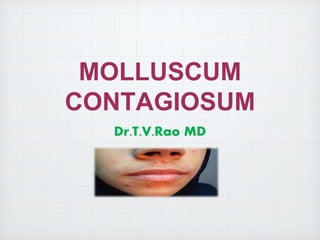
MOLLUSCUM
CONTAGIOSUM
Dr.T.V.Rao MD
Molluscum contagiosum
It is caused by a DNA poxvirus called the
molluscum contagiosum virus (MCV). MCV
has no nonhuman-animal reservoir
(infecting only humans). There are four
types of MCV, MCV-1 to -4; MCV-1 is the
most prevalent and MCV-2 is seen usually
in adults. The virus that causes molluscum
is spread from person to person by
touching the affected skin. The virus may
also be spread by touching a surface with
the virus on it, such as a towel, clothing, or
toys.
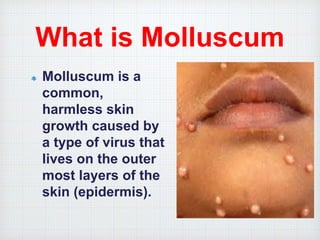
What is Molluscum
Molluscum is a
common,
harmless skin
growth caused by
a type of virus that
lives on the outer
most layers of the
skin (epidermis).
Molloscum contagiosum
Children and young adults are infected
Present with pearly white wart like
Normal sections show large 20 – 30
micron sized Eosinophilic hyaline
inclusion bodies are seen.
Molluscum bodies contain large number
of virus particles in a protein matrix.
Dr.T.V.Rao MD 4
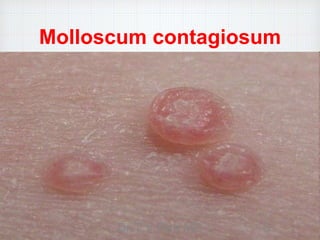
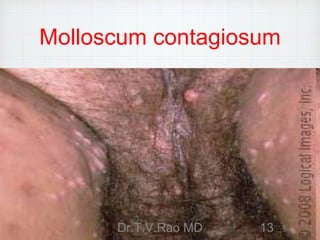
Lesions begin as small (3 to 6 mm) papules that are smooth, flesh-colored domes
with a central dimple. Inside the papule is a white, curd-like core that can be
easily expressed.
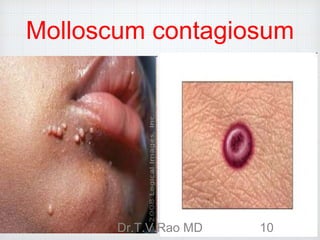
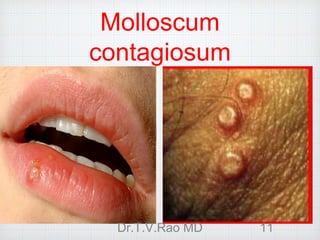
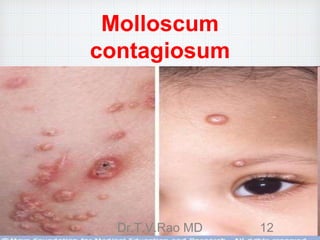
Lesions can occur anywhere on the skin and mucous membranes, but are usually
grouped in one or two areas. Occasionally, they may be widely disseminated.
Typically fewer than 20 lesions are present, but some individuals may have
hundreds.
The head, eyelids, trunk, and genitalia are most commonly affected, the genitalia
being the predominant site in adults.
The lesions are characteristically asymptomatic, but a few patients may complain
of itching or may develop an eczematous reaction around the lesions.
Molluscum Contagiosum
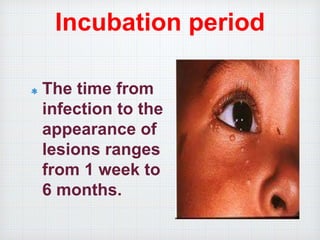
Incubation period
The time from
infection to the
appearance of
lesions ranges
from 1 week to
6 months.
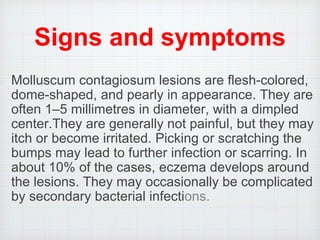
Signs and symptoms
Molluscum contagiosum lesions are flesh-colored,
dome-shaped, and pearly in appearance. They are
often 1–5 millimetres in diameter, with a dimpled
center.They are generally not painful, but they may
itch or become irritated. Picking or scratching the
bumps may lead to further infection or scarring. In
about 10% of the cases, eczema develops around
the lesions. They may occasionally be complicated
by secondary bacterial infections.
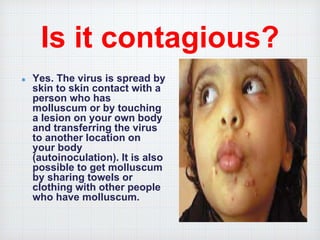
Is it contagious?
Yes. The virus is spread by
skin to skin contact with a
person who has
molluscum or by touching
a lesion on your own body
and transferring the virus
to another location on
your body
(autoinoculation). It is also
possible to get molluscum
by sharing towels or
clothing with other people
who have molluscum.
Molloscum contagiosum
Dr.T.V.Rao MD 9
Molloscum contagiosum
Dr.T.V.Rao MD 10
Molloscum
contagiosum
Dr.T.V.Rao MD 11
Molloscum
contagiosum
Dr.T.V.Rao MD 12
Molloscum contagiosum
Dr.T.V.Rao MD 13
Diagnosis
Diagnosis is made on the clinical appearance;
the virus cannot routinely be cultured. The
diagnosis can be confirmed by excisional
biopsy.
Histologically, molluscum contagiosum is
characterized by molluscum bodies in the
epidermis above the stratum basale, which
consist of large cells with: abundant granular
eosinophilic cytoplasm (accumulated virions),
anda small peripheral nucleus.
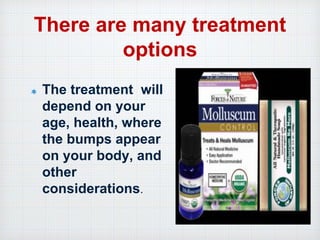
There are many treatment
options
The treatment will
depend on your
age, health, where
the bumps appear
on your body, and
other
considerations.
Treatments that a dermatologist can
perform in the office to treat Molluscum
contagiosum include:
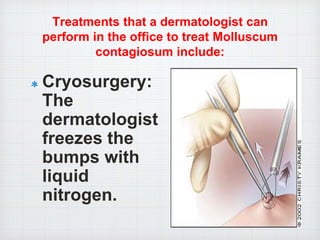
Cryosurgery:
The
dermatologist
freezes the
bumps with
liquid
nitrogen.
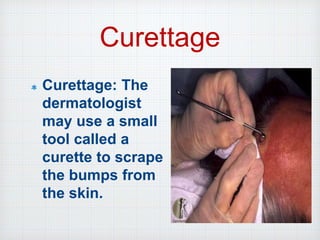
Curettage
Curettage: The
dermatologist
may use a small
tool called a
curette to scrape
the bumps from
the skin.
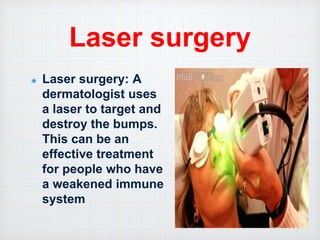
Laser surgery
Laser surgery: A
dermatologist uses
a laser to target and
destroy the bumps.
This can be an
effective treatment
for people who have
a weakened immune
system
In AIDS Patients
If a person has AIDS or another
disease that weakens the immune
system, the bumps will not go
away without treatment — and the
bumps can be a challenge to treat.
Dermatologists often combine
treatments to offer these patients
some clearing. Complete clearing
may not be possible.
Drugs to Treat
Imiquimod: This medicine is applied to
the bumps. Imiquimod helps your
immune system fight the virus. This is
strong medicine. It also is used to treat
stubborn warts and some skin cancers.
Retinoid or antiviral medicine applied
to the skin: Patients apply this
medicine to the bumps as instructed.
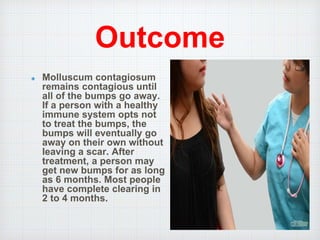
Outcome
Molluscum contagiosum
remains contagious until
all of the bumps go away.
If a person with a healthy
immune system opts not
to treat the bumps, the
bumps will eventually go
away on their own without
leaving a scar. After
treatment, a person may
get new bumps for as long
as 6 months. Most people
have complete clearing in
2 to 4 months.
Program Created by Dr.T.V.Rao MD
for Basic learning on Infectious
diseases
Email
doctortvrao@gmail.com

Molluscum contagiosum

  • 1.
  • 2.
    Molluscum contagiosum It iscaused by a DNA poxvirus called the molluscum contagiosum virus (MCV). MCV has no nonhuman-animal reservoir (infecting only humans). There are four types of MCV, MCV-1 to -4; MCV-1 is the most prevalent and MCV-2 is seen usually in adults. The virus that causes molluscum is spread from person to person by touching the affected skin. The virus may also be spread by touching a surface with the virus on it, such as a towel, clothing, or toys.
  • 3.
    What is Molluscum Molluscumis a common, harmless skin growth caused by a type of virus that lives on the outer most layers of the skin (epidermis).
  • 4.
    Molloscum contagiosum Children andyoung adults are infected Present with pearly white wart like Normal sections show large 20 – 30 micron sized Eosinophilic hyaline inclusion bodies are seen. Molluscum bodies contain large number of virus particles in a protein matrix. Dr.T.V.Rao MD 4
  • 5.
    Lesions begin assmall (3 to 6 mm) papules that are smooth, flesh-colored domes with a central dimple. Inside the papule is a white, curd-like core that can be easily expressed. Lesions can occur anywhere on the skin and mucous membranes, but are usually grouped in one or two areas. Occasionally, they may be widely disseminated. Typically fewer than 20 lesions are present, but some individuals may have hundreds. The head, eyelids, trunk, and genitalia are most commonly affected, the genitalia being the predominant site in adults. The lesions are characteristically asymptomatic, but a few patients may complain of itching or may develop an eczematous reaction around the lesions. Molluscum Contagiosum
  • 6.
    Incubation period The timefrom infection to the appearance of lesions ranges from 1 week to 6 months.
  • 7.
    Signs and symptoms Molluscumcontagiosum lesions are flesh-colored, dome-shaped, and pearly in appearance. They are often 1–5 millimetres in diameter, with a dimpled center.They are generally not painful, but they may itch or become irritated. Picking or scratching the bumps may lead to further infection or scarring. In about 10% of the cases, eczema develops around the lesions. They may occasionally be complicated by secondary bacterial infections.
  • 8.
    Is it contagious? Yes.The virus is spread by skin to skin contact with a person who has molluscum or by touching a lesion on your own body and transferring the virus to another location on your body (autoinoculation). It is also possible to get molluscum by sharing towels or clothing with other people who have molluscum.
  • 9.
  • 10.
  • 11.
  • 12.
  • 13.
  • 14.
    Diagnosis Diagnosis is madeon the clinical appearance; the virus cannot routinely be cultured. The diagnosis can be confirmed by excisional biopsy. Histologically, molluscum contagiosum is characterized by molluscum bodies in the epidermis above the stratum basale, which consist of large cells with: abundant granular eosinophilic cytoplasm (accumulated virions), anda small peripheral nucleus.
  • 15.
    There are manytreatment options The treatment will depend on your age, health, where the bumps appear on your body, and other considerations.
  • 16.
    Treatments that adermatologist can perform in the office to treat Molluscum contagiosum include: Cryosurgery: The dermatologist freezes the bumps with liquid nitrogen.
  • 17.
    Curettage Curettage: The dermatologist may usea small tool called a curette to scrape the bumps from the skin.
  • 18.
    Laser surgery Laser surgery:A dermatologist uses a laser to target and destroy the bumps. This can be an effective treatment for people who have a weakened immune system
  • 19.
    In AIDS Patients Ifa person has AIDS or another disease that weakens the immune system, the bumps will not go away without treatment — and the bumps can be a challenge to treat. Dermatologists often combine treatments to offer these patients some clearing. Complete clearing may not be possible.
  • 20.
    Drugs to Treat Imiquimod:This medicine is applied to the bumps. Imiquimod helps your immune system fight the virus. This is strong medicine. It also is used to treat stubborn warts and some skin cancers. Retinoid or antiviral medicine applied to the skin: Patients apply this medicine to the bumps as instructed.
  • 21.
    Outcome Molluscum contagiosum remains contagiousuntil all of the bumps go away. If a person with a healthy immune system opts not to treat the bumps, the bumps will eventually go away on their own without leaving a scar. After treatment, a person may get new bumps for as long as 6 months. Most people have complete clearing in 2 to 4 months.
  • 22.
    Program Created byDr.T.V.Rao MD for Basic learning on Infectious diseases Email doctortvrao@gmail.com