Respiratory Failure
by
By
Dr. Adel Hamada
Lecturer of Chest Diseases
Faculty of Medicine Zagazig University
It is a condition in which the lung cannot
fulfill its primary function of maintaining
adequate gas exchange leading to PaO2 less
than 60mmHg and/or PaCO2 more than 50
mmHg .
Definition
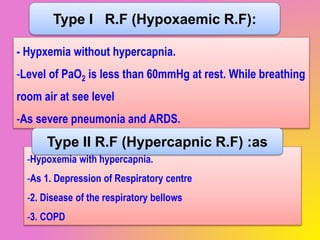
- Hypxemia without hypercapnia.
-Level of PaO2 is less than 60mmHg at rest. While breathing
room air at see level
-As severe pneumonia and ARDS.
-Hypoxemia with hypercapnia.
-As 1. Depression of Respiratory centre
-2. Disease of the respiratory bellows
-3. COPD
Type I R.F (Hypoxaemic R.F):
Type II R.F (Hypercapnic R.F) :as
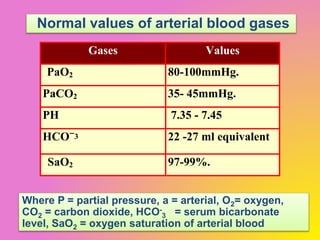
Gases Values
PaO2 80-100mmHg.
PaCO2 35- 45mmHg.
PH 7.35 - 7.45
HCO-
3 22 -27 ml equivalent
SaO2 97-99%.
Normal values of arterial blood gases
Where P = partial pressure, a = arterial, O2= oxygen,
CO2 = carbon dioxide, HCO-
3 = serum bicarbonate
level, SaO2 = oxygen saturation of arterial blood
Pathogenesis
Type I
1- ventilation
perfusion mis-
match
2- Shunt effect
Type II
Alveolar
Hypoventilation
Causes of alveolar
hypoventilation
generator Pump Effector organ
Presentation of
respiratory failure
hypoxemia
hypercapnea
Both
Manifestation of precipitating cause
Plus
Dyspnea
Impaired
mental status
headache
Tachycardia
Papiledema
Cyanosis
Lung
examination
Symptoms
signs
Tremors
Treatment of
respiratory failure
A B C D E
Maintain adequate
oxygen delivery
Mechanical ventilation
if indicated
Treatment of cause
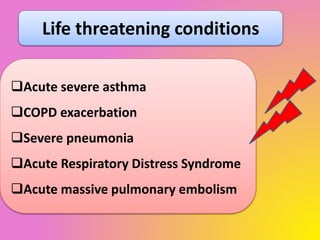
Life threatening conditions
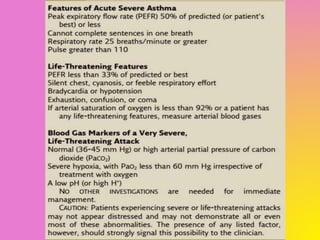
Acute severe asthma
COPD exacerbation
Severe pneumonia
Acute Respiratory Distress Syndrome
Acute massive pulmonary embolism
Acute severe asthma
An exacerbation of COPD is:
“an acute event characterized by a
worsening of the patient’s respiratory
symptoms that is beyond normal day-
to-day variations and leads to a
change in medication.”
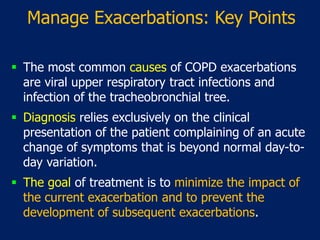
Manage Exacerbations: Key Points
 The most common causes of COPD exacerbations
are viral upper respiratory tract infections and
infection of the tracheobronchial tree.
 Diagnosis relies exclusively on the clinical
presentation of the patient complaining of an acute
change of symptoms that is beyond normal day-to-
day variation.
 The goal of treatment is to minimize the impact of
the current exacerbation and to prevent the
development of subsequent exacerbations.
 Short-acting inhaled beta2-agonists with or without
short-acting anticholinergics are usually the
preferred bronchodilators for treatment of an
exacerbation.
 Systemic corticosteroids and antibiotics can shorten
recovery time, improve lung function (FEV1) and
arterial hypoxemia (PaO2), and reduce the risk of
early relapse, treatment failure, and length of
hospital stay.
 COPD exacerbations can often be prevented.
Manage Exacerbations: Key Points
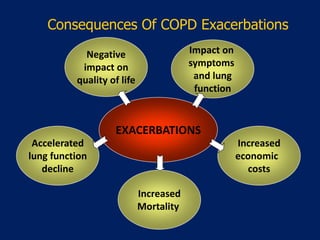
Impact on
symptoms
and lung
function
Negative
impact on
quality of life
Increased
economic
costs
Accelerated
lung function
decline
Increased
Mortality
EXACERBATIONS
Consequences Of COPD Exacerbations
Manage Exacerbations: Assessments
Arterial blood gas measurements (in hospital): PaO2 < 8.0
kPa with or without PaCO2 > 6.7 kPa when breathing room air
indicates respiratory failure.
Chest radiographs: useful to exclude alternative diagnoses.
ECG: may aid in the diagnosis of coexisting cardiac problems.
Whole blood count: identify polycythemia, anemia or
bleeding.
Purulent sputum during an exacerbation: indication to begin
empirical antibiotic treatment.
Biochemical tests: detect electrolyte disturbances, diabetes,
and poor nutrition.
Spirometric tests: not recommended during an exacerbation.
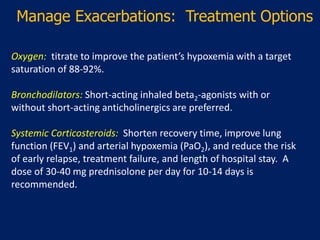
Manage Exacerbations: Treatment Options
Oxygen: titrate to improve the patient’s hypoxemia with a target
saturation of 88-92%.
Bronchodilators: Short-acting inhaled beta2-agonists with or
without short-acting anticholinergics are preferred.
Systemic Corticosteroids: Shorten recovery time, improve lung
function (FEV1) and arterial hypoxemia (PaO2), and reduce the risk
of early relapse, treatment failure, and length of hospital stay. A
dose of 30-40 mg prednisolone per day for 10-14 days is
recommended.
Antibiotics should be given to patients with:
 Three cardinal symptoms: increased
dyspnea, increased sputum volume, and
increased sputum purulence.
 Who require mechanical ventilation.
Manage Exacerbations: Treatment Options
Noninvasive ventilation (NIV):
 Improves respiratory acidosis, reduces
respiratory rate, severity of dyspnea,
complications and length of hospital stay.
 decreases mortality and needs for intubation.
Manage Exacerbations: Treatment Options
Manage Exacerbations: Indications for
Hospital Admission
 Marked increase in intensity of symptoms
 Severe underlying COPD
 Onset of new physical signs
 Failure of an exacerbation to respond to initial
medical management
 Presence of serious comorbidities
 Frequent exacerbations
 Older age
 Insufficient home support
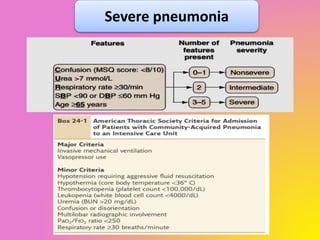
Severe pneumonia
ATS/IDSA Recommendations for Empirical Antibiotic
Treatment of Community-Acquired Pneumonia
Definition:
Form of acute lung injury characterized by non cardiogenic pulmonary
edema and refractory hypoxemia that is produced by neutrophil-
mediated cytotoxicity to lung cells (alveolar epithelium and capillary
endothelium) as a result of a wide variety of insults to the lung, either
directly or indirectly
Acute Respiratory Distress
Syndrome
The Berlin Definition of Acute Respiratory Distress Syndrome
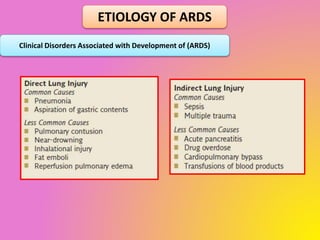
ETIOLOGY OF ARDS
Clinical Disorders Associated with Development of (ARDS)
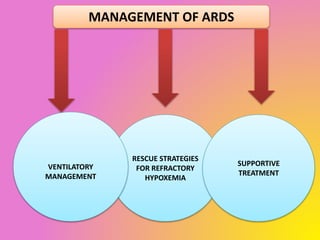
RESCUE STRATEGIES
FOR REFRACTORY
HYPOXEMIA
MANAGEMENT OF ARDS
VENTILATORY
MANAGEMENT
SUPPORTIVE
TREATMENT
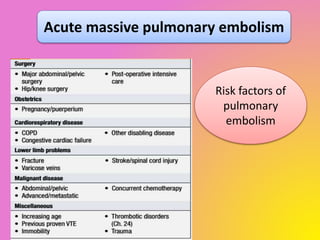
Acute massive pulmonary embolism
Risk factors of
pulmonary
embolism
Treatment
Anticoagulant
Thrombolytic Therapy if
haemodynamically unstable
THANK
YOU

Respiratory failure

  • 1.
    Respiratory Failure by By Dr. AdelHamada Lecturer of Chest Diseases Faculty of Medicine Zagazig University
  • 2.
    It is acondition in which the lung cannot fulfill its primary function of maintaining adequate gas exchange leading to PaO2 less than 60mmHg and/or PaCO2 more than 50 mmHg . Definition
  • 3.
    - Hypxemia withouthypercapnia. -Level of PaO2 is less than 60mmHg at rest. While breathing room air at see level -As severe pneumonia and ARDS. -Hypoxemia with hypercapnia. -As 1. Depression of Respiratory centre -2. Disease of the respiratory bellows -3. COPD Type I R.F (Hypoxaemic R.F): Type II R.F (Hypercapnic R.F) :as
  • 4.
    Gases Values PaO2 80-100mmHg. PaCO235- 45mmHg. PH 7.35 - 7.45 HCO- 3 22 -27 ml equivalent SaO2 97-99%. Normal values of arterial blood gases Where P = partial pressure, a = arterial, O2= oxygen, CO2 = carbon dioxide, HCO- 3 = serum bicarbonate level, SaO2 = oxygen saturation of arterial blood
  • 5.
    Pathogenesis Type I 1- ventilation perfusionmis- match 2- Shunt effect Type II Alveolar Hypoventilation
  • 6.
  • 7.
  • 8.
  • 9.
    Treatment of respiratory failure AB C D E Maintain adequate oxygen delivery Mechanical ventilation if indicated Treatment of cause
  • 10.
    Life threatening conditions Acutesevere asthma COPD exacerbation Severe pneumonia Acute Respiratory Distress Syndrome Acute massive pulmonary embolism
  • 11.
  • 14.
    An exacerbation ofCOPD is: “an acute event characterized by a worsening of the patient’s respiratory symptoms that is beyond normal day- to-day variations and leads to a change in medication.”
  • 15.
    Manage Exacerbations: KeyPoints  The most common causes of COPD exacerbations are viral upper respiratory tract infections and infection of the tracheobronchial tree.  Diagnosis relies exclusively on the clinical presentation of the patient complaining of an acute change of symptoms that is beyond normal day-to- day variation.  The goal of treatment is to minimize the impact of the current exacerbation and to prevent the development of subsequent exacerbations.
  • 16.
     Short-acting inhaledbeta2-agonists with or without short-acting anticholinergics are usually the preferred bronchodilators for treatment of an exacerbation.  Systemic corticosteroids and antibiotics can shorten recovery time, improve lung function (FEV1) and arterial hypoxemia (PaO2), and reduce the risk of early relapse, treatment failure, and length of hospital stay.  COPD exacerbations can often be prevented. Manage Exacerbations: Key Points
  • 17.
    Impact on symptoms and lung function Negative impacton quality of life Increased economic costs Accelerated lung function decline Increased Mortality EXACERBATIONS Consequences Of COPD Exacerbations
  • 18.
    Manage Exacerbations: Assessments Arterialblood gas measurements (in hospital): PaO2 < 8.0 kPa with or without PaCO2 > 6.7 kPa when breathing room air indicates respiratory failure. Chest radiographs: useful to exclude alternative diagnoses. ECG: may aid in the diagnosis of coexisting cardiac problems. Whole blood count: identify polycythemia, anemia or bleeding. Purulent sputum during an exacerbation: indication to begin empirical antibiotic treatment. Biochemical tests: detect electrolyte disturbances, diabetes, and poor nutrition. Spirometric tests: not recommended during an exacerbation.
  • 19.
    Manage Exacerbations: TreatmentOptions Oxygen: titrate to improve the patient’s hypoxemia with a target saturation of 88-92%. Bronchodilators: Short-acting inhaled beta2-agonists with or without short-acting anticholinergics are preferred. Systemic Corticosteroids: Shorten recovery time, improve lung function (FEV1) and arterial hypoxemia (PaO2), and reduce the risk of early relapse, treatment failure, and length of hospital stay. A dose of 30-40 mg prednisolone per day for 10-14 days is recommended.
  • 20.
    Antibiotics should begiven to patients with:  Three cardinal symptoms: increased dyspnea, increased sputum volume, and increased sputum purulence.  Who require mechanical ventilation. Manage Exacerbations: Treatment Options
  • 21.
    Noninvasive ventilation (NIV): Improves respiratory acidosis, reduces respiratory rate, severity of dyspnea, complications and length of hospital stay.  decreases mortality and needs for intubation. Manage Exacerbations: Treatment Options
  • 22.
    Manage Exacerbations: Indicationsfor Hospital Admission  Marked increase in intensity of symptoms  Severe underlying COPD  Onset of new physical signs  Failure of an exacerbation to respond to initial medical management  Presence of serious comorbidities  Frequent exacerbations  Older age  Insufficient home support
  • 26.
  • 27.
    ATS/IDSA Recommendations forEmpirical Antibiotic Treatment of Community-Acquired Pneumonia
  • 28.
    Definition: Form of acutelung injury characterized by non cardiogenic pulmonary edema and refractory hypoxemia that is produced by neutrophil- mediated cytotoxicity to lung cells (alveolar epithelium and capillary endothelium) as a result of a wide variety of insults to the lung, either directly or indirectly Acute Respiratory Distress Syndrome
  • 29.
    The Berlin Definitionof Acute Respiratory Distress Syndrome
  • 30.
    ETIOLOGY OF ARDS ClinicalDisorders Associated with Development of (ARDS)
  • 31.
    RESCUE STRATEGIES FOR REFRACTORY HYPOXEMIA MANAGEMENTOF ARDS VENTILATORY MANAGEMENT SUPPORTIVE TREATMENT
  • 32.
    Acute massive pulmonaryembolism Risk factors of pulmonary embolism
  • 35.
  • 36.