Pleura
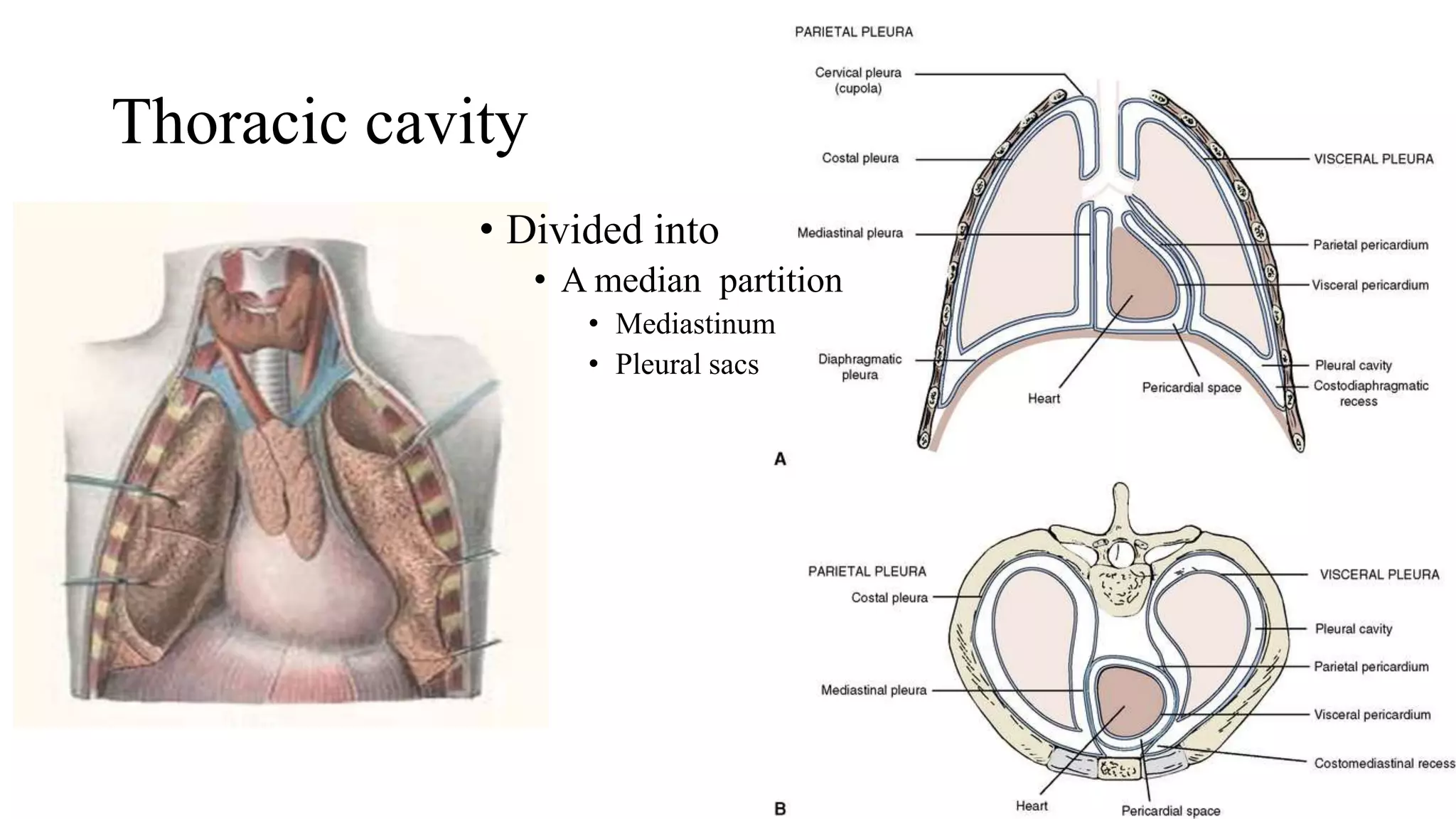
Thoracic cavity
• Divided into
• A median partition
• Mediastinum
• Pleural sacs
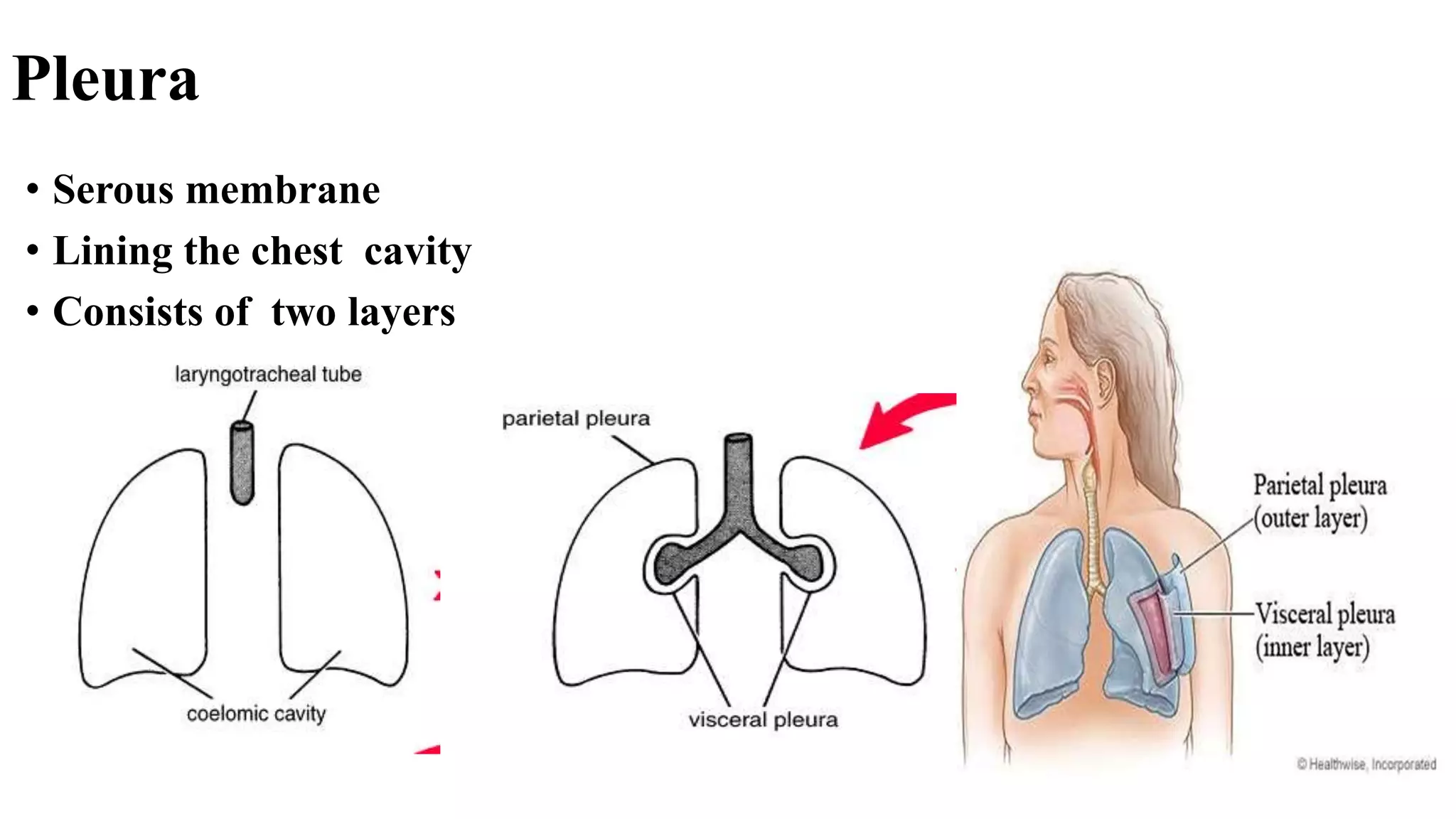
Pleura
• Serous membrane
• Lining the chest cavity
• Consists of two layers
Pleura: Layers
• 1.Visceral
• 2.Parietal
• Cervical
• Costal
• Diaphragmatic
• Mediastinal
12
Pleural cavity
• Space between
• Parietal andvisceral layers of pleura
• Closed sac
• Contains a small amount of pleural fluid
• Acts as a lubricant decreasing friction between the
pleurae
Visceral layer
• Otherwise - pulmonary pleura
• Covers - surface of lung
– Except hilum of lung
• Dips into fissures of lung
• Firmly adherent
• Inseparable from lungs
• Shares blood & nerve supply
with lung
• Develops from
splanchnopleuric mesoderm
Parietal pleura
• Thicker than visceral
• Lines
• Walls of thoracic cavity
• Diaphragm
• Mediastinum
• Subdivisions
– Costal pleura
– Diaphragmatic pleura
– Mediastinal pleura
– Cervical pleura
Cervical pleura
• Dome of the parietal pleura
• Extends into the root of neck
• 1inch above the medial end
of clavicle (2 inches above
the 1st costal cartilage)
– It is known as cupola
– Covers the apex of lung
– Not beyond the neck of 1st
rib
Cervical pleura - Relations
• Anteriorly
– Subclavian artery
– Scalenus anterior
• Posteriorly
– Neck of 1st rib
• Meidally
– Great vessels to H&N
• Laterally
– Scalenus medius
Supra pleural membrane
• Pleural diaphragm
• Cervical pleura + suprapleural membrane
• Musculo-fascial expansion
• Attaches
• Tip of transverse process of C7 vertebra
• Inner border of first rib
• Muscular part derived from
– Scalenus minimus muscle
• Fascial part derives from
– Endothoracic fascia
• Separates apex of lung & cervical pleura
– From structures of root of the neck
Costal pleura
• Lines the inner surface of
thoracic wall
• Ribs, costal cartilage
intercostal spaces and
posterior parts of thoracic
vertebrae
• Separated from thoracic
wall
• By a thin layer of loose
areolar tissue
(endothoracic fascia)
• Lines the mediastinal
surface
• Due to the hilum & the
structures
• Divided into
• 3 parts
• Above & below the hilum
• Continues
• From Costo mediastinal
line to costovertebral
line
Mediastinal pleura
• In the middle part
• Turns laterally
• Surrounds hilar structure and becomes visceral pleura
• Below hilum
• These layer collapsed and become pulmonary ligament
Pulmonary ligament
• Inferior to the lung root
• Similar to cuff of a jacket
• Functions
– Dead space
– Allows descent of the structures
in the root of the lung
– During inspiration
Diaphragmatic pleura
• Covers the superior surface of
diaphragm
Sites of parietal pleura
extends beyond thoracic cage
• 1. Above the medial third of clavicle
• 2. Beyond the right xiphicostal angle
• 3. Below costovertebral angle
Blood supply
• Arterial supply
– Visceral pleura
• Bronchial arteries
– Parietal pleura
• Intercostal, internal
thoracic &
musculophrenic arteries
• Venous drainage
– Visceral pleura
• Bronchial veins
– Parietal pleura
• Azygos & internal
thoracic
Nerve supply
• Parietal pleura
– Costal pleura
• Intercostal nerves
– Mediastinal pleura
• Phrenic nerve
– Diaphragmatic pleura
• Domes by the phrenic nerve
• Periphery by the lower six
intercostal nerves
• Pulmonary pleura
– Autonomic
• Sympathetic (2nd to 5th ganglia)
• Parasympathetic (Vagus)
• During inflammation of pleura
• If central and mediastinal part
• Root of neck & Shoulder
• Due to phrenic nerve (C3, 4 & 5)
• Which shares supra clavicular (C3 & 4)
• If lower costal & peripheral part
• Pain can be referred in anterior abdominal wall also
Referred pain
Surface marking
• Cervical pleura
– Sternoclavicular jt to junction of
middle & medial 3rd of clavicle
• Anterior margin / Sternal line /
costo mediastinal line
– Rt side:
• Sternoclavicular jt
• Mid point of sternal angle
• Midpoint xiphisternal jt
– Lt side:
• Same upto 4th costal cartilage
• Lt lat margin of sternum till 6th costal
cartilage
• Costo-diaphragmatic lines
• Where costal pleura continues with
diaphragmatic pleura
• Right side
• Xiphisternal joint
• 8th rib at midclavicular line
• 10th rib at mid axillary line
• Lateral to 12 thoracic spine
• Left side
• Starts from
• 6th costal cartilage
Costo vertebral line
• Where costal pleura continues with
mediastinal pleura posteriorly
• From
• 2 cm lateral to T1
• To
• 2cm lateral to T12
Pleural recesses
• Extended part of pleural cavity
beyond the lungs during normal
breathing
• Serve as reserve spaces of
pleural cavity
• Essential for expansion of lung
• Present on
• Anterior & inferior aspect
• They are
• Costomediastinal (anterior)
• Costodiaphragmatic (inferior)
• Located inferiorly
• Lies between costal &
diaphragmatic pleurae
• Dimensions
– 5 cm
– Lies opposite to 8th to 10th ribs along
midaxillary line
• Most dependent part
– Hence the fluid of pleural effusion first
collect here
– Related structures
– Right side
– Liver & kidney
– Left side
– Fundus of stomach, spleen & kidney
Costodiaphragmatic recess
Costomediastinal
recess
• Located anteriorly
• Lies between
– Costal & mediastinal
pleurae
– Between sternum &
costal cartilage
• Left costomediastinal
recess is large
– Due to cardiac notch
of left lung
– Wider at 4th to 6th
costal cartilages
Applied anatomy
• Pleura descends inferior to the costal
margin in three regions
• Right infrasternal angle
• Right and left costovertebral angles
• When making incisions through the
anterior abdominal wall
• Incision should not enter the pleural sac
since this results in pneumothorax
Pleurisy / pleuritis
• Inflammation of pleura
• Inflammed pleura becomes rough
• Friction between 2 layers
• Produce
• Sound
• Pain
Pneumothorax
• Air fills in the pleural cavity
• Leads to collapse of lungs
• Due to atomospheric air pressure
• Normally pleural cavity has
• - 4 - -5 cm of water (H2O) pressure
• Causes
• Penetrating thoracic wound
• Fractured rib
• Spontaneous rupture
• During stellate ganglion block
• By anaesthetist
• Exposure of kidney
Pleural effusion
• Presence of excess fluid in
the pleural cavity
• About 300 ml (normally 5-
10 ml)
• In Costodiaphragmatic
recess ,
• Causes
• Inflammation, TB,
malignancy, congestive heart
disease
• Dullness on percussion over
the effusion
Pleural tap
• Collection of pleural effusion
• Normally at
• 8th or 9th intercostal space
• In midaxillary line
• Needle should be inserted
• At lower part of intercostal space
• To avoid injury to intercostal nerve &
vessels
Lungs
Lungs
• A pair of respiratory organs
• Lies in thoracic cavity
• Right and left lung are separated
• By mediastinum
Lungs - Features
• Apex
• Base
• Borders
• Surfaces
• Costal Surface
• Medial Surface
Apex
• Lies above the level of anterior
end of 1st Rib
• Reaches 1-2 cm above medial
1/3rd of clavicle
• Coverings
• Cervical pleura
• Suprapleural membrane
• Grooved by
• Subclavian artery
• Subclavian vein
Base
• Semilunar and concave
• Rests on dome of Diaphragm
• Right sided dome is higher than left
Anterior border
• Corresponds to
• Anterior (Costomediastinal) line of
pleural reflection
• Deeply notched in the left lung
• Posterior to 5th costal cartilage
• Cardiac notch
• Lingula
Inferior border
• Thin and sharp
• Separates the base of lung from
the costal surface
Posterior border
• Thick and ill defined
• Fits into deep paravertebral gutter
• Extends from C7 to T10
Surfaces
• Costal surface
• In contact with costal pleura and
overlying thoracic wall
• Medial surface
• Posterior / Vertebral Part
• Anterior / Mediastinal Part
Relations of Posterior Part
• Vertebral Part
• Intervertebral Discs
• Posterior Intercostal Vessels
• Splanchic Nerves
Hilum
• A large depressed area
• Near the centre of the medial surface
• Various structures enter and leave
• Bronchi and pulmonary vessels
Root of the lung
• Hilar structures
• together contribute what is called the
root of the lung
• which connects the lung to the
mediastinum
Arrangement of structures in the root
• Before backwards
• Superior pulmonary vein
• Pulmonary artery
• Bronchus
• Above downwards
• Left side
• Pulmonary artery
• Bronchus
• Inferior pulmonary vein
Above downwards
Right Side
Eparterial Bronchus
Pulmonary Artery
Hyparterial Bronchus
Inferior Pulmonary
Vein
Fissures and lobes of lungs
• OBLIQUE FISSURE
• Begins posteriorly at the level of 5th
thoracic vertebra
• Passes antero-inferiorly in a spiral
course to meet the inferior margin close
to 6th costochondral junction
• HORIZONTAL FISSURE
• from anterior margin at the level of 4th
costal cartilage
• Runs horizontally backwards to meet
the oblique fissure in the mid-axillary
line

pleura 2022.pptx

  • 1.
  • 2.
    Thoracic cavity • Dividedinto • A median partition • Mediastinum • Pleural sacs
  • 3.
    Pleura • Serous membrane •Lining the chest cavity • Consists of two layers
  • 4.
    Pleura: Layers • 1.Visceral •2.Parietal • Cervical • Costal • Diaphragmatic • Mediastinal 12
  • 5.
    Pleural cavity • Spacebetween • Parietal andvisceral layers of pleura • Closed sac • Contains a small amount of pleural fluid • Acts as a lubricant decreasing friction between the pleurae
  • 6.
    Visceral layer • Otherwise- pulmonary pleura • Covers - surface of lung – Except hilum of lung • Dips into fissures of lung • Firmly adherent • Inseparable from lungs • Shares blood & nerve supply with lung • Develops from splanchnopleuric mesoderm
  • 7.
    Parietal pleura • Thickerthan visceral • Lines • Walls of thoracic cavity • Diaphragm • Mediastinum • Subdivisions – Costal pleura – Diaphragmatic pleura – Mediastinal pleura – Cervical pleura
  • 8.
    Cervical pleura • Domeof the parietal pleura • Extends into the root of neck • 1inch above the medial end of clavicle (2 inches above the 1st costal cartilage) – It is known as cupola – Covers the apex of lung – Not beyond the neck of 1st rib
  • 9.
    Cervical pleura -Relations • Anteriorly – Subclavian artery – Scalenus anterior • Posteriorly – Neck of 1st rib • Meidally – Great vessels to H&N • Laterally – Scalenus medius
  • 10.
    Supra pleural membrane •Pleural diaphragm • Cervical pleura + suprapleural membrane • Musculo-fascial expansion • Attaches • Tip of transverse process of C7 vertebra • Inner border of first rib • Muscular part derived from – Scalenus minimus muscle • Fascial part derives from – Endothoracic fascia • Separates apex of lung & cervical pleura – From structures of root of the neck
  • 11.
    Costal pleura • Linesthe inner surface of thoracic wall • Ribs, costal cartilage intercostal spaces and posterior parts of thoracic vertebrae • Separated from thoracic wall • By a thin layer of loose areolar tissue (endothoracic fascia)
  • 12.
    • Lines themediastinal surface • Due to the hilum & the structures • Divided into • 3 parts • Above & below the hilum • Continues • From Costo mediastinal line to costovertebral line Mediastinal pleura • In the middle part • Turns laterally • Surrounds hilar structure and becomes visceral pleura • Below hilum • These layer collapsed and become pulmonary ligament
  • 13.
    Pulmonary ligament • Inferiorto the lung root • Similar to cuff of a jacket • Functions – Dead space – Allows descent of the structures in the root of the lung – During inspiration
  • 14.
    Diaphragmatic pleura • Coversthe superior surface of diaphragm
  • 15.
    Sites of parietalpleura extends beyond thoracic cage • 1. Above the medial third of clavicle • 2. Beyond the right xiphicostal angle • 3. Below costovertebral angle
  • 16.
    Blood supply • Arterialsupply – Visceral pleura • Bronchial arteries – Parietal pleura • Intercostal, internal thoracic & musculophrenic arteries • Venous drainage – Visceral pleura • Bronchial veins – Parietal pleura • Azygos & internal thoracic
  • 17.
    Nerve supply • Parietalpleura – Costal pleura • Intercostal nerves – Mediastinal pleura • Phrenic nerve – Diaphragmatic pleura • Domes by the phrenic nerve • Periphery by the lower six intercostal nerves • Pulmonary pleura – Autonomic • Sympathetic (2nd to 5th ganglia) • Parasympathetic (Vagus)
  • 18.
    • During inflammationof pleura • If central and mediastinal part • Root of neck & Shoulder • Due to phrenic nerve (C3, 4 & 5) • Which shares supra clavicular (C3 & 4) • If lower costal & peripheral part • Pain can be referred in anterior abdominal wall also Referred pain
  • 19.
    Surface marking • Cervicalpleura – Sternoclavicular jt to junction of middle & medial 3rd of clavicle • Anterior margin / Sternal line / costo mediastinal line – Rt side: • Sternoclavicular jt • Mid point of sternal angle • Midpoint xiphisternal jt – Lt side: • Same upto 4th costal cartilage • Lt lat margin of sternum till 6th costal cartilage
  • 20.
    • Costo-diaphragmatic lines •Where costal pleura continues with diaphragmatic pleura • Right side • Xiphisternal joint • 8th rib at midclavicular line • 10th rib at mid axillary line • Lateral to 12 thoracic spine • Left side • Starts from • 6th costal cartilage
  • 21.
    Costo vertebral line •Where costal pleura continues with mediastinal pleura posteriorly • From • 2 cm lateral to T1 • To • 2cm lateral to T12
  • 22.
    Pleural recesses • Extendedpart of pleural cavity beyond the lungs during normal breathing • Serve as reserve spaces of pleural cavity • Essential for expansion of lung • Present on • Anterior & inferior aspect • They are • Costomediastinal (anterior) • Costodiaphragmatic (inferior)
  • 23.
    • Located inferiorly •Lies between costal & diaphragmatic pleurae • Dimensions – 5 cm – Lies opposite to 8th to 10th ribs along midaxillary line • Most dependent part – Hence the fluid of pleural effusion first collect here – Related structures – Right side – Liver & kidney – Left side – Fundus of stomach, spleen & kidney Costodiaphragmatic recess
  • 24.
    Costomediastinal recess • Located anteriorly •Lies between – Costal & mediastinal pleurae – Between sternum & costal cartilage • Left costomediastinal recess is large – Due to cardiac notch of left lung – Wider at 4th to 6th costal cartilages
  • 25.
    Applied anatomy • Pleuradescends inferior to the costal margin in three regions • Right infrasternal angle • Right and left costovertebral angles • When making incisions through the anterior abdominal wall • Incision should not enter the pleural sac since this results in pneumothorax
  • 26.
    Pleurisy / pleuritis •Inflammation of pleura • Inflammed pleura becomes rough • Friction between 2 layers • Produce • Sound • Pain
  • 27.
    Pneumothorax • Air fillsin the pleural cavity • Leads to collapse of lungs • Due to atomospheric air pressure • Normally pleural cavity has • - 4 - -5 cm of water (H2O) pressure • Causes • Penetrating thoracic wound • Fractured rib • Spontaneous rupture • During stellate ganglion block • By anaesthetist • Exposure of kidney
  • 28.
    Pleural effusion • Presenceof excess fluid in the pleural cavity • About 300 ml (normally 5- 10 ml) • In Costodiaphragmatic recess , • Causes • Inflammation, TB, malignancy, congestive heart disease • Dullness on percussion over the effusion
  • 29.
    Pleural tap • Collectionof pleural effusion • Normally at • 8th or 9th intercostal space • In midaxillary line • Needle should be inserted • At lower part of intercostal space • To avoid injury to intercostal nerve & vessels
  • 30.
  • 31.
    Lungs • A pairof respiratory organs • Lies in thoracic cavity • Right and left lung are separated • By mediastinum
  • 32.
    Lungs - Features •Apex • Base • Borders • Surfaces • Costal Surface • Medial Surface
  • 33.
    Apex • Lies abovethe level of anterior end of 1st Rib • Reaches 1-2 cm above medial 1/3rd of clavicle • Coverings • Cervical pleura • Suprapleural membrane • Grooved by • Subclavian artery • Subclavian vein
  • 34.
    Base • Semilunar andconcave • Rests on dome of Diaphragm • Right sided dome is higher than left
  • 35.
    Anterior border • Correspondsto • Anterior (Costomediastinal) line of pleural reflection • Deeply notched in the left lung • Posterior to 5th costal cartilage • Cardiac notch • Lingula
  • 36.
    Inferior border • Thinand sharp • Separates the base of lung from the costal surface
  • 37.
    Posterior border • Thickand ill defined • Fits into deep paravertebral gutter • Extends from C7 to T10
  • 38.
    Surfaces • Costal surface •In contact with costal pleura and overlying thoracic wall • Medial surface • Posterior / Vertebral Part • Anterior / Mediastinal Part
  • 39.
    Relations of PosteriorPart • Vertebral Part • Intervertebral Discs • Posterior Intercostal Vessels • Splanchic Nerves
  • 40.
    Hilum • A largedepressed area • Near the centre of the medial surface • Various structures enter and leave • Bronchi and pulmonary vessels
  • 41.
    Root of thelung • Hilar structures • together contribute what is called the root of the lung • which connects the lung to the mediastinum
  • 42.
    Arrangement of structuresin the root • Before backwards • Superior pulmonary vein • Pulmonary artery • Bronchus • Above downwards • Left side • Pulmonary artery • Bronchus • Inferior pulmonary vein Above downwards Right Side Eparterial Bronchus Pulmonary Artery Hyparterial Bronchus Inferior Pulmonary Vein
  • 43.
    Fissures and lobesof lungs • OBLIQUE FISSURE • Begins posteriorly at the level of 5th thoracic vertebra • Passes antero-inferiorly in a spiral course to meet the inferior margin close to 6th costochondral junction • HORIZONTAL FISSURE • from anterior margin at the level of 4th costal cartilage • Runs horizontally backwards to meet the oblique fissure in the mid-axillary line