Bones
• Specialized connective tissue
• Has mineralized extracellular
matrix
• Has more regeneration capacity
(second to blood)
• Has 206 bones
Bones
• Provides
• Basic shape & support
• Mechanical base of movement
• Muscular system acts on
• To produce movement
• Store house for salts (eg.
calcium)
• Production unit for blood cells
(Hematopoiesis)
• Protects
• Vital organs
• Brain & spinal cord
• Heart
• Lungs
• Pelvic organs
Bones - classification
• 4 types of classification
• Position
• Shape & size
• Structure
• Ossification
According to position
• Axial - Lie along the central axis
of the body
• Appendicular – lie in the
extremities (upper & lower
limbs)
• Axial (80)
• Skull
• - Cranial bones (8)
• Parietal (2)
• Temporal (2)
• Frontal (1)
• Occipital (1)
• Ethmoid (1)
• Sphenoid (1)
• -Facial bones (14)
• Maxilla (2)
• Zygomatic (2)
• Mandible (1)
• Nasal (2)
• Platine (2)
• Inferior nasal concha (2)
• Lacrimal (2)
• Vomer (1)
• Auditory ossicles (6)
• Malleus (2)
• Incus (2)
• Stapes (2)
• Vertebral column (26)
• Cervical vertebrae (7)
• Thoracic vertebrae (12)
• Lumbar vertebrae (5)
• Sacrum (1)
• Coccyx (1)
• Thoracic Cage (25)
• Sternum (1)
• Ribs (24)
• Hyoid bone (1)
• Pelvic Girdle (2)
• Hip bones (2)
• Lower Extremity (60)
• Femur (2)
• Tibia (2)
• Fibula (2)
• Patella (2)
• Tarsals (14)
• Metatarsals (10)
• Phalanges (28)
Appendicular Skeleton (126 bones)
• Pectoral girdles (4)
• Clavicle (2)
• Scapula (2)
• Upper Extremity (60)
• Humerus (2)
• Radius (2)
• Ulna (2)
• Carpals (16)
• Metacarpals (10)
• Phalanges (28)
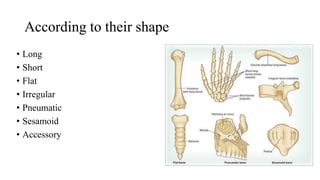
According to their shape
• Long
• Short
• Flat
• Irregular
• Pneumatic
• Sesamoid
• Accessory
Long bones
• Has
• 2 ends
• One shaft
• Medullary cavity
• Except clavicle
• Cartilaginous type of ossification
• Except clavicle (membranous)
• Nutrient foramen
• Directs away from growing end
• Types
• Long bones
• Eg., limb bones (humerus, femur…)
• Miniature long bones
• Has one end
• Eg. Metatarsals and metacarpals
Long bones - parts
• Diaphysis
• Shaft
• Epiphysis
• Ends of long bone
• Metaphysis
• Lies between
• Diaphysis & epiphysis
• Has
• Growth plate
Epiphysis
• Part of the bone
• Ossified from secondary ossification
centre
• Formed after birth
• Exception – lower end of femur
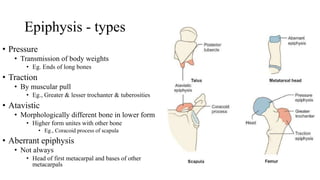
Epiphysis - types
• Pressure
• Transmission of body weights
• Eg. Ends of long bones
• Traction
• By muscular pull
• Eg., Greater & lesser trochanter & tuberosities
• Atavistic
• Morphologically different bone in lower form
• Higher form unites with other bone
• Eg., Coracoid process of scapula
• Aberrant epiphysis
• Not always
• Head of first metacarpal and bases of other
metacarpals
Metaphysis
• Epiphyseal end of diaphysis
• Of young growing bone
• Growing region of diaphysis
• Vascular zone of growing bone
• Blood vessels form hair pin bend
• Infection in a long bone starts from this
site
• Condition known as osteomyelitis in
children
• Weak due to
• Stress & strain
• Due to attachment of
• Muscles, ligaments & capsule
Blood supply – long bones
• 4 sets of vessels
• Nutrient artery
• Metaphyseal artery
• Hair pin bend – osteomyelitis
• Epiphysial artery
• Periosteal aretey
Short bones
• Cubical in shape
• Have six surfaces
• 4 surfaces are articular
• Carpals & tarsals
Carpals Tarsals
Flat bones
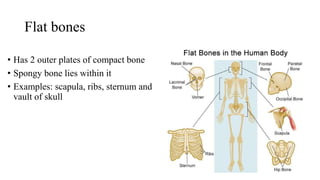
• Has 2 outer plates of compact bone
• Spongy bone lies within it
• Examples: scapula, ribs, sternum and
vault of skull
Sesamoid bone
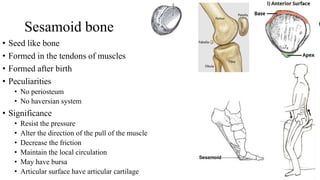
• Seed like bone
• Formed in the tendons of muscles
• Formed after birth
• Peculiarities
• No periosteum
• No haversian system
• Significance
• Resist the pressure
• Alter the direction of the pull of the muscle
• Decrease the friction
• Maintain the local circulation
• May have bursa
• Articular surface have articular cartilage
Sesamoid bone
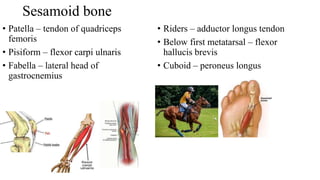
• Patella – tendon of quadriceps
femoris
• Pisiform – flexor carpi ulnaris
• Fabella – lateral head of
gastrocnemius
• Riders – adductor longus tendon
• Below first metatarsal – flexor
hallucis brevis
• Cuboid – peroneus longus
Pneumatic bones
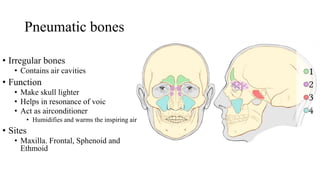
• Irregular bones
• Contains air cavities
• Function
• Make skull lighter
• Helps in resonance of voic
• Act as airconditioner
• Humidifies and warms the inspiring air
• Sites
• Maxilla. Frontal, Sphenoid and
Ethmoid
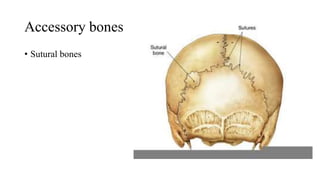
Accessory bones
• Sutural bones
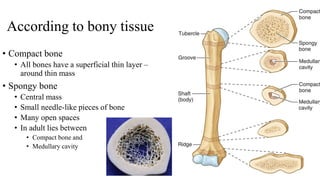
According to bony tissue
• Compact bone
• All bones have a superficial thin layer –
around thin mass
• Spongy bone
• Central mass
• Small needle-like pieces of bone
• Many open spaces
• In adult lies between
• Compact bone and
• Medullary cavity
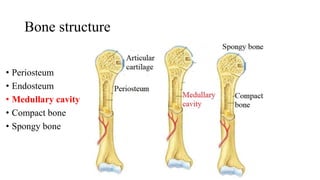
Bone structure
• Periosteum
• Endosteum
• Medullary cavity
• Compact bone
• Spongy bone
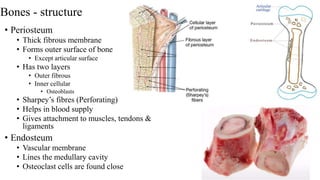
Bones - structure
• Periosteum
• Thick fibrous membrane
• Forms outer surface of bone
• Except articular surface
• Has two layers
• Outer fibrous
• Inner cellular
• Osteoblasts
• Sharpey’s fibres (Perforating)
• Helps in blood supply
• Gives attachment to muscles, tendons &
ligaments
• Endosteum
• Vascular membrane
• Lines the medullary cavity
• Osteoclast cells are found close
Bones – structure
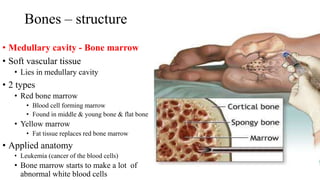
• Medullary cavity - Bone marrow
• Soft vascular tissue
• Lies in medullary cavity
• 2 types
• Red bone marrow
• Blood cell forming marrow
• Found in middle & young bone & flat bone
• Yellow marrow
• Fat tissue replaces red bone marrow
• Applied anatomy
• Leukemia (cancer of the blood cells)
• Bone marrow starts to make a lot of
abnormal white blood cells
Bones – structure
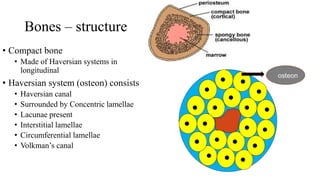
• Compact bone
• Made of Haversian systems in
longitudinal
• Haversian system (osteon) consists
• Haversian canal
• Surrounded by Concentric lamellae
• Lacunae present
• Interstitial lamellae
• Circumferential lamellae
• Volkman’s canal
Haversian system (osteon)
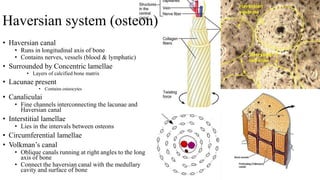
• Haversian canal
• Runs in longitudinal axis of bone
• Contains nerves, vessels (blood & lymphatic)
• Surrounded by Concentric lamellae
• Layers of calcified bone matrix
• Lacunae present
• Contains osteocytes
• Canaliculai
• Fine channels interconnecting the lacunae and
Haversian canal
• Interstitial lamellae
• Lies in the intervals between osteons
• Circumferential lamellae
• Volkman’s canal
• Oblique canals running at right angles to the long
axis of bone
• Connect the haversian canal with the medullary
cavity and surface of bone
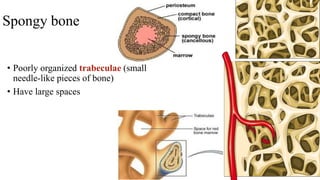
Spongy bone
• Poorly organized trabeculae (small
needle-like pieces of bone)
• Have large spaces
Components of bone
• 2 components
• Bone cells
• Inter cellular substance (Matrix)
Bone cells
• Osteogenic cells
• Resting cells
• Found in external & internal surface
• Osteoblasts
• Bone forming cells
• Derived from mesenchyme
• Secrete inorganic matrix (synthesis of osteoid & its
mineralization)
• May become osteocyte, osteoclast (fused osteoblasts)
• Osteocytes
• Matured bone cells
• Located in lacunae
• Osteoclasts
• Mutinucleated cells
• Bone destroying cells
• Lie resorption bays (Howship lacunae)
Intercellular substance
• 2 parts
• Organic
• Collagen
• Cement substance
• Mucoprotein, glycoprotein,
mucopolysaccharides etc.,
• Inorganic
• Calcium, magnesium, phosphate, citrate
etc.,
Ossification
• Process of bone formation
• Proliferation of collagen and ground
substance
• Subsequently deposition of calcium
• Types
• Intramembranous
• Mesenchyme directly converted into bone
• Eg., Clavicle, Vault of skull and flat bones
• Intracartilaginous
• Mesenchyme first becomes cartilaginous
model
• Cartilaginous model replaced by bone tissue
Centre of ossification
• From which point ossification starts
• 2 types
• Primary ossification center
• Which appears first usually before birth
• Diaphysis of long bones
• Exception: In carpal & Tarsal after birth
• Except – Talus, Cuboid and Calcaneus
• Secondary ossification center
• Which appears after birth
• Epiphysis (ends) of long bones
• Except: lower end of femur and upper end of
tibia
Laws of ossification
• Secondary ossification centre
• Where two secondary centres present
• The centre which appears first unites last
• Exception: Fibula
• Nutrient foramen
• Always away from growing end of bone
• Growing end of bone
• If there are two ends
• Ossification in one end appears first
• Grows longer and fuses later
Bone markings – gross features
• How made
• Attachments of
• Tendons, ligaments and
fascia
• Passage of
• Tendon, vessels and nerves
Bone markings – gross features
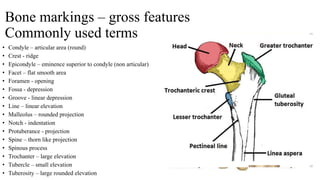
Commonly used terms
• Condyle – articular area (round)
• Crest - ridge
• Epicondyle – eminence superior to condyle (non articular)
• Facet – flat smooth area
• Foramen - opening
• Fossa - depression
• Groove - linear depression
• Line – linear elevation
• Malleolus – rounded projection
• Notch - indentation
• Protuberance - projection
• Spine – thorn like projection
• Spinous process
• Trochanter – large elevation
• Tubercle – small elevation
• Tuberosity – large rounded elevation

skeletal system21-22.pptx

  • 1.
    Bones • Specialized connectivetissue • Has mineralized extracellular matrix • Has more regeneration capacity (second to blood) • Has 206 bones
  • 2.
    Bones • Provides • Basicshape & support • Mechanical base of movement • Muscular system acts on • To produce movement • Store house for salts (eg. calcium) • Production unit for blood cells (Hematopoiesis) • Protects • Vital organs • Brain & spinal cord • Heart • Lungs • Pelvic organs
  • 3.
    Bones - classification •4 types of classification • Position • Shape & size • Structure • Ossification
  • 4.
    According to position •Axial - Lie along the central axis of the body • Appendicular – lie in the extremities (upper & lower limbs)
  • 5.
    • Axial (80) •Skull • - Cranial bones (8) • Parietal (2) • Temporal (2) • Frontal (1) • Occipital (1) • Ethmoid (1) • Sphenoid (1) • -Facial bones (14) • Maxilla (2) • Zygomatic (2) • Mandible (1) • Nasal (2) • Platine (2) • Inferior nasal concha (2) • Lacrimal (2) • Vomer (1) • Auditory ossicles (6) • Malleus (2) • Incus (2) • Stapes (2) • Vertebral column (26) • Cervical vertebrae (7) • Thoracic vertebrae (12) • Lumbar vertebrae (5) • Sacrum (1) • Coccyx (1) • Thoracic Cage (25) • Sternum (1) • Ribs (24) • Hyoid bone (1)
  • 6.
    • Pelvic Girdle(2) • Hip bones (2) • Lower Extremity (60) • Femur (2) • Tibia (2) • Fibula (2) • Patella (2) • Tarsals (14) • Metatarsals (10) • Phalanges (28) Appendicular Skeleton (126 bones) • Pectoral girdles (4) • Clavicle (2) • Scapula (2) • Upper Extremity (60) • Humerus (2) • Radius (2) • Ulna (2) • Carpals (16) • Metacarpals (10) • Phalanges (28)
  • 7.
    According to theirshape • Long • Short • Flat • Irregular • Pneumatic • Sesamoid • Accessory
  • 8.
    Long bones • Has •2 ends • One shaft • Medullary cavity • Except clavicle • Cartilaginous type of ossification • Except clavicle (membranous) • Nutrient foramen • Directs away from growing end • Types • Long bones • Eg., limb bones (humerus, femur…) • Miniature long bones • Has one end • Eg. Metatarsals and metacarpals
  • 9.
    Long bones -parts • Diaphysis • Shaft • Epiphysis • Ends of long bone • Metaphysis • Lies between • Diaphysis & epiphysis • Has • Growth plate
  • 10.
    Epiphysis • Part ofthe bone • Ossified from secondary ossification centre • Formed after birth • Exception – lower end of femur
  • 11.
    Epiphysis - types •Pressure • Transmission of body weights • Eg. Ends of long bones • Traction • By muscular pull • Eg., Greater & lesser trochanter & tuberosities • Atavistic • Morphologically different bone in lower form • Higher form unites with other bone • Eg., Coracoid process of scapula • Aberrant epiphysis • Not always • Head of first metacarpal and bases of other metacarpals
  • 12.
    Metaphysis • Epiphyseal endof diaphysis • Of young growing bone • Growing region of diaphysis • Vascular zone of growing bone • Blood vessels form hair pin bend • Infection in a long bone starts from this site • Condition known as osteomyelitis in children • Weak due to • Stress & strain • Due to attachment of • Muscles, ligaments & capsule
  • 13.
    Blood supply –long bones • 4 sets of vessels • Nutrient artery • Metaphyseal artery • Hair pin bend – osteomyelitis • Epiphysial artery • Periosteal aretey
  • 14.
    Short bones • Cubicalin shape • Have six surfaces • 4 surfaces are articular • Carpals & tarsals Carpals Tarsals
  • 15.
    Flat bones • Has2 outer plates of compact bone • Spongy bone lies within it • Examples: scapula, ribs, sternum and vault of skull
  • 16.
    Sesamoid bone • Seedlike bone • Formed in the tendons of muscles • Formed after birth • Peculiarities • No periosteum • No haversian system • Significance • Resist the pressure • Alter the direction of the pull of the muscle • Decrease the friction • Maintain the local circulation • May have bursa • Articular surface have articular cartilage
  • 17.
    Sesamoid bone • Patella– tendon of quadriceps femoris • Pisiform – flexor carpi ulnaris • Fabella – lateral head of gastrocnemius • Riders – adductor longus tendon • Below first metatarsal – flexor hallucis brevis • Cuboid – peroneus longus
  • 18.
    Pneumatic bones • Irregularbones • Contains air cavities • Function • Make skull lighter • Helps in resonance of voic • Act as airconditioner • Humidifies and warms the inspiring air • Sites • Maxilla. Frontal, Sphenoid and Ethmoid
  • 19.
  • 20.
    According to bonytissue • Compact bone • All bones have a superficial thin layer – around thin mass • Spongy bone • Central mass • Small needle-like pieces of bone • Many open spaces • In adult lies between • Compact bone and • Medullary cavity
  • 21.
    Bone structure • Periosteum •Endosteum • Medullary cavity • Compact bone • Spongy bone
  • 22.
    Bones - structure •Periosteum • Thick fibrous membrane • Forms outer surface of bone • Except articular surface • Has two layers • Outer fibrous • Inner cellular • Osteoblasts • Sharpey’s fibres (Perforating) • Helps in blood supply • Gives attachment to muscles, tendons & ligaments • Endosteum • Vascular membrane • Lines the medullary cavity • Osteoclast cells are found close
  • 23.
    Bones – structure •Medullary cavity - Bone marrow • Soft vascular tissue • Lies in medullary cavity • 2 types • Red bone marrow • Blood cell forming marrow • Found in middle & young bone & flat bone • Yellow marrow • Fat tissue replaces red bone marrow • Applied anatomy • Leukemia (cancer of the blood cells) • Bone marrow starts to make a lot of abnormal white blood cells
  • 24.
    Bones – structure •Compact bone • Made of Haversian systems in longitudinal • Haversian system (osteon) consists • Haversian canal • Surrounded by Concentric lamellae • Lacunae present • Interstitial lamellae • Circumferential lamellae • Volkman’s canal
  • 25.
    Haversian system (osteon) •Haversian canal • Runs in longitudinal axis of bone • Contains nerves, vessels (blood & lymphatic) • Surrounded by Concentric lamellae • Layers of calcified bone matrix • Lacunae present • Contains osteocytes • Canaliculai • Fine channels interconnecting the lacunae and Haversian canal • Interstitial lamellae • Lies in the intervals between osteons • Circumferential lamellae • Volkman’s canal • Oblique canals running at right angles to the long axis of bone • Connect the haversian canal with the medullary cavity and surface of bone
  • 26.
    Spongy bone • Poorlyorganized trabeculae (small needle-like pieces of bone) • Have large spaces
  • 28.
    Components of bone •2 components • Bone cells • Inter cellular substance (Matrix)
  • 29.
    Bone cells • Osteogeniccells • Resting cells • Found in external & internal surface • Osteoblasts • Bone forming cells • Derived from mesenchyme • Secrete inorganic matrix (synthesis of osteoid & its mineralization) • May become osteocyte, osteoclast (fused osteoblasts) • Osteocytes • Matured bone cells • Located in lacunae • Osteoclasts • Mutinucleated cells • Bone destroying cells • Lie resorption bays (Howship lacunae)
  • 30.
    Intercellular substance • 2parts • Organic • Collagen • Cement substance • Mucoprotein, glycoprotein, mucopolysaccharides etc., • Inorganic • Calcium, magnesium, phosphate, citrate etc.,
  • 31.
    Ossification • Process ofbone formation • Proliferation of collagen and ground substance • Subsequently deposition of calcium • Types • Intramembranous • Mesenchyme directly converted into bone • Eg., Clavicle, Vault of skull and flat bones • Intracartilaginous • Mesenchyme first becomes cartilaginous model • Cartilaginous model replaced by bone tissue
  • 32.
    Centre of ossification •From which point ossification starts • 2 types • Primary ossification center • Which appears first usually before birth • Diaphysis of long bones • Exception: In carpal & Tarsal after birth • Except – Talus, Cuboid and Calcaneus • Secondary ossification center • Which appears after birth • Epiphysis (ends) of long bones • Except: lower end of femur and upper end of tibia
  • 33.
    Laws of ossification •Secondary ossification centre • Where two secondary centres present • The centre which appears first unites last • Exception: Fibula • Nutrient foramen • Always away from growing end of bone • Growing end of bone • If there are two ends • Ossification in one end appears first • Grows longer and fuses later
  • 34.
    Bone markings –gross features • How made • Attachments of • Tendons, ligaments and fascia • Passage of • Tendon, vessels and nerves
  • 35.
    Bone markings –gross features Commonly used terms • Condyle – articular area (round) • Crest - ridge • Epicondyle – eminence superior to condyle (non articular) • Facet – flat smooth area • Foramen - opening • Fossa - depression • Groove - linear depression • Line – linear elevation • Malleolus – rounded projection • Notch - indentation • Protuberance - projection • Spine – thorn like projection • Spinous process • Trochanter – large elevation • Tubercle – small elevation • Tuberosity – large rounded elevation