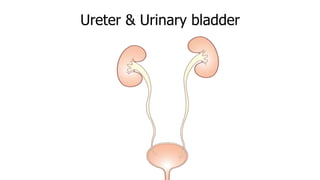
Ureter & Urinary bladder
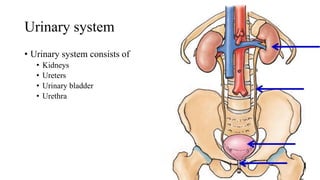
Urinary system
• Urinary system consists of
• Kidneys
• Ureters
• Urinary bladder
• Urethra
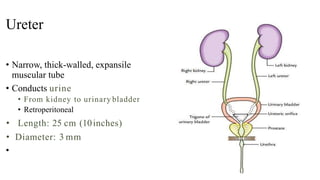
Ureter
• Narrow, thick-walled, expansile
muscular tube
• Conducts urine
• From kidney to urinary bladder
• Retroperitoneal
• Length: 25 cm (10inches)
• Diameter: 3 mm
•
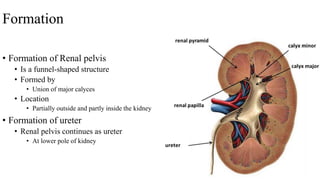
Formation
• Formation of Renal pelvis
• Is a funnel-shaped structure
• Formed by
• Union of major calyces
• Location
• Partially outside and partly inside the kidney
• Formation of ureter
• Renal pelvis continues as ureter
• At lower pole of kidney
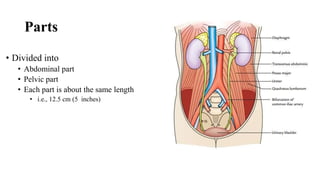
Parts
• Divided into
• Abdominal part
• Pelvic part
• Each part is about the same length
• i.e., 12.5 cm (5 inches)
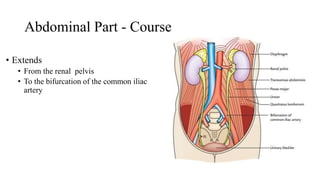
Abdominal Part - Course
• Extends
• From the renal pelvis
• To the bifurcation of the common iliac
artery
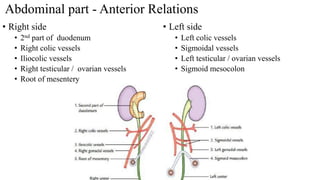
Abdominal part - Anterior Relations
• Left side
• Left colic vessels
• Sigmoidal vessels
• Left testicular / ovarian vessels
• Sigmoid mesocolon
• Right side
• 2nd part of duodenum
• Right colic vessels
• Iliocolic vessels
• Right testicular / ovarian vessels
• Root of mesentery
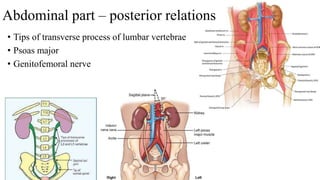
• Tips of transverse process of lumbar vertebrae
• Psoas major
• Genitofemoral nerve
Abdominal part – posterior relations
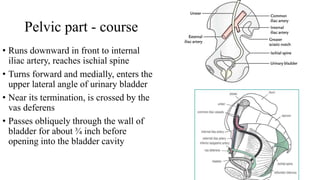
Pelvic part - course
• Runs downward in front to internal
iliac artery, reaches ischial spine
• Turns forward and medially, enters the
upper lateral angle of urinary bladder
• Near its termination, is crossed by the
vas deferens
• Passes obliquely through the wall of
bladder for about ¾ inch before
opening into the bladder cavity
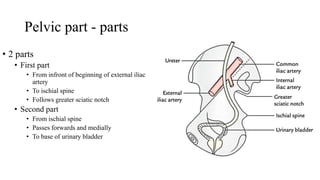
Pelvic part - parts
• 2 parts
• First part
• From infront of beginning of external iliac
artery
• To ischial spine
• Follows greater sciatic notch
• Second part
• From ischial spine
• Passes forwards and medially
• To base of urinary bladder
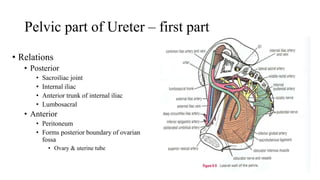
Pelvic part of Ureter – first part
• Relations
• Posterior
• Sacroiliac joint
• Internal iliac
• Anterior trunk of internal iliac
• Lumbosacral
• Anterior
• Peritoneum
• Forms posterior boundary of ovarian
fossa
• Ovary & uterine tube
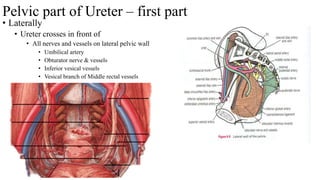
Pelvic part of Ureter – first part
• Laterally
• Ureter crosses in front of
• All nerves and vessels on lateral pelvic wall
• Umbilical artery
• Obturator nerve & vessels
• Inferior vesical vessels
• Vesical branch of Middle rectal vessels
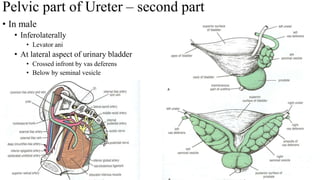
Pelvic part of Ureter – second part
• In male
• Inferolaterally
• Levator ani
• At lateral aspect of urinary bladder
• Crossed infront by vas deferens
• Below by seminal vesicle
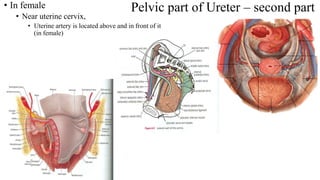
Pelvic part of Ureter – second part
• In female
• Near uterine cervix,
• Uterine artery is located above and in front of it
(in female)
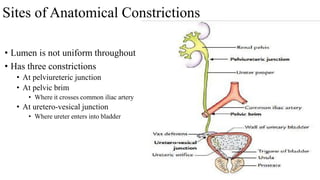
Sites of Anatomical Constrictions
• Lumen is not uniform throughout
• Has three constrictions
• At pelviureteric junction
• At pelvic brim
• Where it crosses common iliac artery
• At uretero-vesical junction
• Where ureter enters into bladder
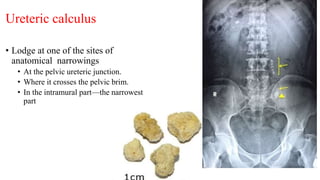
Ureteric calculus
• Lodge at one of the sites of
anatomical narrowings
• At the pelvic ureteric junction.
• Where it crosses the pelvic brim.
• In the intramural part—the narrowest
part
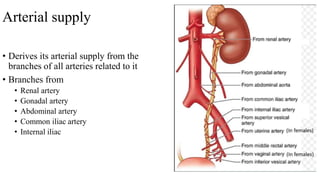
Arterial supply
• Derives its arterial supply from the
branches of all arteries related to it
• Branches from
• Renal artery
• Gonadal artery
• Abdominal artery
• Common iliac artery
• Internal iliac
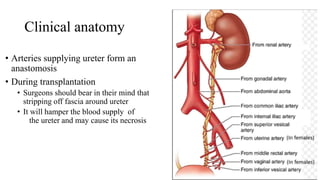
Clinical anatomy
• Arteries supplying ureter form an
anastomosis
• During transplantation
• Surgeons should bear in their mind that
stripping off fascia around ureter
• It will hamper the blood supply of
the ureter and may cause its necrosis
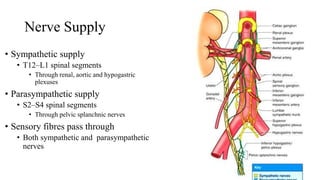
Nerve Supply
• Sympathetic supply
• T12–L1 spinal segments
• Through renal, aortic and hypogastric
plexuses
• Parasympathetic supply
• S2–S4 spinal segments
• Through pelvic splanchnic nerves
• Sensory fibres pass through
• Both sympathetic and parasympathetic
nerves
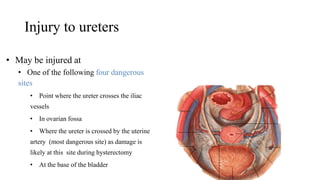
Injury to ureters
• May be injured at
• One of the following four dangerous
sites
• Point where the ureter crosses the iliac
vessels
• In ovarian fossa
• Where the ureter is crossed by the uterine
artery (most dangerous site) as damage is
likely at this site during hysterectomy
• At the base of the bladder
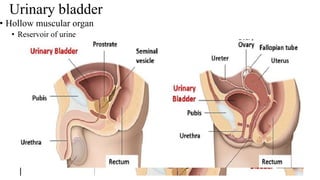
Urinary bladder
• Hollow muscular organ
• Reservoir of urine
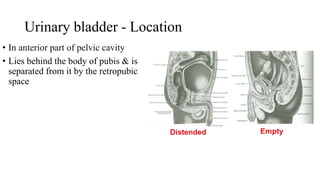
Urinary bladder - Location
• In anterior part of pelvic cavity
• Lies behind the body of pubis & is
separated from it by the retropubic
space
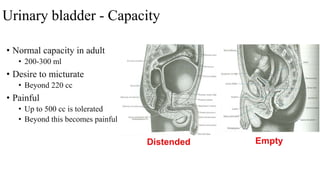
Urinary bladder - Capacity
• Normal capacity in adult
• 200-300 ml
• Desire to micturate
• Beyond 220 cc
• Painful
• Up to 500 cc is tolerated
• Beyond this becomes painful
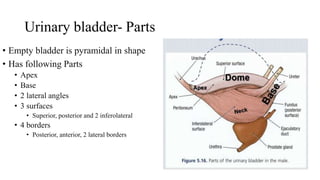
Urinary bladder- Parts
• Empty bladder is pyramidal in shape
• Has following Parts
• Apex
• Base
• 2 lateral angles
• 3 surfaces
• Superior, posterior and 2 inferolateral
• 4 borders
• Posterior, anterior, 2 lateral borders
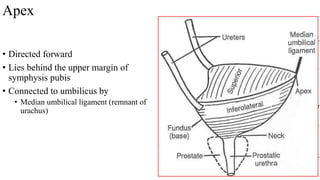
Apex
• Directed forward
• Lies behind the upper margin of
symphysis pubis
• Connected to umbilicus by
• Median umbilical ligament (remnant of
urachus)
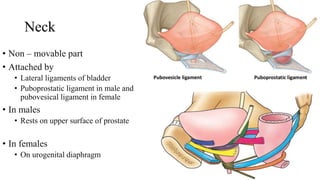
Neck
• Non – movable part
• Attached by
• Lateral ligaments of bladder
• Puboprostatic ligament in male and
pubovesical ligament in female
• In males
• Rests on upper surface of prostate
• In females
• On urogenital diaphragm
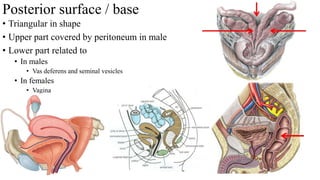
Posterior surface / base
• Triangular in shape
• Upper part covered by peritoneum in male
• Lower part related to
• In males
• Vas deferens and seminal vesicles
• In females
• Vagina
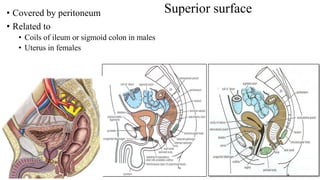
Superior surface
• Covered by peritoneum
• Related to
• Coils of ileum or sigmoid colon in males
• Uterus in females
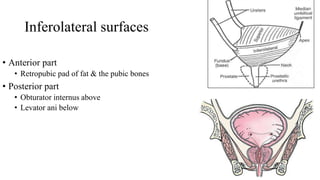
Inferolateral surfaces
• Anterior part
• Retropubic pad of fat & the pubic bones
• Posterior part
• Obturator internus above
• Levator ani below
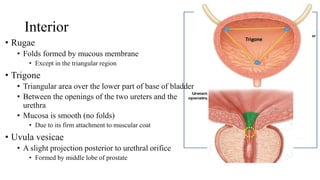
Interior
• Rugae
• Folds formed by mucous membrane
• Except in the triangular region
• Trigone
• Triangular area over the lower part of base of bladder
• Between the openings of the two ureters and the
urethra
• Mucosa is smooth (no folds)
• Due to its firm attachment to muscular coat
• Uvula vesicae
• A slight projection posterior to urethral orifice
• Formed by middle lobe of prostate
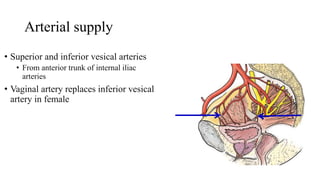
Arterial supply
• Superior and inferior vesical arteries
• From anterior trunk of internal iliac
arteries
• Vaginal artery replaces inferior vesical
artery in female
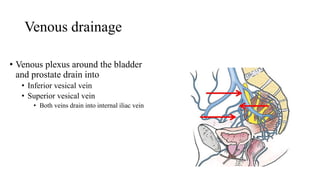
Venous drainage
• Venous plexus around the bladder
and prostate drain into
• Inferior vesical vein
• Superior vesical vein
• Both veins drain into internal iliac vein
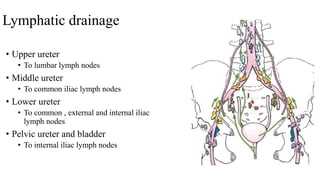
Lymphatic drainage
• Upper ureter
• To lumbar lymph nodes
• Middle ureter
• To common iliac lymph nodes
• Lower ureter
• To common , external and internal iliac
lymph nodes
• Pelvic ureter and bladder
• To internal iliac lymph nodes
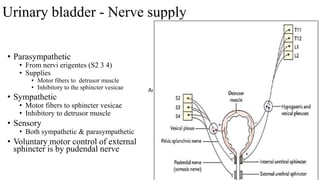
Urinary bladder - Nerve supply
• Parasympathetic
• From nervi erigentes (S2 3 4)
• Supplies
• Motor fibers to detrusor muscle
• Inhibitory to the sphincter vesicae
• Sympathetic
• Motor fibers to sphincter vesicae
• Inhibitory to detrusor muscle
• Sensory
• Both sympathetic & parasympathetic
• Voluntary motor control of external
sphincter is by pudendal nerve
Anatomy
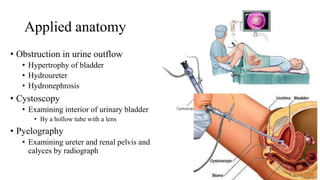
Applied anatomy
• Obstruction in urine outflow
• Hypertrophy of bladder
• Hydroureter
• Hydronephrosis
• Cystoscopy
• Examining interior of urinary bladder
• By a hollow tube with a lens
• Pyelography
• Examining ureter and renal pelvis and
calyces by radiograph

ureter & urinary bladder -.pptx

  • 2.
  • 3.
    Urinary system • Urinarysystem consists of • Kidneys • Ureters • Urinary bladder • Urethra
  • 4.
    Ureter • Narrow, thick-walled,expansile muscular tube • Conducts urine • From kidney to urinary bladder • Retroperitoneal • Length: 25 cm (10inches) • Diameter: 3 mm •
  • 5.
    Formation • Formation ofRenal pelvis • Is a funnel-shaped structure • Formed by • Union of major calyces • Location • Partially outside and partly inside the kidney • Formation of ureter • Renal pelvis continues as ureter • At lower pole of kidney
  • 6.
    Parts • Divided into •Abdominal part • Pelvic part • Each part is about the same length • i.e., 12.5 cm (5 inches)
  • 7.
    Abdominal Part -Course • Extends • From the renal pelvis • To the bifurcation of the common iliac artery
  • 8.
    Abdominal part -Anterior Relations • Left side • Left colic vessels • Sigmoidal vessels • Left testicular / ovarian vessels • Sigmoid mesocolon • Right side • 2nd part of duodenum • Right colic vessels • Iliocolic vessels • Right testicular / ovarian vessels • Root of mesentery
  • 9.
    • Tips oftransverse process of lumbar vertebrae • Psoas major • Genitofemoral nerve Abdominal part – posterior relations
  • 10.
    Pelvic part -course • Runs downward in front to internal iliac artery, reaches ischial spine • Turns forward and medially, enters the upper lateral angle of urinary bladder • Near its termination, is crossed by the vas deferens • Passes obliquely through the wall of bladder for about ¾ inch before opening into the bladder cavity
  • 11.
    Pelvic part -parts • 2 parts • First part • From infront of beginning of external iliac artery • To ischial spine • Follows greater sciatic notch • Second part • From ischial spine • Passes forwards and medially • To base of urinary bladder
  • 12.
    Pelvic part ofUreter – first part • Relations • Posterior • Sacroiliac joint • Internal iliac • Anterior trunk of internal iliac • Lumbosacral • Anterior • Peritoneum • Forms posterior boundary of ovarian fossa • Ovary & uterine tube
  • 13.
    Pelvic part ofUreter – first part • Laterally • Ureter crosses in front of • All nerves and vessels on lateral pelvic wall • Umbilical artery • Obturator nerve & vessels • Inferior vesical vessels • Vesical branch of Middle rectal vessels
  • 14.
    Pelvic part ofUreter – second part • In male • Inferolaterally • Levator ani • At lateral aspect of urinary bladder • Crossed infront by vas deferens • Below by seminal vesicle
  • 15.
    Pelvic part ofUreter – second part • In female • Near uterine cervix, • Uterine artery is located above and in front of it (in female)
  • 16.
    Sites of AnatomicalConstrictions • Lumen is not uniform throughout • Has three constrictions • At pelviureteric junction • At pelvic brim • Where it crosses common iliac artery • At uretero-vesical junction • Where ureter enters into bladder
  • 17.
    Ureteric calculus • Lodgeat one of the sites of anatomical narrowings • At the pelvic ureteric junction. • Where it crosses the pelvic brim. • In the intramural part—the narrowest part
  • 18.
    Arterial supply • Derivesits arterial supply from the branches of all arteries related to it • Branches from • Renal artery • Gonadal artery • Abdominal artery • Common iliac artery • Internal iliac
  • 19.
    Clinical anatomy • Arteriessupplying ureter form an anastomosis • During transplantation • Surgeons should bear in their mind that stripping off fascia around ureter • It will hamper the blood supply of the ureter and may cause its necrosis
  • 20.
    Nerve Supply • Sympatheticsupply • T12–L1 spinal segments • Through renal, aortic and hypogastric plexuses • Parasympathetic supply • S2–S4 spinal segments • Through pelvic splanchnic nerves • Sensory fibres pass through • Both sympathetic and parasympathetic nerves
  • 21.
    Injury to ureters •May be injured at • One of the following four dangerous sites • Point where the ureter crosses the iliac vessels • In ovarian fossa • Where the ureter is crossed by the uterine artery (most dangerous site) as damage is likely at this site during hysterectomy • At the base of the bladder
  • 22.
    Urinary bladder • Hollowmuscular organ • Reservoir of urine
  • 23.
    Urinary bladder -Location • In anterior part of pelvic cavity • Lies behind the body of pubis & is separated from it by the retropubic space
  • 24.
    Urinary bladder -Capacity • Normal capacity in adult • 200-300 ml • Desire to micturate • Beyond 220 cc • Painful • Up to 500 cc is tolerated • Beyond this becomes painful
  • 25.
    Urinary bladder- Parts •Empty bladder is pyramidal in shape • Has following Parts • Apex • Base • 2 lateral angles • 3 surfaces • Superior, posterior and 2 inferolateral • 4 borders • Posterior, anterior, 2 lateral borders
  • 26.
    Apex • Directed forward •Lies behind the upper margin of symphysis pubis • Connected to umbilicus by • Median umbilical ligament (remnant of urachus)
  • 27.
    Neck • Non –movable part • Attached by • Lateral ligaments of bladder • Puboprostatic ligament in male and pubovesical ligament in female • In males • Rests on upper surface of prostate • In females • On urogenital diaphragm
  • 28.
    Posterior surface /base • Triangular in shape • Upper part covered by peritoneum in male • Lower part related to • In males • Vas deferens and seminal vesicles • In females • Vagina
  • 29.
    Superior surface • Coveredby peritoneum • Related to • Coils of ileum or sigmoid colon in males • Uterus in females
  • 30.
    Inferolateral surfaces • Anteriorpart • Retropubic pad of fat & the pubic bones • Posterior part • Obturator internus above • Levator ani below
  • 31.
    Interior • Rugae • Foldsformed by mucous membrane • Except in the triangular region • Trigone • Triangular area over the lower part of base of bladder • Between the openings of the two ureters and the urethra • Mucosa is smooth (no folds) • Due to its firm attachment to muscular coat • Uvula vesicae • A slight projection posterior to urethral orifice • Formed by middle lobe of prostate
  • 32.
    Arterial supply • Superiorand inferior vesical arteries • From anterior trunk of internal iliac arteries • Vaginal artery replaces inferior vesical artery in female
  • 33.
    Venous drainage • Venousplexus around the bladder and prostate drain into • Inferior vesical vein • Superior vesical vein • Both veins drain into internal iliac vein
  • 34.
    Lymphatic drainage • Upperureter • To lumbar lymph nodes • Middle ureter • To common iliac lymph nodes • Lower ureter • To common , external and internal iliac lymph nodes • Pelvic ureter and bladder • To internal iliac lymph nodes
  • 35.
    Urinary bladder -Nerve supply • Parasympathetic • From nervi erigentes (S2 3 4) • Supplies • Motor fibers to detrusor muscle • Inhibitory to the sphincter vesicae • Sympathetic • Motor fibers to sphincter vesicae • Inhibitory to detrusor muscle • Sensory • Both sympathetic & parasympathetic • Voluntary motor control of external sphincter is by pudendal nerve Anatomy
  • 36.
    Applied anatomy • Obstructionin urine outflow • Hypertrophy of bladder • Hydroureter • Hydronephrosis • Cystoscopy • Examining interior of urinary bladder • By a hollow tube with a lens • Pyelography • Examining ureter and renal pelvis and calyces by radiograph