Femoral Triangle
By Dr. Piyush
INTRODUCTION
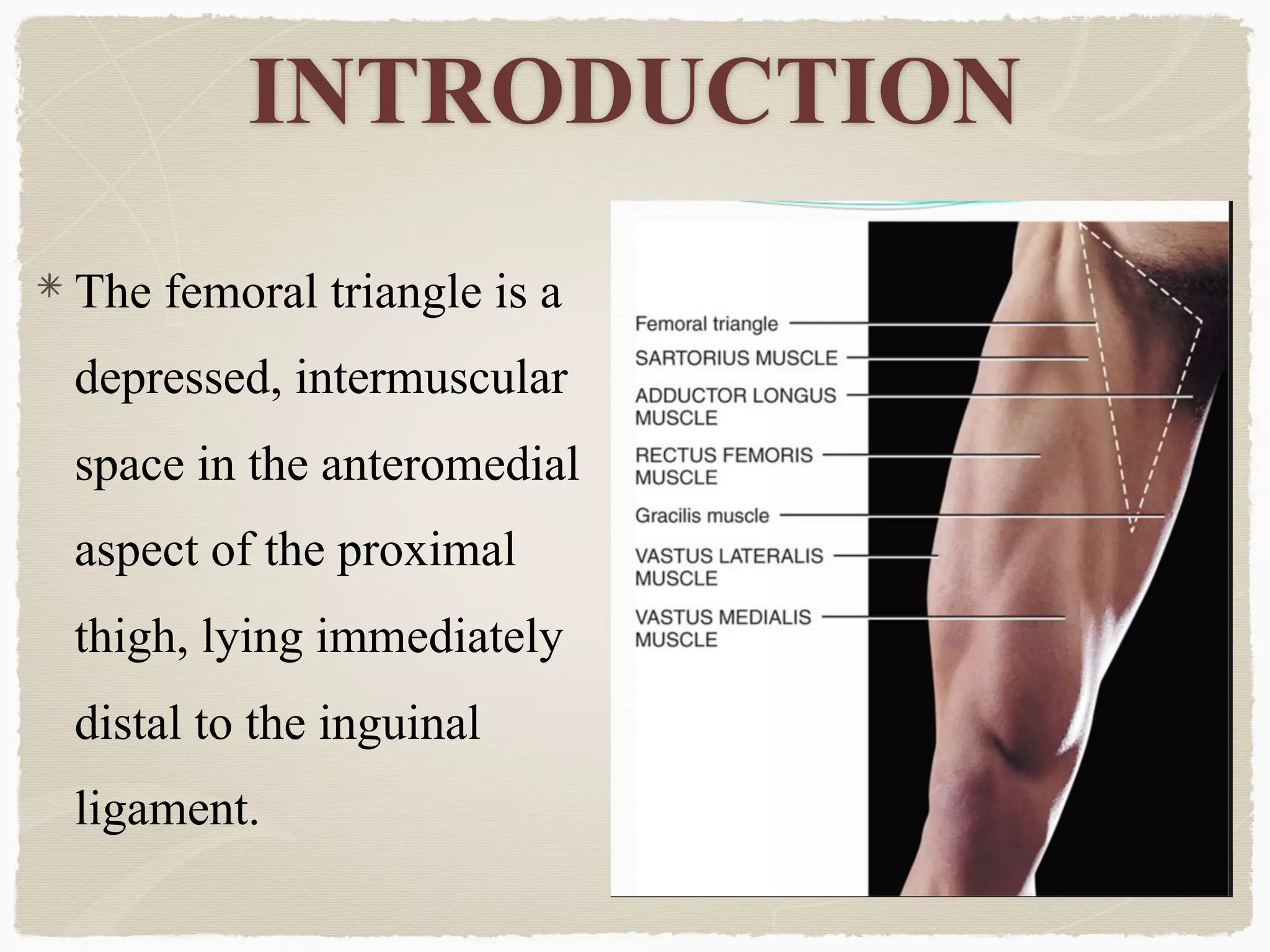
The femoral triangle is a
depressed, intermuscular
space in the anteromedial
aspect of the proximal
thigh, lying immediately
distal to the inguinal
ligament.
Surface marking
Boundaries:
Base: Inguinal ligament
Lateral: Medial border of
Sartorius
Medial: Medial border of
Adductor Longus
Floor: Medial to lateral
Adductor longus
Pectineus
Psoas major
Iliacus
Roof:
Deep fascia (fascia lata)
Superficial fascia
Skin
Sartorius :
Longest strap muscle
Anterior compartment of
thigh
Spirals obliquely
Origin: Anterior superior iliac
spine & notch below it.
Insertion: upper part of
subcutaneous medial surface of
shaft of tibia.
Details of Muscles Associated with Femoral triangle
Nerve supply: nerve to
sartorius from anterior
division of femoral nerve
Actions:
Flexion, abduction and
lateral rotation at hip joint
Flexion and medial
rotation at knee joint in
semi-flexed position.
Adductor longus:
Triangular shape
Origin: Round tendon
from angle between pubic
crest and symphysis.
Insertion: Medial lip of
linea aspera in middle third
of femoral shaft.
Nerve supply: Anterior
division of obturator nerve.
Actions:
Adduction and medial
rotation of Hip joint
Assist in flexion of hip
joint.
Pectineus:
Quadrilateral
Same plane with adductor
longus
Origin: pecten pubis and
bone in front of it.
Insertion: vertical line from
lesser trochanter to linea
aspera.
Nerve supply: Since it is a composite muscle has dual nerve supply
Ventral stratum: from trunk of femoral nerve
Dorsal stratum: from the anterior division of obturator nerve
and accessory obturator nerve when present.
Actions: Flexion and adduction at Hip joint.
Psoas major:
Long fusiform shape
Muscle of posterior abdominal wall
Origin:
1. Anterior surface and lower border
of transverse process of all lumbar
vertebra
2. Through 5 fleshy slips from bodies
and intervertebral disc of lumbar
vertebrae
3. From tendinous arches bridging the
sides of lumbar vertebrae.
Insertion: Anterior surface of tip of
lesser trochanter of the femur.
Nerve Supply: ventral rami of L1, L2
& L3 Spinal nerve.
Actions:
Acting from above- Chief Flexor
of hip joint with Iliacus.
Acting from below- Flexes the
trunk.
When foot of ground also acts as
lateral rotator of hip
When foot on ground medial
rotator of hip.
Electromyography shows no rotator
action of psoas but in conditions of
fractured neck of femur distal
fragment is rotated laterally by it.
Iliacus:
Triangular shaped
Origin:
Upper 2/3rd of Iliac fossa
Ventral sacroiliac
ligament
Adjoining ala of sacrum
Insertion: Into psoas tendon
and shaft of femur for about
2.5cm front and below lesser
trochanter.
Nerve Supply: trunk of femoral nerve
Actions:
Acting with psoas major it is the chief flexor of hip joint.
Assists in medial rotation of hip joint
Femoral artery & its branches
Femoral vein & its tributaries
Deep inguinal lymph nodes
Femoral nerve and its
branches
A part of lateral femoral
cutaneous
Femoral branch of Genito-
femoral nerve
Fibro-fatty tissues
Contents
Proximal 3-4cm in femoral
sheath
Femoral artery course and its
branches:
Continuation of external iliac
Enters femoral triangle at mid
inguinal point.
Leaves femoral triangle at its
apex.
Enters the adductor canal
then leaves through adductor
hiatus to become popliteal
artery (5th osseo-aponeurotic
opening in adductor magnus)
Branches:
3 superficial , 3 deep and
few muscular branches
Superficial epigastric
Superficial circumflex
iliac
Superficial external
pudendal
Deep external
pudendal
Profunda femoris
Descending genicular
Profunda femoris and its
branches:
Arises from femoral artery 3.5
cm below inguinal ligament
Spirals medially and leaves
triangle between pectineus and
adductor longus
Descends behind adductor
longus
Pierces adductor magnus as 4th
perforating artery
Anastomoses with superior
muscular branch of popliteal
artery
Branches:
Lateral circumflex femoral
Medial circumflex femoral
4 perforating arteries
Femoral vein & its tributaries:
In Adductor canal femoral vein lies
posterior to artery.
Enters femoral triangle at apex
Ascends and shifts to medial side of
artery
Continues as external iliac vein above
inguinal ligament
Important Tributaries:
Profunda femoris vein
Great saphenous vein
Other corresponding veins with
arteries
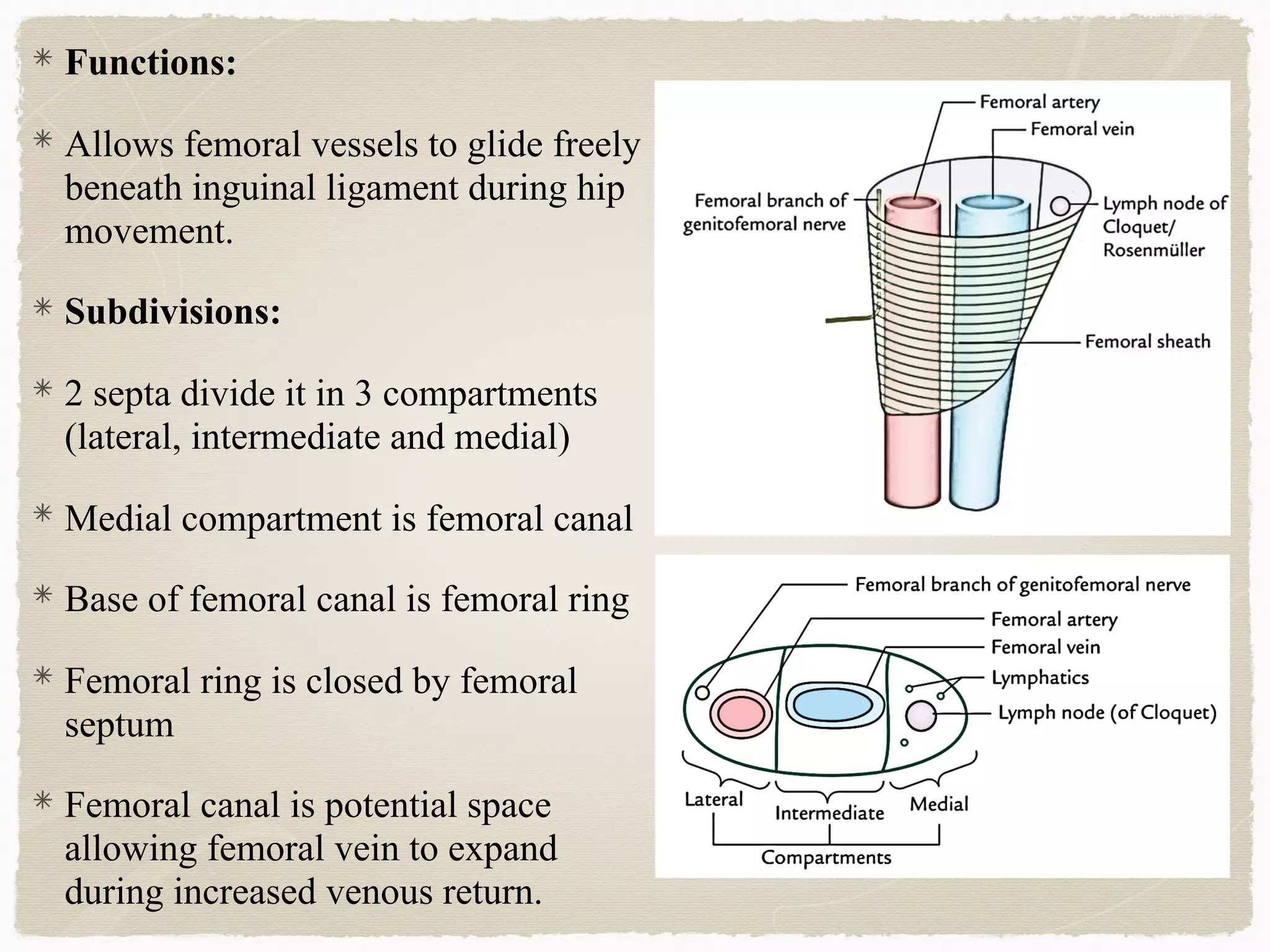
Femoral sheath:
Funnel shaped fascial extension
around proximal part of femoral
vessels.
Blends with tunica adventitia 3-4
cm below inguinal ligament
Formation:
Anterior wall- fascia transversalis
Posterior wall- fascia iliaca
Femoral nerve not enclosed by
sheath as it passis entirely
beneath fascia iliaca.
Functions:
Allows femoral vessels to glide freely
beneath inguinal ligament during hip
movement.
Subdivisions:
2 septa divide it in 3 compartments
(lateral, intermediate and medial)
Medial compartment is femoral canal
Base of femoral canal is femoral ring
Femoral ring is closed by femoral
septum
Femoral canal is potential space
allowing femoral vein to expand
during increased venous return.
Femoral nerve & its branches
Largest branch of lumbar plexus
Nerve of extensor compartment
of thigh
Root value : dorsal branches of
ventral rami of L2, L3 & L4
spinal nerves
After formation inside the psoas
major it comes out from the
lateral border of the muscle.
In the iliac fossa runs under
cover of fascia iliaca.
Appear in Femoral triangle
lateral to femoral sheath
between psoas major &
iliacus.
2-3 cm below inguinal
ligament trunk of nerve
splits in 2 divisions
(anterior & posterior) by
lateral circumflex femoral
artery.
BRANCHES:
Incision:
A curved incision from ASIS to
pubic symphysis.
Vertical incision on medial side of
thigh till 10 cm below knee.
When the abdomen has not been
dissected previously another
horizontal incision from ASIS to
midline is made.
Skin reflected laterally to expose
superficial fascia
Dissection
Superficial fascia
Great saphenous vein and its
tributaries
Superficial group of inguinal
lymph nodes
Ilioinguinal nerve with spermatic
cord (round ligament in female)
emerging through superficial
inguinal ring.
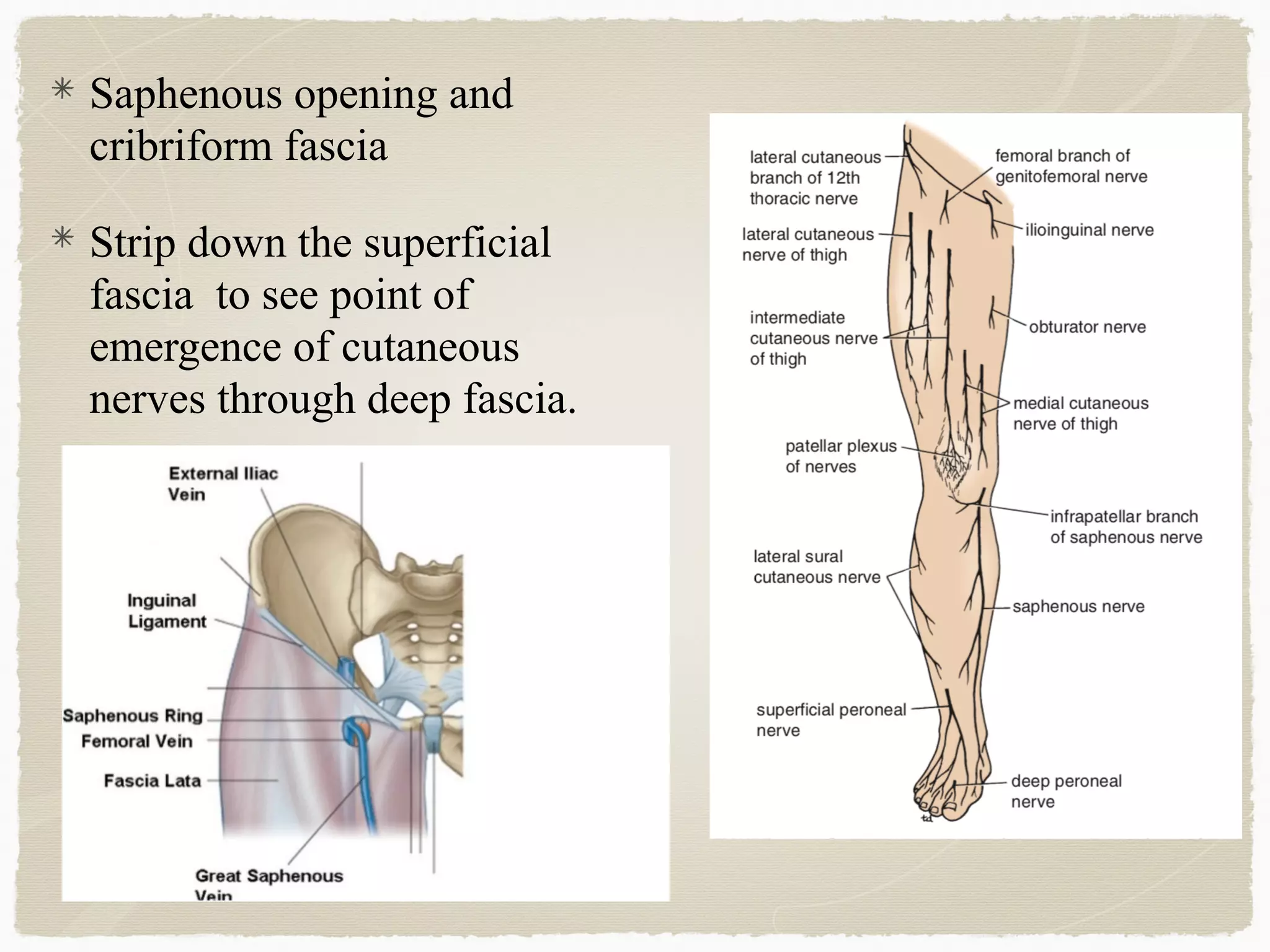
Saphenous opening and
cribriform fascia
Strip down the superficial
fascia to see point of
emergence of cutaneous
nerves through deep fascia.
Deep fascia
Called fascia lata
Thick along lateral side of thigh and
named Ilio-tibial tract.
Has the saphenous opening
Following saphenous vein
upwards femoral sheath is
exposed and split
Femoral sheath contents
exposed
Fascia lata cut and boundaries
of femoral triangle made clear
Contents of the femoral
triangle seen
Branches of femoral nerve
and artery traced distally.
Contents of triangle mobilised
to see the floor muscles
Applied
Varicose veins
Varicosed vein is one that has a larger diameter than
normal and is elongated and tortuous.
Commonly occurs in the superficial veins of the lower
limb
Not life threatening, is responsible for considerable
discomfort and pain.
Causes:
Hereditary weakness of the vein walls and
incompetent valves
Elevated intra- abdominal pressure as a result of
multiple pregnancies or abdominal tumors
Thrombophlebitis of the deep veins, causes faulty
perforators resulting in the superficial veins
becoming the main venous pathway for the lower
limb.
Every time the patient exercises, high-pressure
venous blood escapes from the deep veins into the
superficial veins
Thus producing a varicosity, which might be
localized to begin with but becomes more
extensive later.
Successful operative treatment of varicosed veins
depends on the ligation and division of all the
main tributaries of the great or small saphenous
veins,
This prevents a collateral venous circulation from
developing
The ligation and division of all the perforating
veins prevents the leakage of high- pressure blood
from the deep to the superficial veins.
It is now common practice to remove or strip the
superficial veins in addition.
Veinous cut down (venesection)
Saphenous vein in Coronary artery bypass grafting
The venous segment is reversed so that its valves do not
obstruct the arterial flow.
Femoral hernia
It is more common in women than
in men (possibly because of their
wider pelvis and femoral canal).
The hernial sac passes down the
femoral canal, pushing the femoral
septum before it.
On escaping through the lower end
of the femoral canal, it expands to
form a swelling in the upper part of
the thigh deep to the deep fascia.
With further expansion, the hernial
sac may turn upward to cross the
anterior surface of the inguinal
ligament.
The neck of the sac always lies below and
lateral to the pubic tubercle.
This serves to distinguish it from an
inguinal hernia, which lies above and
medial to the pubic tubercle.
The ring is related anteriorly to the inguinal
ligament, pos- teriorly to the pectineal
ligament and the superior ramus of the
pubis, medially to the sharp free edge of the
lacunar ligament, and laterally to the
femoral vein.
Because of these anatomic structures, the
neck of the sac is unable to expand.
Once an abdominal viscus has passed
through the neck into the body of the sac, it
may be difficult to push it up and return it to
the abdominal cavity (irreducible hernia).
Psoas abscess
Tuberculous infection of a lumbar vertebra can result in the
extravasation of pus down the psoas sheath into 

the thigh.
The presence of a swelling above and below the inguinal ligament,
together with clinical signs and symptoms referred to the vertebral
column.
Femoral artery catheterization
Femoral vein catheterization
Adductor muscles and cerebral palsy
Some patients with cerebral palsy have
marked spasticity of the adductor group
of muscles
It is common practice to perform a
tenotomy of the adductor longus tendon
and to divide the anterior division of the
obturator nerve.
In some severe cases, the posterior
division of the obturator nerve is crushed.
This operation overcomes the spasm of
the adductor group of muscles and
permits slow recovery of the muscles
supplied by the posterior division of the
obturator nerve.
A K Dutta’s Essentials of human anatomy.
Grays anatomy for students.
Snell’s Clinical Antomy by regions.
BIBLIOGRAPHY
THANK YOU

Femoral triangle

  • 1.
  • 2.
    INTRODUCTION The femoral triangleis a depressed, intermuscular space in the anteromedial aspect of the proximal thigh, lying immediately distal to the inguinal ligament.
  • 3.
  • 4.
    Boundaries: Base: Inguinal ligament Lateral:Medial border of Sartorius Medial: Medial border of Adductor Longus
  • 5.
    Floor: Medial tolateral Adductor longus Pectineus Psoas major Iliacus
  • 6.
    Roof: Deep fascia (fascialata) Superficial fascia Skin
  • 7.
    Sartorius : Longest strapmuscle Anterior compartment of thigh Spirals obliquely Origin: Anterior superior iliac spine & notch below it. Insertion: upper part of subcutaneous medial surface of shaft of tibia. Details of Muscles Associated with Femoral triangle
  • 8.
    Nerve supply: nerveto sartorius from anterior division of femoral nerve Actions: Flexion, abduction and lateral rotation at hip joint Flexion and medial rotation at knee joint in semi-flexed position.
  • 10.
    Adductor longus: Triangular shape Origin:Round tendon from angle between pubic crest and symphysis. Insertion: Medial lip of linea aspera in middle third of femoral shaft.
  • 11.
    Nerve supply: Anterior divisionof obturator nerve. Actions: Adduction and medial rotation of Hip joint Assist in flexion of hip joint.
  • 12.
    Pectineus: Quadrilateral Same plane withadductor longus Origin: pecten pubis and bone in front of it. Insertion: vertical line from lesser trochanter to linea aspera.
  • 13.
    Nerve supply: Sinceit is a composite muscle has dual nerve supply Ventral stratum: from trunk of femoral nerve Dorsal stratum: from the anterior division of obturator nerve and accessory obturator nerve when present. Actions: Flexion and adduction at Hip joint.
  • 14.
    Psoas major: Long fusiformshape Muscle of posterior abdominal wall Origin: 1. Anterior surface and lower border of transverse process of all lumbar vertebra 2. Through 5 fleshy slips from bodies and intervertebral disc of lumbar vertebrae 3. From tendinous arches bridging the sides of lumbar vertebrae. Insertion: Anterior surface of tip of lesser trochanter of the femur.
  • 15.
    Nerve Supply: ventralrami of L1, L2 & L3 Spinal nerve. Actions: Acting from above- Chief Flexor of hip joint with Iliacus. Acting from below- Flexes the trunk. When foot of ground also acts as lateral rotator of hip When foot on ground medial rotator of hip. Electromyography shows no rotator action of psoas but in conditions of fractured neck of femur distal fragment is rotated laterally by it.
  • 16.
    Iliacus: Triangular shaped Origin: Upper 2/3rdof Iliac fossa Ventral sacroiliac ligament Adjoining ala of sacrum Insertion: Into psoas tendon and shaft of femur for about 2.5cm front and below lesser trochanter.
  • 17.
    Nerve Supply: trunkof femoral nerve Actions: Acting with psoas major it is the chief flexor of hip joint. Assists in medial rotation of hip joint
  • 18.
    Femoral artery &its branches Femoral vein & its tributaries Deep inguinal lymph nodes Femoral nerve and its branches A part of lateral femoral cutaneous Femoral branch of Genito- femoral nerve Fibro-fatty tissues Contents Proximal 3-4cm in femoral sheath
  • 20.
    Femoral artery courseand its branches: Continuation of external iliac Enters femoral triangle at mid inguinal point. Leaves femoral triangle at its apex. Enters the adductor canal then leaves through adductor hiatus to become popliteal artery (5th osseo-aponeurotic opening in adductor magnus)
  • 21.
    Branches: 3 superficial ,3 deep and few muscular branches Superficial epigastric Superficial circumflex iliac Superficial external pudendal Deep external pudendal Profunda femoris Descending genicular
  • 22.
    Profunda femoris andits branches: Arises from femoral artery 3.5 cm below inguinal ligament Spirals medially and leaves triangle between pectineus and adductor longus Descends behind adductor longus Pierces adductor magnus as 4th perforating artery Anastomoses with superior muscular branch of popliteal artery
  • 23.
    Branches: Lateral circumflex femoral Medialcircumflex femoral 4 perforating arteries
  • 26.
    Femoral vein &its tributaries: In Adductor canal femoral vein lies posterior to artery. Enters femoral triangle at apex Ascends and shifts to medial side of artery Continues as external iliac vein above inguinal ligament Important Tributaries: Profunda femoris vein Great saphenous vein Other corresponding veins with arteries
  • 27.
    Femoral sheath: Funnel shapedfascial extension around proximal part of femoral vessels. Blends with tunica adventitia 3-4 cm below inguinal ligament Formation: Anterior wall- fascia transversalis Posterior wall- fascia iliaca Femoral nerve not enclosed by sheath as it passis entirely beneath fascia iliaca.
  • 28.
    Functions: Allows femoral vesselsto glide freely beneath inguinal ligament during hip movement. Subdivisions: 2 septa divide it in 3 compartments (lateral, intermediate and medial) Medial compartment is femoral canal Base of femoral canal is femoral ring Femoral ring is closed by femoral septum Femoral canal is potential space allowing femoral vein to expand during increased venous return.
  • 29.
    Femoral nerve &its branches Largest branch of lumbar plexus Nerve of extensor compartment of thigh Root value : dorsal branches of ventral rami of L2, L3 & L4 spinal nerves After formation inside the psoas major it comes out from the lateral border of the muscle. In the iliac fossa runs under cover of fascia iliaca.
  • 30.
    Appear in Femoraltriangle lateral to femoral sheath between psoas major & iliacus. 2-3 cm below inguinal ligament trunk of nerve splits in 2 divisions (anterior & posterior) by lateral circumflex femoral artery.
  • 31.
  • 32.
    Incision: A curved incisionfrom ASIS to pubic symphysis. Vertical incision on medial side of thigh till 10 cm below knee. When the abdomen has not been dissected previously another horizontal incision from ASIS to midline is made. Skin reflected laterally to expose superficial fascia Dissection
  • 33.
    Superficial fascia Great saphenousvein and its tributaries Superficial group of inguinal lymph nodes Ilioinguinal nerve with spermatic cord (round ligament in female) emerging through superficial inguinal ring.
  • 34.
    Saphenous opening and cribriformfascia Strip down the superficial fascia to see point of emergence of cutaneous nerves through deep fascia.
  • 35.
    Deep fascia Called fascialata Thick along lateral side of thigh and named Ilio-tibial tract. Has the saphenous opening
  • 36.
    Following saphenous vein upwardsfemoral sheath is exposed and split Femoral sheath contents exposed Fascia lata cut and boundaries of femoral triangle made clear Contents of the femoral triangle seen Branches of femoral nerve and artery traced distally. Contents of triangle mobilised to see the floor muscles
  • 37.
  • 38.
    Varicose veins Varicosed veinis one that has a larger diameter than normal and is elongated and tortuous. Commonly occurs in the superficial veins of the lower limb Not life threatening, is responsible for considerable discomfort and pain. Causes: Hereditary weakness of the vein walls and incompetent valves Elevated intra- abdominal pressure as a result of multiple pregnancies or abdominal tumors Thrombophlebitis of the deep veins, causes faulty perforators resulting in the superficial veins becoming the main venous pathway for the lower limb.
  • 39.
    Every time thepatient exercises, high-pressure venous blood escapes from the deep veins into the superficial veins Thus producing a varicosity, which might be localized to begin with but becomes more extensive later. Successful operative treatment of varicosed veins depends on the ligation and division of all the main tributaries of the great or small saphenous veins, This prevents a collateral venous circulation from developing The ligation and division of all the perforating veins prevents the leakage of high- pressure blood from the deep to the superficial veins. It is now common practice to remove or strip the superficial veins in addition.
  • 40.
    Veinous cut down(venesection)
  • 41.
    Saphenous vein inCoronary artery bypass grafting The venous segment is reversed so that its valves do not obstruct the arterial flow.
  • 42.
    Femoral hernia It ismore common in women than in men (possibly because of their wider pelvis and femoral canal). The hernial sac passes down the femoral canal, pushing the femoral septum before it. On escaping through the lower end of the femoral canal, it expands to form a swelling in the upper part of the thigh deep to the deep fascia. With further expansion, the hernial sac may turn upward to cross the anterior surface of the inguinal ligament.
  • 43.
    The neck ofthe sac always lies below and lateral to the pubic tubercle. This serves to distinguish it from an inguinal hernia, which lies above and medial to the pubic tubercle. The ring is related anteriorly to the inguinal ligament, pos- teriorly to the pectineal ligament and the superior ramus of the pubis, medially to the sharp free edge of the lacunar ligament, and laterally to the femoral vein. Because of these anatomic structures, the neck of the sac is unable to expand. Once an abdominal viscus has passed through the neck into the body of the sac, it may be difficult to push it up and return it to the abdominal cavity (irreducible hernia).
  • 44.
    Psoas abscess Tuberculous infectionof a lumbar vertebra can result in the extravasation of pus down the psoas sheath into 
 the thigh. The presence of a swelling above and below the inguinal ligament, together with clinical signs and symptoms referred to the vertebral column.
  • 45.
  • 46.
    Adductor muscles andcerebral palsy Some patients with cerebral palsy have marked spasticity of the adductor group of muscles It is common practice to perform a tenotomy of the adductor longus tendon and to divide the anterior division of the obturator nerve. In some severe cases, the posterior division of the obturator nerve is crushed. This operation overcomes the spasm of the adductor group of muscles and permits slow recovery of the muscles supplied by the posterior division of the obturator nerve.
  • 47.
    A K Dutta’sEssentials of human anatomy. Grays anatomy for students. Snell’s Clinical Antomy by regions. BIBLIOGRAPHY
  • 48.