An Introduction to Cardiology
Nikhil Vaishnav, Clinical coordinator
Department of Paramedical & Health Science
Pericardium
CHAPTER-2
Introduction
Pericardium
The pericardium (Greek “around
heart”) is a fibroserous fluid filled
sac
Pericardium surrounds the
heart and the roots of the great
vessels( aorta, pulmonary artery,
Pulmonary veins ,SVC and IVC .
.
Pericardium
It is situated in the middle
mediastinum.
Layers of the pericardium
Image source : Google
Pericardium has 2
layers.
A. Fibrous pericardium
which is the outer sac
consist of the fibrous
tissue.
B. Serous pericardium
which Inner continuous
double layer of serous
membrane .
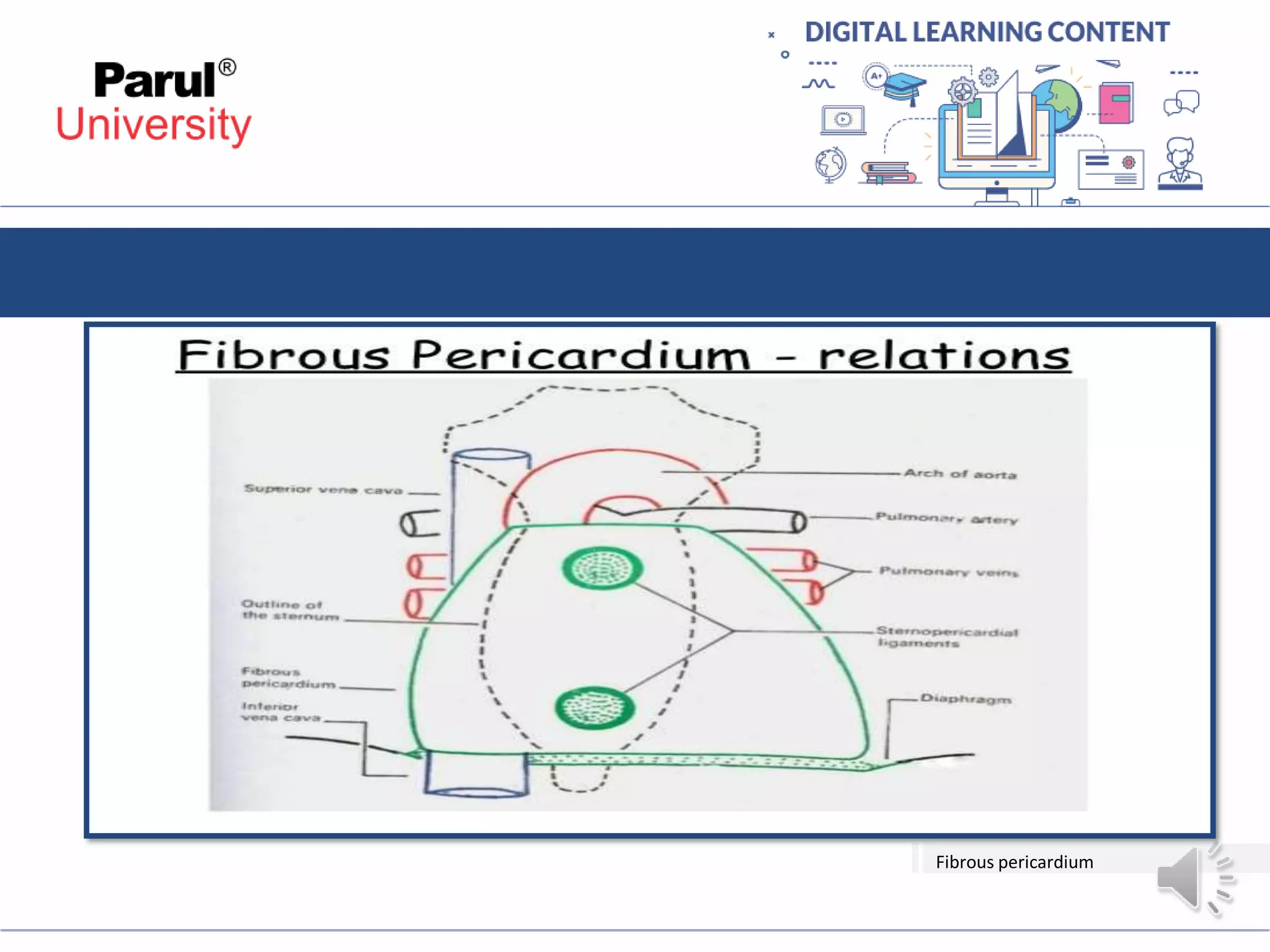
Fibrous pericardium
Image source : Google
 Fibrous pericardium is a conical sac made up of fibrous tissue and is
relatively non-distensible.
Its rigid structure protects the heart against sudden overfilling and
prevents over expansion of the heart.
The parietal layer of serous pericardium is attached to its deep surface.
 The apex is blunt and fused with the root of the great vessels.
The base is broad and blended with central tendon of diaphragm.
Anteriorly it is connected to body of sternum by sternopericardial
ligaments.
Image source : Google
 Posteriorly attached with principal bronchi, esophagus and descending
thoracic aorta
 On each side, it is related to the Mediastinal pleura, the Mediastinal
surface of the lung.
 Aorta, SVC, Pulmonary arteries & Pulmonary veins receive fibrous
prolongations from fibrous layer.
 As IVC enters the pericardium through the central tendon of diaphragm
So receives no covering from fibrous layer.
Fibrous pericardium
Layers of pericardium
Serous pericardium
Image source : Google
 Serous pericardium is thin, double-layered serous membrane lined by
mesothelium. It is made up of parietal serous layer and visceral serous
layer.
 The outer layer or parietal pericardium is fused with fibrous
pericardium.
 The inner layer or the visceral pericardium, or epicardium is fused to the
heart.
Serous pericardium
Pericardial cavity
Pericardial cavity
 The pericardial cavity is a
potential space between the
parietal pericardium and the
visceral pericardium.
Pericardial cavity contains
only a thin film of serous
fluid known as pericardial
fluid.
Pericardial cavity
The pericardial fluid
reduces friction within the
pericardium by lubricating
the epicardial surface
allowing the membranes
to glide over each other
with each heart beat.
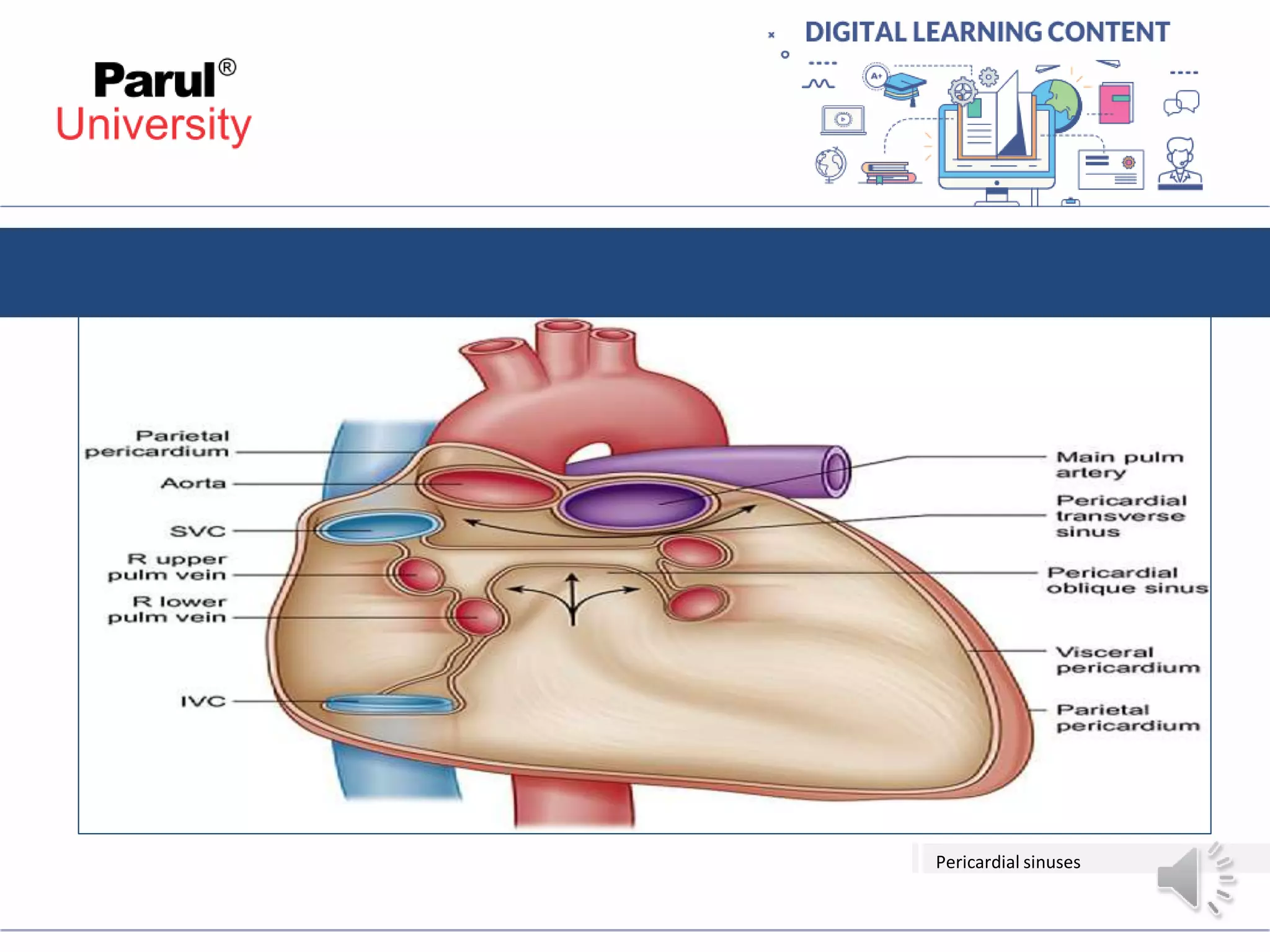
Pericardial sinuses
Pericardial sinuses
 The Sinuses
of Pericardium lie between
the parietal and visceral layers
of serous pericardium and are
2 in number: Transverse sinus
& oblique sinus.
 They’re created because of
the reflection of visceral layer
of serous pericardium around
great vessels of the heart.
Transverse pericardial sinuses
Image source : Google
 Transverse sinus is the horizontal gap between the arterial ends of the heart
tubes in front and venous end behind .
transverse pericardial sinus separates the heart’s arterial outflow (aorta,
pulmonary trunk) from its venous inflow (superior vena cava, pulmonary
veins).
It is located: Posterior to the ascending aorta and pulmonary trunk
.Anterior to the superior vena cava. Superior to the left atrium.
 During cardiac surgery, following the pericardial sac is opened anteriorly, a
finger is gone through the transverse sinus of pericardium.
 A temporary ligature is gone through the transverse sinus around the aorta
and pulmonary trunk.
Transverse sinus
Oblique pericardial sinuses
Image source : Google
 The oblique sinus of the pericardial cavity is a blind ending passage
posterior to the heart formed by the reflections of the visceral and parietal
pericardium onto the vessels traversing the space.
With the heart in its anatomical position and the dorsal pericardium intact,
it forms an inverted U-shaped recess that can be probed to reveal the
structures forming its walls:
Pericardial sinuses
Pericardial sinuses
Content of the pericardium
Image source : Google
 Heart with cardiac vessels and nerves
 Ascending aorta.
 Pulmonary trunk.
 Lower half of the superior vena cava.
 Terminal part of the inferior vena cava
 The terminal parts of the pulmonary veins
Content of the pericardium
Image source : Google
Functions of the pericardium
Image source : Google
 Fixes the heart in the mediastinum and limits its motion.
 Prevents overfilling of the heart.
 Lubrication: A thin film of fluid between the two layers of the serous
pericardium reduces the friction generated by the heart as it moves within the
thoracic cavity
 Protection from infection. The fibrous pericardium serves as a physical barrier
between the muscular body of the heart and adjacent organs prone to infection,
such as the lungs.
Image source : Google
Blood supply of the pericardium
Arterial supply:
1. Pericardiophrenic artery
2. Musculophrenic artery .
3. Additional branches Bronchial ,Oesophageal , Superior phrenic arteries .
 Pericardiophrenic artery is main artery supplies the pericardium and
diaphragm except the visceral pericardium.
 Pericardiophrenic artery & musculophrenic artery are branches of internal
thoracic artery.
 Note: Coronary artery supplies only the visceral layer of serous
pericardium(Epicardium).
Blood supply of
pericardium
Blood supply of
pericardium
Venous drainage of the pericardium
Deoxygenated blood is drained into the azygos venous system and
the Pericardiophrenic veins.
Azygos venous system and Pericardiophrenic veins are tributaries of
the brachiocephalic vein.
Venous drainage of
pericardium
Venous drainage of
pericardium
Nerve supply of the pericardium
Image source : Google
A. Phrenic nerve(C3-C5) provides somatic afferent innervation. It innervates
fibrous and parietal layer of serous pericardium. It is Sensitive to pain. Phrenic
nerve is a common source of referred pain. Thus shoulder pain is experienced
as a result of pericarditis.
 B. The sympathetic trunk provides postganglionic vasomotor fibres. The
Visceral layer of Serous pericardium is innervated by branches of sympathetic
trunk
 C. vagus nerve (ANS): Visceral layer (Epicardium) is pain insensitive.
Phrenic nerve
Phrenic nerve
Clinical relevance of the pericardium
Image source : Google
 Pericarditis
 Pericardial Effusion
 Cardiac Tamponade
 Pericardiocentesis
Pericarditis
Pericarditis
 Pericarditis is an
Inflammation of the
lining around the
heart(the pericardium).
 Pericardium causes
chest pain and
accumulation of fluid
around the heart .
Pericardial effusion
Pericardial effusion(fluid
around the heart ) is an
abnormal accumulation of
the fluid , which is
between the heart and
pericardial cavity .
Cardiac tamponade
Cardiac tamponade
Cardiac tamponade is a
clinical syndrome caused by
the accumulation of fluid in
the pericardial space.
 It results in reduced
ventricular filling .
 It is a medical emergency
Pericardiocentesis
Pericardiocentesis
Pericardiocentesis, also
called a pericardial tap.
 It is a procedure in
which a needle and
catheter remove fluid
from the pericardium, the
sac around heart.
www.paruluniversity.ac.in

Pericardium

  • 1.
    An Introduction toCardiology Nikhil Vaishnav, Clinical coordinator Department of Paramedical & Health Science
  • 2.
  • 3.
    Introduction Pericardium The pericardium (Greek“around heart”) is a fibroserous fluid filled sac Pericardium surrounds the heart and the roots of the great vessels( aorta, pulmonary artery, Pulmonary veins ,SVC and IVC . .
  • 4.
    Pericardium It is situatedin the middle mediastinum.
  • 5.
    Layers of thepericardium Image source : Google Pericardium has 2 layers. A. Fibrous pericardium which is the outer sac consist of the fibrous tissue. B. Serous pericardium which Inner continuous double layer of serous membrane .
  • 6.
    Fibrous pericardium Image source: Google  Fibrous pericardium is a conical sac made up of fibrous tissue and is relatively non-distensible. Its rigid structure protects the heart against sudden overfilling and prevents over expansion of the heart. The parietal layer of serous pericardium is attached to its deep surface.  The apex is blunt and fused with the root of the great vessels. The base is broad and blended with central tendon of diaphragm. Anteriorly it is connected to body of sternum by sternopericardial ligaments.
  • 7.
    Image source :Google  Posteriorly attached with principal bronchi, esophagus and descending thoracic aorta  On each side, it is related to the Mediastinal pleura, the Mediastinal surface of the lung.  Aorta, SVC, Pulmonary arteries & Pulmonary veins receive fibrous prolongations from fibrous layer.  As IVC enters the pericardium through the central tendon of diaphragm So receives no covering from fibrous layer.
  • 8.
  • 9.
  • 10.
    Serous pericardium Image source: Google  Serous pericardium is thin, double-layered serous membrane lined by mesothelium. It is made up of parietal serous layer and visceral serous layer.  The outer layer or parietal pericardium is fused with fibrous pericardium.  The inner layer or the visceral pericardium, or epicardium is fused to the heart.
  • 11.
  • 12.
    Pericardial cavity Pericardial cavity The pericardial cavity is a potential space between the parietal pericardium and the visceral pericardium. Pericardial cavity contains only a thin film of serous fluid known as pericardial fluid.
  • 13.
    Pericardial cavity The pericardialfluid reduces friction within the pericardium by lubricating the epicardial surface allowing the membranes to glide over each other with each heart beat.
  • 14.
    Pericardial sinuses Pericardial sinuses The Sinuses of Pericardium lie between the parietal and visceral layers of serous pericardium and are 2 in number: Transverse sinus & oblique sinus.  They’re created because of the reflection of visceral layer of serous pericardium around great vessels of the heart.
  • 15.
    Transverse pericardial sinuses Imagesource : Google  Transverse sinus is the horizontal gap between the arterial ends of the heart tubes in front and venous end behind . transverse pericardial sinus separates the heart’s arterial outflow (aorta, pulmonary trunk) from its venous inflow (superior vena cava, pulmonary veins). It is located: Posterior to the ascending aorta and pulmonary trunk .Anterior to the superior vena cava. Superior to the left atrium.  During cardiac surgery, following the pericardial sac is opened anteriorly, a finger is gone through the transverse sinus of pericardium.  A temporary ligature is gone through the transverse sinus around the aorta and pulmonary trunk.
  • 16.
  • 17.
    Oblique pericardial sinuses Imagesource : Google  The oblique sinus of the pericardial cavity is a blind ending passage posterior to the heart formed by the reflections of the visceral and parietal pericardium onto the vessels traversing the space. With the heart in its anatomical position and the dorsal pericardium intact, it forms an inverted U-shaped recess that can be probed to reveal the structures forming its walls:
  • 18.
  • 19.
  • 20.
    Content of thepericardium Image source : Google  Heart with cardiac vessels and nerves  Ascending aorta.  Pulmonary trunk.  Lower half of the superior vena cava.  Terminal part of the inferior vena cava  The terminal parts of the pulmonary veins
  • 21.
    Content of thepericardium Image source : Google
  • 22.
    Functions of thepericardium Image source : Google  Fixes the heart in the mediastinum and limits its motion.  Prevents overfilling of the heart.  Lubrication: A thin film of fluid between the two layers of the serous pericardium reduces the friction generated by the heart as it moves within the thoracic cavity  Protection from infection. The fibrous pericardium serves as a physical barrier between the muscular body of the heart and adjacent organs prone to infection, such as the lungs.
  • 23.
  • 24.
    Blood supply ofthe pericardium Arterial supply: 1. Pericardiophrenic artery 2. Musculophrenic artery . 3. Additional branches Bronchial ,Oesophageal , Superior phrenic arteries .
  • 25.
     Pericardiophrenic arteryis main artery supplies the pericardium and diaphragm except the visceral pericardium.  Pericardiophrenic artery & musculophrenic artery are branches of internal thoracic artery.  Note: Coronary artery supplies only the visceral layer of serous pericardium(Epicardium).
  • 26.
  • 27.
  • 28.
    Venous drainage ofthe pericardium Deoxygenated blood is drained into the azygos venous system and the Pericardiophrenic veins. Azygos venous system and Pericardiophrenic veins are tributaries of the brachiocephalic vein.
  • 29.
  • 30.
  • 31.
    Nerve supply ofthe pericardium Image source : Google A. Phrenic nerve(C3-C5) provides somatic afferent innervation. It innervates fibrous and parietal layer of serous pericardium. It is Sensitive to pain. Phrenic nerve is a common source of referred pain. Thus shoulder pain is experienced as a result of pericarditis.  B. The sympathetic trunk provides postganglionic vasomotor fibres. The Visceral layer of Serous pericardium is innervated by branches of sympathetic trunk  C. vagus nerve (ANS): Visceral layer (Epicardium) is pain insensitive.
  • 33.
  • 34.
  • 35.
    Clinical relevance ofthe pericardium Image source : Google  Pericarditis  Pericardial Effusion  Cardiac Tamponade  Pericardiocentesis
  • 36.
    Pericarditis Pericarditis  Pericarditis isan Inflammation of the lining around the heart(the pericardium).  Pericardium causes chest pain and accumulation of fluid around the heart .
  • 37.
    Pericardial effusion Pericardial effusion Pericardialeffusion(fluid around the heart ) is an abnormal accumulation of the fluid , which is between the heart and pericardial cavity .
  • 38.
    Cardiac tamponade Cardiac tamponade Cardiactamponade is a clinical syndrome caused by the accumulation of fluid in the pericardial space.  It results in reduced ventricular filling .  It is a medical emergency
  • 39.
    Pericardiocentesis Pericardiocentesis Pericardiocentesis, also called apericardial tap.  It is a procedure in which a needle and catheter remove fluid from the pericardium, the sac around heart.
  • 40.