ANATOMY & DEVELOPMENT OF LUNGS
Dr Mathew Joseph
MBBS, MD(AIIMS), BCC(Palliative Medicine)
Assistant Professor
Department of Anatomy
Amala Institute of Medical Sciences, Thrissur
CONTENTS
• GROSS ANATOMY OF LUNGS
• SURFACES AND BORDERS OF LUNGS
• HILUM AND ROOT OF LUNGS
• FISSURES AND LOBES OF LUNGS
• BRONCHOPULMONARY SEGMENTS
• BLOOD SUPPLY OF LUNGS
• NERVE SUPPLY OF LUNGS
• LYMPHATICS OF LUNGS
• PLEURA
• DEVELOPMENT OF LUNGS
GROSS ORGANIZATION OF LUNGS
• Lungs are pair of respiratory organs situated
in thoracic cavity.
• Texture: Spongy
• Color:Young- Pinkish brown
Adult-mottled black due to deposition
of carbon particles
• Lungs weigh 650 to 800g ,of which 40 to 50%
is blood.
• Each lung has an apex, three surfaces (costal,
medial, and diaphragmatic), and three borders
(anterior, inferior, and posterior).
• The right lung is divided into upper, middle,
and lower lobes by oblique and horizontal
fissures.
• The left lung has usually only upper and lower
lobes, separated by an oblique fissure.
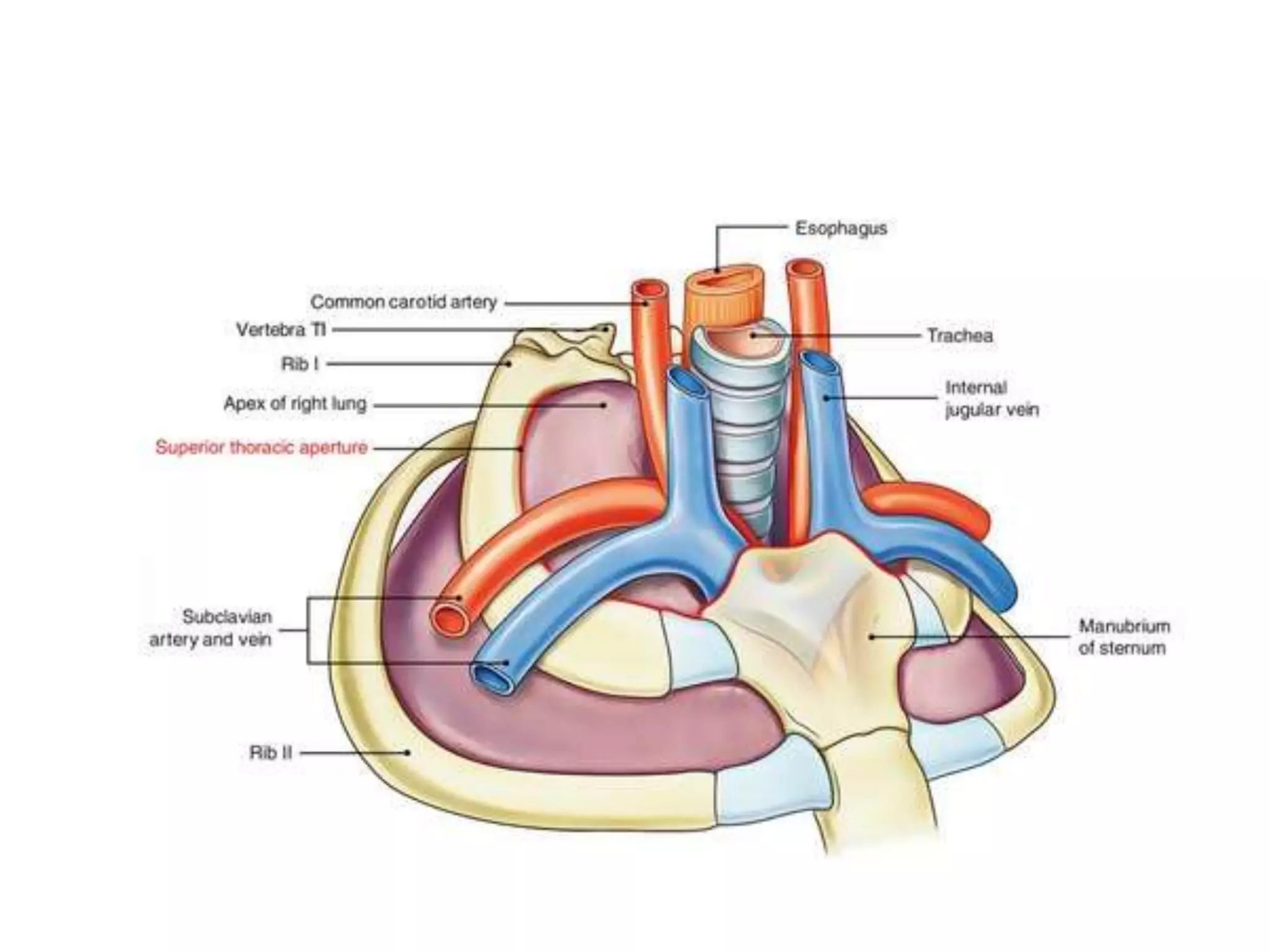
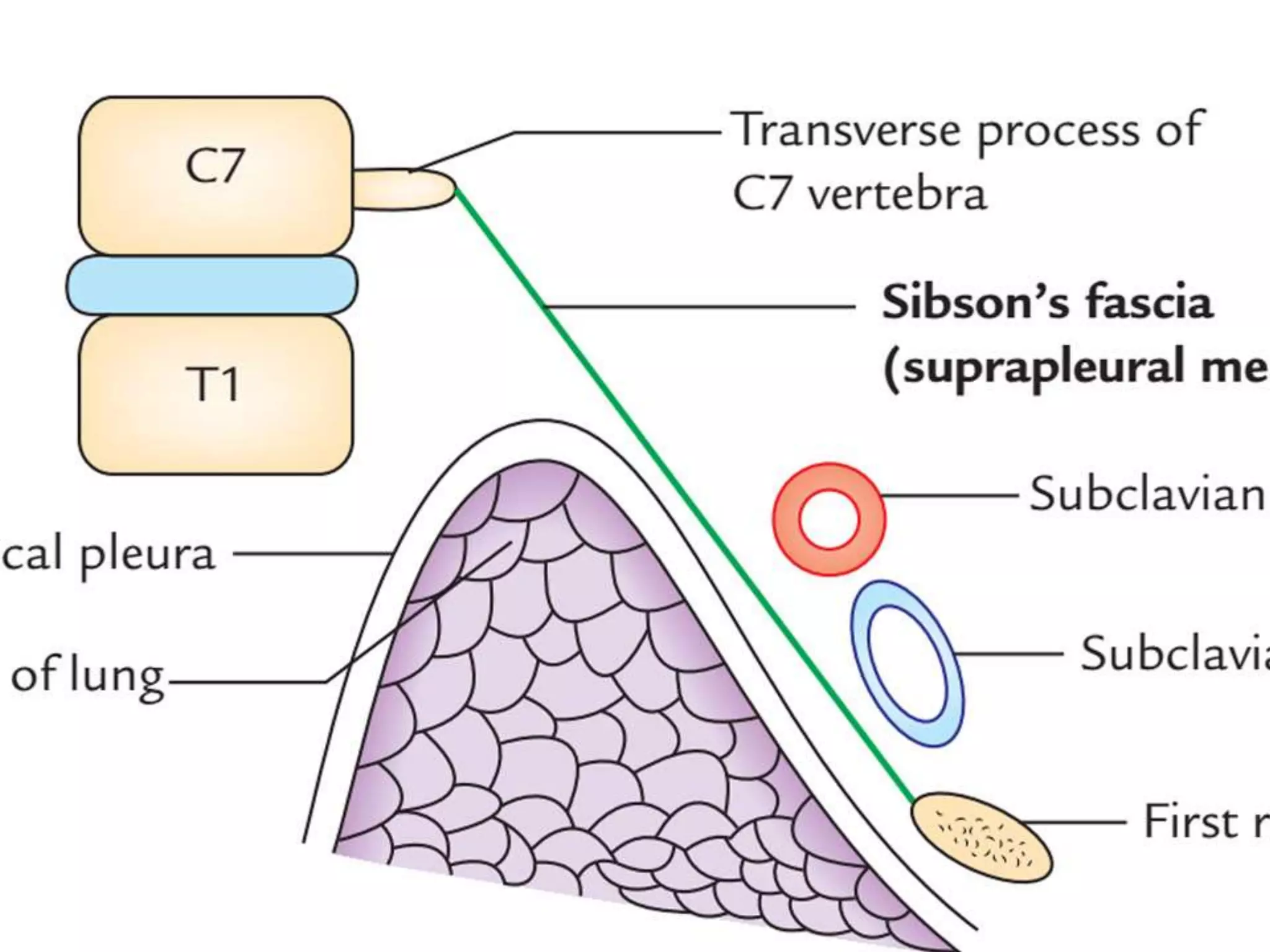
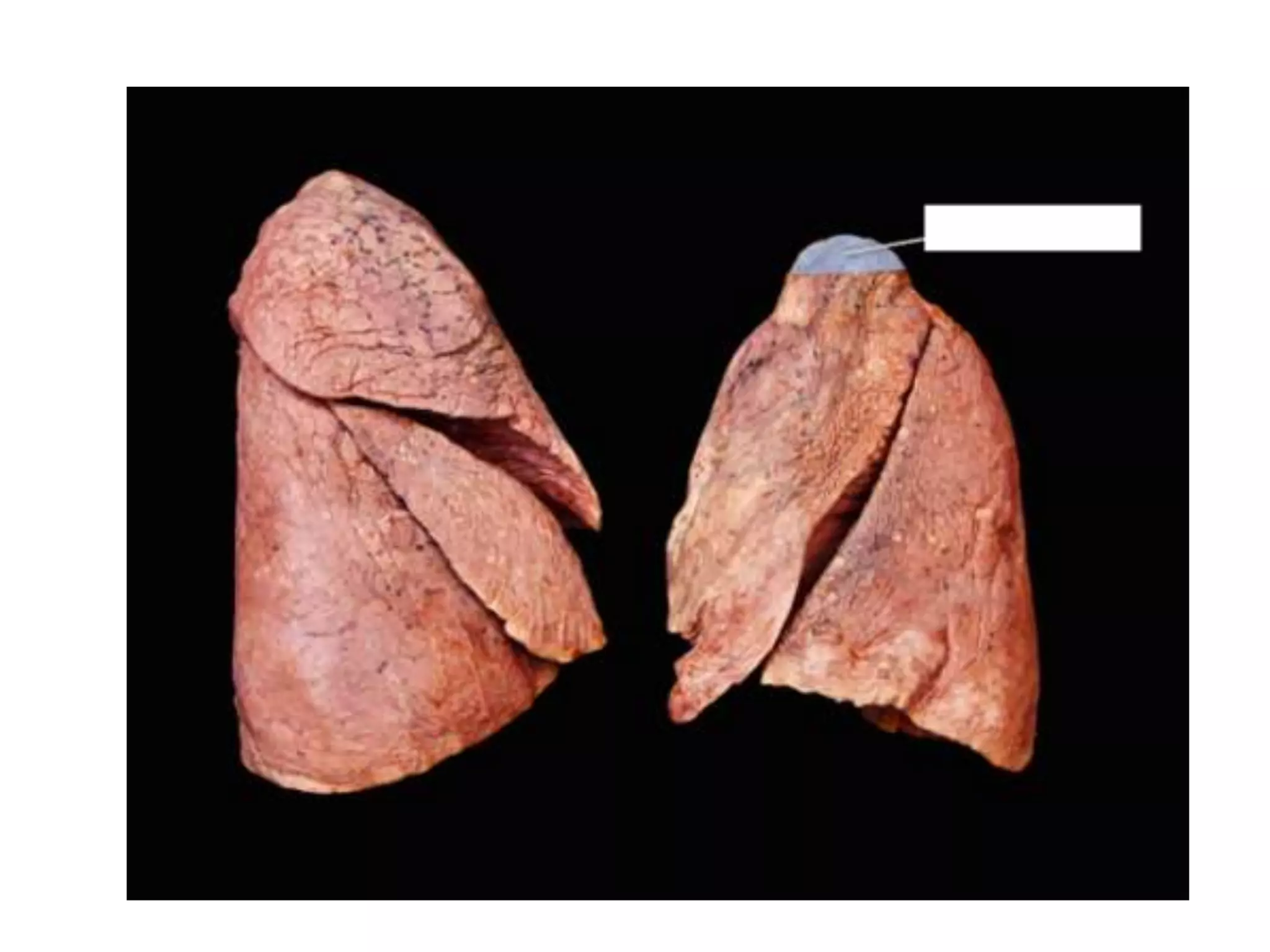
APEX OF LUNG
• BLUNT
• Lie above level of anterior end of 1st rib
• Reaches 1-2 cm above medial 1/3rd of clavicle
• Coverings-cervical pleura ,suprapleural
membrane
• Grooved by subclavian artery and vein
BORDERS OF LUNGS
• ANTERIOR BORDER
• Corresponds to the anterior (Costomediastinal) line of
pleural reflection.
•It is deeply notched in the left lung posterior to 5th
costal cartilage by the pericardium and extends vertically
downwards to form Lingula. This is called cardiac
notch(percussion in this area gives a dull note as
compared to dull note obtained over lung).
INFERIOR BORDER
• Thin and sharp
•It seperates the base of lung from the
costal surface.
POSTERIOR BORDER
• Thick and ill defined
• Fits into deep paravertebral gutter.
• Extends from C7 to T10.
SURFACES OF THE LUNG
Costal Surface
• It is in contact with
costal pleura and
overlying thoracic wall.
• Posterior / Vertebral
Part
Medial Surface
• Anterior or mediastinal
part
Relations of Posterior Part
Vertebral Part
Intervertebral Discs
Posterior Intercostal Vessels
Splanchnic Nerves
RELATIONS OF ANTERIOR PART
RIGHT SIDE
• Right atrium
• Small part of RV
• SVC
• Right brachiocephalic
vein(lower part)
• Azygos vein
• Esophagus
• IVC
• Trachea
• Right vagus nerve
• Right phrenic nerve
LEFT SIDE
• Left ventricle
• Pulmonary trunk
• Arch of Aorta
• Descending thoracic
aorta
• Left Subclavian Artery
• Thoracic duct
• Left Brachiocephalic
Vein
• Left vagus nerve
• Left phrenic nerve
• Left recurrent laryngeal
nerve
RIGHT LUNG MEDIAL VIEW
LEFT LUNG MEDIAL VIEW
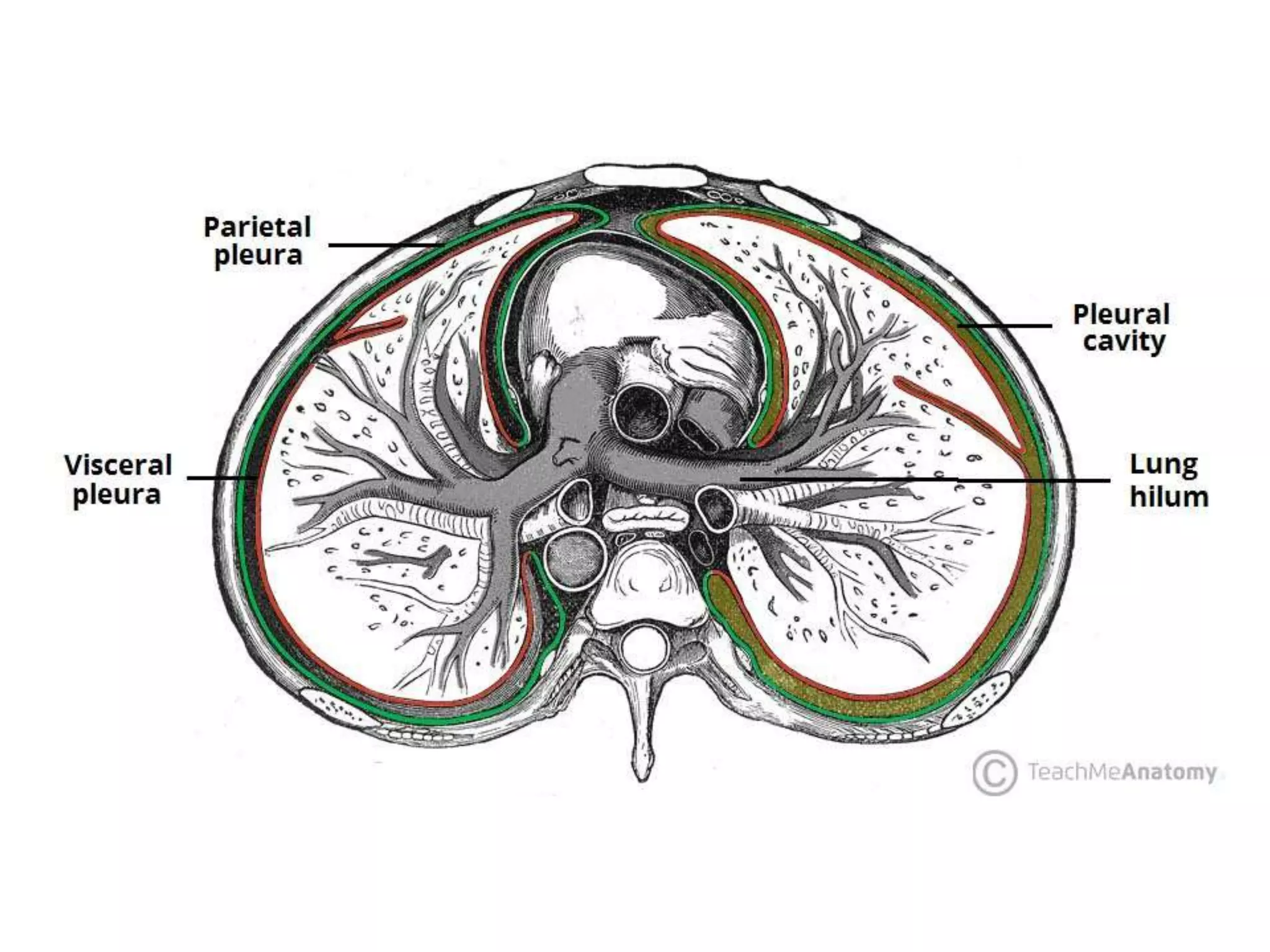
ROOT AND HILUM OF LUNGS
• The bronchi and pulmonary vessels, which
extend from the trachea and heart,
respectively, collectively form the root of the
lung.
• The part of the medial surface where these
structures enter the lung is known as the
hilum of lung.
ROOT OF RIGHT LUNG
• Eparterial and
Hyparterial bronchus
• One pulmonary artery .
Two pulmonary veins -
• Bronchial arteries (one)
ROOT OF LEFT LUNG
• Principal Bronchus
• Pulmonary artery
• Pumonary vein
• Bronchial artery
•
• The right lung is divided into upper, middle,
and lower lobes by oblique and horizontal
fissures.
• Azygous lobes occur in 0.25 % cases on Right
side.Azygous vein seprate medial part of right
upper lobe from rest of lung produce linear
mark on radiograph
• The left lung has usually only upper and lower
lobes, separated by an oblique fissure.
FISSURES AND LOBES OF LUNGS
OBLIQUE FISSURE
• • The oblique fissure start at 3rd thoracic
spine, descend downward laterally and
anteriorly cutting midaxillary line in 5 th rib,
ending at 6 costal cartilage 3 inches from
midline
HORIZONTAL FISSURE
•The horizontal fissure begins at the oblique
fissure near the midaxillary line (of the right
side), at about the level of rib 6 to 4th costal
cartilage.
• Important for localization of particular lobe
during chest injury.
TRACHEA
• Extend from larynx to bifurcation at the level of 5 th
thoracic vertebra.
• Rigid fibroelastic structure.
• Incomplete rings of hyaline cartilage maintain
patency of lumen.
• Average length of trachea 10-12 cm in adult and
diametre is 2-2.5 cm in diametre.
• Lower end divides into right and left main bronchus.
• The trachea has 15 to 20 C-shaped bars of hyaline
cartilage that prevent it from collapsing.
• Bridged posteriorly by Trachealis muscle.
• Trachea is supplied by cervical portion of
Inferior Thyroid artery and thoracic portion of
bronchial artery
• Venous Inferior thyroid venous plexus
• Nerve supply general secretion by vagus and
recurrent laryngeal nerves
• Autonomic secretion sympathetic T1 ,T2
• Parasympathtic -vagus
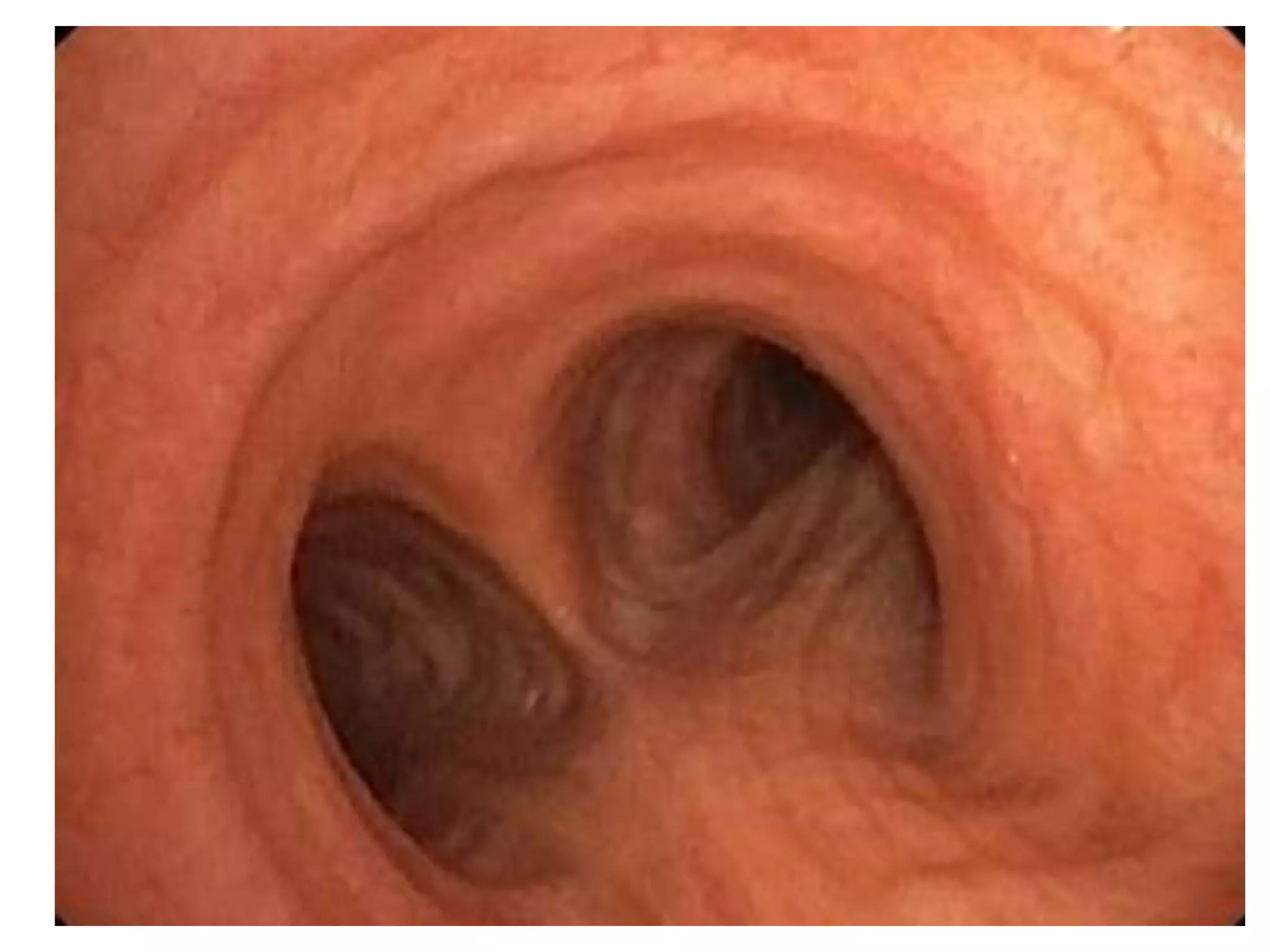
CARINA
•The carina is the upward-directed ridge seen
internally at the bifurcation and is a landmark
during bronchoscopy.
Trachea is supplied mainly by the inferior
thyroid arteries. Its smooth muscle is supplied
by parasympathetic and sympathetic
fibers, and pain fibers are carried by the vagi.
Right bronchus
• Right direct continuation
• 1-2.5 cm long
• Shorter
• Wider
• More in line with trachea
Clinical Anatomy
Foreign body traversing the trachea are more likely to
enter the right main bronchus.
Left bronchus
• Left run more oblique
• About 5 cm long
• Longer
• narrower
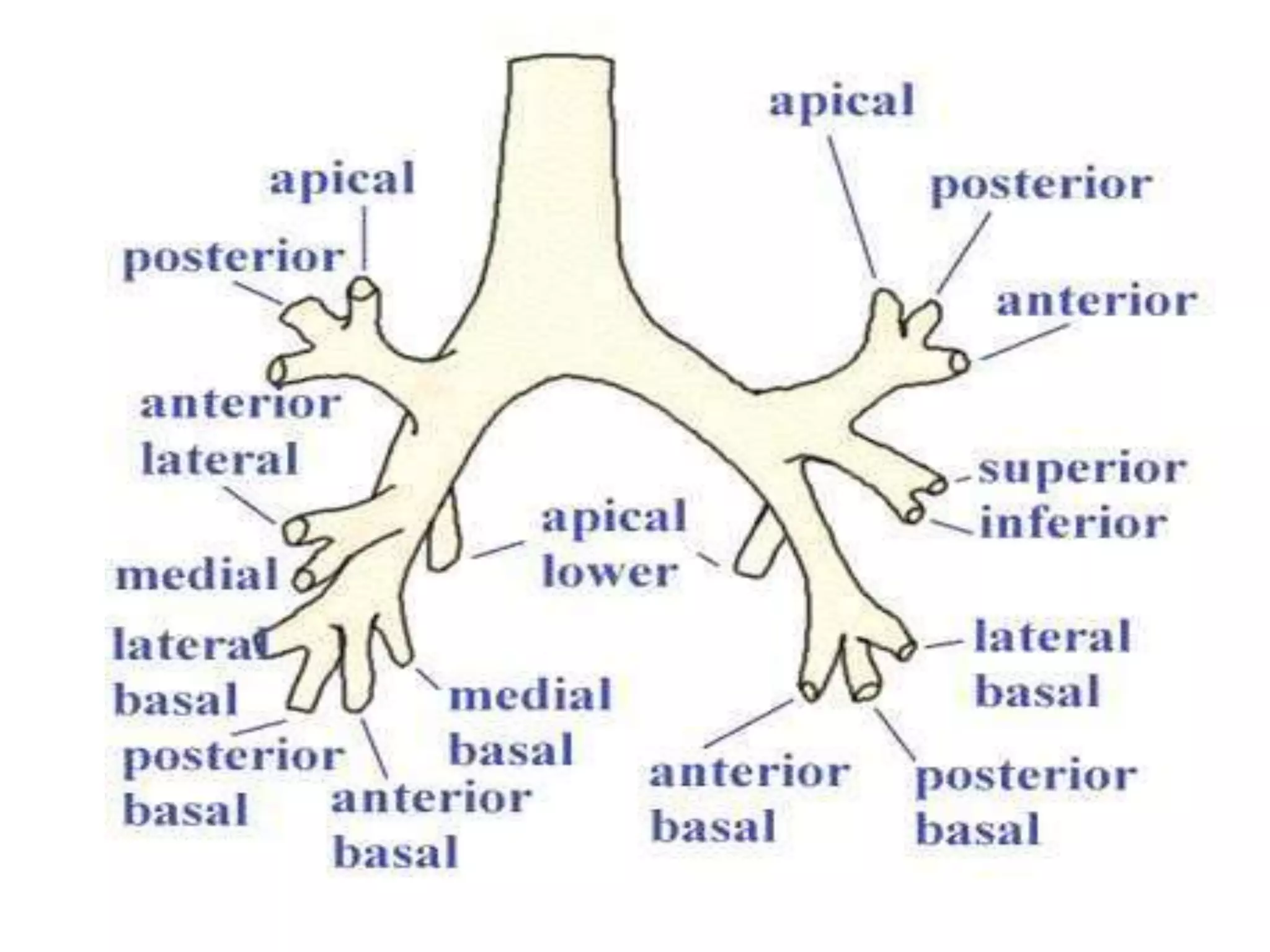
Bronchopulmonary segment
• A bronchopulmonary segment is the area of lung
supplied by a segmental bronchus and its
accompanying pulmonary artery branch.
• Bronchopulmonary segment is the smallest,
functionally independent region of a lung
• The smallest area of lung that can be isolated and
removed without affecting adjacent regions.
CLINICAL SIGNIFICANCE
• Segmental resection with minimal destruction
to the surrounding lung tissue.
• To visualize the interior of a bronchi through a
bronchoscope when diseases process is
limited in a segment.
BLOOD SUPPLY OF LUNGS
• Two types
• 1. Bronchial circulation
2. Pulmonary circulation
Bronchial circulation
• • The trachea (and esophagus), main-stem
bronchi, and pulmonary vessels into the lung , as
well as the visceral pleura in humans are supplied
by the bronchial (systemic) circulation.
• • The bronchial circulation has enormous growth
potential. In longstanding inflammatory and
proliferative diseases, such as bronchiectasis or
carcinoma, bronchial blood flow may be greatly
increased.
Pulmonary circulation
•In humans the pulmonary artery enters each
lung at the hilum in a loose connective tissue
sheath adjacent to the main bronchus.
•Anatomically, the pulmonary blood vessels can
be divided into two groups in
1. Extra-alveolar
2. Alveolar.
• Sequestered lung is an embryonic Lung tissue
which separate from tracheobronchial tree.
• This is seen in lower lobe of left lung.
• It may be supplied by abnormal branch of
abdominal aorta.
NERVE SUPPLY OF LUNGS
• Anterior and posterior pulmonary plexus
• Parasympathetc fibres-Right and Left vagus
• Sympathetic fibre 4 or 5 thoracic ganglion
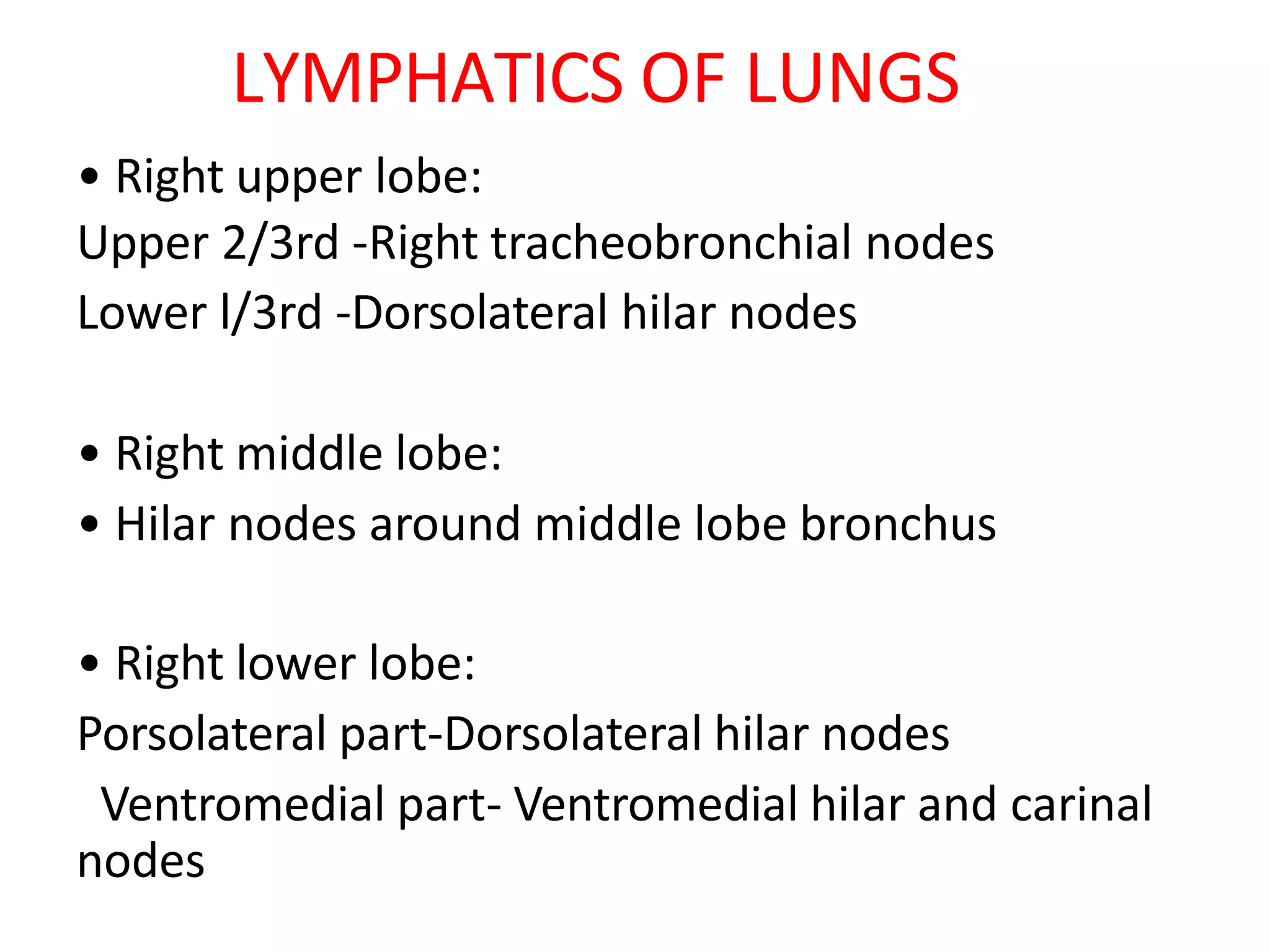
LYMPHATICS OF LUNGS
• Right upper lobe:
Upper 2/3rd -Right tracheobronchial nodes
Lower l/3rd -Dorsolateral hilar nodes
• Right middle lobe:
• Hilar nodes around middle lobe bronchus
• Right lower lobe:
Porsolateral part-Dorsolateral hilar nodes
Ventromedial part- Ventromedial hilar and carinal
nodes
Left upper lobe:
• Apex-para-aortic node
Other than apex-Anterior and posterior hilar
nodes
• Left lower lobe
Dorsolateral part-Dorsolateral hilar nodes
Ventromedial paraVentromedial hilar and carinal
nodes
PLEURA
•The pleura is a thin, glistening, slippery serous
membrane, inflammation of which is called
pleurisy.
•The pleura lines the thoracic wall and
diaphragm, where it is known as the parietal
pleura. It is reflected onto the lung, where it is
called the visceral pleura.
Both are derivatives of mesoderm germ layer
• The parietal pleura has costal, mediastinal,
diaphragmatic parts and a cupola.
• the cupola of the pleura and the apex of the
lung project upward into the neck, hence may
be injured in wounds of the neck.
• Their highest point is 2 to 3 cm above the level
of the medial third of the clavicle.
• The inferior limit of the lung crosses rib 6 in
the midclavicular line and rib 8 in the
midaxillary line and then proceeds toward the
10th thoracic vertebra.
• • Inferior limit of pleura is rib 8 in MCL, rib 10
in MAL and 12th thoracic vertebra along
paravertebral line.
• The pleural cavity, which is the potential space
between the two layers, contains only a thin
film of fluid.
• Air in the pleural cavity (pneumothorax)
results in collapse of the lung.
• Irritation of the parietal pleura causes pain
referred to the thoraco-abdominal wall to the
shoulder (phrenic nerve).
• Visceral pleura is pain insensitive.
Lung Development
Initial Changes
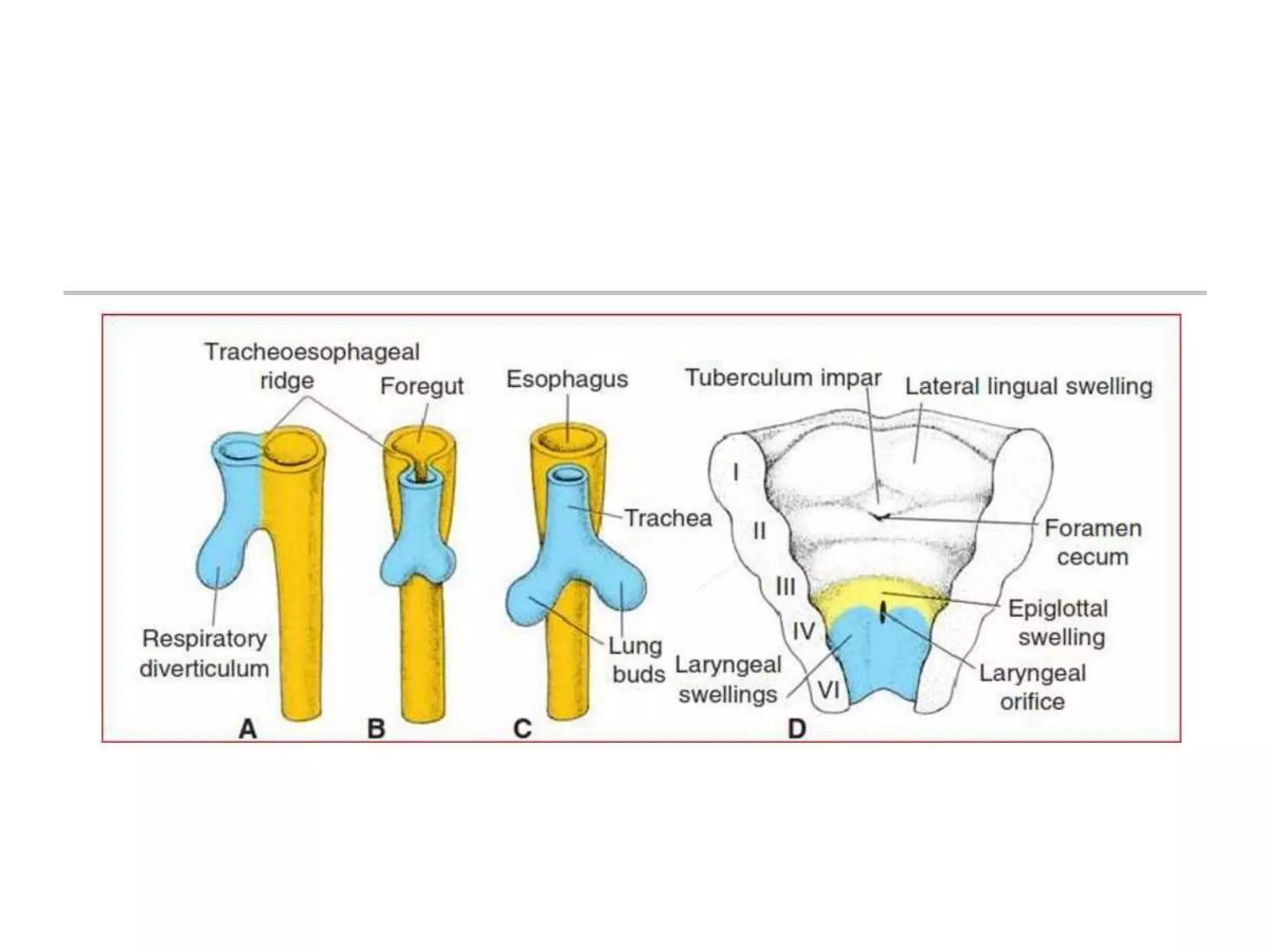
The respiratory system is derived from the primitive gut
tube.
Endodermal - Lateral folding
At week 4 -Respiratory Diverticulum.
Respiratory diverticulum is continuous with the foregut -
not functionally suitable.
Longitudinal ridge - Tracheoesophageal septum
The diverticulum bifurcates into two buds - Left and right
primary bronchi.
The primary bronchi then proliferate to give rise to
secondary and tertiary bronchi
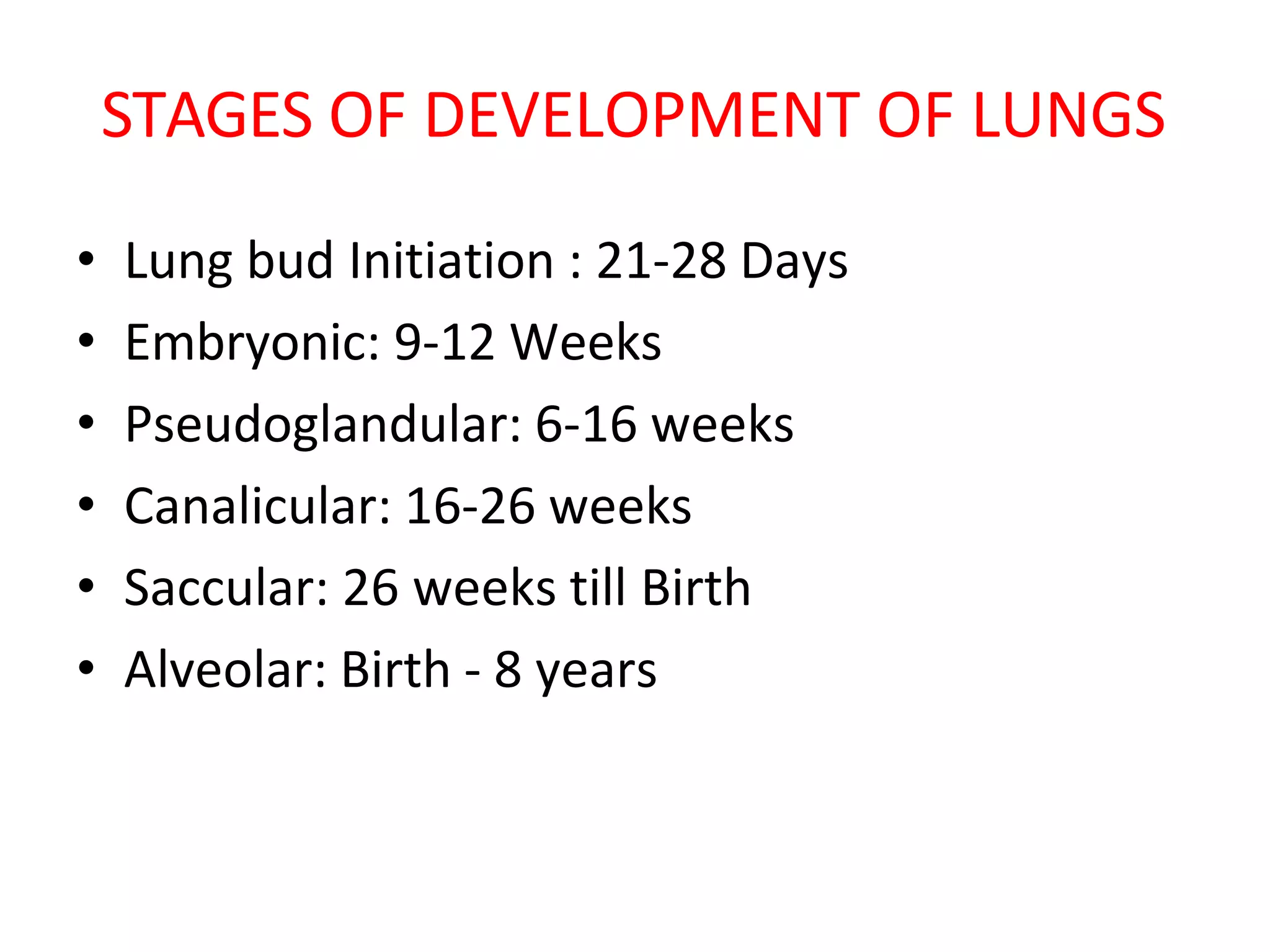
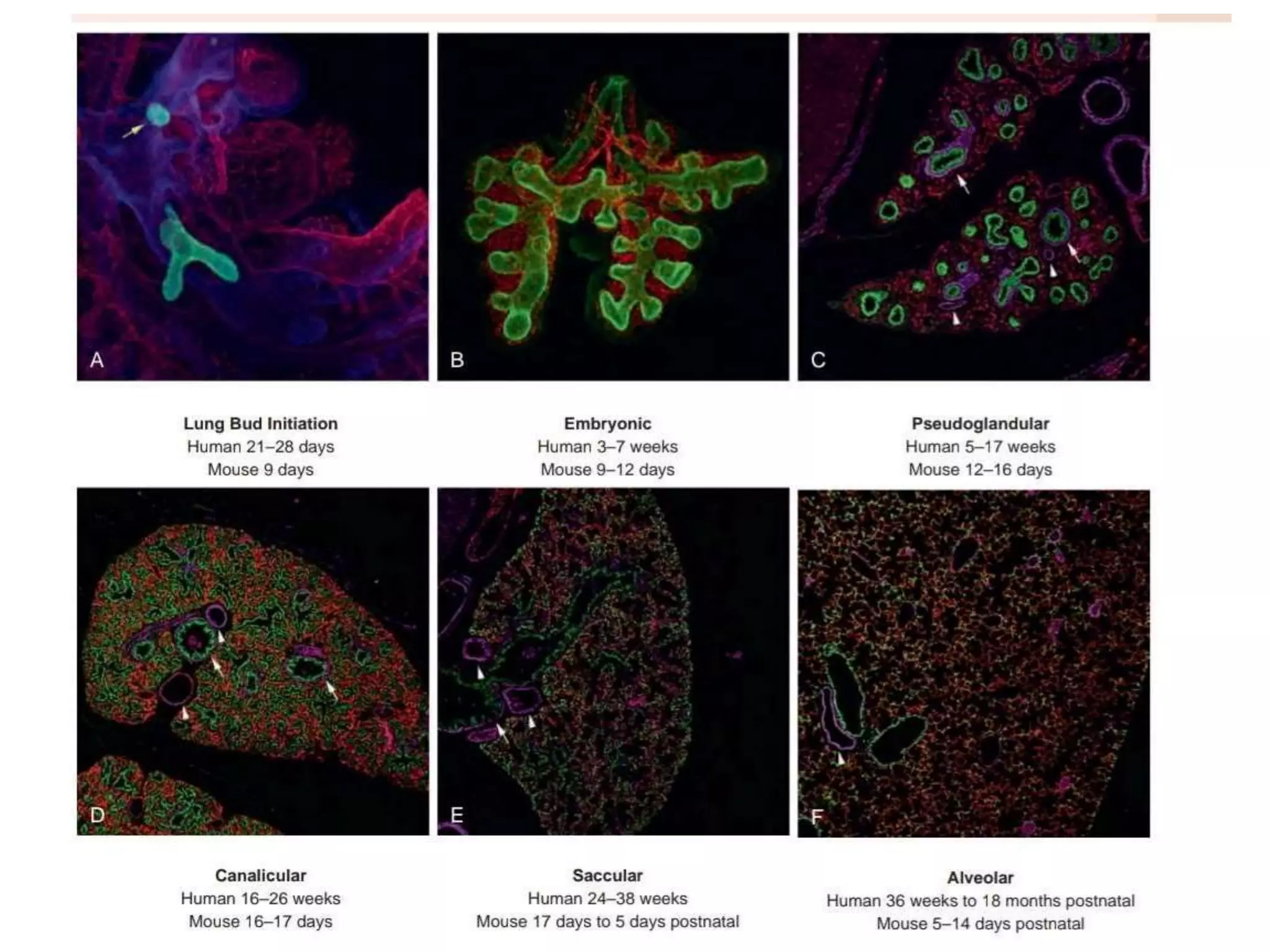
STAGES OF DEVELOPMENT OF LUNGS
• Lung bud Initiation : 21-28 Days
• Embryonic: 9-12 Weeks
• Pseudoglandular: 6-16 weeks
• Canalicular: 16-26 weeks
• Saccular: 26 weeks till Birth
• Alveolar: Birth - 8 years
EMBRYONIC 21-28 DAYS
• Lungs appear as epithelial bud at the caudal
end of laryngotracheal tube on 26 th day of
ovulation
• Developing lung bud divides into 2 halves an
elongates grows caudally on either sides of
esophagus.
• By day 33 Trachea become separated from the
foregut.
• ABNORMAL partition results in esophgeal
atresia ,Tracheoesophgeal fistula.
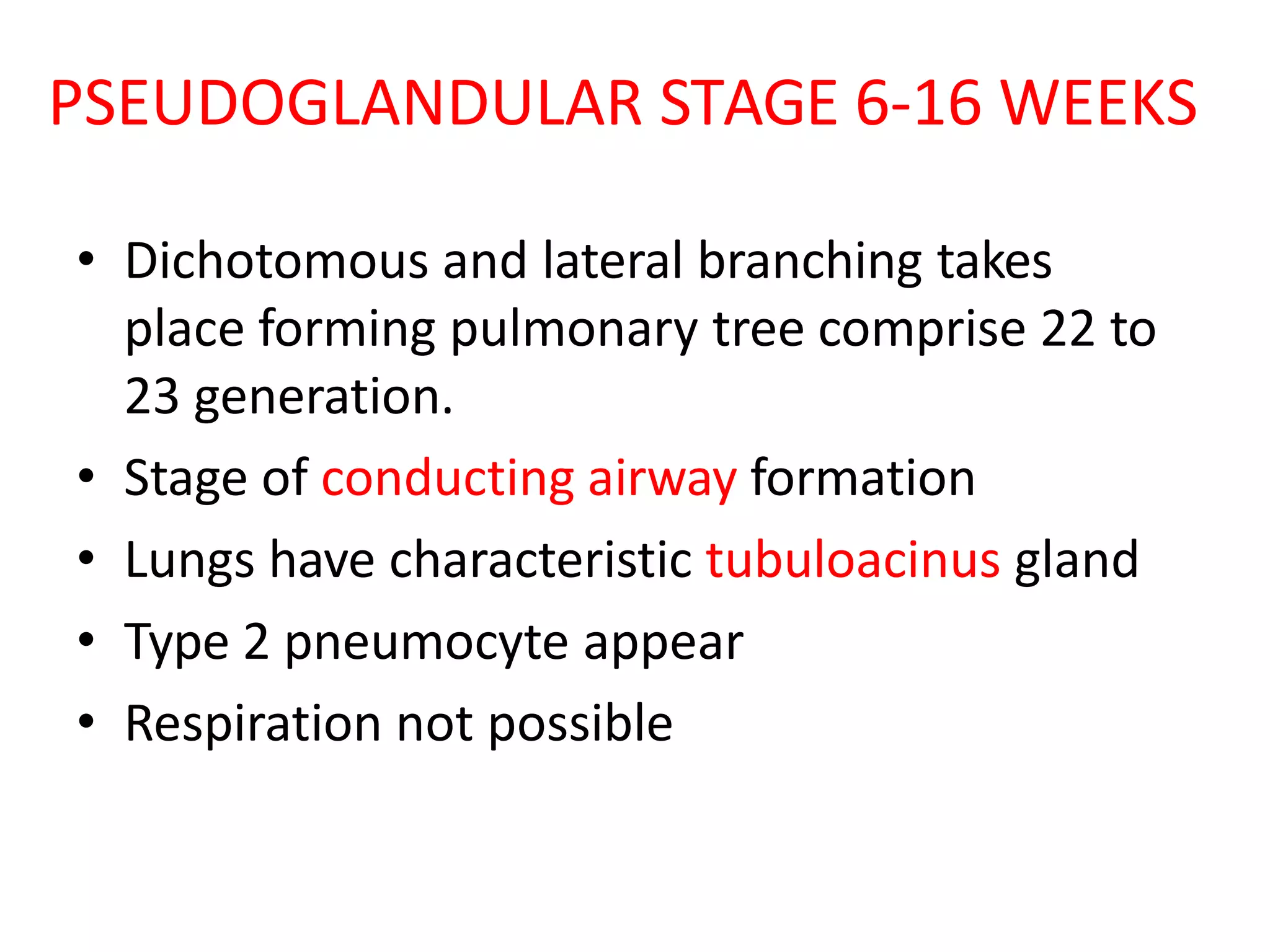
PSEUDOGLANDULAR STAGE 6-16 WEEKS
• Dichotomous and lateral branching takes
place forming pulmonary tree comprise 22 to
23 generation.
• Stage of conducting airway formation
• Lungs have characteristic tubuloacinus gland
• Type 2 pneumocyte appear
• Respiration not possible
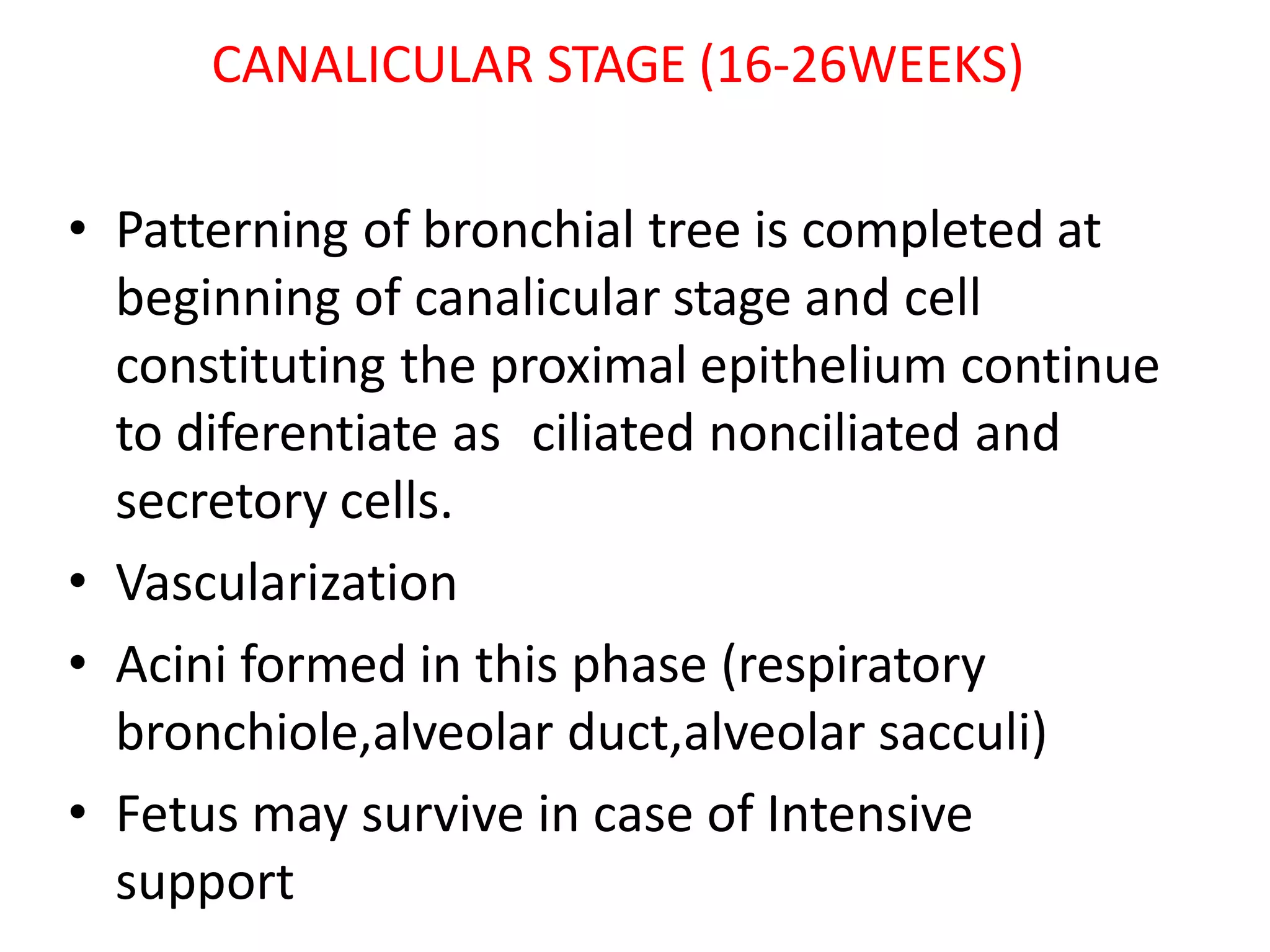
CANALICULAR STAGE (16-26WEEKS)
• Patterning of bronchial tree is completed at
beginning of canalicular stage and cell
constituting the proximal epithelium continue
to diferentiate as ciliated nonciliated and
secretory cells.
• Vascularization
• Acini formed in this phase (respiratory
bronchiole,alveolar duct,alveolar sacculi)
• Fetus may survive in case of Intensive
support
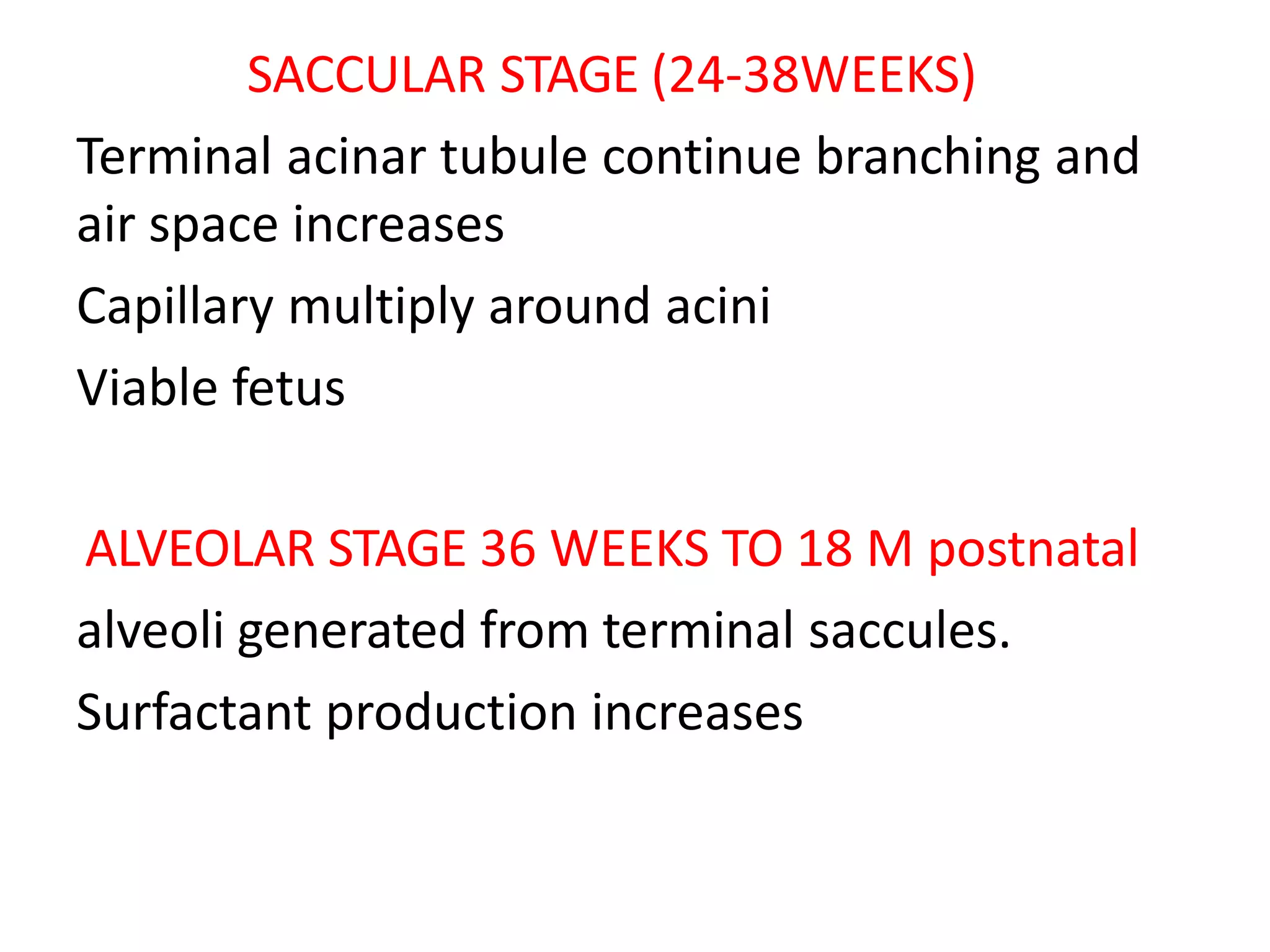
SACCULAR STAGE (24-38WEEKS)
Terminal acinar tubule continue branching and
air space increases
Capillary multiply around acini
Viable fetus
ALVEOLAR STAGE 36 WEEKS TO 18 M postnatal
alveoli generated from terminal saccules.
Surfactant production increases
MOLECULAR REGULATION OF LUNG
DEVELOPMENT
DIFUSIBLE MEDIATORS TRANSCRIPTIONAL
• Fibroblast growth factors
and receptors
• Retinoic acid
• Platelet derived growth
factors
• Vascular endothelial growth
factors
• Thyroid transcriptional
factor 1
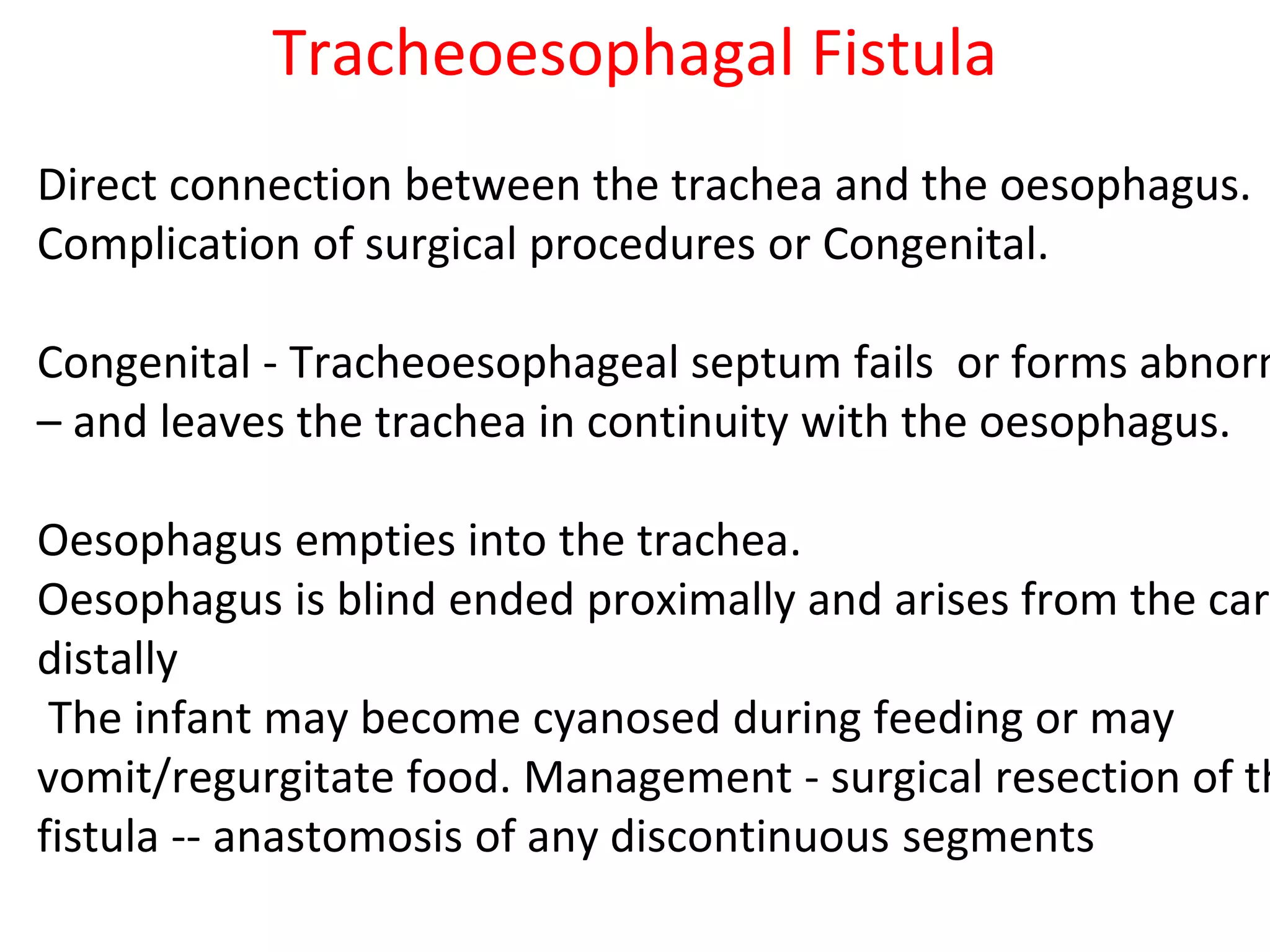
Tracheoesophagal Fistula
Direct connection between the trachea and the oesophagus.
Complication of surgical procedures or Congenital.
Congenital - Tracheoesophageal septum fails or forms abnorm
– and leaves the trachea in continuity with the oesophagus.
Oesophagus empties into the trachea.
Oesophagus is blind ended proximally and arises from the cari
distally
The infant may become cyanosed during feeding or may
vomit/regurgitate food. Management - surgical resection of th
fistula -- anastomosis of any discontinuous segments
Case Scenerio
A mother brought her new born baby to the
pediatrician with a complaint of feeding difficulty as
the baby is not swallowing the milk and when tried
to feed there wewe episods of choking. The
pediatrician tried to introduce a nasogastric tube
but failed. He ordered for an x-ray chest which
showed absence of stomach bubble. When
enquired about antenatal history it was found to be
a case of polyhydramniosis.
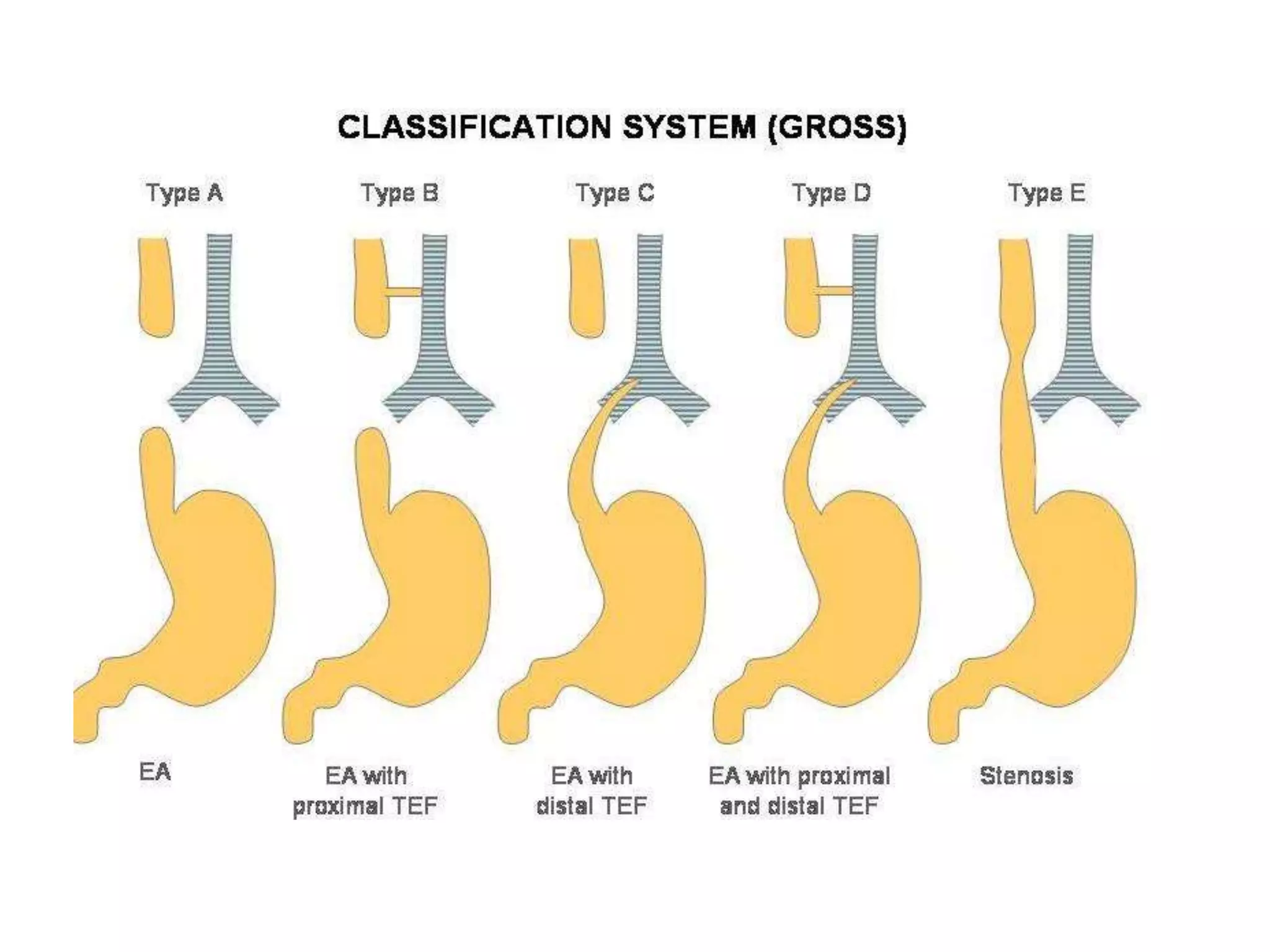
Esophagal Atresia -Tracheoesophagal
Fistula
Polyhydramniosis
Absence of stomach bubble
Impossible to introduce nasogastric tube
Chocking
Respiratory Distress Syndrome
If a baby is born prior to the development of type
II pneumocytes, they will be unable to produce
surfactant. As a result, they will have difficulty
expanding their lungs to take their first breath.
If a pre-term delivery is unavoidable or inevitable,
the mother can be given glucocorticoids to
stimulate surfactant production in the fetus.
Reference
• Crofton and Douglas’s Respiratory diseases 5
th edition
• Murray and Nadel’s Textbook of Respiratory
Medicine 6 Th edition
• Fishman’s Pulmonary diseases and disorders
5th edition
THANK YOU

Lungs.pptx

  • 1.
    ANATOMY & DEVELOPMENTOF LUNGS Dr Mathew Joseph MBBS, MD(AIIMS), BCC(Palliative Medicine) Assistant Professor Department of Anatomy Amala Institute of Medical Sciences, Thrissur
  • 3.
    CONTENTS • GROSS ANATOMYOF LUNGS • SURFACES AND BORDERS OF LUNGS • HILUM AND ROOT OF LUNGS • FISSURES AND LOBES OF LUNGS • BRONCHOPULMONARY SEGMENTS • BLOOD SUPPLY OF LUNGS • NERVE SUPPLY OF LUNGS • LYMPHATICS OF LUNGS • PLEURA • DEVELOPMENT OF LUNGS
  • 4.
    GROSS ORGANIZATION OFLUNGS • Lungs are pair of respiratory organs situated in thoracic cavity. • Texture: Spongy • Color:Young- Pinkish brown Adult-mottled black due to deposition of carbon particles • Lungs weigh 650 to 800g ,of which 40 to 50% is blood.
  • 5.
    • Each lunghas an apex, three surfaces (costal, medial, and diaphragmatic), and three borders (anterior, inferior, and posterior). • The right lung is divided into upper, middle, and lower lobes by oblique and horizontal fissures. • The left lung has usually only upper and lower lobes, separated by an oblique fissure.
  • 7.
    APEX OF LUNG •BLUNT • Lie above level of anterior end of 1st rib • Reaches 1-2 cm above medial 1/3rd of clavicle • Coverings-cervical pleura ,suprapleural membrane • Grooved by subclavian artery and vein
  • 11.
    BORDERS OF LUNGS •ANTERIOR BORDER • Corresponds to the anterior (Costomediastinal) line of pleural reflection. •It is deeply notched in the left lung posterior to 5th costal cartilage by the pericardium and extends vertically downwards to form Lingula. This is called cardiac notch(percussion in this area gives a dull note as compared to dull note obtained over lung).
  • 12.
    INFERIOR BORDER • Thinand sharp •It seperates the base of lung from the costal surface.
  • 13.
    POSTERIOR BORDER • Thickand ill defined • Fits into deep paravertebral gutter. • Extends from C7 to T10.
  • 15.
    SURFACES OF THELUNG Costal Surface • It is in contact with costal pleura and overlying thoracic wall. • Posterior / Vertebral Part Medial Surface • Anterior or mediastinal part
  • 17.
    Relations of PosteriorPart Vertebral Part Intervertebral Discs Posterior Intercostal Vessels Splanchnic Nerves
  • 18.
    RELATIONS OF ANTERIORPART RIGHT SIDE • Right atrium • Small part of RV • SVC • Right brachiocephalic vein(lower part) • Azygos vein • Esophagus • IVC • Trachea • Right vagus nerve • Right phrenic nerve LEFT SIDE • Left ventricle • Pulmonary trunk • Arch of Aorta • Descending thoracic aorta • Left Subclavian Artery • Thoracic duct • Left Brachiocephalic Vein • Left vagus nerve • Left phrenic nerve • Left recurrent laryngeal nerve
  • 19.
  • 20.
  • 21.
    ROOT AND HILUMOF LUNGS • The bronchi and pulmonary vessels, which extend from the trachea and heart, respectively, collectively form the root of the lung. • The part of the medial surface where these structures enter the lung is known as the hilum of lung.
  • 24.
    ROOT OF RIGHTLUNG • Eparterial and Hyparterial bronchus • One pulmonary artery . Two pulmonary veins - • Bronchial arteries (one)
  • 25.
    ROOT OF LEFTLUNG • Principal Bronchus • Pulmonary artery • Pumonary vein • Bronchial artery •
  • 26.
    • The rightlung is divided into upper, middle, and lower lobes by oblique and horizontal fissures. • Azygous lobes occur in 0.25 % cases on Right side.Azygous vein seprate medial part of right upper lobe from rest of lung produce linear mark on radiograph • The left lung has usually only upper and lower lobes, separated by an oblique fissure.
  • 27.
  • 29.
    OBLIQUE FISSURE • •The oblique fissure start at 3rd thoracic spine, descend downward laterally and anteriorly cutting midaxillary line in 5 th rib, ending at 6 costal cartilage 3 inches from midline
  • 30.
    HORIZONTAL FISSURE •The horizontalfissure begins at the oblique fissure near the midaxillary line (of the right side), at about the level of rib 6 to 4th costal cartilage. • Important for localization of particular lobe during chest injury.
  • 33.
    TRACHEA • Extend fromlarynx to bifurcation at the level of 5 th thoracic vertebra. • Rigid fibroelastic structure. • Incomplete rings of hyaline cartilage maintain patency of lumen. • Average length of trachea 10-12 cm in adult and diametre is 2-2.5 cm in diametre. • Lower end divides into right and left main bronchus. • The trachea has 15 to 20 C-shaped bars of hyaline cartilage that prevent it from collapsing. • Bridged posteriorly by Trachealis muscle.
  • 34.
    • Trachea issupplied by cervical portion of Inferior Thyroid artery and thoracic portion of bronchial artery • Venous Inferior thyroid venous plexus • Nerve supply general secretion by vagus and recurrent laryngeal nerves • Autonomic secretion sympathetic T1 ,T2 • Parasympathtic -vagus
  • 35.
    CARINA •The carina isthe upward-directed ridge seen internally at the bifurcation and is a landmark during bronchoscopy. Trachea is supplied mainly by the inferior thyroid arteries. Its smooth muscle is supplied by parasympathetic and sympathetic fibers, and pain fibers are carried by the vagi.
  • 37.
    Right bronchus • Rightdirect continuation • 1-2.5 cm long • Shorter • Wider • More in line with trachea Clinical Anatomy Foreign body traversing the trachea are more likely to enter the right main bronchus. Left bronchus • Left run more oblique • About 5 cm long • Longer • narrower
  • 38.
    Bronchopulmonary segment • Abronchopulmonary segment is the area of lung supplied by a segmental bronchus and its accompanying pulmonary artery branch. • Bronchopulmonary segment is the smallest, functionally independent region of a lung • The smallest area of lung that can be isolated and removed without affecting adjacent regions.
  • 40.
    CLINICAL SIGNIFICANCE • Segmentalresection with minimal destruction to the surrounding lung tissue. • To visualize the interior of a bronchi through a bronchoscope when diseases process is limited in a segment.
  • 45.
    BLOOD SUPPLY OFLUNGS • Two types • 1. Bronchial circulation 2. Pulmonary circulation
  • 46.
    Bronchial circulation • •The trachea (and esophagus), main-stem bronchi, and pulmonary vessels into the lung , as well as the visceral pleura in humans are supplied by the bronchial (systemic) circulation. • • The bronchial circulation has enormous growth potential. In longstanding inflammatory and proliferative diseases, such as bronchiectasis or carcinoma, bronchial blood flow may be greatly increased.
  • 48.
    Pulmonary circulation •In humansthe pulmonary artery enters each lung at the hilum in a loose connective tissue sheath adjacent to the main bronchus. •Anatomically, the pulmonary blood vessels can be divided into two groups in 1. Extra-alveolar 2. Alveolar.
  • 49.
    • Sequestered lungis an embryonic Lung tissue which separate from tracheobronchial tree. • This is seen in lower lobe of left lung. • It may be supplied by abnormal branch of abdominal aorta.
  • 51.
    NERVE SUPPLY OFLUNGS • Anterior and posterior pulmonary plexus • Parasympathetc fibres-Right and Left vagus • Sympathetic fibre 4 or 5 thoracic ganglion
  • 54.
    LYMPHATICS OF LUNGS •Right upper lobe: Upper 2/3rd -Right tracheobronchial nodes Lower l/3rd -Dorsolateral hilar nodes • Right middle lobe: • Hilar nodes around middle lobe bronchus • Right lower lobe: Porsolateral part-Dorsolateral hilar nodes Ventromedial part- Ventromedial hilar and carinal nodes
  • 55.
    Left upper lobe: •Apex-para-aortic node Other than apex-Anterior and posterior hilar nodes • Left lower lobe Dorsolateral part-Dorsolateral hilar nodes Ventromedial paraVentromedial hilar and carinal nodes
  • 57.
    PLEURA •The pleura isa thin, glistening, slippery serous membrane, inflammation of which is called pleurisy. •The pleura lines the thoracic wall and diaphragm, where it is known as the parietal pleura. It is reflected onto the lung, where it is called the visceral pleura. Both are derivatives of mesoderm germ layer
  • 59.
    • The parietalpleura has costal, mediastinal, diaphragmatic parts and a cupola. • the cupola of the pleura and the apex of the lung project upward into the neck, hence may be injured in wounds of the neck. • Their highest point is 2 to 3 cm above the level of the medial third of the clavicle.
  • 60.
    • The inferiorlimit of the lung crosses rib 6 in the midclavicular line and rib 8 in the midaxillary line and then proceeds toward the 10th thoracic vertebra. • • Inferior limit of pleura is rib 8 in MCL, rib 10 in MAL and 12th thoracic vertebra along paravertebral line.
  • 61.
    • The pleuralcavity, which is the potential space between the two layers, contains only a thin film of fluid. • Air in the pleural cavity (pneumothorax) results in collapse of the lung. • Irritation of the parietal pleura causes pain referred to the thoraco-abdominal wall to the shoulder (phrenic nerve). • Visceral pleura is pain insensitive.
  • 62.
  • 63.
    Initial Changes The respiratorysystem is derived from the primitive gut tube. Endodermal - Lateral folding At week 4 -Respiratory Diverticulum. Respiratory diverticulum is continuous with the foregut - not functionally suitable. Longitudinal ridge - Tracheoesophageal septum The diverticulum bifurcates into two buds - Left and right primary bronchi. The primary bronchi then proliferate to give rise to secondary and tertiary bronchi
  • 65.
    STAGES OF DEVELOPMENTOF LUNGS • Lung bud Initiation : 21-28 Days • Embryonic: 9-12 Weeks • Pseudoglandular: 6-16 weeks • Canalicular: 16-26 weeks • Saccular: 26 weeks till Birth • Alveolar: Birth - 8 years
  • 68.
    EMBRYONIC 21-28 DAYS •Lungs appear as epithelial bud at the caudal end of laryngotracheal tube on 26 th day of ovulation • Developing lung bud divides into 2 halves an elongates grows caudally on either sides of esophagus. • By day 33 Trachea become separated from the foregut. • ABNORMAL partition results in esophgeal atresia ,Tracheoesophgeal fistula.
  • 69.
    PSEUDOGLANDULAR STAGE 6-16WEEKS • Dichotomous and lateral branching takes place forming pulmonary tree comprise 22 to 23 generation. • Stage of conducting airway formation • Lungs have characteristic tubuloacinus gland • Type 2 pneumocyte appear • Respiration not possible
  • 70.
    CANALICULAR STAGE (16-26WEEKS) •Patterning of bronchial tree is completed at beginning of canalicular stage and cell constituting the proximal epithelium continue to diferentiate as ciliated nonciliated and secretory cells. • Vascularization • Acini formed in this phase (respiratory bronchiole,alveolar duct,alveolar sacculi) • Fetus may survive in case of Intensive support
  • 71.
    SACCULAR STAGE (24-38WEEKS) Terminalacinar tubule continue branching and air space increases Capillary multiply around acini Viable fetus ALVEOLAR STAGE 36 WEEKS TO 18 M postnatal alveoli generated from terminal saccules. Surfactant production increases
  • 72.
    MOLECULAR REGULATION OFLUNG DEVELOPMENT DIFUSIBLE MEDIATORS TRANSCRIPTIONAL • Fibroblast growth factors and receptors • Retinoic acid • Platelet derived growth factors • Vascular endothelial growth factors • Thyroid transcriptional factor 1
  • 73.
    Tracheoesophagal Fistula Direct connectionbetween the trachea and the oesophagus. Complication of surgical procedures or Congenital. Congenital - Tracheoesophageal septum fails or forms abnorm – and leaves the trachea in continuity with the oesophagus. Oesophagus empties into the trachea. Oesophagus is blind ended proximally and arises from the cari distally The infant may become cyanosed during feeding or may vomit/regurgitate food. Management - surgical resection of th fistula -- anastomosis of any discontinuous segments
  • 75.
    Case Scenerio A motherbrought her new born baby to the pediatrician with a complaint of feeding difficulty as the baby is not swallowing the milk and when tried to feed there wewe episods of choking. The pediatrician tried to introduce a nasogastric tube but failed. He ordered for an x-ray chest which showed absence of stomach bubble. When enquired about antenatal history it was found to be a case of polyhydramniosis.
  • 76.
    Esophagal Atresia -Tracheoesophagal Fistula Polyhydramniosis Absenceof stomach bubble Impossible to introduce nasogastric tube Chocking
  • 77.
    Respiratory Distress Syndrome Ifa baby is born prior to the development of type II pneumocytes, they will be unable to produce surfactant. As a result, they will have difficulty expanding their lungs to take their first breath. If a pre-term delivery is unavoidable or inevitable, the mother can be given glucocorticoids to stimulate surfactant production in the fetus.
  • 78.
    Reference • Crofton andDouglas’s Respiratory diseases 5 th edition • Murray and Nadel’s Textbook of Respiratory Medicine 6 Th edition • Fishman’s Pulmonary diseases and disorders 5th edition
  • 79.