LUNGS &
BRONCHOPULMONARY
SEGMENTS
Shyambabu. P. Rauniyar
Lecturer
Dept of Anatomy
04/01/2015
LUNGS
 A pair of respiratory
organs situated in the
thoracic cavity and
invaginate into the
corresponding pleural
sac.
 Lungs are soft, spongy
and elastic
 Colour – rosy pink in
new born & dark gray
in adult.
GROSS FEATURES
 Shape – conical
 Weight – right –
700gm & left –
600gm ie. right is
heavier than left
lung
 Parts –apex, base,
surface - costal &
medial,
borders - anterior,
posterior & inferior
SURFACES & BORDERS
COSTAL SURFACE
LOBES & FISSURES
 Right lung: 3 lobes
 Upper lobe
 Middle lobe
 Lower lobe
Horizontal fissure
Oblique fissure
 Left lung: 2 lobes
 Upper lobe
 Lower lobe
Oblique fissure
6
STRUCTURES SEEN IN THE MEDIAL SURFACE OF LUNGS
 Hilus or (hilum)
 Indentation on mediastinal (medial) surface
 Place where blood vessels, bronchi, lymph vessel, and
nerves enter and exit the lung
 “Root” of the lung
 Above structures attaching lung to mediastinum
 Main ones: pulmonary artery and veins and main
bronchus
10
Medial view R lung Medial view of L lung
BLOOD SUPPLY
ARTERIAL SUPPLY VENOUS DRAINAGE
 Right side – one bronchial
artery branch from third
right posterior intercostal
artery
 Left side – two bronchial
arteries both are branch
from descending thoracic
aorta.
 Two bronchial veins on
each side.
 Right drain into azygos
vein.
 Left drain into hemiazygos
vein.
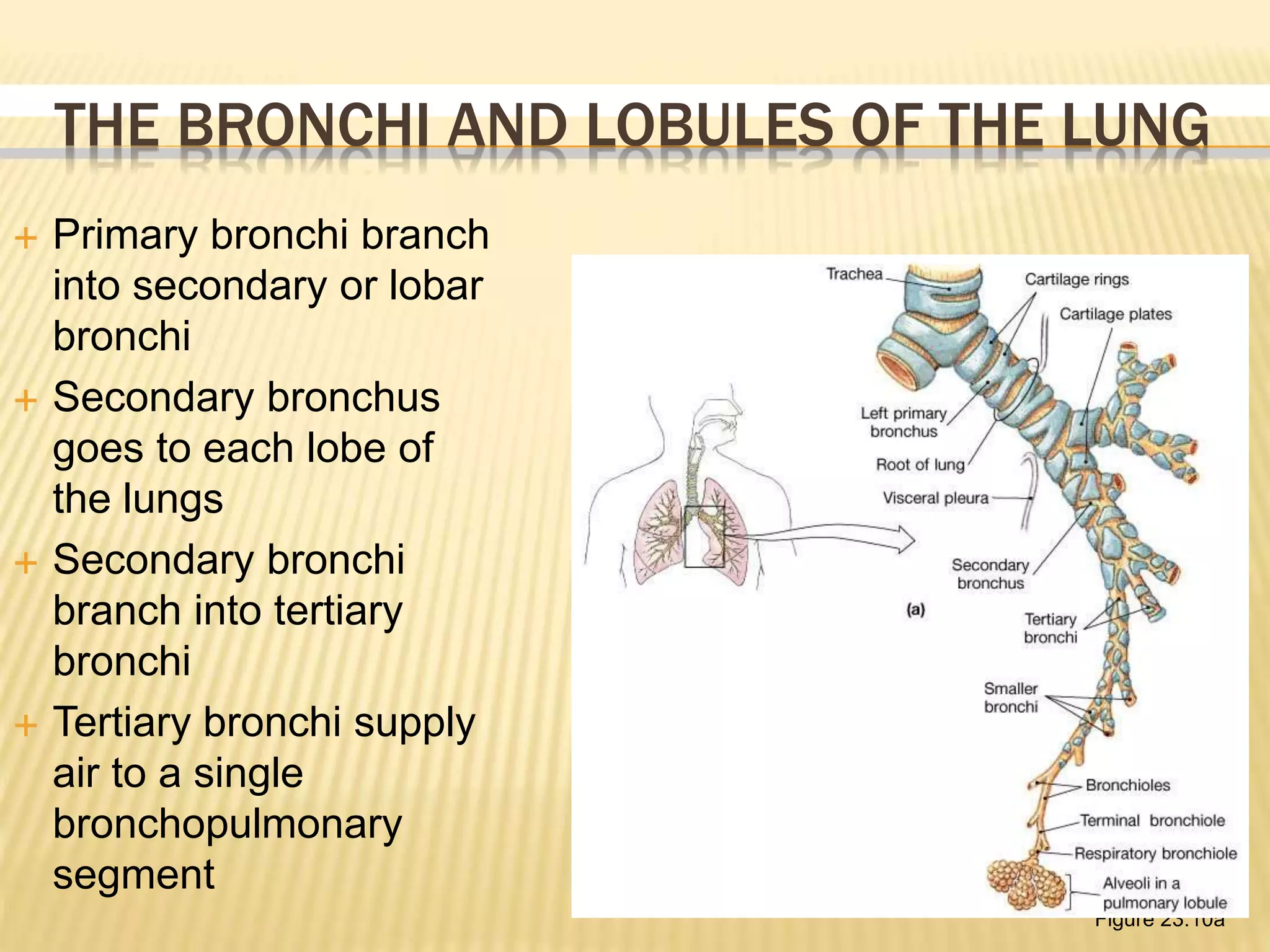
THE BRONCHIAL TREE
 System of tubes
formed from the
primary bronchi and
their branches is called
bronchial tree.
 Cartilage in walls
decrease and
smooth muscle
increase with
branching
Figure 23.10a
THE BRONCHI AND LOBULES OF THE LUNG
 Primary bronchi branch
into secondary or lobar
bronchi
 Secondary bronchus
goes to each lobe of
the lungs
 Secondary bronchi
branch into tertiary
bronchi
 Tertiary bronchi supply
air to a single
bronchopulmonary
segment
CHARACTERISTICS OF BRONCHOPULMONARY
SEGMENT
 The anatomic, functional, and surgical units
of the lung is known as bronchopulmonary
segments .
 Each segment receives air from an individual
segmental (tertiary) bronchus
 Approximately 10 bronchopulmonary segments
in each lung
 Each segments are pyramid shaped, with
its apex toward the lung root
 It has a segmental bronchus, a segmental
artery, lymph vessels, and autonomic
nerves
 The segmental vein lies in the connective
tissue between adjacent
bronchopulmonary segments
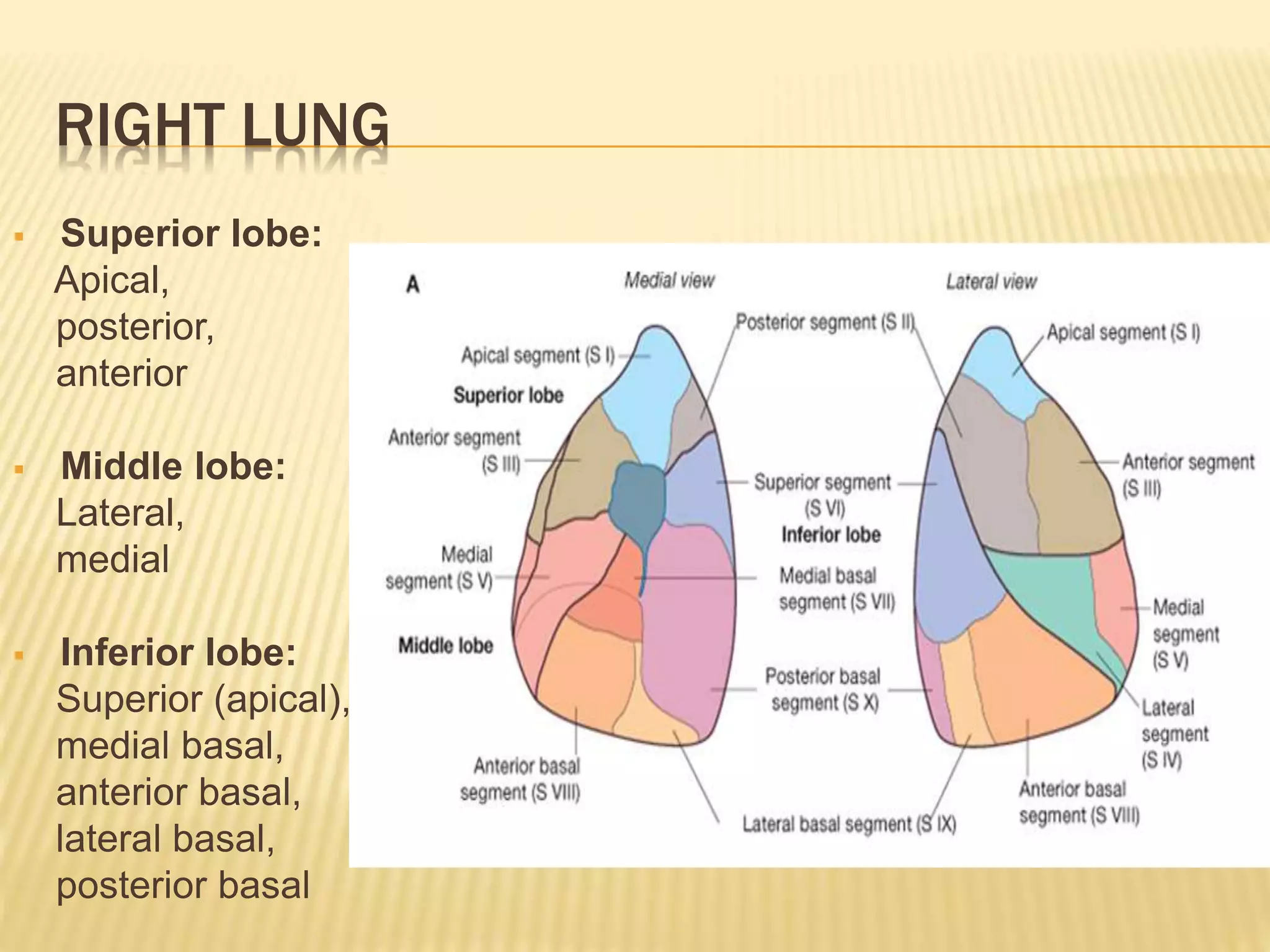
RIGHT LUNG
 Superior lobe:
Apical,
posterior,
anterior
 Middle lobe:
Lateral,
medial
 Inferior lobe:
Superior (apical),
medial basal,
anterior basal,
lateral basal,
posterior basal
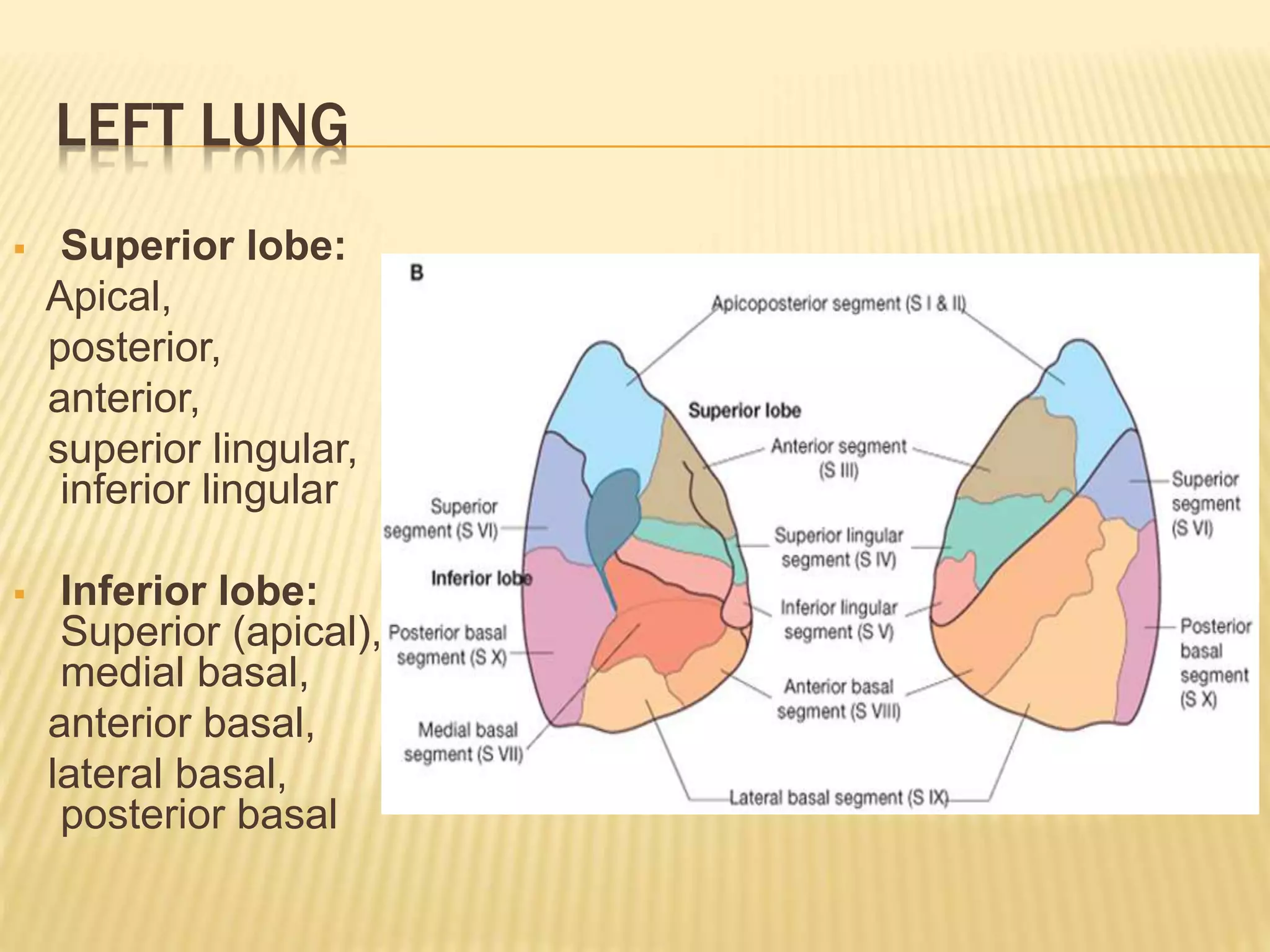
LEFT LUNG
 Superior lobe:
Apical,
posterior,
anterior,
superior lingular,
inferior lingular
 Inferior lobe:
Superior (apical),
medial basal,
anterior basal,
lateral basal,
posterior basal
 On entering a bronchopulmonary segment,
each segmental bronchus divides repeatedly.
 The segmental bronchus is accompanied by a
branch of the pulmonary artery ie each
segment has separate artery.
 Pulmonary vein do not accompanied the
bronchi or arteries.
 Each segment has its own lymphatic vessels
and autonomic nerve supply.
Lungs & bronchopulmonary segments

Lungs & bronchopulmonary segments

  • 1.
    LUNGS & BRONCHOPULMONARY SEGMENTS Shyambabu. P.Rauniyar Lecturer Dept of Anatomy 04/01/2015
  • 2.
    LUNGS  A pairof respiratory organs situated in the thoracic cavity and invaginate into the corresponding pleural sac.  Lungs are soft, spongy and elastic  Colour – rosy pink in new born & dark gray in adult.
  • 3.
    GROSS FEATURES  Shape– conical  Weight – right – 700gm & left – 600gm ie. right is heavier than left lung  Parts –apex, base, surface - costal & medial, borders - anterior, posterior & inferior
  • 4.
  • 5.
  • 6.
    LOBES & FISSURES Right lung: 3 lobes  Upper lobe  Middle lobe  Lower lobe Horizontal fissure Oblique fissure  Left lung: 2 lobes  Upper lobe  Lower lobe Oblique fissure 6
  • 7.
    STRUCTURES SEEN INTHE MEDIAL SURFACE OF LUNGS
  • 10.
     Hilus or(hilum)  Indentation on mediastinal (medial) surface  Place where blood vessels, bronchi, lymph vessel, and nerves enter and exit the lung  “Root” of the lung  Above structures attaching lung to mediastinum  Main ones: pulmonary artery and veins and main bronchus 10 Medial view R lung Medial view of L lung
  • 11.
    BLOOD SUPPLY ARTERIAL SUPPLYVENOUS DRAINAGE  Right side – one bronchial artery branch from third right posterior intercostal artery  Left side – two bronchial arteries both are branch from descending thoracic aorta.  Two bronchial veins on each side.  Right drain into azygos vein.  Left drain into hemiazygos vein.
  • 12.
    THE BRONCHIAL TREE System of tubes formed from the primary bronchi and their branches is called bronchial tree.  Cartilage in walls decrease and smooth muscle increase with branching
  • 13.
    Figure 23.10a THE BRONCHIAND LOBULES OF THE LUNG  Primary bronchi branch into secondary or lobar bronchi  Secondary bronchus goes to each lobe of the lungs  Secondary bronchi branch into tertiary bronchi  Tertiary bronchi supply air to a single bronchopulmonary segment
  • 15.
    CHARACTERISTICS OF BRONCHOPULMONARY SEGMENT The anatomic, functional, and surgical units of the lung is known as bronchopulmonary segments .  Each segment receives air from an individual segmental (tertiary) bronchus  Approximately 10 bronchopulmonary segments in each lung
  • 16.
     Each segmentsare pyramid shaped, with its apex toward the lung root  It has a segmental bronchus, a segmental artery, lymph vessels, and autonomic nerves  The segmental vein lies in the connective tissue between adjacent bronchopulmonary segments
  • 18.
    RIGHT LUNG  Superiorlobe: Apical, posterior, anterior  Middle lobe: Lateral, medial  Inferior lobe: Superior (apical), medial basal, anterior basal, lateral basal, posterior basal
  • 19.
    LEFT LUNG  Superiorlobe: Apical, posterior, anterior, superior lingular, inferior lingular  Inferior lobe: Superior (apical), medial basal, anterior basal, lateral basal, posterior basal
  • 21.
     On enteringa bronchopulmonary segment, each segmental bronchus divides repeatedly.  The segmental bronchus is accompanied by a branch of the pulmonary artery ie each segment has separate artery.  Pulmonary vein do not accompanied the bronchi or arteries.  Each segment has its own lymphatic vessels and autonomic nerve supply.