A
Short Term Training Report
on
PLC SCADA And HMI
PRESENTED BY:
Rameez Raja
MUR1300087
B.Tech ECE 3rd Yr.
GUIDED BY :
MR. PAWAN KUMAR
Tech. Head of Automation
[IGTR, Aurangabad]
AUTOMATION
 Automation is the use of control systems and
information technologies to reduce the need for human
work in the production of goods and services.
 Tools of Automation
 PLC
 SCADA
 HMI or TS
What is PLC?
 PLC is an industrial computer that monitors inputs, makes decisions based
on its program and controls outputs to automate a process or machine.
 A PLC has a built-in operating system(OS). This OS is highly specialized to
handle incoming events in real-time, or at the time of their occurrence.
 PLC is a digital computer designed for multiple inputs and output
arrangements, extended temperature ranges, immunity to electrical noise, and
resistance to vibration and other impacts.
 A PLC is an example of a real time system.
 PLC implements logic control functions by means of a program.
4
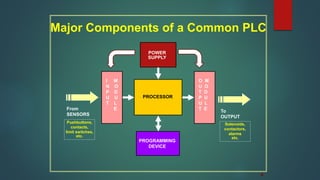
Major Components of a Common PLC
PROCESSOR
POWER
SUPPLY
I M
N O
P D
U U
T L
E
O M
U O
T D
P U
U L
T E
PROGRAMMING
DEVICE
From
SENSORS
Pushbuttons,
contacts,
limit switches,
etc.
To
OUTPUT
Solenoids,
contactors,
alarms
etc.
PLC operation sequence
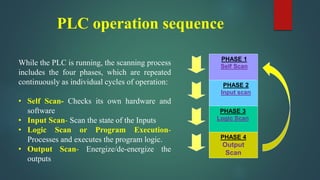
While the PLC is running, the scanning process
includes the four phases, which are repeated
continuously as individual cycles of operation:
• Self Scan- Checks its own hardware and
software
• Input Scan- Scan the state of the Inputs
• Logic Scan or Program Execution-
Processes and executes the program logic.
• Output Scan- Energize/de-energize the
outputs
PHASE 2
Input scan
PHASE 3
Logic Scan
PHASE 4
Output
Scan
PHASE 1
Self Scan
Ladder Logic For Basic gates
A B Logic(Y)
OFF
OFF
ON
ON
OFF
ON
OFF
ON
OFF
OFF
OFF
ON
AND Gate
A B Y
A B Logic(Y)
OFF
OFF
ON
ON
OFF
ON
OFF
ON
OFF
ON
ON
ON
OR Gate
A
B
Y
SCADA
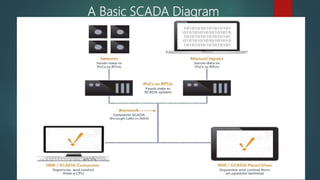
 SCADA is “Supervisory Control and Data
Acquisition” – A real time industrial process
control systems used to centrally monitor and
control remote or local industrial equipment such
as motors, valves, pumps, relays, etc.
 Supervisory control over a particular system.
 Increases production efficiency of a company.
 Reduces man-power needs.
HUMAN MACHINE INTERFACE (HMI)
 A human machine interface (HMI) is an interface which
permits interaction between a human being and a machine.
 Human machine interfaces vary widely, from control
panels for nuclear power plants to the screen and input
buttons on a cell phone.
 A human user needs some way to tell the machine what to
do, to make requests of the machine, or to adjust the
machine. Examples of input devices include keyboards,
switches, touch screens,
A Basic SCADA Diagram
Advantages of PLC and SCADA:
 Increased Reliability, flexibility and accuracy.
 Ease of maintenance /troubleshooting.
 Remote control capability.
 Communication Capability.
 Handles much more complicated systems.
 Cost effective for controlling complex systems.
 High speed of operation.
 Reduced space.
 Energy saving.
Disadvantages of PLC and SCADA
 Initial Costs Are High.
 Unemployment rate increases due to machines replacing
humans and putting those humans out of their jobs.
 Technical Limitation
 Security Threats
Applications:
 Wherever automation is desired the PLCs are best suited
to meet the task.
 Few examples of industries where PLCs are used :
 1) Robots manufacturing and control
 2) Car park control
 3) Train control station system
 4) Food processing
 5) Materials handling
 6)Machine tools
 7)Conveyer system etc.
Conclusion
 Automation is a gift for us in this current world and it
helped us to reach our such Goals of our life which was
impossible without it
 But We have to use it(Automation) in a limited amount not
in excess coz more we use it will definitely let our world
in a great instability and destruction.
 It is being said by someone “excess of every thing is bad “.
THANKS
HAVE A NICE DAY

Plc 8 raja presentation plc

  • 1.
    A Short Term TrainingReport on PLC SCADA And HMI PRESENTED BY: Rameez Raja MUR1300087 B.Tech ECE 3rd Yr. GUIDED BY : MR. PAWAN KUMAR Tech. Head of Automation [IGTR, Aurangabad]
  • 2.
    AUTOMATION  Automation isthe use of control systems and information technologies to reduce the need for human work in the production of goods and services.  Tools of Automation  PLC  SCADA  HMI or TS
  • 3.
    What is PLC? PLC is an industrial computer that monitors inputs, makes decisions based on its program and controls outputs to automate a process or machine.  A PLC has a built-in operating system(OS). This OS is highly specialized to handle incoming events in real-time, or at the time of their occurrence.  PLC is a digital computer designed for multiple inputs and output arrangements, extended temperature ranges, immunity to electrical noise, and resistance to vibration and other impacts.  A PLC is an example of a real time system.  PLC implements logic control functions by means of a program.
  • 4.
    4 Major Components ofa Common PLC PROCESSOR POWER SUPPLY I M N O P D U U T L E O M U O T D P U U L T E PROGRAMMING DEVICE From SENSORS Pushbuttons, contacts, limit switches, etc. To OUTPUT Solenoids, contactors, alarms etc.
  • 5.
    PLC operation sequence Whilethe PLC is running, the scanning process includes the four phases, which are repeated continuously as individual cycles of operation: • Self Scan- Checks its own hardware and software • Input Scan- Scan the state of the Inputs • Logic Scan or Program Execution- Processes and executes the program logic. • Output Scan- Energize/de-energize the outputs PHASE 2 Input scan PHASE 3 Logic Scan PHASE 4 Output Scan PHASE 1 Self Scan
  • 6.
    Ladder Logic ForBasic gates A B Logic(Y) OFF OFF ON ON OFF ON OFF ON OFF OFF OFF ON AND Gate A B Y A B Logic(Y) OFF OFF ON ON OFF ON OFF ON OFF ON ON ON OR Gate A B Y
  • 7.
    SCADA  SCADA is“Supervisory Control and Data Acquisition” – A real time industrial process control systems used to centrally monitor and control remote or local industrial equipment such as motors, valves, pumps, relays, etc.  Supervisory control over a particular system.  Increases production efficiency of a company.  Reduces man-power needs.
  • 8.
    HUMAN MACHINE INTERFACE(HMI)  A human machine interface (HMI) is an interface which permits interaction between a human being and a machine.  Human machine interfaces vary widely, from control panels for nuclear power plants to the screen and input buttons on a cell phone.  A human user needs some way to tell the machine what to do, to make requests of the machine, or to adjust the machine. Examples of input devices include keyboards, switches, touch screens,
  • 9.
  • 10.
    Advantages of PLCand SCADA:  Increased Reliability, flexibility and accuracy.  Ease of maintenance /troubleshooting.  Remote control capability.  Communication Capability.  Handles much more complicated systems.  Cost effective for controlling complex systems.  High speed of operation.  Reduced space.  Energy saving.
  • 11.
    Disadvantages of PLCand SCADA  Initial Costs Are High.  Unemployment rate increases due to machines replacing humans and putting those humans out of their jobs.  Technical Limitation  Security Threats
  • 12.
    Applications:  Wherever automationis desired the PLCs are best suited to meet the task.  Few examples of industries where PLCs are used :  1) Robots manufacturing and control  2) Car park control  3) Train control station system  4) Food processing  5) Materials handling  6)Machine tools  7)Conveyer system etc.
  • 13.
    Conclusion  Automation isa gift for us in this current world and it helped us to reach our such Goals of our life which was impossible without it  But We have to use it(Automation) in a limited amount not in excess coz more we use it will definitely let our world in a great instability and destruction.  It is being said by someone “excess of every thing is bad “.
  • 14.