 AUTOMATION
 TYPES OF AUTOMATION
 INDUSTRIAL AUTOMATION
 INTRODUCTION OF THE COMPANY
 WHAT IS PLC?
 WHAT IS SCADA?
 SENSORS
 ASSEMBLY LINES
 ACTUATOR &DRUM BRAKE ASSEMBLY
 QUALITY GAUGES
 MAINTENANCE OF THE COMPANY
 FUTURE SCOPE
 CONCLUSION
Automation is basically the delegation of human control
functions to technical equipment aimed towards
achieving:
 Higher productivity.
 Superior quality of end product.
 Efficient usage of energy and raw materials.
 Improved safety in working conditions etc.
 Building automation
Example: lifts, smoke detectors
 Office automation
Example: printers, cctv cameras
 Scientific automation
Example: rocket launching
 Light automation
Example: street solar lightening
 Industrial automation
Example: automated bottle filling stations , steel factories etc
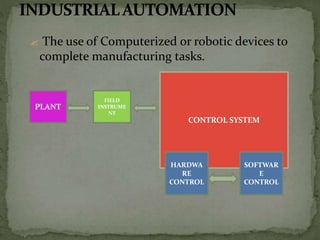
 The use of Computerized or robotic devices to
complete manufacturing tasks.
PLANT
FIELD
INSTRUME
NT
CONTROL SYSTEM
HARDWA
RE
CONTROL
SOFTWAR
E
CONTROL
 Programmable Logic Controller (PLC) is an industrial computer that
monitors inputs, makes decisions based on its program and controls
outputs to automate a process or machine.
 The automation of many different processes, such as controlling
machines or factory assembly lines, is done through the use of small
computers called a programmable logic controllers (PLCs).
 To reduce human efforts .
 To get maximum efficiency from machine and control them with
human logic .
 To reduce complex circuitry of entire system .
 To eliminate the high costs associated with inflexible, relay-controlled
systems.
UNDERSTANDING OF PLC
(Example )Machine can be controlled by PLC without human efforts
MAJOR COMPONENTS OF A PLC
PROCESSOR
POWER
SUPPLY
I M
N O
P D
U U
T L
E
O M
U O
T D
P U
U L
T E
PROGRAMMING
DEVICE
From
SENSORS
Pushbuttons,
contacts,
limit switches,
etc.
To
OUTPUT
Solenoids,
contactors,
alarms
etc.
PLC
INPUT OUTPUT
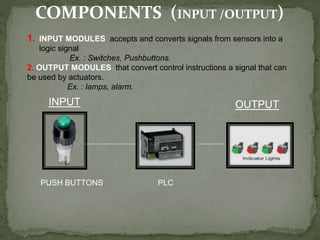
PUSH BUTTONS
1. INPUT MODULES accepts and converts signals from sensors into a
logic signal
Ex. : Switches, Pushbuttons.
2. OUTPUT MODULES that convert control instructions a signal that can
be used by actuators.
Ex. : lamps, alarm.
COMPONENTS (INPUT /OUTPUT)
3. CENTRAL PROCESSING UNIT(CPU)
It is the brain of PLC and governs the activities of the entire PLC systems
 The CPU consists of following blocks :
Arithmetic Logic Unit (ALU),
Internal memory of CPU
Internal timers ,counters and Flags .
 The various operations performed are :
Scanning I/O bus traffic control,
Program execution,
Peripheral and External device communication,
Data handling and self diagnostics.
PROCESSOR
4. MEMORY is the component that stores information, programs and data in
a PLC.
COMPONENTS (CPU ,MEMORY)
Types of memories used in PLCs are read only memory (ROM) and
random access memory (RAM).
5. POWER SUPPLY
Provides the voltage needed to run the primary PLC
components. POWER
SUPPLY
6. PROGRAMMING DEVICE
The programming terminal is used for programming
the PLC and monitoring/sequencing PLCs
operation.
PROGRAMMING
DEVICE
COMPONENTS (POWER SUPPLY, PROGRAMMING
DEVICE)
 CHECK INPUT STATUS
First the PLC takes a look at each
I/O to determine if it is on or off.
 EXECUTE PROGRAM
Next the PLC executes the program
one instruction at a time.
 UPDATE OUTPUT STATUS
Finally the PLC updates the status of
the outputs .It updates the outputs
based on which inputs were on during
the first step.
PLC OPERATION
Ladder logic is a programming language used to develop software for
PLC used in industrial control applications.
RUNGES
RAIL RAIL
PLC PROGRAMMING
ELEMENTS OF LADDER LOGIC
NORMALLY OPEN NORMALLY CLOSED
(CONTACT) (CONTACT)
COILS
A B Logic(Y)
OFF
OFF
ON
ON
OFF
ON
OFF
ON
OFF
OFF
OFF
ON
AND Gate
A B Y
A B Logic(Y)
OFF
OFF
ON
ON
OFF
ON
OFF
ON
OFF
ON
ON
ON
OR Gate
A
B
Y
NOR Gate
A B Y
A B Logic(Y)
OFF
OFF
ON
ON
OFF
ON
OFF
ON
ON
ON
ON
OFF
A B Logic(Y)
OFF
OFF
ON
ON
OFF
ON
OFF
ON
ON
OFF
OFF
OFF
NAND Gate
B
Y
A
 Manufacturing / Machining
 Food / Beverage
Textile Industry
 Travel Industry
 Aerospace
 Printing Industry
AREAS OF APPLICATION
 Replacing Human Operators
Dangerous Environments
Beyond Human Capabilities
 Fast
 Easily programmed and have an easily understood
programming language.
 Improves Productivity
 Improves Quality
ADVANTAGES
Initial Costs Are High
 There's Too Much Work Required In
Connecting Wires
 Unemployment Rate Increases
DISADVANTAGES
21SCADA SYSTEMS CLASSIFICATIONS (ILIA DORMISHEV, KRENAR KOMONI)
 Supervisory Control and Data Acquisition
 Supervisory
 Operator/s, engineer/s, supervisor/s, etc
 Control
 Monitoring
 Limited
 Telemetry
 Remote/Local
 Data acquisition
 Access and acquire information or data from the
equipment
 Sends it to different sites through telemetry
 Analog / Digital
NORWICH UNIVERISTY CENTER OF EXELLENCE IN DISTRIBUTED CONTROL SYSTEM SECURITY
22SCADA SYSTEMS CLASSIFICATIONS (ILIA DORMISHEV, KRENAR KOMONI)
 Saves Time and Money
 Less traveling for workers (e.g. helicopter ride)
 Reduces man-power needs
 Increases production efficiency of a company
 Cost effective for power systems
 Saves energy
 Reliable
 Supervisory control over a particular system
NORWICH UNIVERISTY CENTER OF EXELLENCE IN DISTRIBUTED CONTROL SYSTEM SECURITY
23SCADA SYSTEMS CLASSIFICATIONS (ILIA DORMISHEV, KRENAR KOMONI)
Main SCADA applications:
 Water and Wastewater
 Power
 Oil and Gas
 Research facilities
 Transportation
 Security systems
 Siren systems
 Irrigation
 Communication control
NORWICH UNIVERISTY CENTER OF EXELLENCE IN DISTRIBUTED CONTROL SYSTEM SECURITY
1. Sensors
2. Solenoids
3. Load cells
4. Limit switch
5. Relay
 Assembling of complex items such as automobiles,
transportation equipments, household appliances &
electronic goods.
 Different operations are:
1. rework station
2. Bladder screw assembly
3. Low pressure testing
4. High pressure testing………
 Actuator assembly is used to describe actuator
mechanism.
 It consists of a typical power supply, actuator arm ,
actuator mechanism.
 Drum brake assembly components include:
1. Backing plate
2. Brake drum
3. Springs & pins
 Used to make measurements in order to display
certain information, like time, thickness.
 Types:
 Pressure gauge
 Hydraulic gauge
 Bore gauge
 1. coordinate measuring machine (CMM)
Device used for measuring physical geometrical
characteristics of an object.
2. Micrometers
Precise measurement of components.
 . Maintenance is the discipline and profession for the optimization of
equipment, procedures, and departmental budgets to achieve
better maintainability, reliability, and availability of equipment
 Types
1. Preventive
2. Predictive
3. Time-based
4. Condition-based
 Because of relatively small production volumes and
huge applications, industrial automation uses new
technologies that are present in the market.
 In the coming time there would be fully automated
factories established which would not only reduce and
save time and energy but also leads to increase in
countries economic growth.
 The PLC have in recent years experienced an unprecedented
growth as universal element in industrial automation .It can be
effectively used in applications ranging from simple control like
replacing a small number of relays to complex automation
problems.Today the PLCs are used for control & automation job
in a single machine & it increases up to full automation of
manufacturing / testing process in a factory. It is said that
countries that have embraced automation enjoy a higher standard
of living than those that have not. At the same time, a concern is
often aired that automating tasks jobs from people that used to
build things by hand. Regardless of the social implications , there
is no doubt that productivity increases with the proper application
of automation techniques.
CONCLUSION
Industrialautomation final

Industrialautomation final

  • 2.
     AUTOMATION  TYPESOF AUTOMATION  INDUSTRIAL AUTOMATION  INTRODUCTION OF THE COMPANY  WHAT IS PLC?  WHAT IS SCADA?  SENSORS  ASSEMBLY LINES  ACTUATOR &DRUM BRAKE ASSEMBLY  QUALITY GAUGES  MAINTENANCE OF THE COMPANY  FUTURE SCOPE  CONCLUSION
  • 3.
    Automation is basicallythe delegation of human control functions to technical equipment aimed towards achieving:  Higher productivity.  Superior quality of end product.  Efficient usage of energy and raw materials.  Improved safety in working conditions etc.
  • 4.
     Building automation Example:lifts, smoke detectors  Office automation Example: printers, cctv cameras  Scientific automation Example: rocket launching  Light automation Example: street solar lightening  Industrial automation Example: automated bottle filling stations , steel factories etc
  • 5.
     The useof Computerized or robotic devices to complete manufacturing tasks. PLANT FIELD INSTRUME NT CONTROL SYSTEM HARDWA RE CONTROL SOFTWAR E CONTROL
  • 6.
     Programmable LogicController (PLC) is an industrial computer that monitors inputs, makes decisions based on its program and controls outputs to automate a process or machine.  The automation of many different processes, such as controlling machines or factory assembly lines, is done through the use of small computers called a programmable logic controllers (PLCs).
  • 7.
     To reducehuman efforts .  To get maximum efficiency from machine and control them with human logic .  To reduce complex circuitry of entire system .  To eliminate the high costs associated with inflexible, relay-controlled systems.
  • 8.
    UNDERSTANDING OF PLC (Example)Machine can be controlled by PLC without human efforts
  • 9.
    MAJOR COMPONENTS OFA PLC PROCESSOR POWER SUPPLY I M N O P D U U T L E O M U O T D P U U L T E PROGRAMMING DEVICE From SENSORS Pushbuttons, contacts, limit switches, etc. To OUTPUT Solenoids, contactors, alarms etc.
  • 10.
    PLC INPUT OUTPUT PUSH BUTTONS 1.INPUT MODULES accepts and converts signals from sensors into a logic signal Ex. : Switches, Pushbuttons. 2. OUTPUT MODULES that convert control instructions a signal that can be used by actuators. Ex. : lamps, alarm. COMPONENTS (INPUT /OUTPUT)
  • 11.
    3. CENTRAL PROCESSINGUNIT(CPU) It is the brain of PLC and governs the activities of the entire PLC systems  The CPU consists of following blocks : Arithmetic Logic Unit (ALU), Internal memory of CPU Internal timers ,counters and Flags .  The various operations performed are : Scanning I/O bus traffic control, Program execution, Peripheral and External device communication, Data handling and self diagnostics. PROCESSOR 4. MEMORY is the component that stores information, programs and data in a PLC. COMPONENTS (CPU ,MEMORY) Types of memories used in PLCs are read only memory (ROM) and random access memory (RAM).
  • 12.
    5. POWER SUPPLY Providesthe voltage needed to run the primary PLC components. POWER SUPPLY 6. PROGRAMMING DEVICE The programming terminal is used for programming the PLC and monitoring/sequencing PLCs operation. PROGRAMMING DEVICE COMPONENTS (POWER SUPPLY, PROGRAMMING DEVICE)
  • 13.
     CHECK INPUTSTATUS First the PLC takes a look at each I/O to determine if it is on or off.  EXECUTE PROGRAM Next the PLC executes the program one instruction at a time.  UPDATE OUTPUT STATUS Finally the PLC updates the status of the outputs .It updates the outputs based on which inputs were on during the first step. PLC OPERATION
  • 14.
    Ladder logic isa programming language used to develop software for PLC used in industrial control applications. RUNGES RAIL RAIL PLC PROGRAMMING
  • 15.
    ELEMENTS OF LADDERLOGIC NORMALLY OPEN NORMALLY CLOSED (CONTACT) (CONTACT) COILS
  • 16.
    A B Logic(Y) OFF OFF ON ON OFF ON OFF ON OFF OFF OFF ON ANDGate A B Y A B Logic(Y) OFF OFF ON ON OFF ON OFF ON OFF ON ON ON OR Gate A B Y
  • 17.
    NOR Gate A BY A B Logic(Y) OFF OFF ON ON OFF ON OFF ON ON ON ON OFF A B Logic(Y) OFF OFF ON ON OFF ON OFF ON ON OFF OFF OFF NAND Gate B Y A
  • 18.
     Manufacturing /Machining  Food / Beverage Textile Industry  Travel Industry  Aerospace  Printing Industry AREAS OF APPLICATION
  • 19.
     Replacing HumanOperators Dangerous Environments Beyond Human Capabilities  Fast  Easily programmed and have an easily understood programming language.  Improves Productivity  Improves Quality ADVANTAGES
  • 20.
    Initial Costs AreHigh  There's Too Much Work Required In Connecting Wires  Unemployment Rate Increases DISADVANTAGES
  • 21.
    21SCADA SYSTEMS CLASSIFICATIONS(ILIA DORMISHEV, KRENAR KOMONI)  Supervisory Control and Data Acquisition  Supervisory  Operator/s, engineer/s, supervisor/s, etc  Control  Monitoring  Limited  Telemetry  Remote/Local  Data acquisition  Access and acquire information or data from the equipment  Sends it to different sites through telemetry  Analog / Digital NORWICH UNIVERISTY CENTER OF EXELLENCE IN DISTRIBUTED CONTROL SYSTEM SECURITY
  • 22.
    22SCADA SYSTEMS CLASSIFICATIONS(ILIA DORMISHEV, KRENAR KOMONI)  Saves Time and Money  Less traveling for workers (e.g. helicopter ride)  Reduces man-power needs  Increases production efficiency of a company  Cost effective for power systems  Saves energy  Reliable  Supervisory control over a particular system NORWICH UNIVERISTY CENTER OF EXELLENCE IN DISTRIBUTED CONTROL SYSTEM SECURITY
  • 23.
    23SCADA SYSTEMS CLASSIFICATIONS(ILIA DORMISHEV, KRENAR KOMONI) Main SCADA applications:  Water and Wastewater  Power  Oil and Gas  Research facilities  Transportation  Security systems  Siren systems  Irrigation  Communication control NORWICH UNIVERISTY CENTER OF EXELLENCE IN DISTRIBUTED CONTROL SYSTEM SECURITY
  • 24.
    1. Sensors 2. Solenoids 3.Load cells 4. Limit switch 5. Relay
  • 25.
     Assembling ofcomplex items such as automobiles, transportation equipments, household appliances & electronic goods.  Different operations are: 1. rework station 2. Bladder screw assembly 3. Low pressure testing 4. High pressure testing………
  • 26.
     Actuator assemblyis used to describe actuator mechanism.  It consists of a typical power supply, actuator arm , actuator mechanism.  Drum brake assembly components include: 1. Backing plate 2. Brake drum 3. Springs & pins
  • 27.
     Used tomake measurements in order to display certain information, like time, thickness.  Types:  Pressure gauge  Hydraulic gauge  Bore gauge
  • 28.
     1. coordinatemeasuring machine (CMM) Device used for measuring physical geometrical characteristics of an object. 2. Micrometers Precise measurement of components.
  • 29.
     . Maintenanceis the discipline and profession for the optimization of equipment, procedures, and departmental budgets to achieve better maintainability, reliability, and availability of equipment  Types 1. Preventive 2. Predictive 3. Time-based 4. Condition-based
  • 30.
     Because ofrelatively small production volumes and huge applications, industrial automation uses new technologies that are present in the market.  In the coming time there would be fully automated factories established which would not only reduce and save time and energy but also leads to increase in countries economic growth.
  • 31.
     The PLChave in recent years experienced an unprecedented growth as universal element in industrial automation .It can be effectively used in applications ranging from simple control like replacing a small number of relays to complex automation problems.Today the PLCs are used for control & automation job in a single machine & it increases up to full automation of manufacturing / testing process in a factory. It is said that countries that have embraced automation enjoy a higher standard of living than those that have not. At the same time, a concern is often aired that automating tasks jobs from people that used to build things by hand. Regardless of the social implications , there is no doubt that productivity increases with the proper application of automation techniques. CONCLUSION