INDUSTRIAL
AUTOMATION
MEMBERS
 TUSHAR SWAMI
 VIKAS PRASAD
 TANISH GARG
ACKNOWLEDGEMENT
We would like to express our special thanks of gratitude to our teacher Dr. Vandana
who gave us the golden opportunity to present this wonderful presentation on the topic
(Industrial Automation), which also helped us in doing a lot of Research and we came
to know about new things. We are really thankful to her.
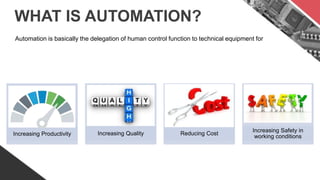
Automation is basically the delegation of human control function to technical equipment for
WHAT IS AUTOMATION?
Increasing Productivity Increasing Quality Reducing Cost
Increasing Safety in
working conditions
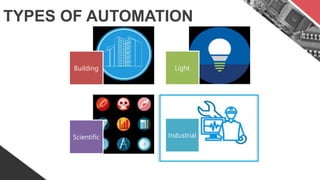
TYPES OF AUTOMATION
Building Light
Scientific Industrial
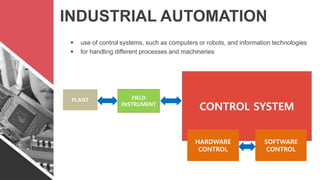
INDUSTRIAL AUTOMATION
 use of control systems, such as computers or robots, and information technologies
 for handling different processes and machineries
PLANT FIELD
INSTRUMENT
CONTROL SYSTEM
HARDWARE
CONTROL
SOFTWARE
CONTROL
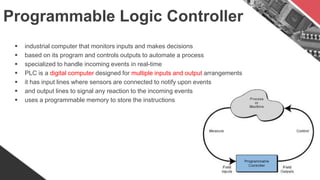
Programmable Logic Controller
 industrial computer that monitors inputs and makes decisions
 based on its program and controls outputs to automate a process
 specialized to handle incoming events in real-time
 PLC is a digital computer designed for multiple inputs and output arrangements
 it has input lines where sensors are connected to notify upon events
 and output lines to signal any reaction to the incoming events
 uses a programmable memory to store the instructions
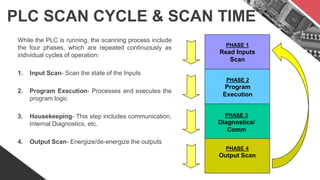
PLC SCAN CYCLE & SCAN TIME
While the PLC is running, the scanning process include
the four phases, which are repeated continuously as
individual cycles of operation:
1. Input Scan- Scan the state of the Inputs
2. Program Execution- Processes and executes the
program logic
3. Housekeeping- This step includes communication,
Internal Diagnostics, etc.
4. Output Scan- Energize/de-energize the outputs
PHASE 2
Program
Execution
PHASE 3
Diagnostics/
Comm
PHASE 4
Output Scan
PHASE 1
Read Inputs
Scan
MAJOR COMPONENTS OF PLC
PROCESSOR
POWER SUPPLY
INPUT
MODULE
PROGRAMMING DEVICE
From
SENSORS
Pushbuttons,
contacts,
limit switches,
etc.
To
OUTPUT
Solenoids,
contactors,
alarms etc.
OUTPUT
MODULE
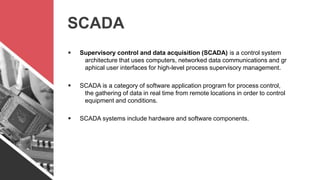
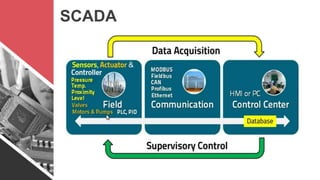
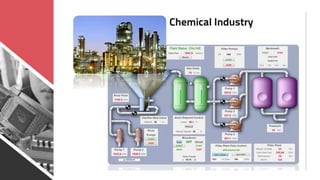
SCADA
 Supervisory control and data acquisition (SCADA) is a control system
architecture that uses computers, networked data communications and gr
aphical user interfaces for high-level process supervisory management.
 SCADA is a category of software application program for process control,
the gathering of data in real time from remote locations in order to control
equipment and conditions.
 SCADA systems include hardware and software components.
SCADA
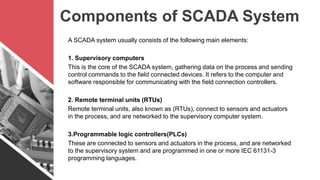
Components of SCADA System
A SCADA system usually consists of the following main elements:
1. Supervisory computers
This is the core of the SCADA system, gathering data on the process and sending
control commands to the field connected devices. It refers to the computer and
software responsible for communicating with the field connection controllers.
2. Remote terminal units (RTUs)
Remote terminal units, also known as (RTUs), connect to sensors and actuators
in the process, and are networked to the supervisory computer system.
3.Programmable logic controllers(PLCs)
These are connected to sensors and actuators in the process, and are networked
to the supervisory system and are programmed in one or more IEC 61131-3
programming languages.
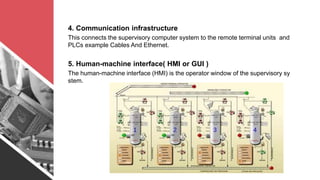
4. Communication infrastructure
This connects the supervisory computer system to the remote terminal units and
PLCs example Cables And Ethernet.
5. Human-machine interface( HMI or GUI )
The human-machine interface (HMI) is the operator window of the supervisory sy
stem.
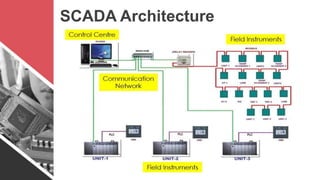
SCADA Architecture
Example
APPLICATIONS
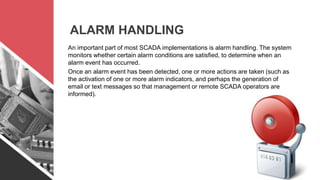
ALARM HANDLING
An important part of most SCADA implementations is alarm handling. The system
monitors whether certain alarm conditions are satisfied, to determine when an
alarm event has occurred.
Once an alarm event has been detected, one or more actions are taken (such as
the activation of one or more alarm indicators, and perhaps the generation of
email or text messages so that management or remote SCADA operators are
informed).
• Laboratory Virtual Instrument Engineering Workbench, is a programming
environment in which you create programs using a graphical notation
• Increase your productivity by orders of magnitude,
• it is specifically designed to take measurements, analyze data & present
results to the user
INTRODUCTION
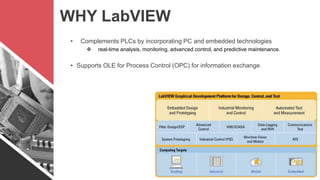
WHY LabVIEW
• Complements PLCs by incorporating PC and embedded technologies
 real-time analysis, monitoring, advanced control, and predictive maintenance.
• Supports OLE for Process Control (OPC) for information exchange
• For High-Speed Measurements from a Broad Range of Sensors
• Acquire and generate signals from plug-in boards, USB devices, and Ethernet-based
systems.
• Special data types and measurement analysis functions
• Measurements from physical sensors as quickly and easily as possible
• For Data Logging
• Utilities for data logging and alarm management, real-time and historical trending.
• The historical data is stored in database, so you can use standard data extraction
tools to retrieve the information for use in other parts of the enterprise
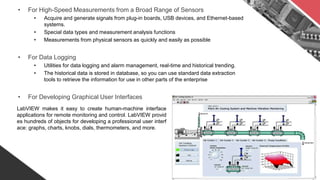
• For Developing Graphical User Interfaces
LabVIEW makes it easy to create human-machine interface
applications for remote monitoring and control. LabVIEW provid
es hundreds of objects for developing a professional user interf
ace: graphs, charts, knobs, dials, thermometers, and more.
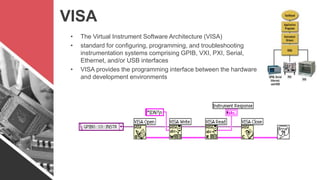
VISA
• The Virtual Instrument Software Architecture (VISA)
• standard for configuring, programming, and troubleshooting
instrumentation systems comprising GPIB, VXI, PXI, Serial,
Ethernet, and/or USB interfaces
• VISA provides the programming interface between the hardware
and development environments
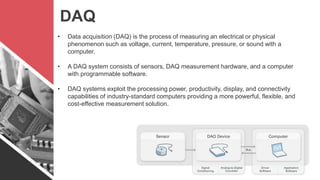
DAQ
• Data acquisition (DAQ) is the process of measuring an electrical or physical
phenomenon such as voltage, current, temperature, pressure, or sound with a
computer.
• A DAQ system consists of sensors, DAQ measurement hardware, and a computer
with programmable software.
• DAQ systems exploit the processing power, productivity, display, and connectivity
capabilities of industry-standard computers providing a more powerful, flexible, and
cost-effective measurement solution.
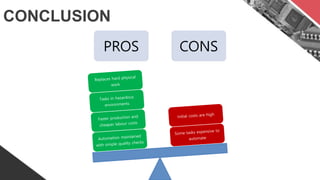
CONCLUSION
PROS CONS
Explained about the interfacing of various industrial machines with
myriad logical controllers.
Since “MAKE IN INDIA” campaign is on the rage right now.
Industrial Automation – ever-growing field
Fair employment chances for Engineers with knowledge about the
working of machines, and programming languages and software
like:
• MATLAB
• Python
• C#
• Java, etc.
REFERENCES
• http://www.surecontrols.com/what-is-industrial-automation/https://hal.archives-ouvertes
• https://en.wikipedia.org/wiki/SCADA
• https://www.youtube.com/watch?v=5ZiIA-kMV8
• http://whatis.techtarget.com/definition/SCADA-supervisory-control-and-data-acquisition
• http://www.informit.com/articles/article.aspx?p=662895&seqNum=3
• https://www.researchgate.net/figure/228855466_fig1_Figure-1-How-LabVIEW-work
• https://en.wikipedia.org/wiki/LabVIEW#Related_software
• http://www.ni.com/white-paper/9082/en/
• http://www.ni.com/labview/why/
• http://www.icon-tech.com.au/s53/faq-the-labview-platform-for-industry
• https://www.researchgate.net/post/How_and_which_industry_PLC_LabVIEW
• http://www.ni.com/white-paper/2956/en/
• http://www.ni.com/data-acquisition/what-is/
• https://www.ni.com/visa/
• http://www.ni.com/tutorial/3702/en/
CONCLUSION

Industrial Automation

  • 1.
  • 2.
    MEMBERS  TUSHAR SWAMI VIKAS PRASAD  TANISH GARG
  • 3.
    ACKNOWLEDGEMENT We would liketo express our special thanks of gratitude to our teacher Dr. Vandana who gave us the golden opportunity to present this wonderful presentation on the topic (Industrial Automation), which also helped us in doing a lot of Research and we came to know about new things. We are really thankful to her.
  • 4.
    Automation is basicallythe delegation of human control function to technical equipment for WHAT IS AUTOMATION? Increasing Productivity Increasing Quality Reducing Cost Increasing Safety in working conditions
  • 5.
    TYPES OF AUTOMATION BuildingLight Scientific Industrial
  • 6.
    INDUSTRIAL AUTOMATION  useof control systems, such as computers or robots, and information technologies  for handling different processes and machineries PLANT FIELD INSTRUMENT CONTROL SYSTEM HARDWARE CONTROL SOFTWARE CONTROL
  • 7.
    Programmable Logic Controller industrial computer that monitors inputs and makes decisions  based on its program and controls outputs to automate a process  specialized to handle incoming events in real-time  PLC is a digital computer designed for multiple inputs and output arrangements  it has input lines where sensors are connected to notify upon events  and output lines to signal any reaction to the incoming events  uses a programmable memory to store the instructions
  • 8.
    PLC SCAN CYCLE& SCAN TIME While the PLC is running, the scanning process include the four phases, which are repeated continuously as individual cycles of operation: 1. Input Scan- Scan the state of the Inputs 2. Program Execution- Processes and executes the program logic 3. Housekeeping- This step includes communication, Internal Diagnostics, etc. 4. Output Scan- Energize/de-energize the outputs PHASE 2 Program Execution PHASE 3 Diagnostics/ Comm PHASE 4 Output Scan PHASE 1 Read Inputs Scan
  • 9.
    MAJOR COMPONENTS OFPLC PROCESSOR POWER SUPPLY INPUT MODULE PROGRAMMING DEVICE From SENSORS Pushbuttons, contacts, limit switches, etc. To OUTPUT Solenoids, contactors, alarms etc. OUTPUT MODULE
  • 11.
    SCADA  Supervisory controland data acquisition (SCADA) is a control system architecture that uses computers, networked data communications and gr aphical user interfaces for high-level process supervisory management.  SCADA is a category of software application program for process control, the gathering of data in real time from remote locations in order to control equipment and conditions.  SCADA systems include hardware and software components.
  • 12.
  • 13.
    Components of SCADASystem A SCADA system usually consists of the following main elements: 1. Supervisory computers This is the core of the SCADA system, gathering data on the process and sending control commands to the field connected devices. It refers to the computer and software responsible for communicating with the field connection controllers. 2. Remote terminal units (RTUs) Remote terminal units, also known as (RTUs), connect to sensors and actuators in the process, and are networked to the supervisory computer system. 3.Programmable logic controllers(PLCs) These are connected to sensors and actuators in the process, and are networked to the supervisory system and are programmed in one or more IEC 61131-3 programming languages.
  • 14.
    4. Communication infrastructure Thisconnects the supervisory computer system to the remote terminal units and PLCs example Cables And Ethernet. 5. Human-machine interface( HMI or GUI ) The human-machine interface (HMI) is the operator window of the supervisory sy stem.
  • 15.
  • 16.
  • 17.
  • 19.
    ALARM HANDLING An importantpart of most SCADA implementations is alarm handling. The system monitors whether certain alarm conditions are satisfied, to determine when an alarm event has occurred. Once an alarm event has been detected, one or more actions are taken (such as the activation of one or more alarm indicators, and perhaps the generation of email or text messages so that management or remote SCADA operators are informed).
  • 21.
    • Laboratory VirtualInstrument Engineering Workbench, is a programming environment in which you create programs using a graphical notation • Increase your productivity by orders of magnitude, • it is specifically designed to take measurements, analyze data & present results to the user INTRODUCTION
  • 22.
    WHY LabVIEW • ComplementsPLCs by incorporating PC and embedded technologies  real-time analysis, monitoring, advanced control, and predictive maintenance. • Supports OLE for Process Control (OPC) for information exchange
  • 23.
    • For High-SpeedMeasurements from a Broad Range of Sensors • Acquire and generate signals from plug-in boards, USB devices, and Ethernet-based systems. • Special data types and measurement analysis functions • Measurements from physical sensors as quickly and easily as possible • For Data Logging • Utilities for data logging and alarm management, real-time and historical trending. • The historical data is stored in database, so you can use standard data extraction tools to retrieve the information for use in other parts of the enterprise • For Developing Graphical User Interfaces LabVIEW makes it easy to create human-machine interface applications for remote monitoring and control. LabVIEW provid es hundreds of objects for developing a professional user interf ace: graphs, charts, knobs, dials, thermometers, and more.
  • 24.
    VISA • The VirtualInstrument Software Architecture (VISA) • standard for configuring, programming, and troubleshooting instrumentation systems comprising GPIB, VXI, PXI, Serial, Ethernet, and/or USB interfaces • VISA provides the programming interface between the hardware and development environments
  • 25.
    DAQ • Data acquisition(DAQ) is the process of measuring an electrical or physical phenomenon such as voltage, current, temperature, pressure, or sound with a computer. • A DAQ system consists of sensors, DAQ measurement hardware, and a computer with programmable software. • DAQ systems exploit the processing power, productivity, display, and connectivity capabilities of industry-standard computers providing a more powerful, flexible, and cost-effective measurement solution.
  • 26.
  • 27.
    Explained about theinterfacing of various industrial machines with myriad logical controllers. Since “MAKE IN INDIA” campaign is on the rage right now. Industrial Automation – ever-growing field Fair employment chances for Engineers with knowledge about the working of machines, and programming languages and software like: • MATLAB • Python • C# • Java, etc.
  • 28.
    REFERENCES • http://www.surecontrols.com/what-is-industrial-automation/https://hal.archives-ouvertes • https://en.wikipedia.org/wiki/SCADA •https://www.youtube.com/watch?v=5ZiIA-kMV8 • http://whatis.techtarget.com/definition/SCADA-supervisory-control-and-data-acquisition • http://www.informit.com/articles/article.aspx?p=662895&seqNum=3 • https://www.researchgate.net/figure/228855466_fig1_Figure-1-How-LabVIEW-work • https://en.wikipedia.org/wiki/LabVIEW#Related_software • http://www.ni.com/white-paper/9082/en/ • http://www.ni.com/white-paper/9082/en/ • http://www.ni.com/labview/why/ • http://www.icon-tech.com.au/s53/faq-the-labview-platform-for-industry • https://www.researchgate.net/post/How_and_which_industry_PLC_LabVIEW • http://www.ni.com/white-paper/2956/en/ • http://www.ni.com/data-acquisition/what-is/ • https://www.ni.com/visa/ • http://www.ni.com/tutorial/3702/en/
  • 29.