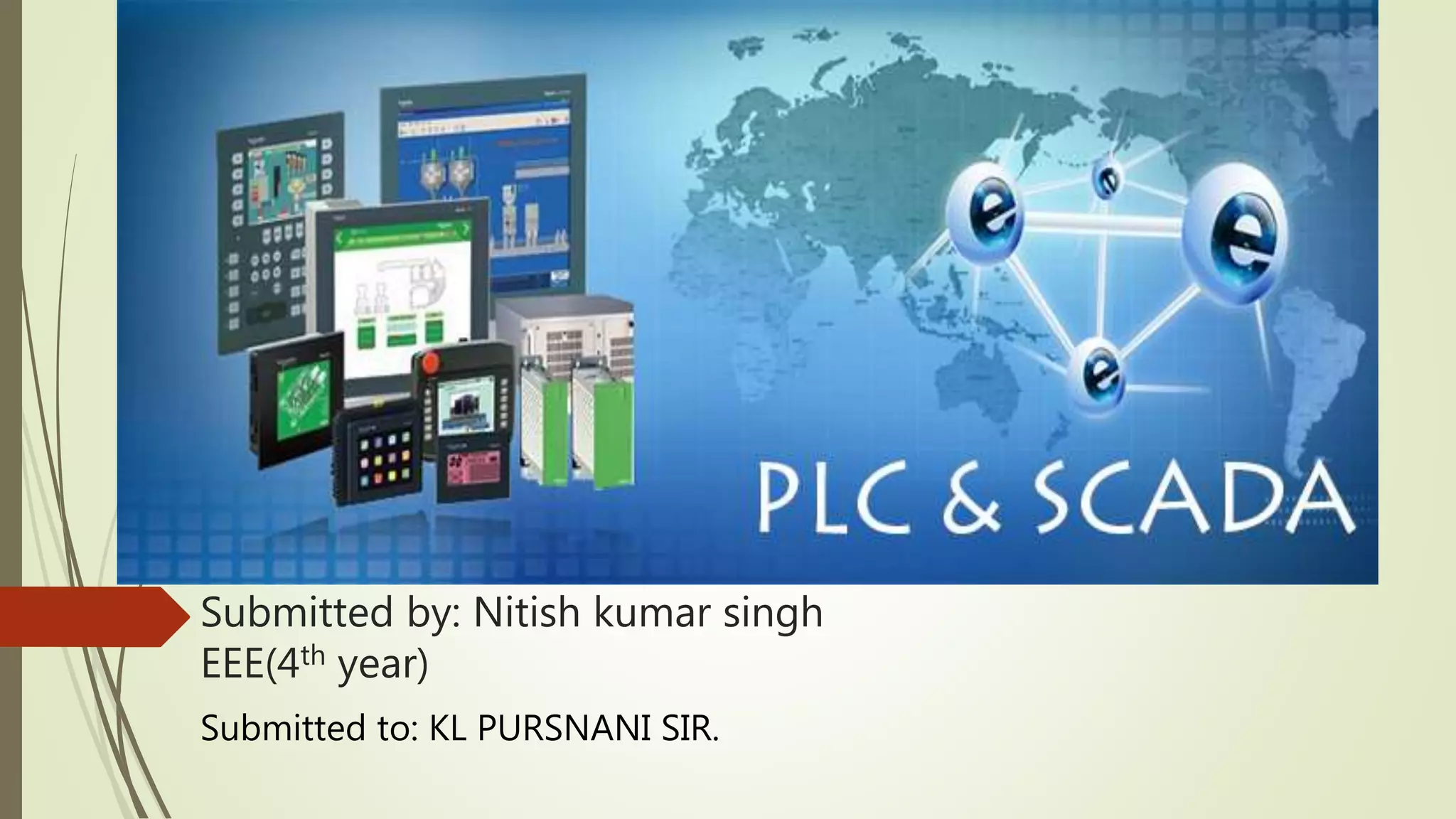
Submitted by: Nitish kumar singh
EEE(4th year)
Submitted to: KL PURSNANI SIR.
content
 History of automation
 What is PLC?
 history of PLC
 Brand of PLC
 Types of PLC
 Architecture of PLC
 Programming of PLC
 Symbols of ladder logic
 Introduction of micrologix1000
 Introduction of SCADA system.
HISTORY OF AUTOMATION
1) Manual control system.
2) Hydraulic & Pneumatic control system.
3) Hard-wire control system.
4) Electronics control system.
5) PLC controlling.
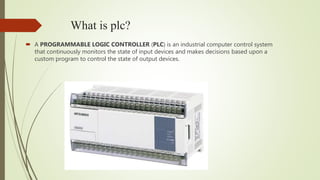
What is plc?
 A PROGRAMMABLE LOGIC CONTROLLER (PLC) is an industrial computer control system
that continuously monitors the state of input devices and makes decisions based upon a
custom program to control the state of output devices.
History of plc.
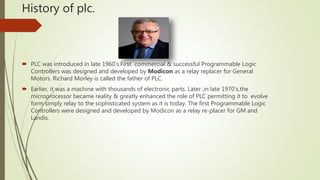
 PLC was introduced in late 1960’s.First commercial & successful Programmable Logic
Controllers was designed and developed by Modicon as a relay replacer for General
Motors. Richard Morley is called the father of PLC.
 Earlier, it was a machine with thousands of electronic parts. Later ,in late 1970’s,the
microprocessor became reality & greatly enhanced the role of PLC permitting it to evolve
form simply relay to the sophisticated system as it is today. The first Programmable Logic
Controllers were designed and developed by Modicon as a relay re-placer for GM and
Landis.
Brand of plc.
1) Allen Bradley(AB).
2) Siemens.
3) Delta.
4) Mitsubishi.
5) Panasonic.
6) Omron.
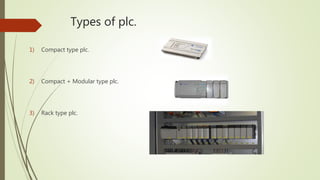
Types of plc.
1) Compact type plc.
2) Compact + Modular type plc.
3) Rack type plc.
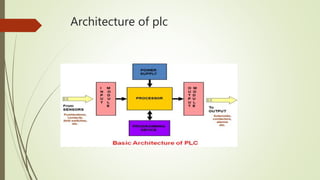
Architecture of plc
Programming language
 IEC 1131-3 is the international standard for programmable controller programming
languages. The following is a list of programming languages specified by this standard:
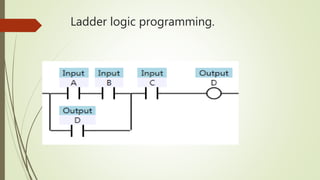
1) Ladder diagram
2) Sequential Function Charts (SFC)
3) Function Block Diagram (FBD)
4) Structured Text (ST)
5) Instruction List (IL)
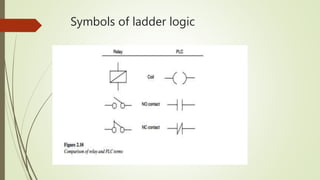
Symbols of ladder logic
Ladder logic programming.
MICROLOGIX 1000
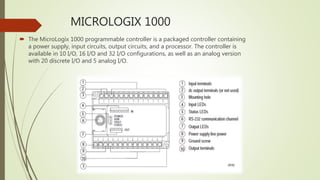
 The MicroLogix 1000 programmable controller is a packaged controller containing
a power supply, input circuits, output circuits, and a processor. The controller is
available in 10 I/O, 16 I/O and 32 I/O configurations, as well as an analog version
with 20 discrete I/O and 5 analog I/O.
Micrologic1000 consist of following things:
 Input terminals-In input terminal we attach the power supply according to the
requirement of plc either AC or DC.
 Output terminal-It is used to attach the load like motor ,drive, led ,machinery etc.
 Input & status led-these show the status of input given and the status of PLC like
Power,run,fault,force.
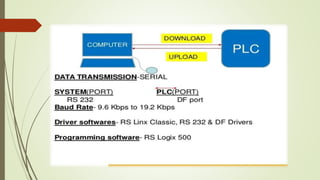
 Communication port-In this,RS232 port is used as communication port .PMO2
cable is used to communicate it with PC.DF1 protocol is used here.
 DCcom-It is used to complete the circuit.
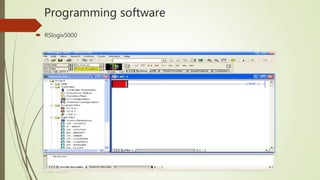
Programming software
 RSlogix5000
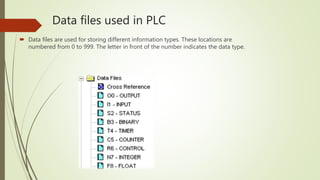
Data files used in PLC
 Data files are used for storing different information types. These locations are
numbered from 0 to 999. The letter in front of the number indicates the data type.
Advantage of automation
 Repeatability
 Tighter quality control
 Waste reduction
 Integration with business systems
 Increased productivity and reduction of labour
Disadvantage
 High initial costs
 Increased dependence on maintenance.
Application
 Automotive assembly and painting
 Machining and metal processing
 Plastics injection molding
 Forest processing
 Robotics
 Material testing
 Industrial process control
 Motion simulation
 Animation
 Medical equipment.
 scada
 SCADA is an acronym for ‘Supervisory Control and Data Acquisition’. SCADA
systems are used to monitor and control a plant or equipment in industries such as
telecommunications, water and waste control, energy, oil and gas refining and
transportation.
 SCADA system gathers information, transfer the information back to back to a
central site, then alert the home station that has leak occurred, carrying out
necessary analysis and control.
Why scada?
 Saves time and money
 Less travelling for workers
 Reduce man power need
 Increases productivity of a company
 Cost effective for power system
 Saves energy
 Reliable
Features of scada
 Dynamic process graphic
 Real time and historical trending
 Alarms
 Recipe management
 Security
 Device connectivity
 Script for logic development
 Database connectivity
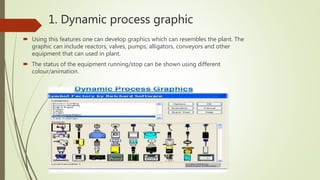
1. Dynamic process graphic
 Using this features one can develop graphics which can resembles the plant. The
graphic can include reactors, valves, pumps, alligators, conveyors and other
equipment that can used in plant.
 The status of the equipment running/stop can be shown using different
colour/animation.
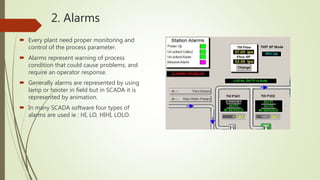
2. Alarms
 Every plant need proper monitoring and
control of the process parameter.
 Alarms represent warning of process
condition that could cause problems, and
require an operator response.
 Generally alarms are represented by using
lamp or hooter in field but in SCADA it is
represented by animation.
 In many SCADA software four types of
alarms are used ie : HI, LO, HIHI, LOLO.
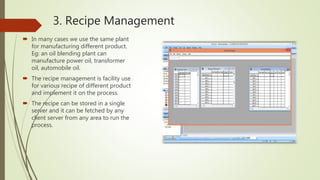
3. Recipe Management
 In many cases we use the same plant
for manufacturing different product.
Eg: an oil blending plant can
manufacture power oil, transformer
oil, automobile oil.
 The recipe management is facility use
for various recipe of different product
and implement it on the process.
 The recipe can be stored in a single
server and it can be fetched by any
client server from any area to run the
process.
4. Security
 Every SCADA software has various
level of security for securing the
application by avoiding unauthorized
access.
 Depending upon the access level
given the operator/engineer is
allowed to do the task. In most of the
case operator are allowed only to
operate the plant while maintenance
engineers can do the application
modification.
 The security can be given for
individual as well as for groups.
5. Device connectivity
 Every control hardware has its own communication protocol for communicating
with other hardware/software. Some of the leading protocol including Ethernet
DH485.
 The SCADA software need device driver software for communication with PLC or
other control hardware.
 More the driver software available better is the device connectivity. Most of the
SCADA software used in the industry have connectivity with most of the leading
control system.
6. Database connectivity
 In many plant it is important to download the real-time information in this case
database connectivity is must.
 Wonderware intouch provides a single integrated view of all your controls and
information resources. Intouch enables engineer, supervisor, operator to view and
interact with the working of entire operation through graphical representation of
their production processes.
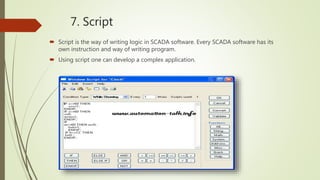
7. Script
 Script is the way of writing logic in SCADA software. Every SCADA software has its
own instruction and way of writing program.
 Using script one can develop a complex application.
THANKING YOU

Automation PLC & SCADA

  • 1.
    Submitted by: Nitishkumar singh EEE(4th year) Submitted to: KL PURSNANI SIR.
  • 2.
    content  History ofautomation  What is PLC?  history of PLC  Brand of PLC  Types of PLC  Architecture of PLC  Programming of PLC  Symbols of ladder logic  Introduction of micrologix1000  Introduction of SCADA system.
  • 3.
    HISTORY OF AUTOMATION 1)Manual control system. 2) Hydraulic & Pneumatic control system. 3) Hard-wire control system. 4) Electronics control system. 5) PLC controlling.
  • 4.
    What is plc? A PROGRAMMABLE LOGIC CONTROLLER (PLC) is an industrial computer control system that continuously monitors the state of input devices and makes decisions based upon a custom program to control the state of output devices.
  • 5.
    History of plc. PLC was introduced in late 1960’s.First commercial & successful Programmable Logic Controllers was designed and developed by Modicon as a relay replacer for General Motors. Richard Morley is called the father of PLC.  Earlier, it was a machine with thousands of electronic parts. Later ,in late 1970’s,the microprocessor became reality & greatly enhanced the role of PLC permitting it to evolve form simply relay to the sophisticated system as it is today. The first Programmable Logic Controllers were designed and developed by Modicon as a relay re-placer for GM and Landis.
  • 6.
    Brand of plc. 1)Allen Bradley(AB). 2) Siemens. 3) Delta. 4) Mitsubishi. 5) Panasonic. 6) Omron.
  • 7.
    Types of plc. 1)Compact type plc. 2) Compact + Modular type plc. 3) Rack type plc.
  • 8.
  • 9.
    Programming language  IEC1131-3 is the international standard for programmable controller programming languages. The following is a list of programming languages specified by this standard: 1) Ladder diagram 2) Sequential Function Charts (SFC) 3) Function Block Diagram (FBD) 4) Structured Text (ST) 5) Instruction List (IL)
  • 10.
  • 11.
  • 13.
    MICROLOGIX 1000  TheMicroLogix 1000 programmable controller is a packaged controller containing a power supply, input circuits, output circuits, and a processor. The controller is available in 10 I/O, 16 I/O and 32 I/O configurations, as well as an analog version with 20 discrete I/O and 5 analog I/O.
  • 14.
    Micrologic1000 consist offollowing things:  Input terminals-In input terminal we attach the power supply according to the requirement of plc either AC or DC.  Output terminal-It is used to attach the load like motor ,drive, led ,machinery etc.  Input & status led-these show the status of input given and the status of PLC like Power,run,fault,force.  Communication port-In this,RS232 port is used as communication port .PMO2 cable is used to communicate it with PC.DF1 protocol is used here.  DCcom-It is used to complete the circuit.
  • 15.
  • 16.
    Data files usedin PLC  Data files are used for storing different information types. These locations are numbered from 0 to 999. The letter in front of the number indicates the data type.
  • 17.
    Advantage of automation Repeatability  Tighter quality control  Waste reduction  Integration with business systems  Increased productivity and reduction of labour
  • 18.
    Disadvantage  High initialcosts  Increased dependence on maintenance.
  • 19.
    Application  Automotive assemblyand painting  Machining and metal processing  Plastics injection molding  Forest processing  Robotics  Material testing  Industrial process control  Motion simulation  Animation  Medical equipment.
  • 20.
     scada  SCADAis an acronym for ‘Supervisory Control and Data Acquisition’. SCADA systems are used to monitor and control a plant or equipment in industries such as telecommunications, water and waste control, energy, oil and gas refining and transportation.  SCADA system gathers information, transfer the information back to back to a central site, then alert the home station that has leak occurred, carrying out necessary analysis and control.
  • 21.
    Why scada?  Savestime and money  Less travelling for workers  Reduce man power need  Increases productivity of a company  Cost effective for power system  Saves energy  Reliable
  • 22.
    Features of scada Dynamic process graphic  Real time and historical trending  Alarms  Recipe management  Security  Device connectivity  Script for logic development  Database connectivity
  • 23.
    1. Dynamic processgraphic  Using this features one can develop graphics which can resembles the plant. The graphic can include reactors, valves, pumps, alligators, conveyors and other equipment that can used in plant.  The status of the equipment running/stop can be shown using different colour/animation.
  • 24.
    2. Alarms  Everyplant need proper monitoring and control of the process parameter.  Alarms represent warning of process condition that could cause problems, and require an operator response.  Generally alarms are represented by using lamp or hooter in field but in SCADA it is represented by animation.  In many SCADA software four types of alarms are used ie : HI, LO, HIHI, LOLO.
  • 25.
    3. Recipe Management In many cases we use the same plant for manufacturing different product. Eg: an oil blending plant can manufacture power oil, transformer oil, automobile oil.  The recipe management is facility use for various recipe of different product and implement it on the process.  The recipe can be stored in a single server and it can be fetched by any client server from any area to run the process.
  • 26.
    4. Security  EverySCADA software has various level of security for securing the application by avoiding unauthorized access.  Depending upon the access level given the operator/engineer is allowed to do the task. In most of the case operator are allowed only to operate the plant while maintenance engineers can do the application modification.  The security can be given for individual as well as for groups.
  • 27.
    5. Device connectivity Every control hardware has its own communication protocol for communicating with other hardware/software. Some of the leading protocol including Ethernet DH485.  The SCADA software need device driver software for communication with PLC or other control hardware.  More the driver software available better is the device connectivity. Most of the SCADA software used in the industry have connectivity with most of the leading control system.
  • 28.
    6. Database connectivity In many plant it is important to download the real-time information in this case database connectivity is must.  Wonderware intouch provides a single integrated view of all your controls and information resources. Intouch enables engineer, supervisor, operator to view and interact with the working of entire operation through graphical representation of their production processes.
  • 29.
    7. Script  Scriptis the way of writing logic in SCADA software. Every SCADA software has its own instruction and way of writing program.  Using script one can develop a complex application.
  • 30.