 AUTOMATION
 PLC
 SCADA
 HMI
 COMMUNICATION
 E-CAD
Making products under the control of computers and
programmable controllers is known as automation.
Manufacturing assembly lines as well as standalone
machine tools and robotic devices fall into this category.
Automation is the use of control system such as
computers to control industrial machinery & processes,
reducing for need for human intervention in the scope of
industrialization.
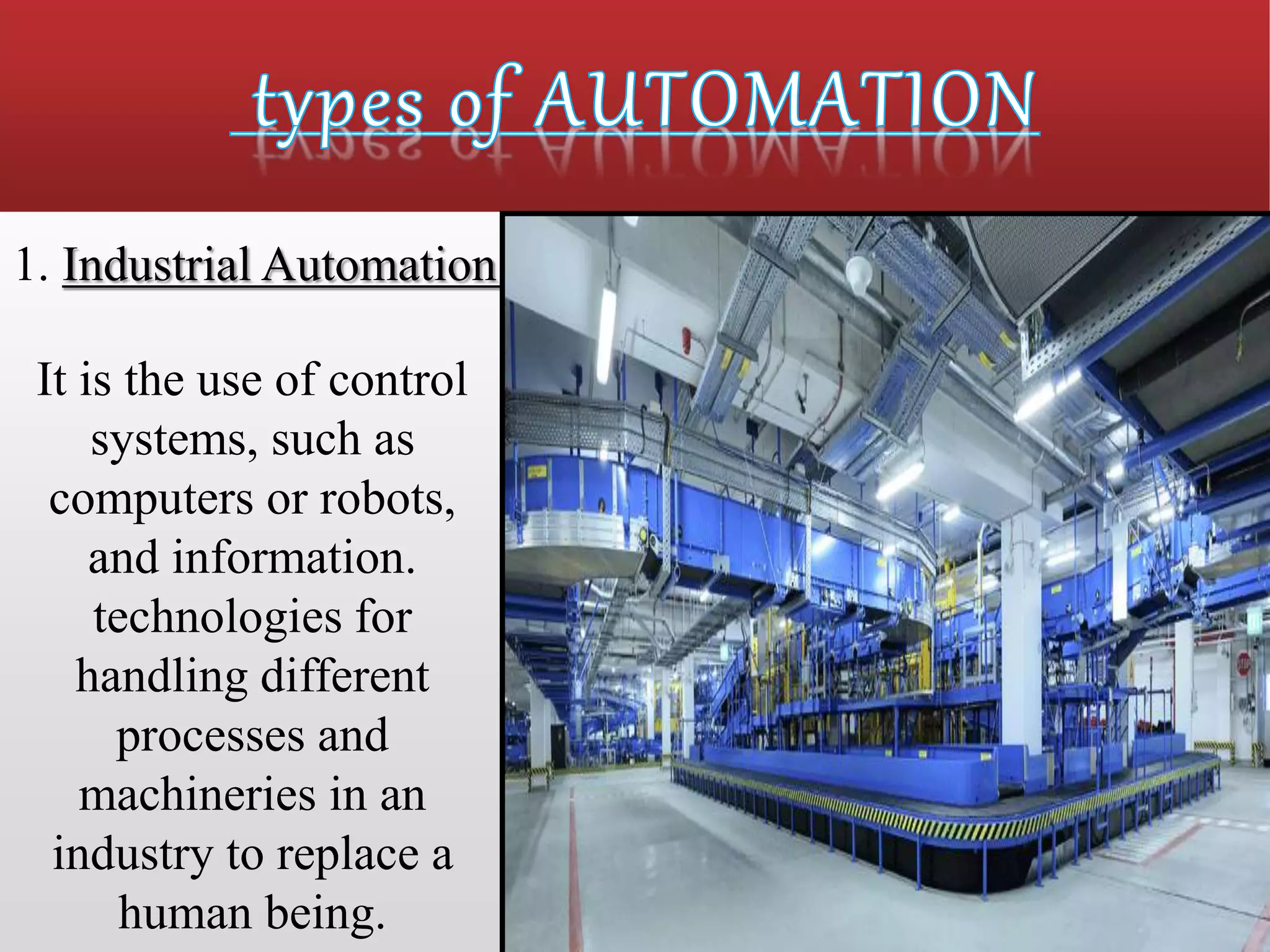
1. Industrial Automation:
It is the use of control
systems, such as
computers or robots,
and information.
technologies for
handling different
processes and
machineries in an
industry to replace a
human being.
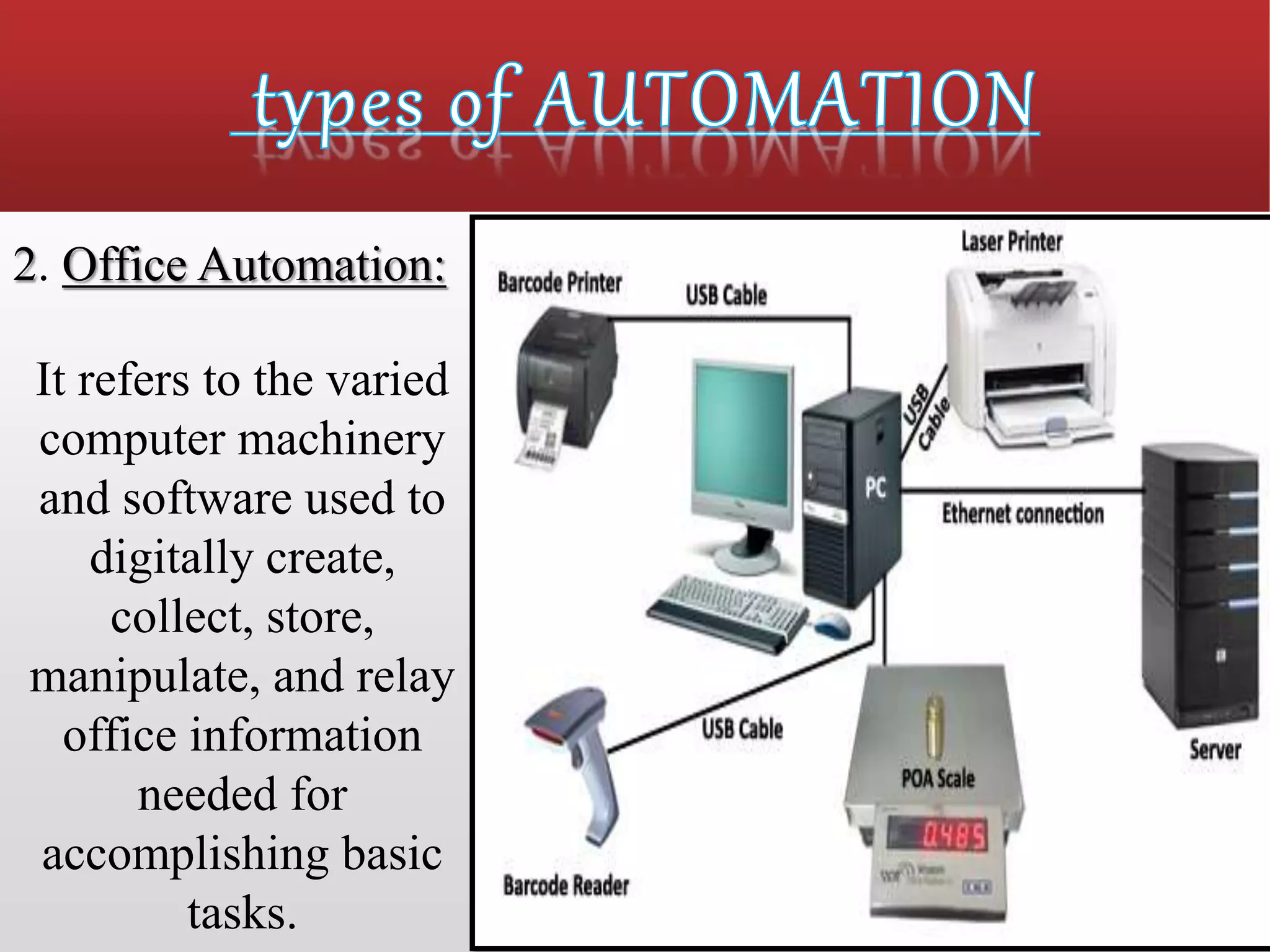
2. Office Automation:
It refers to the varied
computer machinery
and software used to
digitally create,
collect, store,
manipulate, and relay
office information
needed for
accomplishing basic
tasks.
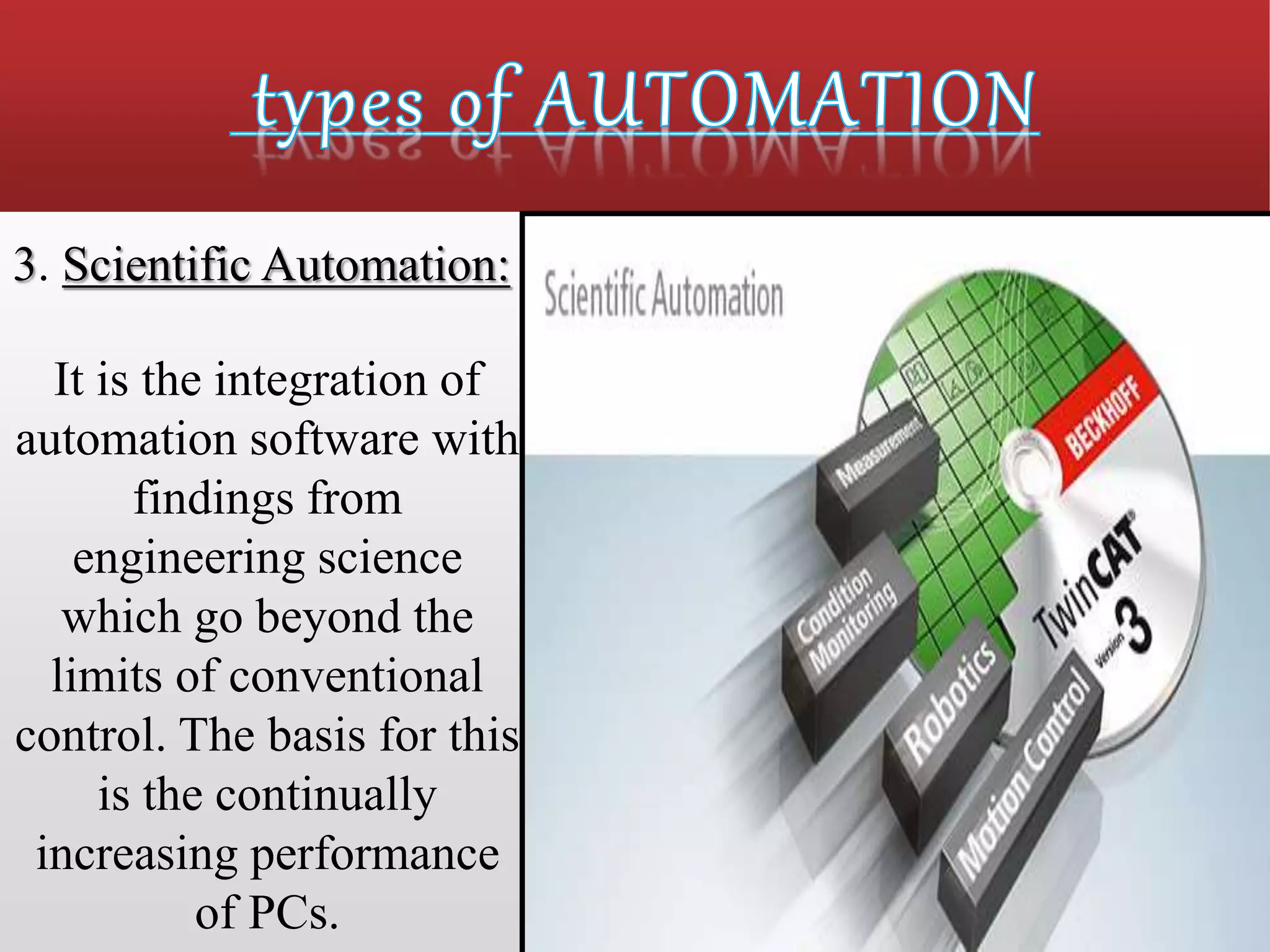
3. Scientific Automation:
It is the integration of
automation software with
findings from
engineering science
which go beyond the
limits of conventional
control. The basis for this
is the continually
increasing performance
of PCs.
4. Bio- Medical Automation:
It optimizes the functioning,
effectiveness, and
accuracy of a laboratory by
helping to respond to
the increased demands made
in terms of costs,
resource management and
report generation
times, Tanzania Bio-
Medicals Ltd.
5. Transportation Automation:
It is a small group of high
tech R&D engineers
dedicated to the promotion of
Synchrotron, a power and
control system for
automating driverless
vehicles for a variety
of transport systems
including Mass Transit,
Airport Baggage Handling.
 Productivity Increases.
 Improved Quality.
 Improved Consistency.
 Reduce direct human labor & expenses.
 Reduces operation time and work handling time
significantly.
 Provides higher level jobs in the development, deployment,
maintenance and running of the automated processes.
 Can perform tasks beyond human capabilities.
ADVANTAGES
 Replaces hard physical
or monotonous work.
 Tasks in hazardous
environments can be
done by machines
 Faster production and
cheaper labour costs
 Automation can be
maintained with simple
quality checks
DISADVANTAGES
 As of now, not all the
tasks can be automated
 Some tasks are more
expensive to automate
 Initial costs are high
 Failure to maintain a
system could result in
the loss of the product
DCS - Distributed Control
System
SCADA - Supervisory
Control and Data Acquisition
PLC - Programmable Logic
Controller
ANN - Artificial neural
network
 HMI - Human Machine
Interface
Instrumentation, Motion
control, Robotics
It is microprocessor based solid state/industrial
computer that perform discrete or sequential logic.
It was developed to replace mechanical relays,
timers, counters.
The early PLC’s were used to reduce the changeover
time, wiring/re-wiring.
The PLC programming procedures replaced the
rewiring a panel full of wires, relays, timers, counters.
The first PLCs offered relay functionality, thus
replacing the original hardwired relay logic, which
used electrically operated devices to mechanically
switch electrical circuits.
The 1st programmable controllers formed the
conceptual design of the PLC even though they were
more or less just relay replacer. Their primary
Function was to perform the sequential operations that
were implemented by relays.
Smaller physical size than hard-wired solutions.
Easier and faster to make changes.
PLCs have integrated diagnostics and override
functions.
Diagnostics are certainly available.
Application can be immediately documented.
Application can be duplicated faster and less
expensively.
Speed in operation.
Security
Online/ Offline modifications.
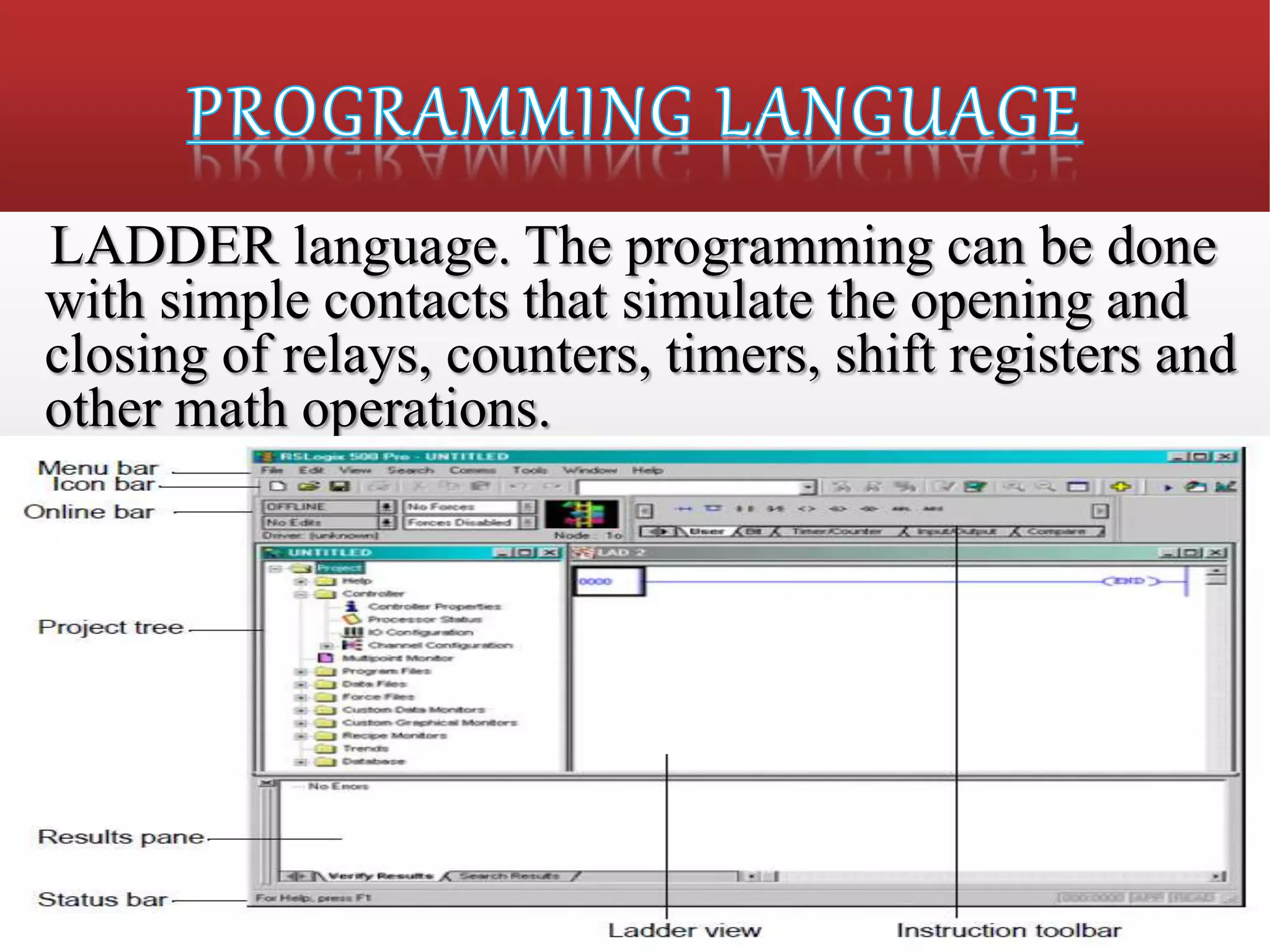
LADDER language. The programming can be done
with simple contacts that simulate the opening and
closing of relays, counters, timers, shift registers and
other math operations.
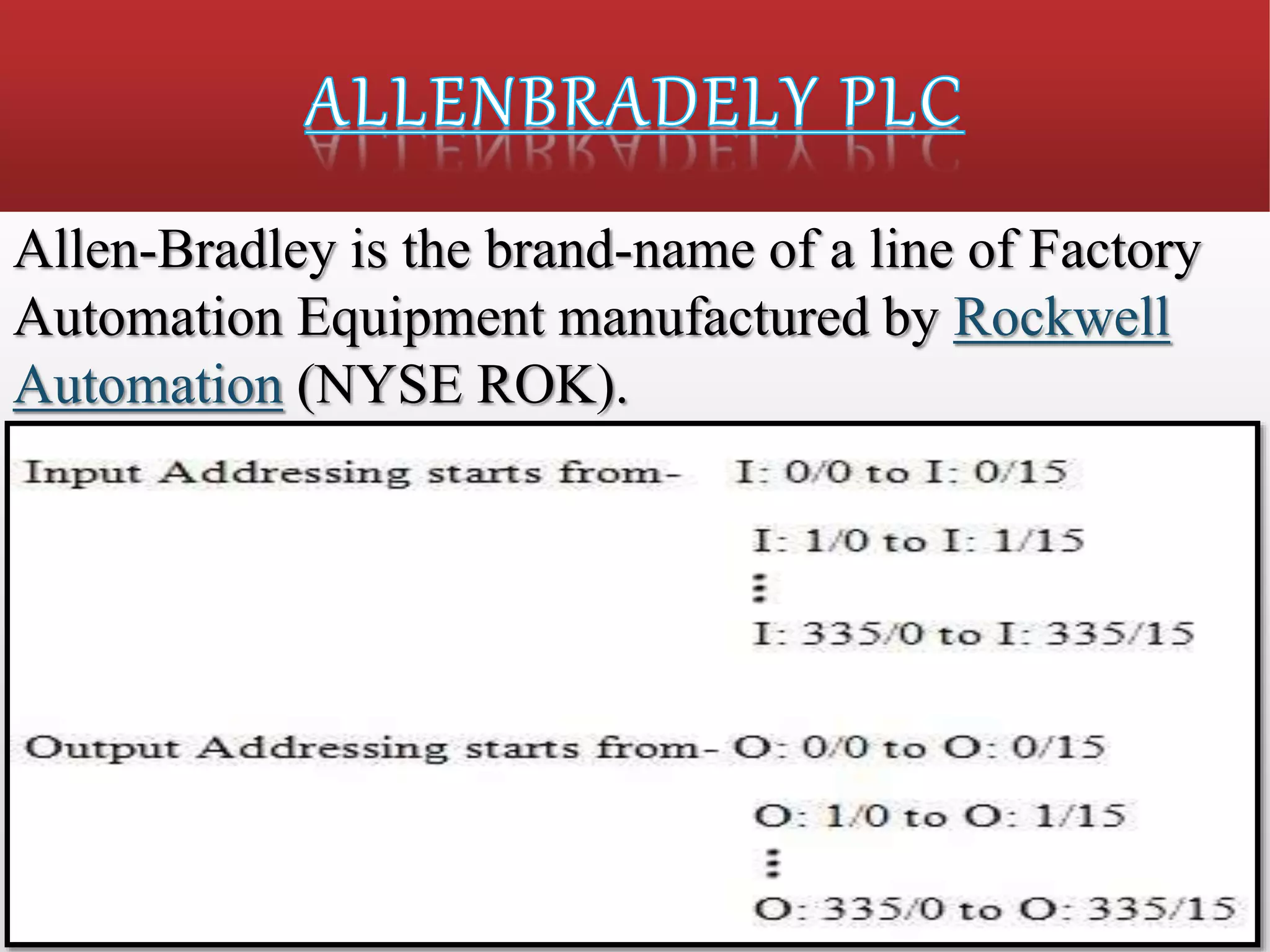
Allen-Bradley is the brand-name of a line of Factory
Automation Equipment manufactured by Rockwell
Automation (NYSE ROK).
I. Interlocking
II. Timer
Time On Delay (TON)
Time Off Delay (TOF)
Retentative Time On Delay (RTO)
III. Counter
CTU instructions (UP COUNTER)
CTD instructions (DOWN COUNTER)
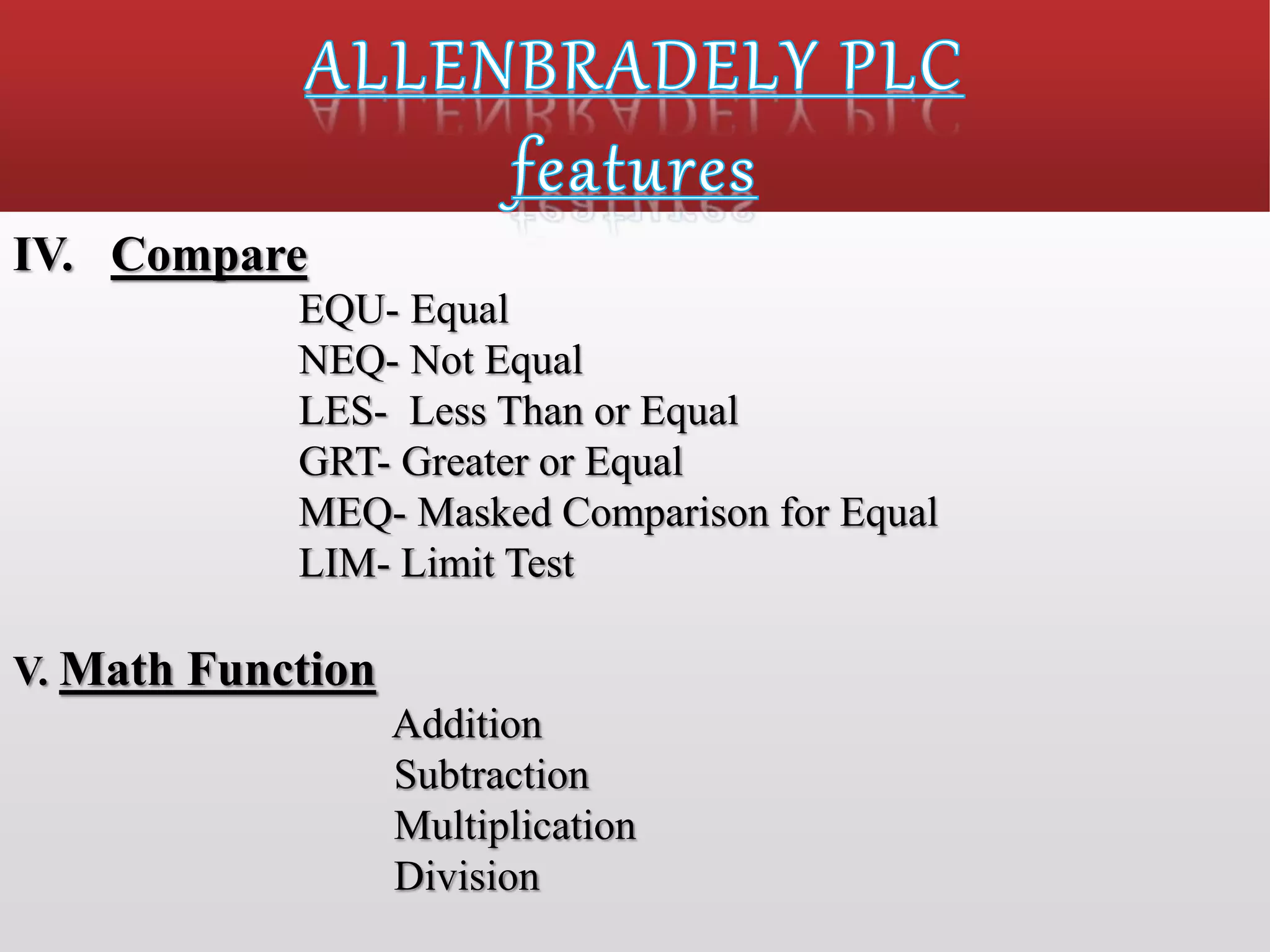
IV. Compare
EQU- Equal
NEQ- Not Equal
LES- Less Than or Equal
GRT- Greater or Equal
MEQ- Masked Comparison for Equal
LIM- Limit Test
V. Math Function
Addition
Subtraction
Multiplication
Division
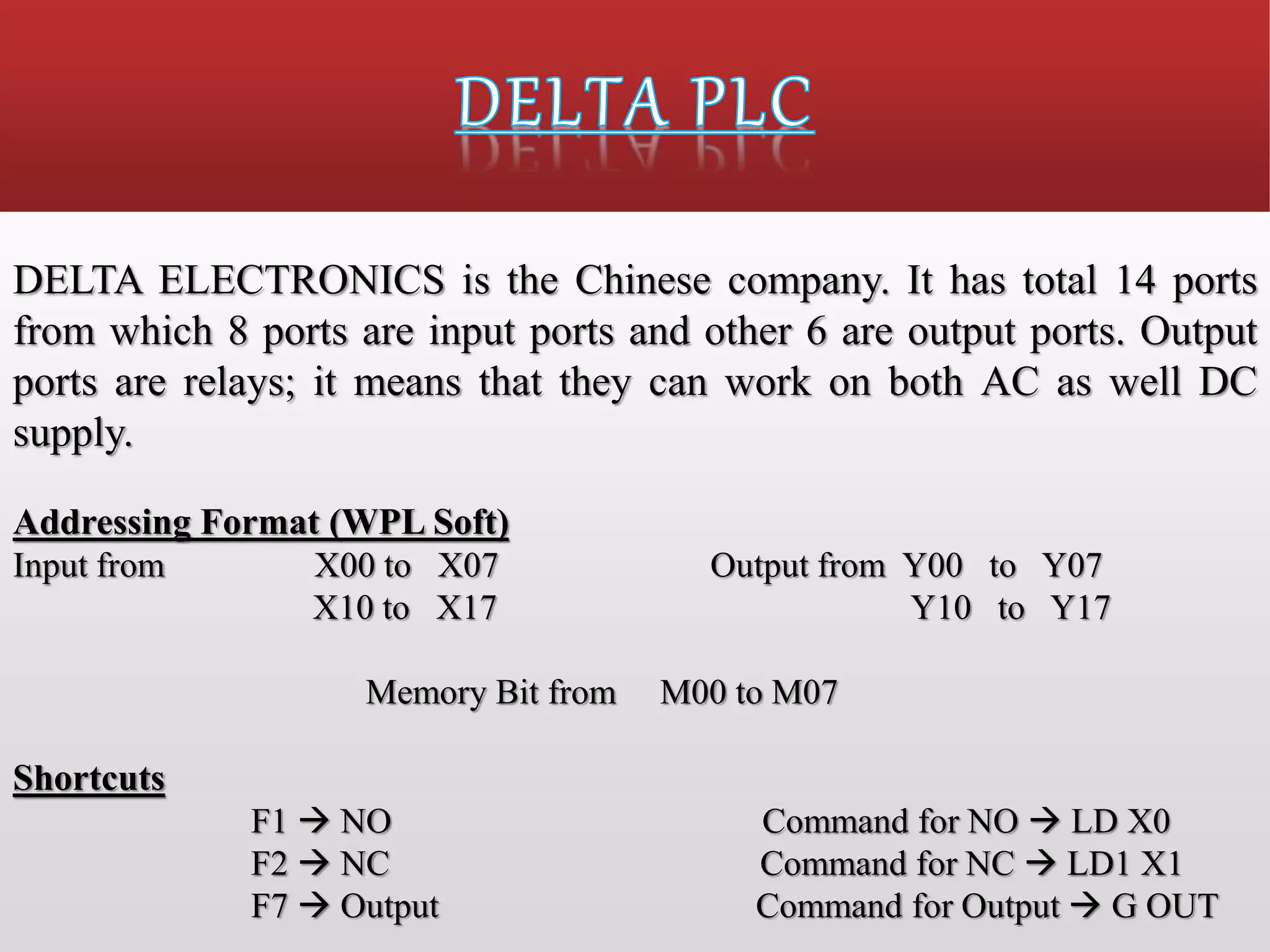
DELTA ELECTRONICS is the Chinese company. It has total 14 ports
from which 8 ports are input ports and other 6 are output ports. Output
ports are relays; it means that they can work on both AC as well DC
supply.
Addressing Format (WPL Soft)
Input from X00 to X07 Output from Y00 to Y07
X10 to X17 Y10 to Y17
Memory Bit from M00 to M07
Shortcuts
F1  NO Command for NO  LD X0
F2  NC Command for NC  LD1 X1
F7  Output Command for Output  G OUT
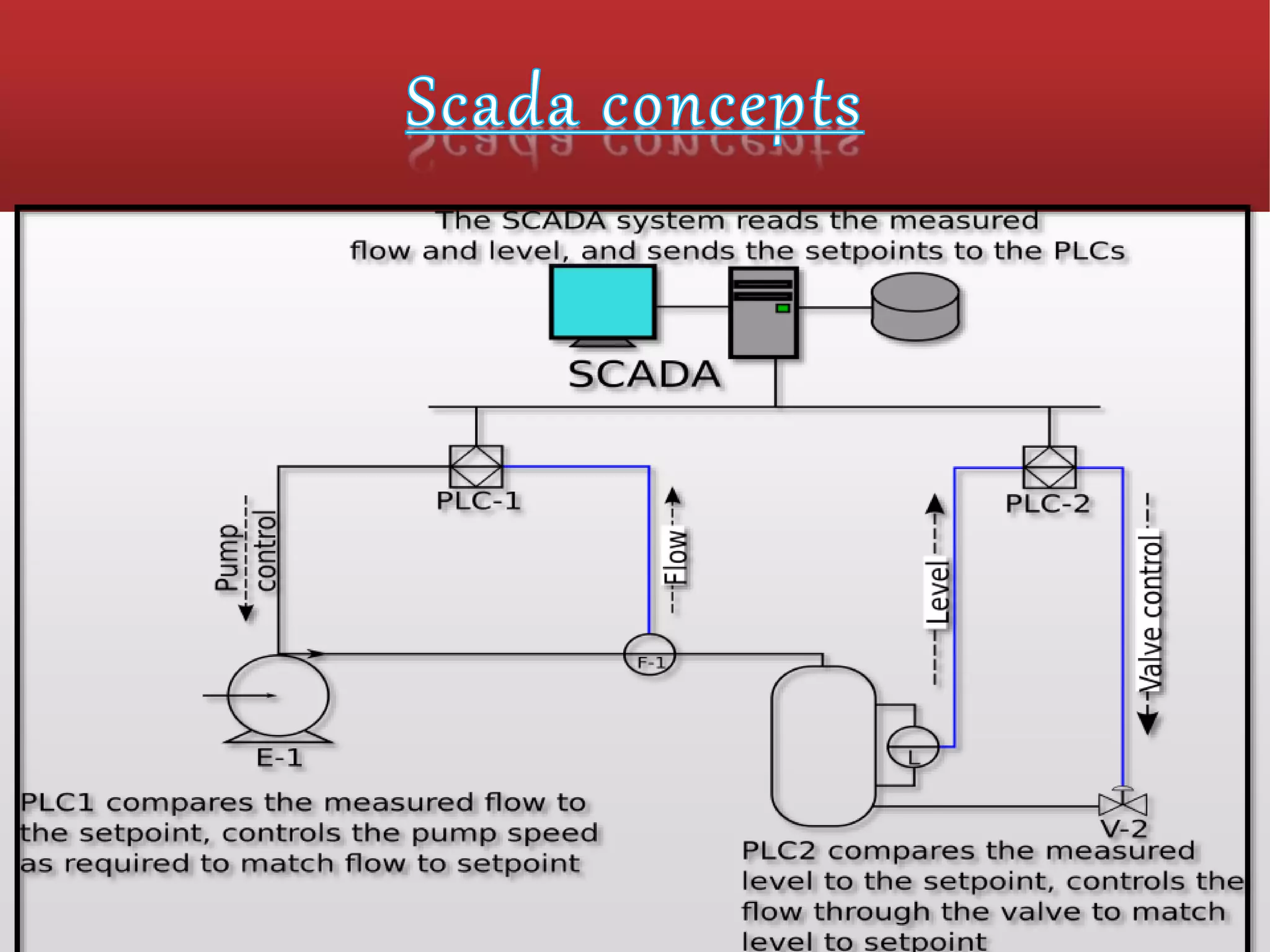
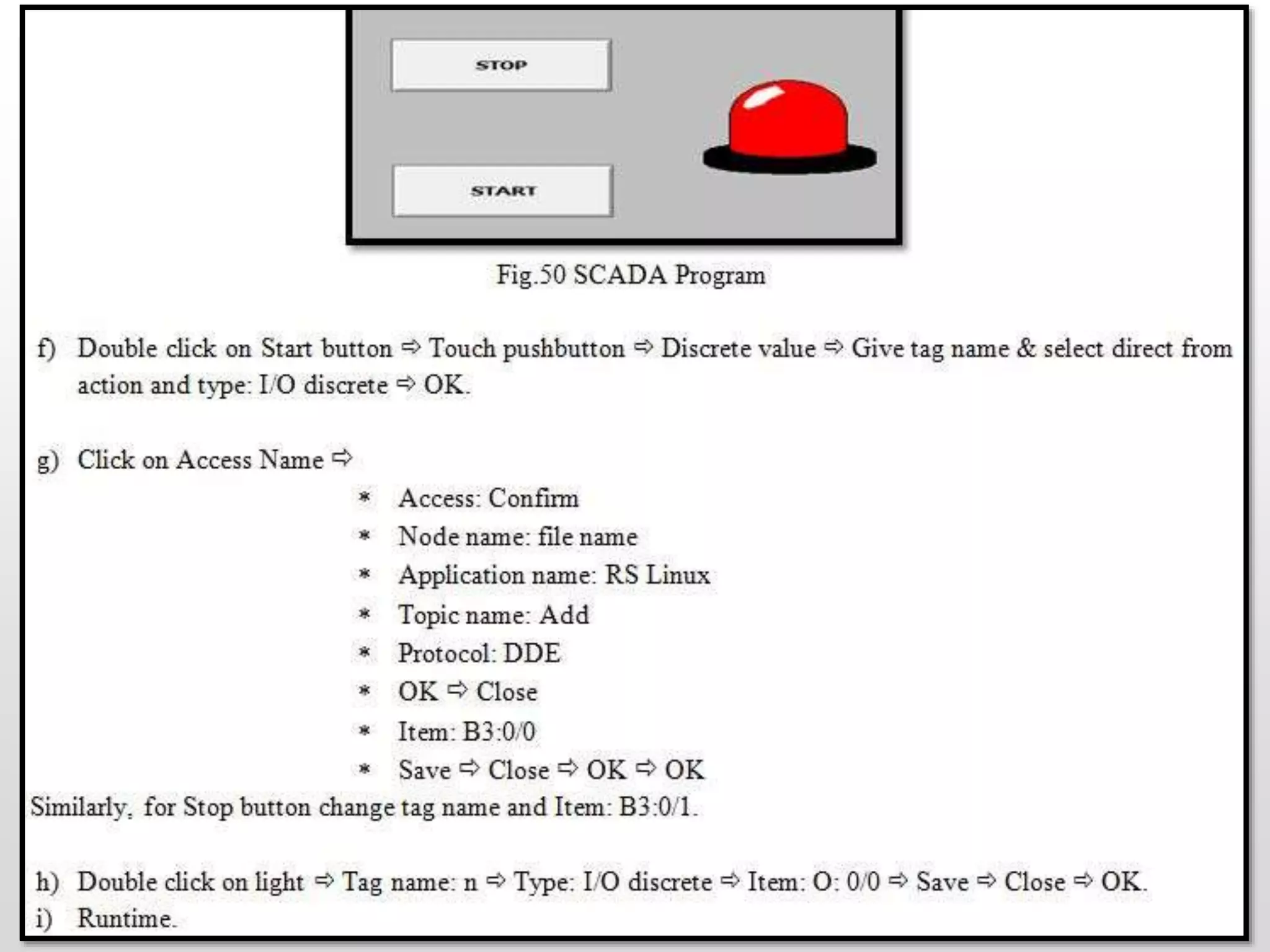
SCADA is real-time industrial
process control system used to
centrally monitor and control
remote or local industrial equipment
such as motor, valves, pumps,
relays, sensors etc.
It is logical name of a variable or object that be used in
our animation of a plant.
 Dynamic process graphics
Alarm summary
 trending
 security
 Recipe management
 scripts
Applications
Production Department
Quality Department
Maintenance Department
Manufacturing Department
Advantages
Increase Efficiency
Maximize Profitability
Maximize Safety
Reduce Manpower Requirement
A Human Machine Interface (HMI) is the
apparatus which present process data to
human operator, and through this, the
human operator monitors and controls
the process. It permits interaction between
a human being and a machine.
KEYPAD TOUCH SCREEN
KEYPAD + TOUCH SCREEN
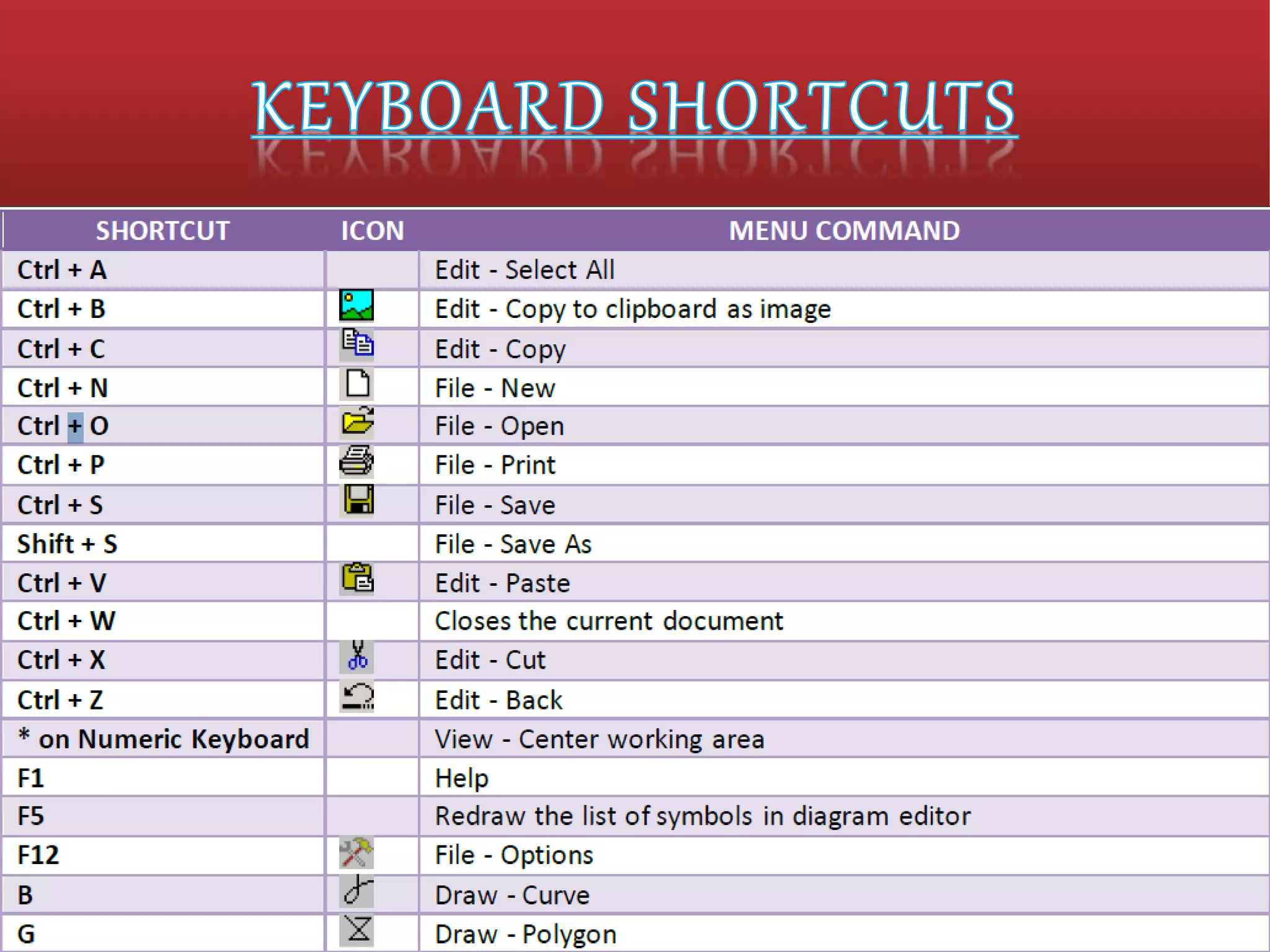
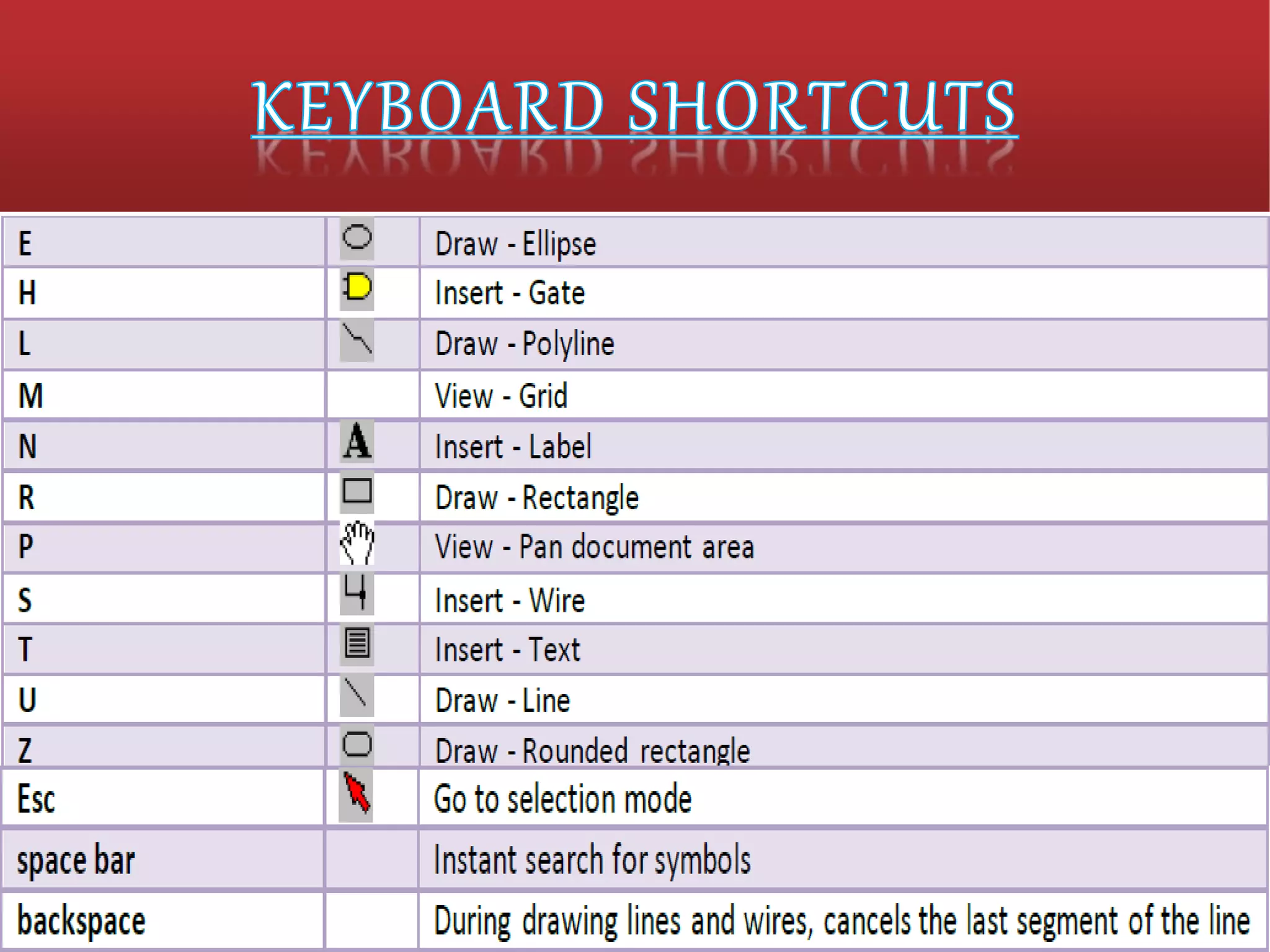
Electrical CAD software can automate all design tasks
and facilitate drafting productivity.
Electrical and electronic diagrams, schematics, control
circuit diagrams, and documentation.
It would be as easy as placing electrical symbols and
attaching the wires.
CAD software will have a library of all electrical
symbols, and they catch problems instantly.
This is to conclude that the project that I undertook was worked upon
with a sincere effort. Most of the requirements have been fulfilled up to
the mark and the requirements which have been remaining, can be
completed with a short extension.
The PLC & SCADA is the powerful tool that was ever designed by
man to solve problem that include controlling and processing data.
The PLC & SCADA approach of developing the system has helped in:
•Reducing human labor and cost.
•Improving product quality.
•Establishing automation in industries.
Industrial Automation (PLC, SCADA & HMI) by Nilesh Jha

Industrial Automation (PLC, SCADA & HMI) by Nilesh Jha

  • 2.
     AUTOMATION  PLC SCADA  HMI  COMMUNICATION  E-CAD
  • 4.
    Making products underthe control of computers and programmable controllers is known as automation. Manufacturing assembly lines as well as standalone machine tools and robotic devices fall into this category. Automation is the use of control system such as computers to control industrial machinery & processes, reducing for need for human intervention in the scope of industrialization.
  • 5.
    1. Industrial Automation: Itis the use of control systems, such as computers or robots, and information. technologies for handling different processes and machineries in an industry to replace a human being.
  • 6.
    2. Office Automation: Itrefers to the varied computer machinery and software used to digitally create, collect, store, manipulate, and relay office information needed for accomplishing basic tasks.
  • 7.
    3. Scientific Automation: Itis the integration of automation software with findings from engineering science which go beyond the limits of conventional control. The basis for this is the continually increasing performance of PCs.
  • 8.
    4. Bio- MedicalAutomation: It optimizes the functioning, effectiveness, and accuracy of a laboratory by helping to respond to the increased demands made in terms of costs, resource management and report generation times, Tanzania Bio- Medicals Ltd.
  • 9.
    5. Transportation Automation: Itis a small group of high tech R&D engineers dedicated to the promotion of Synchrotron, a power and control system for automating driverless vehicles for a variety of transport systems including Mass Transit, Airport Baggage Handling.
  • 10.
     Productivity Increases. Improved Quality.  Improved Consistency.  Reduce direct human labor & expenses.  Reduces operation time and work handling time significantly.  Provides higher level jobs in the development, deployment, maintenance and running of the automated processes.  Can perform tasks beyond human capabilities.
  • 11.
    ADVANTAGES  Replaces hardphysical or monotonous work.  Tasks in hazardous environments can be done by machines  Faster production and cheaper labour costs  Automation can be maintained with simple quality checks DISADVANTAGES  As of now, not all the tasks can be automated  Some tasks are more expensive to automate  Initial costs are high  Failure to maintain a system could result in the loss of the product
  • 12.
    DCS - DistributedControl System SCADA - Supervisory Control and Data Acquisition PLC - Programmable Logic Controller ANN - Artificial neural network  HMI - Human Machine Interface Instrumentation, Motion control, Robotics
  • 14.
    It is microprocessorbased solid state/industrial computer that perform discrete or sequential logic. It was developed to replace mechanical relays, timers, counters. The early PLC’s were used to reduce the changeover time, wiring/re-wiring. The PLC programming procedures replaced the rewiring a panel full of wires, relays, timers, counters.
  • 15.
    The first PLCsoffered relay functionality, thus replacing the original hardwired relay logic, which used electrically operated devices to mechanically switch electrical circuits. The 1st programmable controllers formed the conceptual design of the PLC even though they were more or less just relay replacer. Their primary Function was to perform the sequential operations that were implemented by relays.
  • 16.
    Smaller physical sizethan hard-wired solutions. Easier and faster to make changes. PLCs have integrated diagnostics and override functions. Diagnostics are certainly available. Application can be immediately documented. Application can be duplicated faster and less expensively. Speed in operation. Security Online/ Offline modifications.
  • 19.
    LADDER language. Theprogramming can be done with simple contacts that simulate the opening and closing of relays, counters, timers, shift registers and other math operations.
  • 21.
    Allen-Bradley is thebrand-name of a line of Factory Automation Equipment manufactured by Rockwell Automation (NYSE ROK).
  • 22.
    I. Interlocking II. Timer TimeOn Delay (TON) Time Off Delay (TOF) Retentative Time On Delay (RTO) III. Counter CTU instructions (UP COUNTER) CTD instructions (DOWN COUNTER)
  • 23.
    IV. Compare EQU- Equal NEQ-Not Equal LES- Less Than or Equal GRT- Greater or Equal MEQ- Masked Comparison for Equal LIM- Limit Test V. Math Function Addition Subtraction Multiplication Division
  • 24.
    DELTA ELECTRONICS isthe Chinese company. It has total 14 ports from which 8 ports are input ports and other 6 are output ports. Output ports are relays; it means that they can work on both AC as well DC supply. Addressing Format (WPL Soft) Input from X00 to X07 Output from Y00 to Y07 X10 to X17 Y10 to Y17 Memory Bit from M00 to M07 Shortcuts F1  NO Command for NO  LD X0 F2  NC Command for NC  LD1 X1 F7  Output Command for Output  G OUT
  • 26.
    SCADA is real-timeindustrial process control system used to centrally monitor and control remote or local industrial equipment such as motor, valves, pumps, relays, sensors etc.
  • 28.
    It is logicalname of a variable or object that be used in our animation of a plant.
  • 29.
     Dynamic processgraphics Alarm summary  trending  security  Recipe management  scripts
  • 30.
    Applications Production Department Quality Department MaintenanceDepartment Manufacturing Department Advantages Increase Efficiency Maximize Profitability Maximize Safety Reduce Manpower Requirement
  • 33.
    A Human MachineInterface (HMI) is the apparatus which present process data to human operator, and through this, the human operator monitors and controls the process. It permits interaction between a human being and a machine.
  • 36.
  • 42.
    Electrical CAD softwarecan automate all design tasks and facilitate drafting productivity. Electrical and electronic diagrams, schematics, control circuit diagrams, and documentation. It would be as easy as placing electrical symbols and attaching the wires. CAD software will have a library of all electrical symbols, and they catch problems instantly.
  • 45.
    This is toconclude that the project that I undertook was worked upon with a sincere effort. Most of the requirements have been fulfilled up to the mark and the requirements which have been remaining, can be completed with a short extension. The PLC & SCADA is the powerful tool that was ever designed by man to solve problem that include controlling and processing data. The PLC & SCADA approach of developing the system has helped in: •Reducing human labor and cost. •Improving product quality. •Establishing automation in industries.