Page 1
Plant Layout
Page 2
Definition
• Plant layout refers to the arrangement of physical facilities such as
machines, equipment, tools, furniture etc. in such a manner so as to have
quickest flow of material at the lowest cost and with the least amount of
handling in processing the product from the receipt of raw material to the
delivery of the final product.
• The subject of plant layout not only covers the initial layout of machines
and other facilities encompasses improvement in, or revisions of, existing
layout in the light of subsequent developments in the methods of
production.
Page 3
Objectives of a good Layout
 Provide enough production capacity.
 Reduces handling costs.
 Reduces congestion.
 Reduces hazards to personnel.
 Utilizes labour efficiently.
 Increase employee morale.
 Reduce accidents.
 Utilizes available space efficiently and
effectively.
 Provide for volume and product
facility.
 Provide ease for supervision.
 Facilitate co-ordination
communication.
 Provide safety and health.
 Allow ease of maintenance.
 Allow high machine/equipment
utilization.
 Improve productivity.
Page 4
FACTORS INFLUENCING FACILITY
LAYOUT
• MATERIALS (Type of raw materials and availability)
• PRODUCT (Type of product and its position)
• WORKER (Type , position and requirements)
• MACHINERY(Product, volume and process)
• INDUSTRY (Type of industry: Synthetic, Analytical, Conditioning and
Extractive)
• LOCATION (Factor of production)
• MANAGERIAL POLICIES ( volume, provision for expansion,
automation, making or buying decisions, desire for rapid delivery, purchasing
policy and personnel policies)
Page 5
Principles of Layout
 Principle of minimum travel
 Principle of sequences
 Principle of usage
 Principle of compactness
 Principle of safety and satisfaction
 Principle of flexibility
 Principle of minimum investment.
Page 6
Types of layout
 Process layout or functional or job shop layout.
 Product layout or line processing layout.
 Fixed position layout or static layout.
 Cellular manufacturing layout or Group Technology
layout .
 Combination layout or Hybrid layout.
Page 7
PROCESS LAYOUT
• The process layout involves a grouping together
of like machines in one department.
• For example : machines performing drilling
operations are fixed in the drilling department
– In this way there would be a heating department ,
painting department, casting department.
Page 8
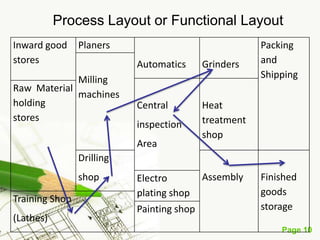
Process Layout or Functional Layout
Inward good
stores
Planers
Automatics Grinders
Packing
and
ShippingMilling
machines
Central
inspection
Area
Heat
treatment
shop
Raw Material
holding
stores
Drilling
shop Assembly Finished
goods
storage
Electro
plating shop
Training Shop
(Lathes)
Painting shop
Page 9
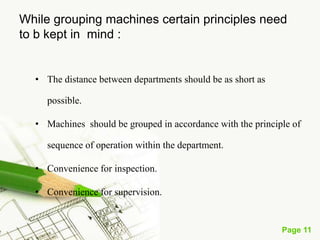
While grouping machines certain principles need
to b kept in mind :
• The distance between departments should be as short as
possible.
• Machines should be grouped in accordance with the principle of
sequence of operation within the department.
• Convenience for inspection.
• Convenience for supervision.
Page 10
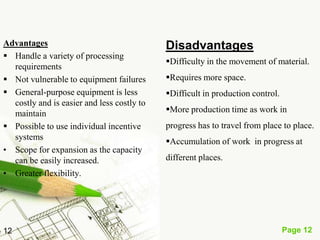
Advantages
 Handle a variety of processing
requirements
 Not vulnerable to equipment failures
 General-purpose equipment is less
costly and is easier and less costly to
maintain
 Possible to use individual incentive
systems
• Scope for expansion as the capacity
can be easily increased.
• Greater flexibility.
10
Disadvantages
Difficulty in the movement of material.
Requires more space.
Difficult in production control.
More production time as work in
progress has to travel from place to place.
Accumulation of work in progress at
different places.
Page 11
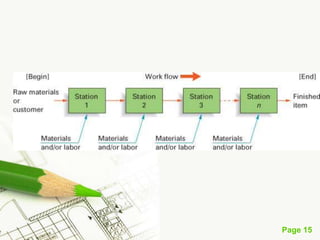
• The product layout involves the arrangement of machines in one
line, depending upon the sequence of operations. Material are fed
into the first machine and finished products come out of the last
machine.
• In between , partly finished goods travel automatically , from
machine to machine, the output of one machine becoming the input
for the next.
• It is a feast for the eyes to watch the way sugarcane , fed at one end
of the mill , comes out as sugar the other end.
Product Layout (Straight Line)
Page 12
Page 13
Page 14
Page 15
Product Layout (Straight Line)
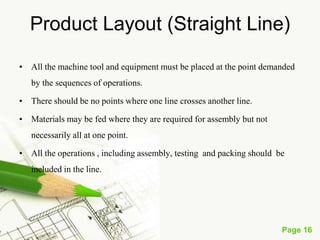
• All the machine tool and equipment must be placed at the point demanded
by the sequences of operations.
• There should be no points where one line crosses another line.
• Materials may be fed where they are required for assembly but not
necessarily all at one point.
• All the operations , including assembly, testing and packing should be
included in the line.
Page 16
Advantages
• Reduction in material handling cost
due to mechanization.
• Avoid production bottleneck.
• Economy in manufacturing time.
• Better production control.
• Require less floor area per unit of
production.
• Work-in-progress is reduced and so on
investment.
• Early detection of mistakes.
• Greater incentive to a group of
workers to raise their level of
performance.
16
Disadvantages
Product layout is known for its
inflexibility.
This is an expensive layout
Difficulty in supervision.
Expansion is also difficult.
Breakdown can disrupt the whole
system.
Page 17
Page 18
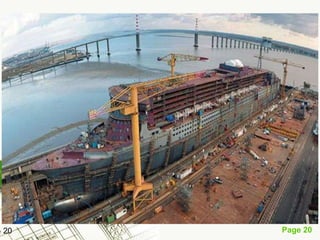
• The fixed position layout involves the movement of men and
machines to the product which remains stationary. In this type
of layout , the material or major components remains in a fixed
location and tools , machinery and men as well as other pieces
of material are brought to this location.
• The movement of men and material to the product is advisable
because the cost of moving them would be less than the cost of
moving the product which is very bulky.
Fixed position layout
Page 1919
Page 20
Fixed Position Layout
(Advantages)
• Men and machine can be used for a wide variety of operations
producing different products.
• The investment on layout is very small.
• The worker identifies himself with the product and takes pride
in it when the work is complete.
• The high cost of, and difficulty in transporting a bulky product
are avoided.
Page 21
Disadvantages
 As the production period being very long so the capital
investment is very high.
 Very large space is required for storage of material and
equipment near the product.
 As several operations are often carried out simultaneously so
there is possibility of confusion and conflicts among different
workgroups.
Page 22
Combined layout or Group technology layout or
Hybrid layout)
• A combination of process and product layouts combines the
advantages of both types of layouts product and process
layout. A combination layout is possible where an item is
being made in different types and sizes.
• Here machinery is arranged in a process layout but the process
grouping is then arranged in a sequence to manufacture
various types and sizes of products. It is to be noted that the
sequence of operations remains same with the variety of
products and sizes.
Page 23
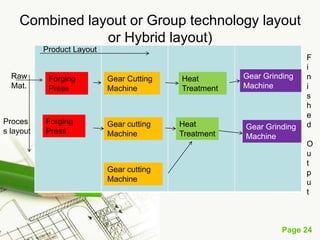
Combined layout or Group technology layout
or Hybrid layout)
Forging
Press
Forging
Press
Gear Cutting
Machine
Gear cutting
Machine
Gear cutting
Machine
Heat
Treatment
Heat
Treatment
Gear Grinding
Machine
Gear Grinding
Machine
F
i
n
i
s
h
e
d
O
u
t
p
u
t
Raw
Mat.
Proces
s layout
Product Layout
Page 24
Group Layout (or Cellular Layout)
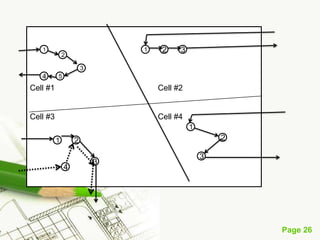
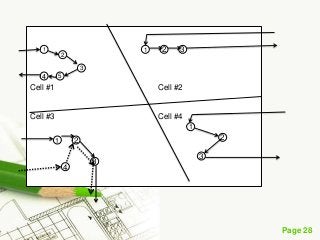
• In cellular manufacturing (CM),machines are grouped
into cells and the cells function somewhat like a product
layout within a larger shop or process layout.
• Each cell in the CM layout is formed to produce a single
parts family-a few parts, all with common characteristics
, which usually means that they require the same
machines and have similar machine settings
Page 25
Page 26
Page 27
Page 28
Cell #1 Cell #2
Cell #3 Cell #4
1
3
3
54
1 2 3
1 2
3
4
1
2
2
Page 29
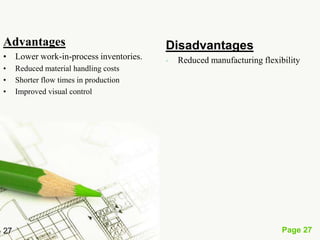
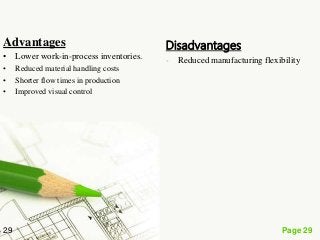
Advantages
• Lower work-in-process inventories.
• Reduced material handling costs
• Shorter flow times in production
• Improved visual control
29
Disadvantages
 Reduced manufacturing flexibility

Plant layout

  • 1.
  • 2.
    Page 2 Definition • Plantlayout refers to the arrangement of physical facilities such as machines, equipment, tools, furniture etc. in such a manner so as to have quickest flow of material at the lowest cost and with the least amount of handling in processing the product from the receipt of raw material to the delivery of the final product. • The subject of plant layout not only covers the initial layout of machines and other facilities encompasses improvement in, or revisions of, existing layout in the light of subsequent developments in the methods of production.
  • 3.
    Page 3 Objectives ofa good Layout  Provide enough production capacity.  Reduces handling costs.  Reduces congestion.  Reduces hazards to personnel.  Utilizes labour efficiently.  Increase employee morale.  Reduce accidents.  Utilizes available space efficiently and effectively.  Provide for volume and product facility.  Provide ease for supervision.  Facilitate co-ordination communication.  Provide safety and health.  Allow ease of maintenance.  Allow high machine/equipment utilization.  Improve productivity.
  • 4.
    Page 4 FACTORS INFLUENCINGFACILITY LAYOUT • MATERIALS (Type of raw materials and availability) • PRODUCT (Type of product and its position) • WORKER (Type , position and requirements) • MACHINERY(Product, volume and process) • INDUSTRY (Type of industry: Synthetic, Analytical, Conditioning and Extractive) • LOCATION (Factor of production) • MANAGERIAL POLICIES ( volume, provision for expansion, automation, making or buying decisions, desire for rapid delivery, purchasing policy and personnel policies)
  • 5.
    Page 5 Principles ofLayout  Principle of minimum travel  Principle of sequences  Principle of usage  Principle of compactness  Principle of safety and satisfaction  Principle of flexibility  Principle of minimum investment.
  • 6.
    Page 6 Types oflayout  Process layout or functional or job shop layout.  Product layout or line processing layout.  Fixed position layout or static layout.  Cellular manufacturing layout or Group Technology layout .  Combination layout or Hybrid layout.
  • 7.
    Page 7 PROCESS LAYOUT •The process layout involves a grouping together of like machines in one department. • For example : machines performing drilling operations are fixed in the drilling department – In this way there would be a heating department , painting department, casting department.
  • 8.
    Page 8 Process Layoutor Functional Layout Inward good stores Planers Automatics Grinders Packing and ShippingMilling machines Central inspection Area Heat treatment shop Raw Material holding stores Drilling shop Assembly Finished goods storage Electro plating shop Training Shop (Lathes) Painting shop
  • 9.
    Page 9 While groupingmachines certain principles need to b kept in mind : • The distance between departments should be as short as possible. • Machines should be grouped in accordance with the principle of sequence of operation within the department. • Convenience for inspection. • Convenience for supervision.
  • 10.
    Page 10 Advantages  Handlea variety of processing requirements  Not vulnerable to equipment failures  General-purpose equipment is less costly and is easier and less costly to maintain  Possible to use individual incentive systems • Scope for expansion as the capacity can be easily increased. • Greater flexibility. 10 Disadvantages Difficulty in the movement of material. Requires more space. Difficult in production control. More production time as work in progress has to travel from place to place. Accumulation of work in progress at different places.
  • 11.
    Page 11 • Theproduct layout involves the arrangement of machines in one line, depending upon the sequence of operations. Material are fed into the first machine and finished products come out of the last machine. • In between , partly finished goods travel automatically , from machine to machine, the output of one machine becoming the input for the next. • It is a feast for the eyes to watch the way sugarcane , fed at one end of the mill , comes out as sugar the other end. Product Layout (Straight Line)
  • 12.
  • 13.
  • 14.
  • 15.
    Page 15 Product Layout(Straight Line) • All the machine tool and equipment must be placed at the point demanded by the sequences of operations. • There should be no points where one line crosses another line. • Materials may be fed where they are required for assembly but not necessarily all at one point. • All the operations , including assembly, testing and packing should be included in the line.
  • 16.
    Page 16 Advantages • Reductionin material handling cost due to mechanization. • Avoid production bottleneck. • Economy in manufacturing time. • Better production control. • Require less floor area per unit of production. • Work-in-progress is reduced and so on investment. • Early detection of mistakes. • Greater incentive to a group of workers to raise their level of performance. 16 Disadvantages Product layout is known for its inflexibility. This is an expensive layout Difficulty in supervision. Expansion is also difficult. Breakdown can disrupt the whole system.
  • 17.
  • 18.
    Page 18 • Thefixed position layout involves the movement of men and machines to the product which remains stationary. In this type of layout , the material or major components remains in a fixed location and tools , machinery and men as well as other pieces of material are brought to this location. • The movement of men and material to the product is advisable because the cost of moving them would be less than the cost of moving the product which is very bulky. Fixed position layout
  • 19.
  • 20.
    Page 20 Fixed PositionLayout (Advantages) • Men and machine can be used for a wide variety of operations producing different products. • The investment on layout is very small. • The worker identifies himself with the product and takes pride in it when the work is complete. • The high cost of, and difficulty in transporting a bulky product are avoided.
  • 21.
    Page 21 Disadvantages  Asthe production period being very long so the capital investment is very high.  Very large space is required for storage of material and equipment near the product.  As several operations are often carried out simultaneously so there is possibility of confusion and conflicts among different workgroups.
  • 22.
    Page 22 Combined layoutor Group technology layout or Hybrid layout) • A combination of process and product layouts combines the advantages of both types of layouts product and process layout. A combination layout is possible where an item is being made in different types and sizes. • Here machinery is arranged in a process layout but the process grouping is then arranged in a sequence to manufacture various types and sizes of products. It is to be noted that the sequence of operations remains same with the variety of products and sizes.
  • 23.
    Page 23 Combined layoutor Group technology layout or Hybrid layout) Forging Press Forging Press Gear Cutting Machine Gear cutting Machine Gear cutting Machine Heat Treatment Heat Treatment Gear Grinding Machine Gear Grinding Machine F i n i s h e d O u t p u t Raw Mat. Proces s layout Product Layout
  • 24.
    Page 24 Group Layout(or Cellular Layout) • In cellular manufacturing (CM),machines are grouped into cells and the cells function somewhat like a product layout within a larger shop or process layout. • Each cell in the CM layout is formed to produce a single parts family-a few parts, all with common characteristics , which usually means that they require the same machines and have similar machine settings
  • 25.
  • 26.
  • 27.
  • 28.
    Page 28 Cell #1Cell #2 Cell #3 Cell #4 1 3 3 54 1 2 3 1 2 3 4 1 2 2
  • 29.
    Page 29 Advantages • Lowerwork-in-process inventories. • Reduced material handling costs • Shorter flow times in production • Improved visual control 29 Disadvantages  Reduced manufacturing flexibility