
Free Powerpoint Templates
Information is Critical
“The information we have
                      is not what we want,”

“The information we want
              is not the information we need,”

“The information we need
                                   is not available.”
                 Free Powerpoint Templates
                                                   Page 2
Information is a Resource
 It is scarce

It has a cost

It has alternative uses

There is an opportunity cost factor involved
 if one does not process information.
                 Free Powerpoint Templates
                                             Page 3
What is MIS?

Right Information
To the right person
At the right place
At the right time
In the right form
 At the right cost
                            Page 4
Management
    Information Systems
DEFINITIO (MIS)
N:-

Management Information Systems (MIS) is a system designed to
supply information required for effective management of an
organization.

A formal structure, generally computerized, for collecting and
analyzing information relevant to an organization's operations.
Management Information System
The three sub-components

          Management, Information and System
        -together   bring out the focus clearly & effectively.

   System emphasizing a fair degree of integration and
                    a holistic view;

   Information stressing on processed data in the context
              in which it is used by end users;

     Management focusing on the ultimate use of such
    information systems for managerial decision making.
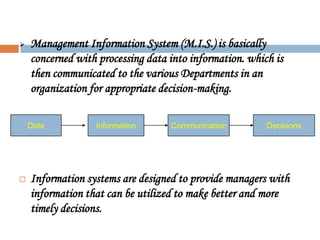
   Management Information System (M.I.S.) is basically
    concerned with processing data into information. which is
    then communicated to the various Departments in an
    organization for appropriate decision-making.

    Data          Information      Communication         Decisions


   Information systems are designed to provide managers with
    information that can be utilized to make better and more
    timely decisions.
The objects of MIS

   To make the desired information available in the right form to
    the right person and at the right time.

   To supply the required information at a reasonable cost.

   To use the most efficient methods of processing data.

   To provide necessary security & the secrecy for important
    and/or confidential information.

   To keep the information up-to-date.
Advantages of MIS
   the means of effective and efficient coordination between
    Departments
   quick and reliable referencing
   access to relevant data and documents
   use of less labor
   improvement in organizational and departmental
    techniques
   management of day-to-day activities (as accounts, stock
    control, payroll etc.);
   day-to-day assistance in a Department and closer contact
    with the rest of the organization.
Features of MIS
10


     On Time
     As required yet dynamic
     Crisp yet detailed
     Accurate
     Consistent
     Comprehensive


                                Page 10
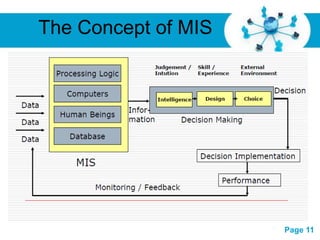
The Concept of MIS


        Free Powerpoint Templates
                                    Page 11
Outputs of a
  Management Information System
Scheduled reports
      Produced periodically, or on a schedule (daily, weekly,
       monthly)
 Key-indicator report
      Summarizes the previous day’s critical activities
      Typically available at the beginning of each day
 Demand report
      Gives certain information at a manager’s request
 Exception report
      Automatically produced when a situation is unusual or
       requires management action
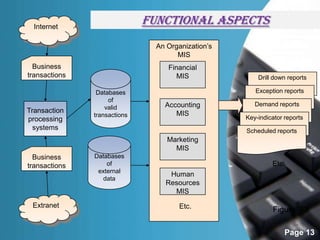
Internet
                              Functional Aspects
                                An Organization’s
                                      MIS
  Business                         Financial
transactions                          MIS               Drill down reports

                Databases                              Exception reports
                    of
                                  Accounting           Demand reports
                   valid
Transaction                          MIS
               transactions                         Key-indicator reports
processing
  systems                                           Scheduled reports
                                   Marketing
                                     MIS
  Business     Databases
transactions       of                                        Etc.
                external
                                   Human
                 data
                                  Resources
                                    MIS
 Extranet                              Etc.                  Figure 9.3

                                                                  Page 13
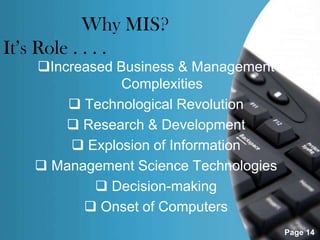
Why MIS?
It’s Role . . . .
   Increased Business & Management
               Complexities
        Technological Revolution
        Research & Development
        Explosion of Information
    Management Science Technologies
            Decision-making
          Onset of Computers
                                       Page 14
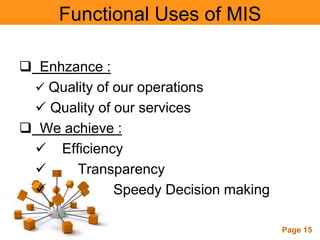
Functional Uses of MIS

 Enhzance :
  Quality of our operations
  Quality of our services
 We achieve :
  Efficiency
      Transparency
             Speedy Decision making

              Powerpoint Templates
                                       Page 15
Organizational Systems & MIS
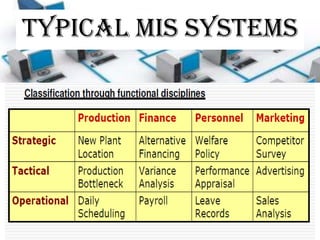
Typical MIS Systems


                  Page 17
Management Information
            Systems
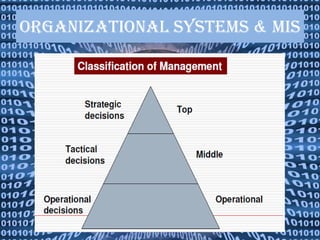
     Levels of Management:
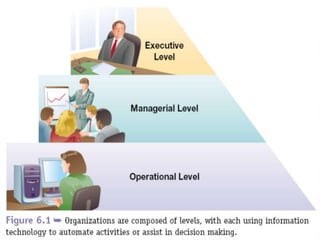
In order to understand who the users of an
  MIS are and what information they
  need, one must first understand the levels
  of management and the types of decisions
  are made at each level.


                                 18
                                          Page 18
19
     Page 19
Levels of management

– 1. Lower level management makes decisions
  that affect day to day operations.
  • Programmed decisions that are predetermined by
    rules and procedures. They lead to a desired
    result.
  • The information needs of lower-level mgrs. can be
    met by administrative data processing activities.


                                       20
                                                   Page 20
Levels of management

– 2. Middle-level mgrs. plan working capital,
  schedule production, formulate budgets, and
  make short-term forecasts.
  • Mid-level managers make tactical decisions that
    usually involve time periods of up to two years.
  • Many Mid-level mgmt decisions are non-
    programmed decisions. No specific predetermined
    steps cab be followed to each solution.
  • The information needs of Mid-level mgrs. must be
    specific.

                                      21
                                                 Page 21
Levels of management

– 3. Top-level mgrs. provide direction for the
  company by planning for the next five years .

  • Top-level mgrs. make strategic decisions
    that involve a great deal of uncertainty.
  • Top-level mgt. decisions are non-
    programmed decisions.


                                    22
                                                Page 22
Thank You

“Doubt is better than Over-confidence”


                                         23

MIS

  • 1.
  • 2.
    Information is Critical “Theinformation we have is not what we want,” “The information we want is not the information we need,” “The information we need is not available.” Free Powerpoint Templates Page 2
  • 3.
    Information is aResource  It is scarce It has a cost It has alternative uses There is an opportunity cost factor involved if one does not process information. Free Powerpoint Templates Page 3
  • 4.
    What is MIS? RightInformation To the right person At the right place At the right time In the right form At the right cost Page 4
  • 5.
    Management Information Systems DEFINITIO (MIS) N:- Management Information Systems (MIS) is a system designed to supply information required for effective management of an organization. A formal structure, generally computerized, for collecting and analyzing information relevant to an organization's operations.
  • 6.
    Management Information System Thethree sub-components Management, Information and System -together bring out the focus clearly & effectively.  System emphasizing a fair degree of integration and a holistic view;  Information stressing on processed data in the context in which it is used by end users;  Management focusing on the ultimate use of such information systems for managerial decision making.
  • 7.
    Management Information System (M.I.S.) is basically concerned with processing data into information. which is then communicated to the various Departments in an organization for appropriate decision-making. Data Information Communication Decisions  Information systems are designed to provide managers with information that can be utilized to make better and more timely decisions.
  • 8.
    The objects ofMIS  To make the desired information available in the right form to the right person and at the right time.  To supply the required information at a reasonable cost.  To use the most efficient methods of processing data.  To provide necessary security & the secrecy for important and/or confidential information.  To keep the information up-to-date.
  • 9.
    Advantages of MIS  the means of effective and efficient coordination between Departments  quick and reliable referencing  access to relevant data and documents  use of less labor  improvement in organizational and departmental techniques  management of day-to-day activities (as accounts, stock control, payroll etc.);  day-to-day assistance in a Department and closer contact with the rest of the organization.
  • 10.
    Features of MIS 10 On Time As required yet dynamic Crisp yet detailed Accurate Consistent Comprehensive Page 10
  • 11.
    The Concept ofMIS Free Powerpoint Templates Page 11
  • 12.
    Outputs of a Management Information System Scheduled reports Produced periodically, or on a schedule (daily, weekly, monthly)  Key-indicator report Summarizes the previous day’s critical activities Typically available at the beginning of each day  Demand report Gives certain information at a manager’s request  Exception report Automatically produced when a situation is unusual or requires management action
  • 13.
    Internet Functional Aspects An Organization’s MIS Business Financial transactions MIS Drill down reports Databases Exception reports of Accounting Demand reports valid Transaction MIS transactions Key-indicator reports processing systems Scheduled reports Marketing MIS Business Databases transactions of Etc. external Human data Resources MIS Extranet Etc. Figure 9.3 Page 13
  • 14.
    Why MIS? It’s Role. . . . Increased Business & Management Complexities  Technological Revolution  Research & Development  Explosion of Information  Management Science Technologies  Decision-making  Onset of Computers Page 14
  • 15.
    Functional Uses ofMIS  Enhzance :  Quality of our operations  Quality of our services  We achieve :  Efficiency  Transparency  Speedy Decision making Powerpoint Templates Page 15
  • 16.
  • 17.
  • 18.
    Management Information Systems Levels of Management: In order to understand who the users of an MIS are and what information they need, one must first understand the levels of management and the types of decisions are made at each level. 18 Page 18
  • 19.
    19 Page 19
  • 20.
    Levels of management –1. Lower level management makes decisions that affect day to day operations. • Programmed decisions that are predetermined by rules and procedures. They lead to a desired result. • The information needs of lower-level mgrs. can be met by administrative data processing activities. 20 Page 20
  • 21.
    Levels of management –2. Middle-level mgrs. plan working capital, schedule production, formulate budgets, and make short-term forecasts. • Mid-level managers make tactical decisions that usually involve time periods of up to two years. • Many Mid-level mgmt decisions are non- programmed decisions. No specific predetermined steps cab be followed to each solution. • The information needs of Mid-level mgrs. must be specific. 21 Page 21
  • 22.
    Levels of management –3. Top-level mgrs. provide direction for the company by planning for the next five years . • Top-level mgrs. make strategic decisions that involve a great deal of uncertainty. • Top-level mgt. decisions are non- programmed decisions. 22 Page 22
  • 23.
    Thank You “Doubt isbetter than Over-confidence” 23