MATERIAL HANDLING
Material Handling
• Material handling is the function of
moving the right material to the right
place in the right time, in the right
amount, in sequence, and in the right
condition to minimize production
cost.
– The cost of MH estimates 20-25 of total
manufacturing labor cost in the United
States [The Material Handling Industry of America (MHIA)]
Material Handling
• According to American society of material
engineers
“Material handling is an art & science
involving the moving, packing & storing of
substances in any form.”
• It involves movement of material mechanically
& manually in batches or one by one within the
plant.
The most successful brands in the world uses
material handling and logistic solutions to gain
competitive edge
Toyota
Wal-Mart
Disney
Coca Cola
NASA
John Deere
Mitsubishi
Pepsi-Cola
Goals of Material Handling
• The primary goal is to reduce unit
costs of production
• Maintain or improve product quality, reduce
damage of materials
• Promote safety and improve working conditions
• Promote productivity
– material should flow in a straight line
– use gravity! It is free power
– move more material at one time
– mechanize material handling
– automate material handling
Overview of Material Handling
Equipment
• Material handling equipment includes:
– Transport Equipment: industrial trucks,
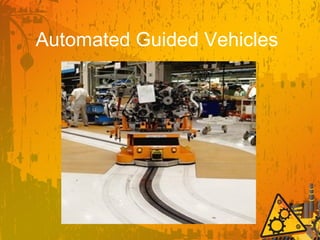
Automated Guided vehicles (AGVs), monorails,
conveyors, cranes and hoists.
– Storage Systems: bulk storage, rack systems,
shelving and bins, drawer storage, automated
storage systems.
– Unitizing Equipment: palletizers
– Identification and Tracking systems
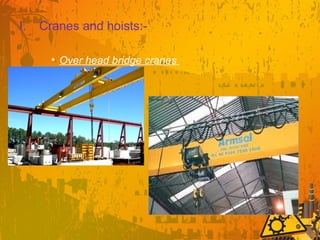
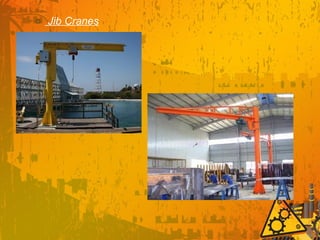
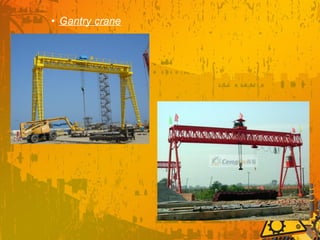
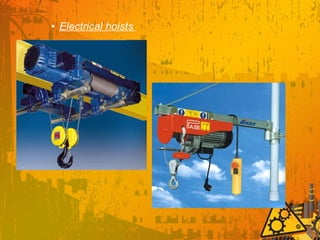
I. Cranes and hoists:-
• Over head bridge cranes
o Jib Cranes
• Gantry crane
• Electrical hoists
Automated Guided Vehicles
• Elevators
• Stacker Crane
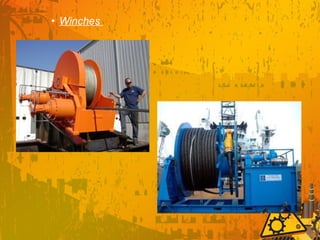
• Winches
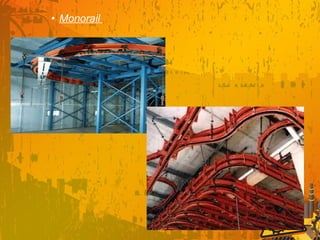
• Monorail
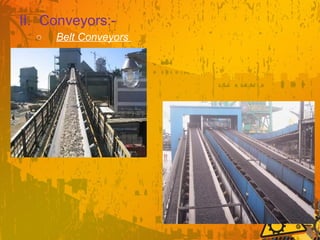
II. Conveyors:-
o Belt Conveyors
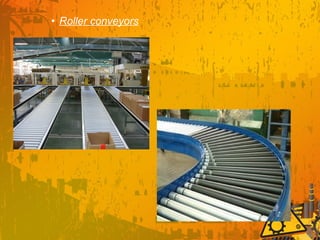
• Roller conveyors
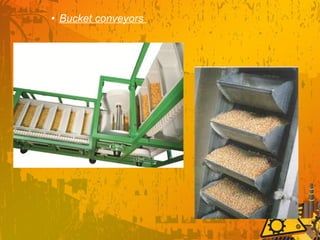
• Bucket conveyors
• Screw conveyors
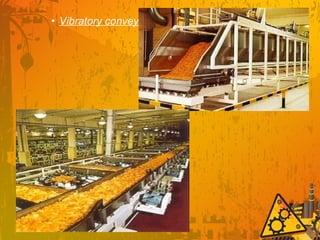
• Vibratory conveyors
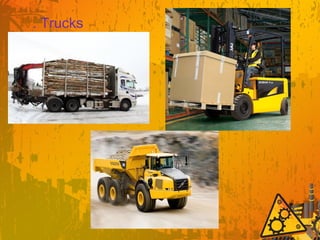
IV. Trucks
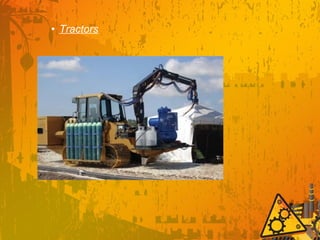
• Tractors
• Trailers
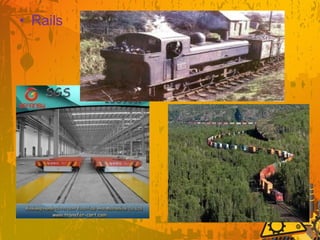
• Rails
V. Ropeways and cableways
VI. Pipelines
VI. Auxiliary equipments
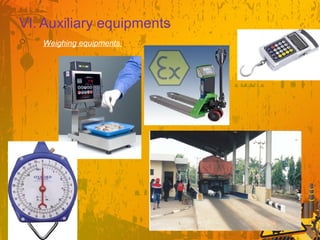
o Weighing equipments
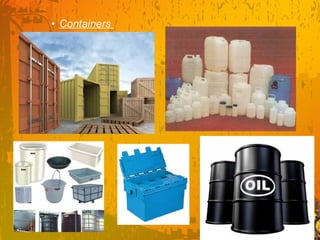
• Containers
• Pallet loader and unloader
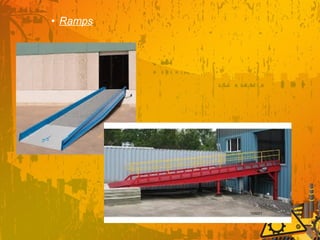
• Ramps
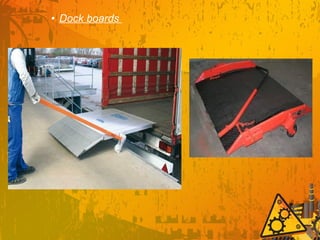
• Dock boards
• Dock levellers
20 Principles of Material Handling
1.The Planning Principle
– Large-scale material handling projects usually
require a team approach.
– Material handling planning considers every
move, every storage need, and any delay in
order to minimize production costs.
– The plan should reflect the strategic objectives
of the organization as well as the more
immediate needs.
2.The systems principle: MH and storage activities
should be fully integrated to form a coordinated, operational
system that spans receiving, inspection, storage,
production, assembly, …, shipping, and the handling of
returns.
– Information flow and physical material flow
should be integrated and treated as concurrent
activities.
– Methods should be provided for easily
identifying materials and products, for
determining their location and status within
facilities and within the supply chain.
3. Simplification principle
– simplify handling by reducing, eliminating, or
combining unnecessary movement and/or
equipment.
– Four questions to ask to simplify any job:
• Can this job be eliminated?
• If we can’t eliminate, can we combine movements to
reduce cost? (unit load concept)
• If we can’t eliminate or combine, can we rearrange the
operations to reduce the travel distance?
• If we can’t do any of the above, can we simplify?
4. Gravity principle
– Utilize gravity to move material whenever
practical.
5.Space utilization principle
– The better we use our building cube, the
less space we need to buy or rent.
– Racks, mezzanines, and overhead
conveyors are a few examples that
promote this goal.
6.Unit load principle
– Unit loads should be appropriately sized
and configured at each stage of the supply
chain.
– The most common unit load is the pallet
• cardboard pallets
• plastic pallets
• wooden pallets
• steel skids
8.Automation principle
– MH operations should be mechanized
and/or automated where feasible to
improve operational efficiency, increase
responsiveness, improve consistency and
predictability, decrease operating costs.
– ASRS is a perfect example.
10. Equipment selection principle
– Why? What? Where? When? How? Who?
– If we answer these questions about each
move, the solution will become evident.
11. The standardization principle
– standardize handling methods as well as types
and sizes of handling equipment
– too many sizes and brands of equipment results
in higher operational cost.
– A fewer sizes of carton will simplify the storage.
12. The dead weight principle
– Try to reduce the ratio of equipment weight to
product weight. Don’t buy equipment that is
bigger than necessary.
– Reduce tare weight and save money.
13. The maintenance principle
– Plan for preventive maintenance and scheduled
repairs of all handling equipment.
– Pallets and storage facilities need repair too.
14. The capacity principle
– use handling equipment to help achieve desired
production capacity
– i.e. material handling equipment can help to
maximize production equipment utilization.

Material handling

  • 1.
  • 2.
    Material Handling • Materialhandling is the function of moving the right material to the right place in the right time, in the right amount, in sequence, and in the right condition to minimize production cost. – The cost of MH estimates 20-25 of total manufacturing labor cost in the United States [The Material Handling Industry of America (MHIA)]
  • 3.
    Material Handling • Accordingto American society of material engineers “Material handling is an art & science involving the moving, packing & storing of substances in any form.” • It involves movement of material mechanically & manually in batches or one by one within the plant.
  • 4.
    The most successfulbrands in the world uses material handling and logistic solutions to gain competitive edge Toyota Wal-Mart Disney Coca Cola NASA John Deere Mitsubishi Pepsi-Cola
  • 5.
    Goals of MaterialHandling • The primary goal is to reduce unit costs of production • Maintain or improve product quality, reduce damage of materials • Promote safety and improve working conditions • Promote productivity – material should flow in a straight line – use gravity! It is free power – move more material at one time – mechanize material handling – automate material handling
  • 6.
    Overview of MaterialHandling Equipment • Material handling equipment includes: – Transport Equipment: industrial trucks, Automated Guided vehicles (AGVs), monorails, conveyors, cranes and hoists. – Storage Systems: bulk storage, rack systems, shelving and bins, drawer storage, automated storage systems. – Unitizing Equipment: palletizers – Identification and Tracking systems
  • 7.
    I. Cranes andhoists:- • Over head bridge cranes
  • 8.
  • 9.
  • 10.
  • 11.
  • 12.
  • 13.
  • 14.
  • 15.
  • 16.
  • 17.
  • 18.
  • 20.
  • 21.
  • 22.
  • 23.
  • 24.
  • 25.
  • 26.
    V. Ropeways andcableways
  • 27.
  • 28.
    VI. Auxiliary equipments oWeighing equipments
  • 29.
  • 30.
    • Pallet loaderand unloader
  • 31.
  • 32.
  • 33.
  • 34.
    20 Principles ofMaterial Handling 1.The Planning Principle – Large-scale material handling projects usually require a team approach. – Material handling planning considers every move, every storage need, and any delay in order to minimize production costs. – The plan should reflect the strategic objectives of the organization as well as the more immediate needs.
  • 35.
    2.The systems principle:MH and storage activities should be fully integrated to form a coordinated, operational system that spans receiving, inspection, storage, production, assembly, …, shipping, and the handling of returns. – Information flow and physical material flow should be integrated and treated as concurrent activities. – Methods should be provided for easily identifying materials and products, for determining their location and status within facilities and within the supply chain.
  • 36.
    3. Simplification principle –simplify handling by reducing, eliminating, or combining unnecessary movement and/or equipment. – Four questions to ask to simplify any job: • Can this job be eliminated? • If we can’t eliminate, can we combine movements to reduce cost? (unit load concept) • If we can’t eliminate or combine, can we rearrange the operations to reduce the travel distance? • If we can’t do any of the above, can we simplify?
  • 37.
    4. Gravity principle –Utilize gravity to move material whenever practical. 5.Space utilization principle – The better we use our building cube, the less space we need to buy or rent. – Racks, mezzanines, and overhead conveyors are a few examples that promote this goal.
  • 38.
    6.Unit load principle –Unit loads should be appropriately sized and configured at each stage of the supply chain. – The most common unit load is the pallet • cardboard pallets • plastic pallets • wooden pallets • steel skids
  • 39.
    8.Automation principle – MHoperations should be mechanized and/or automated where feasible to improve operational efficiency, increase responsiveness, improve consistency and predictability, decrease operating costs. – ASRS is a perfect example.
  • 40.
    10. Equipment selectionprinciple – Why? What? Where? When? How? Who? – If we answer these questions about each move, the solution will become evident. 11. The standardization principle – standardize handling methods as well as types and sizes of handling equipment – too many sizes and brands of equipment results in higher operational cost. – A fewer sizes of carton will simplify the storage.
  • 41.
    12. The deadweight principle – Try to reduce the ratio of equipment weight to product weight. Don’t buy equipment that is bigger than necessary. – Reduce tare weight and save money. 13. The maintenance principle – Plan for preventive maintenance and scheduled repairs of all handling equipment. – Pallets and storage facilities need repair too. 14. The capacity principle – use handling equipment to help achieve desired production capacity – i.e. material handling equipment can help to maximize production equipment utilization.