




DANISH
STAFFING
          This consists of 5 major stages

1.   Planning the recruitment & selection process.

2. Recruiting sufficient number of applicants.

3. Selecting the most suitable applicants.

4. Hiring those candidates who have been
  selected.

5. Socialization & assimilation of the new recruits
  into the firms.
THE PLANNING STAGE.

(a)   Establish responsibility.

(b) Decide the number of salespeople needed.

(c) Outline the type of salespeople needed
DECIDING THE NUMBER OF SALESPEOPLE
NEEDED.
    The decision on how many salespeople are needed
    by the company is an important part of planning. It
    forces the regional & branch sales managers to plan
    their manpower requirements well in
    advance, before the beginning of new financial year.
    This helps the HR department to program the
    various stages of staffing process.
   For calculating the number of salespeople
    needed, each territory sales manager should
    consider the following points.
   1. Decide the optimum sales force size by using one
    or (preferably) more of the three (workload, sales
    potential, & incremental) methods, discussed earlier.
   2. Add number of promotions
    , retirements, transfers
    out, terminations, resignations expected from
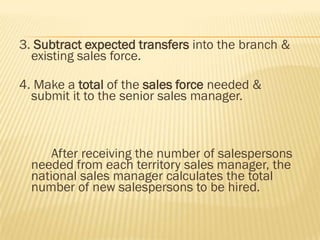
3. Subtract expected transfers into the branch &
  existing sales force.

4. Make a total of the sales force needed &
  submit it to the senior sales manager.


      After receiving the number of salespersons
  needed from each territory sales manager, the
  national sales manager calculates the total
  number of new salespersons to be hired.
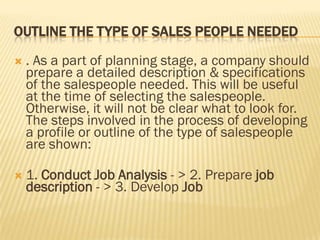
OUTLINE THE TYPE OF SALES PEOPLE NEEDED

   . As a part of planning stage, a company should
    prepare a detailed description & specifications
    of the salespeople needed. This will be useful
    at the time of selecting the salespeople.
    Otherwise, it will not be clear what to look for.
    The steps involved in the process of developing
    a profile or outline of the type of salespeople
    are shown:

   1. Conduct Job Analysis - > 2. Prepare job
    description - > 3. Develop Job
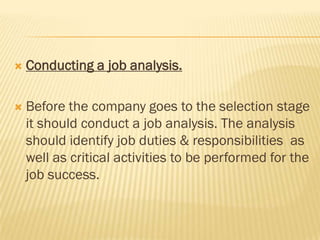
   Conducting a job analysis.

   Before the company goes to the selection stage
    it should conduct a job analysis. The analysis
    should identify job duties & responsibilities as
    well as critical activities to be performed for the
    job success.
   Amreen
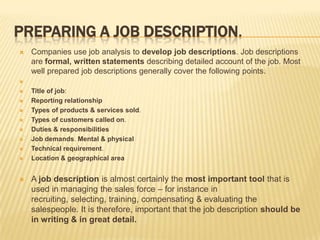
PREPARING A JOB DESCRIPTION.
   Companies use job analysis to develop job descriptions. Job descriptions
    are formal, written statements describing detailed account of the job. Most
    well prepared job descriptions generally cover the following points.


   Title of job:
   Reporting relationship
   Types of products & services sold.
   Types of customers called on.
   Duties & responsibilities
   Job demands. Mental & physical
   Technical requirement.
   Location & geographical area


   A job description is almost certainly the most important tool that is
    used in managing the sales force – for instance in
    recruiting, selecting, training, compensating & evaluating the
    salespeople. It is therefore, important that the job description should be
    in writing & in great detail.
RECRUITING SALES FORCE.

 This stage includes
(a) Finding or identifying the sources of sales
  recruits,

(b) evaluating & selecting the recruiting sources,

(c) contacting candidates through the selected
  source.
FINDING OR IDENTIFYING THE SOURCES OF
SALES RECRUITS,
For identifying or locating prospecting candidates, companies use
   internal & external sources. Internal recruitment sources come
   from inside the company. They include
(a) employee referral programs,
(b) current employees, &
(c) promotions & transfers.

The external sources of recruitment include
 (a) advertisements,
 (b) the internet,
 (c) educational institutions
 (d) employment agencies,
 (e) other companies (competitors, customers), non-competitors, &
  (f) job fairs.
EVALUATION OF RECRUITING SOURCES
   After identifying the sources of recruiting
    salespeople, a company selects those sources
    tat are effective based on the past database.
    This data base is built over a number of
    years, as per the evaluation format.
    However, for a new company, selection of the
    recruiting source depends on its cost. Once the
    source is selected, contacting the candidates is
    a normal practice of implementation, which is
    done by HRD.
SELECTING SALES FORCE.
The selection stage consists of the following 2 steps.
 (a) Developing the selection process consisting of tools & procedure to
    measure the applicants against the job specifications or qualifications, &
(b) selecting the salespeople.

In other words, there are two activities in the selection stage. First the
   company should develop a system or process of tools & procedure for
   measuring applicants against the job specifications or qualifications that
   was developed in the planning stage. The second activity is to make the
   decision on selection.
We shall first identify the major selection tools, which are used by companies
   for selecting salespeople.
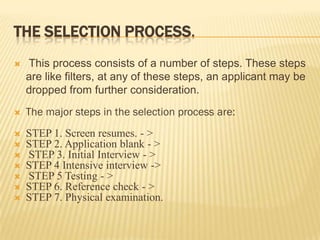
THE SELECTION PROCESS.
   This process consists of a number of steps. These steps
    are like filters, at any of these steps, an applicant may be
    dropped from further consideration.
   The major steps in the selection process are:
   STEP 1. Screen resumes. - >
   STEP 2. Application blank - >
   STEP 3. Initial Interview - >
   STEP 4 Intensive interview ->
   STEP 5 Testing - >
   STEP 6. Reference check - >
   STEP 7. Physical examination.
SELECTION DECISION
   . When all the steps of the selection process have been completed, one
    thing is yet to be completed that is selection decision – which
    applicants are to be selected? For making a selection decision, the
    sales manager should decide the important selection criteria, which are
    necessary for performing the duties of the sales job.

   When selecting the salespersons for rural markets in India, the
    company should decide the selection criteria, such as willingness to
    work in rural areas, knowledge of local language & cultural congruence
    to adapt to rural environment & ethos.

    The sales manager should then evaluate each applicant’s
    qualifications & potential in relation to the selection criteria. Sometimes
    the sales manager has to decide whether an applicant’s strength in one
    selection criterion can compensate for a weakness in another
    criterion, whether the applicant should meet certain minimum levels
    against each criteria, so as to be successful. After evaluating the
    available candidates, the company makes a list of candidates according
    to preference.
MOHASIR
HIRING STAGE.
   The hiring process should be implemented
    properly so as to give a positive impression of the
    company to the candidates, who look for good
    work environment, where people are made to feel
    important.

   There are 2 activities in the hiring stage:

(a) the company making the job offer, &
 (b) acceptance of the job offer by the applicant.
MOTIVATIONAL AND COMPENSATION
PROCEDURES FOR SALES FORCE
   Motivational tools are usually divided into two
    broad categories


1) Financial rewards/Compensation

2) Non-financial compensation.
FINANCIAL REWARDS/COMPENSATION
which includes
(a) Direct payment of money such as
  salary, commission, & bonus.
(b) Indirect payment, which includes fringe
  benefits or perquisites, such as retirement
  plans, medical reimbursement, & leave travel
  assistance (LTA).

It also includes various insurance plans.
NON-FINANCIAL COMPENSATION.

These rewards include the following
a) Promotion
Change in titles or promotions are ranked high
among younger and better educated salesperson
Salesperson – Senior Salesperson – Key Account
Executive
b) Sense of accomplishment
An awareness that something has been achieved
successfully
It is an intrinsic motivation and a firm can only facilitate
c) Personal growth opportunities
Many salespeople rank opportunities for personal
growth high in the list of sales force rewards

d) Recognition
Most sales managers realize that they must pay more
attention to the individual salesperson’s higher order
needs, such as recognition, appreciation, and
admiration.
Formal and Informal recognition
e) Job Security

It is valued highly by older salespeople who are
nearing retirement age, but is least valued
reward among younger salespeople.
HASNAN
OBJECTIVES OF A COMPENSATION PLAN.
  A good compensation plan should consider objectives from the company’s view
   point & also the salesperson view point.
Sales managers should recognize that some of the management objectives may
   conflict with the salesperson’s objective.
 The company viewpoint. The company wants to attract, retain & motivate
   competent salespeople. A good compensation plan should attract & keep top
   quality salespeople. It should also motivate sales people to reach & exceed their
   sales goals.
 To control salespeople’s activities. The compensation plan should offer
   incentives to control several key activities of sales force, such as
   selling, prospecting, payment collection, & customer relationship building. Of
   course these key tasks will vary from company to company. For
   instance, Compaq computer’s sales managers use 20-40% of their
   salespeople’s compensation on individualized sales objectives & goals, like
   improving specific customers’ relationship or introducing a new product.
 To be competitive, yet economical. Most companies want to keep their
   salespeople’s expenses at the same level as those of the competitors. At the
   same time, the company wants its compensation plan economical. It is difficult
   to balance these two objectives.
   To be flexible. A good compensation plan should be flexible to adapt to new
    products, volatile markets, & differing territory sales potential. Some
    companies use individualized compensation plans, in which each
    salesperson is allowed to choose what percentage of his or her
    compensation is fixed (that is, straight salary) & what percentage should be
    variable (that is, commission based).
THE SALESPERSON’S VIEWPOINT.
   To have regular & incentive income. The salesperson wants the
    compensation plan to provide a regular income every month that is
    fixed & secured against any problems or emergencies. If the
    salesperson is sick & cannot work for a period of time, or if the sales
    are down due to various factors, he/she should get some fixed salary to
    take care of living expenses. An extra reward, in addition to fixed
    income, should be included in the compensation plan to produce above
    average performance.
   To have a simple plan. The compensation plan should be simple for the
    salespeople to understand easily. Even most company management
    prefer to have a simple compensation plan. This objective may be in
    conflict with the objective of flexibility.
   To have a fair payment plan. The compensation plan should ensure fair
    or just payment to all salespeople. This can be done by selecting those
    factors which can be measured & controlled by salespeople.
DESIGNING AN EFFECTIVE SALES
COMPENSATION PLAN.
     Designing or developing a new compensation plan, or revising an existing plan
       consists of a number of steps which is considered as the framework.

   Step1.Examine job descriptions.
          Every positions needs a separate job description, with detailed job
    responsibilities & key performance standards, to decide how much the company
    should pay.

   Step 2. Set up specific objectives
    These sales force objectives should be derived from the company’s sales &
    marketing objectives. Also, sales managers should include those specific objectives
    over which salespeople have maximum control, such as number of sales call made
    to ’A’ &’B’ class customers, selling expenses, & new customers developed.
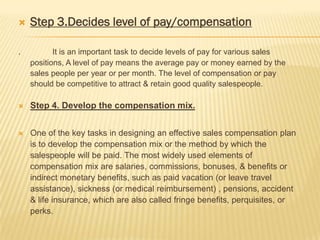
   Step 3.Decides level of pay/compensation

.          It is an important task to decide levels of pay for various sales
    positions, A level of pay means the average pay or money earned by the
    sales people per year or per month. The level of compensation or pay
    should be competitive to attract & retain good quality salespeople.

   Step 4. Develop the compensation mix.


   One of the key tasks in designing an effective sales compensation plan
    is to develop the compensation mix or the method by which the
    salespeople will be paid. The most widely used elements of
    compensation mix are salaries, commissions, bonuses, & benefits or
    indirect monetary benefits, such as paid vacation (or leave travel
    assistance), sickness (or medical reimbursement) , pensions, accident
    & life insurance, which are also called fringe benefits, perquisites, or
    perks.
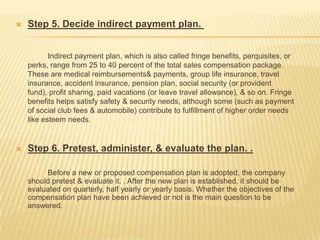
   Step 5. Decide indirect payment plan.


           Indirect payment plan, which is also called fringe benefits, perquisites, or
    perks, range from 25 to 40 percent of the total sales compensation package.
    These are medical reimbursements& payments, group life insurance, travel
    insurance, accident insurance, pension plan, social security (or provident
    fund), profit sharing, paid vacations (or leave travel allowance), & so on. Fringe
    benefits helps satisfy safety & security needs, although some (such as payment
    of social club fees & automobile) contribute to fulfillment of higher order needs
    like esteem needs.


   Step 6. Pretest, administer, & evaluate the plan. .

         Before a new or proposed compensation plan is adopted, the company
    should pretest & evaluate it. . After the new plan is established, it should be
    evaluated on quarterly, half yearly or yearly basis. Whether the objectives of the
    compensation plan have been achieved or not is the main question to be
    answered.
THANK YOU

Sales compensation

  • 2.
  • 3.
    STAFFING This consists of 5 major stages 1. Planning the recruitment & selection process. 2. Recruiting sufficient number of applicants. 3. Selecting the most suitable applicants. 4. Hiring those candidates who have been selected. 5. Socialization & assimilation of the new recruits into the firms.
  • 4.
    THE PLANNING STAGE. (a) Establish responsibility. (b) Decide the number of salespeople needed. (c) Outline the type of salespeople needed
  • 5.
    DECIDING THE NUMBEROF SALESPEOPLE NEEDED.  The decision on how many salespeople are needed by the company is an important part of planning. It forces the regional & branch sales managers to plan their manpower requirements well in advance, before the beginning of new financial year. This helps the HR department to program the various stages of staffing process.  For calculating the number of salespeople needed, each territory sales manager should consider the following points.  1. Decide the optimum sales force size by using one or (preferably) more of the three (workload, sales potential, & incremental) methods, discussed earlier.  2. Add number of promotions , retirements, transfers out, terminations, resignations expected from
  • 6.
    3. Subtract expectedtransfers into the branch & existing sales force. 4. Make a total of the sales force needed & submit it to the senior sales manager. After receiving the number of salespersons needed from each territory sales manager, the national sales manager calculates the total number of new salespersons to be hired.
  • 7.
    OUTLINE THE TYPEOF SALES PEOPLE NEEDED  . As a part of planning stage, a company should prepare a detailed description & specifications of the salespeople needed. This will be useful at the time of selecting the salespeople. Otherwise, it will not be clear what to look for. The steps involved in the process of developing a profile or outline of the type of salespeople are shown:  1. Conduct Job Analysis - > 2. Prepare job description - > 3. Develop Job
  • 8.
    Conducting a job analysis.  Before the company goes to the selection stage it should conduct a job analysis. The analysis should identify job duties & responsibilities as well as critical activities to be performed for the job success.
  • 9.
    Amreen
  • 10.
    PREPARING A JOBDESCRIPTION.  Companies use job analysis to develop job descriptions. Job descriptions are formal, written statements describing detailed account of the job. Most well prepared job descriptions generally cover the following points.   Title of job:  Reporting relationship  Types of products & services sold.  Types of customers called on.  Duties & responsibilities  Job demands. Mental & physical  Technical requirement.  Location & geographical area  A job description is almost certainly the most important tool that is used in managing the sales force – for instance in recruiting, selecting, training, compensating & evaluating the salespeople. It is therefore, important that the job description should be in writing & in great detail.
  • 11.
    RECRUITING SALES FORCE. This stage includes (a) Finding or identifying the sources of sales recruits, (b) evaluating & selecting the recruiting sources, (c) contacting candidates through the selected source.
  • 12.
    FINDING OR IDENTIFYINGTHE SOURCES OF SALES RECRUITS, For identifying or locating prospecting candidates, companies use internal & external sources. Internal recruitment sources come from inside the company. They include (a) employee referral programs, (b) current employees, & (c) promotions & transfers. The external sources of recruitment include (a) advertisements, (b) the internet, (c) educational institutions (d) employment agencies, (e) other companies (competitors, customers), non-competitors, & (f) job fairs.
  • 13.
    EVALUATION OF RECRUITINGSOURCES  After identifying the sources of recruiting salespeople, a company selects those sources tat are effective based on the past database. This data base is built over a number of years, as per the evaluation format. However, for a new company, selection of the recruiting source depends on its cost. Once the source is selected, contacting the candidates is a normal practice of implementation, which is done by HRD.
  • 14.
    SELECTING SALES FORCE. Theselection stage consists of the following 2 steps. (a) Developing the selection process consisting of tools & procedure to measure the applicants against the job specifications or qualifications, & (b) selecting the salespeople. In other words, there are two activities in the selection stage. First the company should develop a system or process of tools & procedure for measuring applicants against the job specifications or qualifications that was developed in the planning stage. The second activity is to make the decision on selection. We shall first identify the major selection tools, which are used by companies for selecting salespeople.
  • 15.
    THE SELECTION PROCESS.  This process consists of a number of steps. These steps are like filters, at any of these steps, an applicant may be dropped from further consideration.  The major steps in the selection process are:  STEP 1. Screen resumes. - >  STEP 2. Application blank - >  STEP 3. Initial Interview - >  STEP 4 Intensive interview ->  STEP 5 Testing - >  STEP 6. Reference check - >  STEP 7. Physical examination.
  • 16.
    SELECTION DECISION  . When all the steps of the selection process have been completed, one thing is yet to be completed that is selection decision – which applicants are to be selected? For making a selection decision, the sales manager should decide the important selection criteria, which are necessary for performing the duties of the sales job.  When selecting the salespersons for rural markets in India, the company should decide the selection criteria, such as willingness to work in rural areas, knowledge of local language & cultural congruence to adapt to rural environment & ethos.  The sales manager should then evaluate each applicant’s qualifications & potential in relation to the selection criteria. Sometimes the sales manager has to decide whether an applicant’s strength in one selection criterion can compensate for a weakness in another criterion, whether the applicant should meet certain minimum levels against each criteria, so as to be successful. After evaluating the available candidates, the company makes a list of candidates according to preference.
  • 17.
  • 18.
    HIRING STAGE.  The hiring process should be implemented properly so as to give a positive impression of the company to the candidates, who look for good work environment, where people are made to feel important.  There are 2 activities in the hiring stage: (a) the company making the job offer, & (b) acceptance of the job offer by the applicant.
  • 19.
    MOTIVATIONAL AND COMPENSATION PROCEDURESFOR SALES FORCE  Motivational tools are usually divided into two broad categories 1) Financial rewards/Compensation 2) Non-financial compensation.
  • 20.
    FINANCIAL REWARDS/COMPENSATION which includes (a)Direct payment of money such as salary, commission, & bonus. (b) Indirect payment, which includes fringe benefits or perquisites, such as retirement plans, medical reimbursement, & leave travel assistance (LTA). It also includes various insurance plans.
  • 21.
    NON-FINANCIAL COMPENSATION. These rewardsinclude the following a) Promotion Change in titles or promotions are ranked high among younger and better educated salesperson Salesperson – Senior Salesperson – Key Account Executive
  • 22.
    b) Sense ofaccomplishment An awareness that something has been achieved successfully It is an intrinsic motivation and a firm can only facilitate c) Personal growth opportunities Many salespeople rank opportunities for personal growth high in the list of sales force rewards d) Recognition Most sales managers realize that they must pay more attention to the individual salesperson’s higher order needs, such as recognition, appreciation, and admiration. Formal and Informal recognition
  • 23.
    e) Job Security Itis valued highly by older salespeople who are nearing retirement age, but is least valued reward among younger salespeople.
  • 24.
  • 25.
    OBJECTIVES OF ACOMPENSATION PLAN.  A good compensation plan should consider objectives from the company’s view point & also the salesperson view point. Sales managers should recognize that some of the management objectives may conflict with the salesperson’s objective.  The company viewpoint. The company wants to attract, retain & motivate competent salespeople. A good compensation plan should attract & keep top quality salespeople. It should also motivate sales people to reach & exceed their sales goals.  To control salespeople’s activities. The compensation plan should offer incentives to control several key activities of sales force, such as selling, prospecting, payment collection, & customer relationship building. Of course these key tasks will vary from company to company. For instance, Compaq computer’s sales managers use 20-40% of their salespeople’s compensation on individualized sales objectives & goals, like improving specific customers’ relationship or introducing a new product.  To be competitive, yet economical. Most companies want to keep their salespeople’s expenses at the same level as those of the competitors. At the same time, the company wants its compensation plan economical. It is difficult to balance these two objectives.
  • 26.
    To be flexible. A good compensation plan should be flexible to adapt to new products, volatile markets, & differing territory sales potential. Some companies use individualized compensation plans, in which each salesperson is allowed to choose what percentage of his or her compensation is fixed (that is, straight salary) & what percentage should be variable (that is, commission based).
  • 27.
    THE SALESPERSON’S VIEWPOINT.  To have regular & incentive income. The salesperson wants the compensation plan to provide a regular income every month that is fixed & secured against any problems or emergencies. If the salesperson is sick & cannot work for a period of time, or if the sales are down due to various factors, he/she should get some fixed salary to take care of living expenses. An extra reward, in addition to fixed income, should be included in the compensation plan to produce above average performance.  To have a simple plan. The compensation plan should be simple for the salespeople to understand easily. Even most company management prefer to have a simple compensation plan. This objective may be in conflict with the objective of flexibility.  To have a fair payment plan. The compensation plan should ensure fair or just payment to all salespeople. This can be done by selecting those factors which can be measured & controlled by salespeople.
  • 28.
    DESIGNING AN EFFECTIVESALES COMPENSATION PLAN. Designing or developing a new compensation plan, or revising an existing plan consists of a number of steps which is considered as the framework.  Step1.Examine job descriptions. Every positions needs a separate job description, with detailed job responsibilities & key performance standards, to decide how much the company should pay.  Step 2. Set up specific objectives These sales force objectives should be derived from the company’s sales & marketing objectives. Also, sales managers should include those specific objectives over which salespeople have maximum control, such as number of sales call made to ’A’ &’B’ class customers, selling expenses, & new customers developed.
  • 29.
    Step 3.Decides level of pay/compensation . It is an important task to decide levels of pay for various sales positions, A level of pay means the average pay or money earned by the sales people per year or per month. The level of compensation or pay should be competitive to attract & retain good quality salespeople.  Step 4. Develop the compensation mix.  One of the key tasks in designing an effective sales compensation plan is to develop the compensation mix or the method by which the salespeople will be paid. The most widely used elements of compensation mix are salaries, commissions, bonuses, & benefits or indirect monetary benefits, such as paid vacation (or leave travel assistance), sickness (or medical reimbursement) , pensions, accident & life insurance, which are also called fringe benefits, perquisites, or perks.
  • 30.
    Step 5. Decide indirect payment plan. Indirect payment plan, which is also called fringe benefits, perquisites, or perks, range from 25 to 40 percent of the total sales compensation package. These are medical reimbursements& payments, group life insurance, travel insurance, accident insurance, pension plan, social security (or provident fund), profit sharing, paid vacations (or leave travel allowance), & so on. Fringe benefits helps satisfy safety & security needs, although some (such as payment of social club fees & automobile) contribute to fulfillment of higher order needs like esteem needs.  Step 6. Pretest, administer, & evaluate the plan. . Before a new or proposed compensation plan is adopted, the company should pretest & evaluate it. . After the new plan is established, it should be evaluated on quarterly, half yearly or yearly basis. Whether the objectives of the compensation plan have been achieved or not is the main question to be answered.
  • 31.