Page 1
Plant Lay-out
Presented by:
Imran Bakshi.
M pharm
QA DEPARTMENT.
Page 2
Facility Layout
Layout refers to the configuration of departments, work
centers, and equipment, with particular emphasis on
movement of work (customers or materials) through the
system.
Layout decisions are important for three basic reasons:
1. require substantial investments of money and effort;
2. involve long-term commitments, which makes mistakes
difficult to overcome; and
3. have a significant impact on the cost and efficiency of
operations
Page 3
Plant layout
• It is a coordinated effort to achieve the final
objective to integrate machines, materials, and
personnel for economic production.
• Plant layout involves the location of different
departments and arrangement of machinery in each
department.
• A proper plant layout is required for ease of
operation for the workers, to have a good
production controls, super-vision and reducing
labour costs, other production costs, capital
investment.
Page 4
Factors affecting Plant Layout
1. Plant location and building
2. Nature of Product
3. Type of Industry
4. Plant Environment
5. Repairs and Maintenance
6. Management Policy
7. Type and quantity of products to be produced
8. Type of process and controls required.
9. New site development or additions to previously
developed site.
Page 5
Factors affecting Plant Layout
10. Space available and space required.
11. Operational convenience and accessibility.
12. Economic distribution of utilities and services
13. Type of buildings and building code
requirements (Schedule M).
14. Health and safety consideration.
15. Waste disposal problems.
16. Auxiliary equipment (steam generators, gas line
etc).
17. Possible future expansion.
Page 6
Plant Lay-out : Types
Page 7
The production process normally determines the type
of plant layout to be applied to the facility:
• Fixed position plant layout
Product stays and resources move to it.
• Product oriented plant layout
Machinery and Materials are placed following the
product path.
• Process oriented plant layout (Functional Layout).
Machinery is placed according to what they do and
materials go to them.
• Combined Layout
Combine aspects of both process and product
layouts
Page 8
Product oriented plant layout
This type of plant layout is useful when the production
process is organized in a continuous or repetitive way.
 Continuous flow : The correct operations flow is
reached through the layout design and the equipment
and machinery specifications.
 Repetitive flow (assembly line): The correct operations
flow will be based in a line balancing exercise, in order to
avoid problems generated by bottle necks.
The plant layout will be based in allocating a machine as
close as possible to the next one in line, in the correct
sequence to manufacture the product.
Page 9
• E.g. ,in the manufacture of tablets; different
unit operations like dispensing, powder
blending, granulation, drying, dry blending,
compression and coating are logically
arranged in a series (Tablet department,
Liquid Orals, Parenteral Department).
Page 10
Product Layouts /Straight line layout
• Product layouts are used to achieve a smooth and rapid flow of
large volumes of goods or customers through a system.
10
Page 11
Advantages
 A high rate of output
 Low unit cost due to high volume
 Low material-handling cost per unit
 A high utilization of labor and equipment
 The establishment of routing and
scheduling in the initial design of the
system
 Fairly routine accounting, purchasing,
and inventory control
 Cost of material handling can be reduced
using conveyors.
11
Disadvantages
 Morale problems and to repetitive stress
injuries.
 Lack of maintaining equipment or quality
of output.
 Iinflexible for output or design
 Highly susceptible to shutdowns
 A high utilization of labor and equipment
 Preventive maintenance, the capacity for
quick repairs, and spare-parts inventories
are necessary expenses
 Incentive plans tied to individual output
are impractical
Page 12
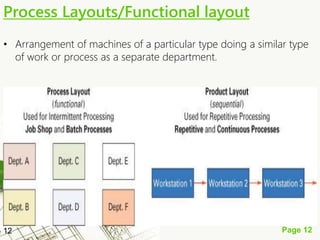
Process Layouts/Functional layout
• Arrangement of machines of a particular type doing a similar type
of work or process as a separate department.
12
Page 13
• Process oriented plant layout (Functional Layout)
– This type of plant layout is useful when the production process
is organized in batches.
– Personnel and equipment to perform the same function are
allocated in the same area.
– The different items have to move from one area to another
one, according to the sequence of operations previously
established.
– The variety of products to produce will lead to a diversity of
flows through the facility.
Eg. all packaging machines may be placed in one
department (Granulation Department, Packing Department,
Capsule filling department ).
Page 14
Advantages
 Not vulnerable to equipment failures
 General-purpose equipment is less costly
and is easier and less costly to maintain
• More effective supervision can be
achieved
• Division of labour or specialized work can
be provided.
• Disruption of production is less. §Scope
for expansion is high
14
Disadvantages
 In-process inventory costs can be high
 Routing and scheduling pose continual
challenges
 Equipment utilization rates are low
 Material handling is slow and inefficient,
and more costly per unit
 Special attention necessary for each
product or customer and low volumes
result in higher unit costs
 Accounting, inventory control, and
purchasing are much more involved
 May not be suitable when number of unit
operations should be performed in a
sequence.
Page 15
Fixed-Position Layouts
• In fixed-position layouts, the item being worked on remains
stationary, and workers, materials, and equipment are moved
about as needed.
• Fixed-position layouts are widely used in farming, firefighting,
road building, home building, remodeling and repair, and drilling
for oil. In each case, compelling reasons bring workers, materials,
and equipment to the “product’s” location instead of the other
way around.
15
Page 16
Advantages
 Saves time and cost in movement
 Flexible as changes in job design can be
easily incorporated
 More economical when several orders in
different stages are executed
 Adjustments can be made to meet
shortage of materials or absence of
workers.
16
Disadvantages
• Production period being very long,
capital investment is quite heavy
• Very large space is required for storage
of materials and equipment
• As several operations are carried
simultaneously, possibility of confusion
and conflicts are high
Page 17
Essentials of Ideal Layout
1. Principle of minimum movement
2. Principle of flow
3. Principle of space
4. Principle of safety
5. Principle of flexibility
6. Principle of interdependence
7. Principle of overall integration
8. Principle of minimum investment
Page 18
Stores Layout
Page 19
Aseptic Area
Page 20
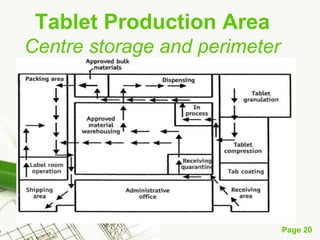
Tablet Production Area
Centre storage and perimeter
production
Page 21
Storage and production side-by-
side
Page 22
Straight -line type
Page 23

Plant layout

  • 1.
    Page 1 Plant Lay-out Presentedby: Imran Bakshi. M pharm QA DEPARTMENT.
  • 2.
    Page 2 Facility Layout Layoutrefers to the configuration of departments, work centers, and equipment, with particular emphasis on movement of work (customers or materials) through the system. Layout decisions are important for three basic reasons: 1. require substantial investments of money and effort; 2. involve long-term commitments, which makes mistakes difficult to overcome; and 3. have a significant impact on the cost and efficiency of operations
  • 3.
    Page 3 Plant layout •It is a coordinated effort to achieve the final objective to integrate machines, materials, and personnel for economic production. • Plant layout involves the location of different departments and arrangement of machinery in each department. • A proper plant layout is required for ease of operation for the workers, to have a good production controls, super-vision and reducing labour costs, other production costs, capital investment.
  • 4.
    Page 4 Factors affectingPlant Layout 1. Plant location and building 2. Nature of Product 3. Type of Industry 4. Plant Environment 5. Repairs and Maintenance 6. Management Policy 7. Type and quantity of products to be produced 8. Type of process and controls required. 9. New site development or additions to previously developed site.
  • 5.
    Page 5 Factors affectingPlant Layout 10. Space available and space required. 11. Operational convenience and accessibility. 12. Economic distribution of utilities and services 13. Type of buildings and building code requirements (Schedule M). 14. Health and safety consideration. 15. Waste disposal problems. 16. Auxiliary equipment (steam generators, gas line etc). 17. Possible future expansion.
  • 6.
  • 7.
    Page 7 The productionprocess normally determines the type of plant layout to be applied to the facility: • Fixed position plant layout Product stays and resources move to it. • Product oriented plant layout Machinery and Materials are placed following the product path. • Process oriented plant layout (Functional Layout). Machinery is placed according to what they do and materials go to them. • Combined Layout Combine aspects of both process and product layouts
  • 8.
    Page 8 Product orientedplant layout This type of plant layout is useful when the production process is organized in a continuous or repetitive way.  Continuous flow : The correct operations flow is reached through the layout design and the equipment and machinery specifications.  Repetitive flow (assembly line): The correct operations flow will be based in a line balancing exercise, in order to avoid problems generated by bottle necks. The plant layout will be based in allocating a machine as close as possible to the next one in line, in the correct sequence to manufacture the product.
  • 9.
    Page 9 • E.g.,in the manufacture of tablets; different unit operations like dispensing, powder blending, granulation, drying, dry blending, compression and coating are logically arranged in a series (Tablet department, Liquid Orals, Parenteral Department).
  • 10.
    Page 10 Product Layouts/Straight line layout • Product layouts are used to achieve a smooth and rapid flow of large volumes of goods or customers through a system. 10
  • 11.
    Page 11 Advantages  Ahigh rate of output  Low unit cost due to high volume  Low material-handling cost per unit  A high utilization of labor and equipment  The establishment of routing and scheduling in the initial design of the system  Fairly routine accounting, purchasing, and inventory control  Cost of material handling can be reduced using conveyors. 11 Disadvantages  Morale problems and to repetitive stress injuries.  Lack of maintaining equipment or quality of output.  Iinflexible for output or design  Highly susceptible to shutdowns  A high utilization of labor and equipment  Preventive maintenance, the capacity for quick repairs, and spare-parts inventories are necessary expenses  Incentive plans tied to individual output are impractical
  • 12.
    Page 12 Process Layouts/Functionallayout • Arrangement of machines of a particular type doing a similar type of work or process as a separate department. 12
  • 13.
    Page 13 • Processoriented plant layout (Functional Layout) – This type of plant layout is useful when the production process is organized in batches. – Personnel and equipment to perform the same function are allocated in the same area. – The different items have to move from one area to another one, according to the sequence of operations previously established. – The variety of products to produce will lead to a diversity of flows through the facility. Eg. all packaging machines may be placed in one department (Granulation Department, Packing Department, Capsule filling department ).
  • 14.
    Page 14 Advantages  Notvulnerable to equipment failures  General-purpose equipment is less costly and is easier and less costly to maintain • More effective supervision can be achieved • Division of labour or specialized work can be provided. • Disruption of production is less. §Scope for expansion is high 14 Disadvantages  In-process inventory costs can be high  Routing and scheduling pose continual challenges  Equipment utilization rates are low  Material handling is slow and inefficient, and more costly per unit  Special attention necessary for each product or customer and low volumes result in higher unit costs  Accounting, inventory control, and purchasing are much more involved  May not be suitable when number of unit operations should be performed in a sequence.
  • 15.
    Page 15 Fixed-Position Layouts •In fixed-position layouts, the item being worked on remains stationary, and workers, materials, and equipment are moved about as needed. • Fixed-position layouts are widely used in farming, firefighting, road building, home building, remodeling and repair, and drilling for oil. In each case, compelling reasons bring workers, materials, and equipment to the “product’s” location instead of the other way around. 15
  • 16.
    Page 16 Advantages  Savestime and cost in movement  Flexible as changes in job design can be easily incorporated  More economical when several orders in different stages are executed  Adjustments can be made to meet shortage of materials or absence of workers. 16 Disadvantages • Production period being very long, capital investment is quite heavy • Very large space is required for storage of materials and equipment • As several operations are carried simultaneously, possibility of confusion and conflicts are high
  • 17.
    Page 17 Essentials ofIdeal Layout 1. Principle of minimum movement 2. Principle of flow 3. Principle of space 4. Principle of safety 5. Principle of flexibility 6. Principle of interdependence 7. Principle of overall integration 8. Principle of minimum investment
  • 18.
  • 19.
  • 20.
    Page 20 Tablet ProductionArea Centre storage and perimeter production
  • 21.
    Page 21 Storage andproduction side-by- side
  • 22.
  • 23.