PLANT LAYOUT
BY
MUHAMMED FARSIN ELARAM
M.B.A 2 SEM
PLANT LAYOUT
• Plant layout refers to the physical arrangement of production
facilities.
• Plant layout is a plan of an optimum arrangement of facilities
including personnel, operating equipment, storage space,
material handling equipment and all other supporting services
along with the design of best structure to contain all these
facilities.
OBJECTIVES OF PLANT LAYOUT
• Minimum materials handling and cost
• Effective utilization of men, material and space.
• Minimum investment in equipment.
• Minimize over all production time.
• Maintain flexibility of arrangements and operations.
PRINCIPLES OF PLANT LAYOUT
• Principles of integration
• Principles of minimum distance
• Principles of cubic space utilization
• Principles of flow
• Principles of maximum flexibility
• Principles of safety, security and satisfaction
• Principles of minimum handling
TYPES OF PLANT LAYOUT
1. Product Layout ( Line Layout)
2. Process Layout (Functional Layout )
3. Fixed Position Layout (Static Product Layout )
4. Hybrid Layout (Combination layout )
5. Cellular Layout (Group Layout )
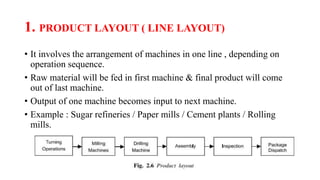
1. PRODUCT LAYOUT ( LINE LAYOUT)
• It involves the arrangement of machines in one line , depending on
operation sequence.
• Raw material will be fed in first machine & final product will come
out of last machine.
• Output of one machine becomes input to next machine.
• Example : Sugar refineries / Paper mills / Cement plants / Rolling
mills.
ADVANTAGES
• Smooth & regular flow of
finished goods.
• In-process inventory is less.
• Shorter processing time due to
less travel , storage & inspection
frequency.
• Minimum material handling
cost.
• Low cost labors & lesser training
requirement.
DISADVANTAGES
• Heavy capital investment.
• Non flexible layout .
• Risk of total production line
shutdown.
2. PROCESS LAYOUT (FUNCTIONAL LAYOUT )
• Facilities are grouped together according to their function.
• Its best suited for intermittent type of operation.
• Machines on layout are called as general purpose machines.
• Example : Machines performing grinding operation are installed
in grinding dept., Machines performing drilling operation are
installed in drilling dept., Heat Treatment / Painting etc.
ADVANTAGES
• Highly flexible
• Investment on equipment will be
comparatively low .
• Better utilization of machines.
• Easy to handle machine
breakdown by transfer of to
another machine.
DISADVANTAGES
• Requires more floor space.
• Difficulty in movement of
material.
• Production control is difficult.
• High production time as material
has to travel from place to place.
3.FIXED POSITION LAYOUT(STATIC PRODUCT
LAYOUT )
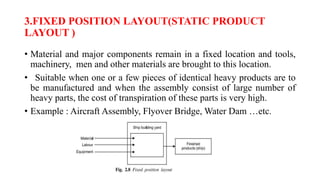
• Material and major components remain in a fixed location and tools,
machinery, men and other materials are brought to this location.
• Suitable when one or a few pieces of identical heavy products are to
be manufactured and when the assembly consist of large number of
heavy parts, the cost of transpiration of these parts is very high.
• Example : Aircraft Assembly, Flyover Bridge, Water Dam …etc.
ADVANTAGES
• Layout capital investment is
very low.
• Greater flexibility with this
type of layout.
• The high cost & difficulty in
transporting a bulky product
are avoided.
4. HYBRID LAYOUT (COMBINATION LAYOUT )
• It combines the advantage of both types of product & process
layouts.
• A combination layout is possible where the item is being
made in different types and sizes.
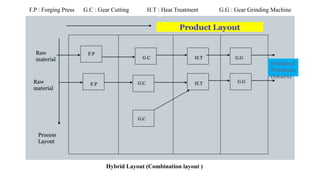
• Here, the machinery is arranged in a process layout, but then
the process grouping is then arranged in a sequence to
produce various types and sizes of product.
Hybrid Layout (Combination layout )
F.P : Forging Press G.C : Gear Cutting H.T : Heat Treatment G.G : Gear Grinding Machine
ADVANTAGES
• Helps in job enlargement.
• Greater flexibility is
possible.
• Layout capital investment is
lower.
5. CELLULAR LAYOUT (GROUP LAYOUT )
• It is a type of hybrid layout.
• Group Technology (GT) is the analysis and comparisons of items (Products)
to group them into families with similar characteristics.
• GT can be used to develop a hybrid between pure process layout and pure
flow line (product) layout.
• This technique is very useful for companies that produce variety of parts in
small batches to enable them to take advantage and economics of flowline
layout.
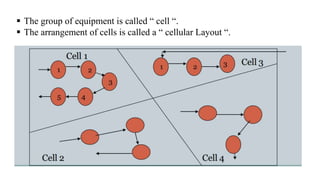
• In cellular manufacturing layout the arrangement of a facility, so that
equipment used to make similar parts or families of parts is grouped
together.
 The group of equipment is called “ cell “.
 The arrangement of cells is called a “ cellular Layout “.
ADVANTAGES
• Reduces the cost.
• Increased flexibility.
• Motivation.
DISADVANTAGES
• Not be feasible for all situations.
Group Technology has Three Aspects:-
• Grouping parts or customers into families.
• Group physical facilities into cells to reduce transportation
time between processes.
• Creating groups of multi-skilled workers.
Thank You!

POM- PLANT LAYOUT.pptx

  • 1.
  • 2.
    PLANT LAYOUT • Plantlayout refers to the physical arrangement of production facilities. • Plant layout is a plan of an optimum arrangement of facilities including personnel, operating equipment, storage space, material handling equipment and all other supporting services along with the design of best structure to contain all these facilities.
  • 3.
    OBJECTIVES OF PLANTLAYOUT • Minimum materials handling and cost • Effective utilization of men, material and space. • Minimum investment in equipment. • Minimize over all production time. • Maintain flexibility of arrangements and operations.
  • 4.
    PRINCIPLES OF PLANTLAYOUT • Principles of integration • Principles of minimum distance • Principles of cubic space utilization • Principles of flow • Principles of maximum flexibility • Principles of safety, security and satisfaction • Principles of minimum handling
  • 5.
    TYPES OF PLANTLAYOUT 1. Product Layout ( Line Layout) 2. Process Layout (Functional Layout ) 3. Fixed Position Layout (Static Product Layout ) 4. Hybrid Layout (Combination layout ) 5. Cellular Layout (Group Layout )
  • 6.
    1. PRODUCT LAYOUT( LINE LAYOUT) • It involves the arrangement of machines in one line , depending on operation sequence. • Raw material will be fed in first machine & final product will come out of last machine. • Output of one machine becomes input to next machine. • Example : Sugar refineries / Paper mills / Cement plants / Rolling mills.
  • 7.
    ADVANTAGES • Smooth &regular flow of finished goods. • In-process inventory is less. • Shorter processing time due to less travel , storage & inspection frequency. • Minimum material handling cost. • Low cost labors & lesser training requirement. DISADVANTAGES • Heavy capital investment. • Non flexible layout . • Risk of total production line shutdown.
  • 8.
    2. PROCESS LAYOUT(FUNCTIONAL LAYOUT ) • Facilities are grouped together according to their function. • Its best suited for intermittent type of operation. • Machines on layout are called as general purpose machines. • Example : Machines performing grinding operation are installed in grinding dept., Machines performing drilling operation are installed in drilling dept., Heat Treatment / Painting etc.
  • 9.
    ADVANTAGES • Highly flexible •Investment on equipment will be comparatively low . • Better utilization of machines. • Easy to handle machine breakdown by transfer of to another machine. DISADVANTAGES • Requires more floor space. • Difficulty in movement of material. • Production control is difficult. • High production time as material has to travel from place to place.
  • 10.
    3.FIXED POSITION LAYOUT(STATICPRODUCT LAYOUT ) • Material and major components remain in a fixed location and tools, machinery, men and other materials are brought to this location. • Suitable when one or a few pieces of identical heavy products are to be manufactured and when the assembly consist of large number of heavy parts, the cost of transpiration of these parts is very high. • Example : Aircraft Assembly, Flyover Bridge, Water Dam …etc.
  • 11.
    ADVANTAGES • Layout capitalinvestment is very low. • Greater flexibility with this type of layout. • The high cost & difficulty in transporting a bulky product are avoided.
  • 12.
    4. HYBRID LAYOUT(COMBINATION LAYOUT ) • It combines the advantage of both types of product & process layouts. • A combination layout is possible where the item is being made in different types and sizes. • Here, the machinery is arranged in a process layout, but then the process grouping is then arranged in a sequence to produce various types and sizes of product.
  • 13.
    Hybrid Layout (Combinationlayout ) F.P : Forging Press G.C : Gear Cutting H.T : Heat Treatment G.G : Gear Grinding Machine
  • 14.
    ADVANTAGES • Helps injob enlargement. • Greater flexibility is possible. • Layout capital investment is lower.
  • 15.
    5. CELLULAR LAYOUT(GROUP LAYOUT ) • It is a type of hybrid layout. • Group Technology (GT) is the analysis and comparisons of items (Products) to group them into families with similar characteristics. • GT can be used to develop a hybrid between pure process layout and pure flow line (product) layout. • This technique is very useful for companies that produce variety of parts in small batches to enable them to take advantage and economics of flowline layout. • In cellular manufacturing layout the arrangement of a facility, so that equipment used to make similar parts or families of parts is grouped together.
  • 16.
     The groupof equipment is called “ cell “.  The arrangement of cells is called a “ cellular Layout “.
  • 17.
    ADVANTAGES • Reduces thecost. • Increased flexibility. • Motivation. DISADVANTAGES • Not be feasible for all situations. Group Technology has Three Aspects:- • Grouping parts or customers into families. • Group physical facilities into cells to reduce transportation time between processes. • Creating groups of multi-skilled workers.
  • 18.