LIQUID DOSAGE FORMS
1
LIQUIDS ORALS
Liquid pharmaceuticals encountered in the pilot
plant are defined as non sterile solutions, suspensions
or emulsions. Scale of each of these present a different
set of processing concerns that must be considered
Liquid orals are the liquid dosage formulations
containing one (or) more active ingredients with (or)
without additives dissolved in a suitable vehicle, meant
for oral administration
2
• The physical form of a drug product that is pourable
displays Newtonian or pseudoplastic flow behaviour
and comforts to it’s container at room temperature.
• Liquid dosage forms may be dispersed systems or
solutions.
• In dispersed systems there are two or more phases,
where one phase is distributed in another.
• A solution refers two or more substances mixed
homogeneously.
3
TYPES OF ORAL LIQUIDS
SOLUTIONS
EMULSION
SUSPENSION
4
OBJECTIVE
A formula is transformed into a viable robust product using
reliable and practical method of manufacture that effects the
orderly transition from lab to routine processing in a full-scale
production
5
STEPSINVOLVEDIN PILOTPLANTFOR LIQUID
ORAL
• Reporting responsibility
• Personal requirements
• Space requirements
• Review of the formula
• Raw materials
• Relevant processing equipments
• Production rates
• Process evaluation
• GMP consideration
• Transfer of analytic method to quality assurance
6
7
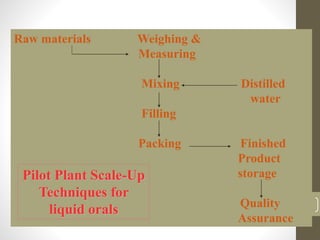
Raw materials Weighing &
Measuring
Mixing Distilled
water
Filling
Packing Finished
Product
storage
Quality
Assurance
Pilot Plant Scale-Up
Techniques for
liquid orals
General Consideration:
I. Reportingresponsibilities:
• The goal of pilot plant scale is to facilitate the
transfer of a product from the laboratory in to
production.
• The formulators continue to provide support to the
production even after the transition in to production
has been completed.
• There must be good relation between pilot plant and
other departments. 8
II. Personnelrequirements:
Have good theoretic knowledge
of pharmaceutics.
Practical experience in liquid orals
manufacturing industry.
Chemical, physical, biochemical
and medical properties of drugs.
Have the knowledge of computer,
electronics. 9
III. Space requirements:
• Administration and information processing area
• Physical testing area
• Standard pilot plant equipment floor space
• Storage area
10
Administration and information
processing area
11
Physical testing area
12
Standard pilot plant equipment floor
space
13
Storage area
14
IV Reviewof formula:
• A thorough review of each and every steps of
formulation is important
• The purpose of each ingredient and its
contribution to the final product should be
studied
• If any modification in formula, it should be done
as soon as possible in phase III trials to allow
time to generate meaningful long term stability
in a support of a proposed new drug application
15
V. Rawmaterials:
• One responsibility of pilot plant function is the approval and
validation of the active ingredient and excipients raw materials
used in the pharmaceutical products.
• The quality of the active ingredients needs to be verified.
16
Formulationconsideration:
 Solvents
 Preservatives
 Antioxidants
 Solubilizers
 Organoleptic agents etc.
17
SOLVENTS
• Water
• Alcohol
• Glycerol
• Polyethylene glycol
• Propylene glycol.
18
Water
• Compared to ordinary drinking water , purified water USP is
more free of solid impurities.
• When evaporated to dryness, it must not yield greater than
0.001% of residue.
• Purified water is obtained by distillation, ion-exchange
treatment, reverse osmosis and other relevant method
19
PRESERVATIVES
• Preservatives are added to prevent the microbial growth
• Preservative are necessary due to chances of microbial
growth
• Raw material, processing containers & equipments, the
manufacturing environment, operators, packing
materials & the user.
• Phenol, chlorocresol, benzoic acid, etc.
20
• Antioxidants: ascorbic acid, sodium thiosulphate, sodium
metabisulphate.
• Solubilizers: co-solvents and surface active agents
• Organoleptic agents etc: colour, flavor, sweetening agents
21
VI. Relevantprocessingequipment:
• Almost all formulation development work is carried out on small,
relatively simple laboratory equipment.
• The equipment that is most economical, the simplest, the most
efficient should be selected
• Liquid pharmaceutical processing tanks, kettles, pipes, mills, filter
housings, and so forth are most frequently fabricated from stainless
steel.
• Of the three types commonly used in the industry (304, 308, and
316), type 316 is most often used because it is the least reactive.
• Ease of cleaning should be considered, if multiple products are to
be manufacture in the same equipment.
22
Stagesof operations:
1.Tankselection
• Material of the tank must not be
additive to the product
• The shape and size of equipment
must be selected according to the
batch size
• The tanks are usually constructed of
polished stainless steel of different
grades
• Teflon and glass lined tank.
• Adequate clean-up procedures
developed. 23
2.Mixing
• Simple mixing is essential to increase
flow of liquids.
• If the liquid is of high viscosity, high
electrical stirrer may be used.
• Addition of ingredients in proper order
have vital important.
• At high viscosity the chance of air
entrapment. 24
Air entrapmentMinimize:-
• By reducing agitator speed
• By caring out the mixing procedure in enclosed tank under
vacuum
• The alternative procedure to the all is versator
25
Versator
26
3. Dispersion
• Suspensions and emulsions
require considerably greater shear
forces
• Laboratory formulation is difficult
to duplicate at large scale
• Dispersion produced by colloidal
mill or an immersion homogenizer
• Variety of equipment should
evaluated for better results.
27
Homogenizer
Colloidal mill
4. Filtrationand clarification—
• Filtration procedure, requires careful evaluation to
ensure that pilot scale-ups will exhibit the same degree
of clarity as their laboratory counterparts.
• During the pilot run the clarity of the filtrate should be
checked periodically, in order to establish schedule for
changing pads, cake, or cartridges, depending on the type
of filtration employed.
• In filtration, filter pads are used which is made up of
asbestos and cellulose.
Selection of filtration depends on
• The product viscosity
• Volumes
• Rate requirement 28
5. Transferand filling
• Filling – important parameter in the transfer of liquids from tank to
tank and into containers.
• New batches should not be started until the previous batches are
completely filled and the tanks are emptied.
• Bins and Piping
29
Methods for filling of liquids:-
• The selection of equipment
depends on characteristic of
liquid such as, viscosity, type of
packaging, surface tension.
• Gravimetric (specific weight)
• Volumetric (specific volume)
• Constant volume filling
30
Gravimetric Volumetric
Containers and closures:
• Glass
• Plastic
• It is more important to store the final product in
container until its expiration.
• Most oral liquids are packed in either amber or
flint glass containers with plastic or metal caps.
31
VII. Productionrates:-
• The immediate and future market requirements -estimating
the production rates, selecting the type and the size of the
equipment needed.
• Determining the product loss in the equipment during
manufacture.
• The time required to clean the equipment between batches.
• The number of batches that will need to be tested for release.
32
VIII. Processevaluation:-
Items that should be examined include the following-
• Mixing speed
• Mixing time
• Rate of addition of solvents, solutions of drug, slurries etc
• Heating and cooling rates
• Filter sizes
• Filling
33
IX. Preparationof manufacturing
procedures:-
• The processing directions should be precise and explicit.
• The batch records should include addition rates, mixing
times, mixing speeds heating and cooling rates and
temperature should be given.
• Finished product specification and release specification
are set; they should be take into consideration.
34
X. GMPconsiderations:-
A check list of GMP items
Equipment qualification
Process validation
Regular process review and revalidation
Relevant written SOP
Adequate provision for training of personnel
A well defined technology transfer system
An orderly arrangement of equipments 35
XI. Transferof analyticmethodto quality
assurance:-
• During the scale up new product the analytic test methods
transferred to the quality department.
• The quality assurance staff should review the process to make
sure that the proper analysis instrumentation is available and
that personnel are trained to perform tests.
36
Viscosity-
• It is the internal resistance (or) friction to the
movement of molecules to “FLOW”.
• Agents which control viscosity
E.g. Polyvinylpyrrolidine, alginates, carbomers, and
various cellulose derivatives. .
37
Purpose to control Viscosity -
1. Improve pour ability.
2. Improve acceptability.
3. Improve palatability.
Equipment used for this purpose
are as followed-
By OSTWALD VISCOMETER
(Or)
BY FALLING SPHERE VISCOMETER.
38
OSTWALD VISCOMETER
FALLING SPHERE VISCOMETER
Preservativeevaluation
• Preservative evaluation – should be done in addition to
physical and chemical tests.
• Depending on the nature of the product and degree of
protection required the surface of the product can be
over lapped during filling or holding stages with carbon
dioxide or nitrogen.
• Bacteriological testing should be done, to know if the
concentration of preservative is to be increased in the
formulation
39
Stabilitystudies:-
• Physical: Physical instability of liquid formulations involves the
formation of precipitates, less-soluble polymorphs, and adsorption
of the drug substances onto container surfaces, changes in product
appearance.
• Chemical: Chemical instability of liquid formulation is mainly due to
interaction between additives, oxidation or some due to interaction
with containers.
• Microbiological: It is the most favorable condition for the growth of
microorganism. So studies must me conducted for different
microbiological test. Different preservatives are used to make
product more stable.
40
Type of changes:
• Contents: Viscosity, Texture, Color, Odour, pH
• Containers: a) Leakage, b) Corrosion, c) Stress d)
cracking
• Glass container
• Plastic or metal cap
41
REFERENCES:
• Leon Lachman, Liberman & Joseph.L, The theory & practice of industrial
pharmacy. 3rd Ed., Vargese publishing house-1991, 466-75,681-84,703-706.
• James Swarbrick, encyclopedia of pharmaceutical technology Third Edition
volume 5.
• Herbert A. Lieberman, Martin M. Rieger and Gilbert S. Banker, pharmaceutical
dosage forms: Disperse system vol 1.
• Howard C. Ansel Introduction to pharmaceutical dosage forms, 4th edition.
• www.google.com
42
The optimized conditions can be achieved
using a surfactant immersion fluid along with
the dark background and High intensity
lighting.used for the lyophilized vials
of biopharmaceuticals.
43

RK- liquid dosage forms.pptx

  • 1.
  • 2.
    LIQUIDS ORALS Liquid pharmaceuticalsencountered in the pilot plant are defined as non sterile solutions, suspensions or emulsions. Scale of each of these present a different set of processing concerns that must be considered Liquid orals are the liquid dosage formulations containing one (or) more active ingredients with (or) without additives dissolved in a suitable vehicle, meant for oral administration 2
  • 3.
    • The physicalform of a drug product that is pourable displays Newtonian or pseudoplastic flow behaviour and comforts to it’s container at room temperature. • Liquid dosage forms may be dispersed systems or solutions. • In dispersed systems there are two or more phases, where one phase is distributed in another. • A solution refers two or more substances mixed homogeneously. 3
  • 4.
    TYPES OF ORALLIQUIDS SOLUTIONS EMULSION SUSPENSION 4
  • 5.
    OBJECTIVE A formula istransformed into a viable robust product using reliable and practical method of manufacture that effects the orderly transition from lab to routine processing in a full-scale production 5
  • 6.
    STEPSINVOLVEDIN PILOTPLANTFOR LIQUID ORAL •Reporting responsibility • Personal requirements • Space requirements • Review of the formula • Raw materials • Relevant processing equipments • Production rates • Process evaluation • GMP consideration • Transfer of analytic method to quality assurance 6
  • 7.
    7 Raw materials Weighing& Measuring Mixing Distilled water Filling Packing Finished Product storage Quality Assurance Pilot Plant Scale-Up Techniques for liquid orals
  • 8.
    General Consideration: I. Reportingresponsibilities: •The goal of pilot plant scale is to facilitate the transfer of a product from the laboratory in to production. • The formulators continue to provide support to the production even after the transition in to production has been completed. • There must be good relation between pilot plant and other departments. 8
  • 9.
    II. Personnelrequirements: Have goodtheoretic knowledge of pharmaceutics. Practical experience in liquid orals manufacturing industry. Chemical, physical, biochemical and medical properties of drugs. Have the knowledge of computer, electronics. 9
  • 10.
    III. Space requirements: •Administration and information processing area • Physical testing area • Standard pilot plant equipment floor space • Storage area 10
  • 11.
  • 12.
  • 13.
    Standard pilot plantequipment floor space 13
  • 14.
  • 15.
    IV Reviewof formula: •A thorough review of each and every steps of formulation is important • The purpose of each ingredient and its contribution to the final product should be studied • If any modification in formula, it should be done as soon as possible in phase III trials to allow time to generate meaningful long term stability in a support of a proposed new drug application 15
  • 16.
    V. Rawmaterials: • Oneresponsibility of pilot plant function is the approval and validation of the active ingredient and excipients raw materials used in the pharmaceutical products. • The quality of the active ingredients needs to be verified. 16
  • 17.
    Formulationconsideration:  Solvents  Preservatives Antioxidants  Solubilizers  Organoleptic agents etc. 17
  • 18.
    SOLVENTS • Water • Alcohol •Glycerol • Polyethylene glycol • Propylene glycol. 18
  • 19.
    Water • Compared toordinary drinking water , purified water USP is more free of solid impurities. • When evaporated to dryness, it must not yield greater than 0.001% of residue. • Purified water is obtained by distillation, ion-exchange treatment, reverse osmosis and other relevant method 19
  • 20.
    PRESERVATIVES • Preservatives areadded to prevent the microbial growth • Preservative are necessary due to chances of microbial growth • Raw material, processing containers & equipments, the manufacturing environment, operators, packing materials & the user. • Phenol, chlorocresol, benzoic acid, etc. 20
  • 21.
    • Antioxidants: ascorbicacid, sodium thiosulphate, sodium metabisulphate. • Solubilizers: co-solvents and surface active agents • Organoleptic agents etc: colour, flavor, sweetening agents 21
  • 22.
    VI. Relevantprocessingequipment: • Almostall formulation development work is carried out on small, relatively simple laboratory equipment. • The equipment that is most economical, the simplest, the most efficient should be selected • Liquid pharmaceutical processing tanks, kettles, pipes, mills, filter housings, and so forth are most frequently fabricated from stainless steel. • Of the three types commonly used in the industry (304, 308, and 316), type 316 is most often used because it is the least reactive. • Ease of cleaning should be considered, if multiple products are to be manufacture in the same equipment. 22
  • 23.
    Stagesof operations: 1.Tankselection • Materialof the tank must not be additive to the product • The shape and size of equipment must be selected according to the batch size • The tanks are usually constructed of polished stainless steel of different grades • Teflon and glass lined tank. • Adequate clean-up procedures developed. 23
  • 24.
    2.Mixing • Simple mixingis essential to increase flow of liquids. • If the liquid is of high viscosity, high electrical stirrer may be used. • Addition of ingredients in proper order have vital important. • At high viscosity the chance of air entrapment. 24
  • 25.
    Air entrapmentMinimize:- • Byreducing agitator speed • By caring out the mixing procedure in enclosed tank under vacuum • The alternative procedure to the all is versator 25
  • 26.
  • 27.
    3. Dispersion • Suspensionsand emulsions require considerably greater shear forces • Laboratory formulation is difficult to duplicate at large scale • Dispersion produced by colloidal mill or an immersion homogenizer • Variety of equipment should evaluated for better results. 27 Homogenizer Colloidal mill
  • 28.
    4. Filtrationand clarification— •Filtration procedure, requires careful evaluation to ensure that pilot scale-ups will exhibit the same degree of clarity as their laboratory counterparts. • During the pilot run the clarity of the filtrate should be checked periodically, in order to establish schedule for changing pads, cake, or cartridges, depending on the type of filtration employed. • In filtration, filter pads are used which is made up of asbestos and cellulose. Selection of filtration depends on • The product viscosity • Volumes • Rate requirement 28
  • 29.
    5. Transferand filling •Filling – important parameter in the transfer of liquids from tank to tank and into containers. • New batches should not be started until the previous batches are completely filled and the tanks are emptied. • Bins and Piping 29
  • 30.
    Methods for fillingof liquids:- • The selection of equipment depends on characteristic of liquid such as, viscosity, type of packaging, surface tension. • Gravimetric (specific weight) • Volumetric (specific volume) • Constant volume filling 30 Gravimetric Volumetric
  • 31.
    Containers and closures: •Glass • Plastic • It is more important to store the final product in container until its expiration. • Most oral liquids are packed in either amber or flint glass containers with plastic or metal caps. 31
  • 32.
    VII. Productionrates:- • Theimmediate and future market requirements -estimating the production rates, selecting the type and the size of the equipment needed. • Determining the product loss in the equipment during manufacture. • The time required to clean the equipment between batches. • The number of batches that will need to be tested for release. 32
  • 33.
    VIII. Processevaluation:- Items thatshould be examined include the following- • Mixing speed • Mixing time • Rate of addition of solvents, solutions of drug, slurries etc • Heating and cooling rates • Filter sizes • Filling 33
  • 34.
    IX. Preparationof manufacturing procedures:- •The processing directions should be precise and explicit. • The batch records should include addition rates, mixing times, mixing speeds heating and cooling rates and temperature should be given. • Finished product specification and release specification are set; they should be take into consideration. 34
  • 35.
    X. GMPconsiderations:- A checklist of GMP items Equipment qualification Process validation Regular process review and revalidation Relevant written SOP Adequate provision for training of personnel A well defined technology transfer system An orderly arrangement of equipments 35
  • 36.
    XI. Transferof analyticmethodtoquality assurance:- • During the scale up new product the analytic test methods transferred to the quality department. • The quality assurance staff should review the process to make sure that the proper analysis instrumentation is available and that personnel are trained to perform tests. 36
  • 37.
    Viscosity- • It isthe internal resistance (or) friction to the movement of molecules to “FLOW”. • Agents which control viscosity E.g. Polyvinylpyrrolidine, alginates, carbomers, and various cellulose derivatives. . 37
  • 38.
    Purpose to controlViscosity - 1. Improve pour ability. 2. Improve acceptability. 3. Improve palatability. Equipment used for this purpose are as followed- By OSTWALD VISCOMETER (Or) BY FALLING SPHERE VISCOMETER. 38 OSTWALD VISCOMETER FALLING SPHERE VISCOMETER
  • 39.
    Preservativeevaluation • Preservative evaluation– should be done in addition to physical and chemical tests. • Depending on the nature of the product and degree of protection required the surface of the product can be over lapped during filling or holding stages with carbon dioxide or nitrogen. • Bacteriological testing should be done, to know if the concentration of preservative is to be increased in the formulation 39
  • 40.
    Stabilitystudies:- • Physical: Physicalinstability of liquid formulations involves the formation of precipitates, less-soluble polymorphs, and adsorption of the drug substances onto container surfaces, changes in product appearance. • Chemical: Chemical instability of liquid formulation is mainly due to interaction between additives, oxidation or some due to interaction with containers. • Microbiological: It is the most favorable condition for the growth of microorganism. So studies must me conducted for different microbiological test. Different preservatives are used to make product more stable. 40
  • 41.
    Type of changes: •Contents: Viscosity, Texture, Color, Odour, pH • Containers: a) Leakage, b) Corrosion, c) Stress d) cracking • Glass container • Plastic or metal cap 41
  • 42.
    REFERENCES: • Leon Lachman,Liberman & Joseph.L, The theory & practice of industrial pharmacy. 3rd Ed., Vargese publishing house-1991, 466-75,681-84,703-706. • James Swarbrick, encyclopedia of pharmaceutical technology Third Edition volume 5. • Herbert A. Lieberman, Martin M. Rieger and Gilbert S. Banker, pharmaceutical dosage forms: Disperse system vol 1. • Howard C. Ansel Introduction to pharmaceutical dosage forms, 4th edition. • www.google.com 42
  • 43.
    The optimized conditionscan be achieved using a surfactant immersion fluid along with the dark background and High intensity lighting.used for the lyophilized vials of biopharmaceuticals. 43