Presented By,
Manisha Rajpurohit (14mph804)
Prachi Sacklecha (14mph305)
Sem:1;M.Pharm
Validation in pharmaceutical manufacturing
Guided By,
Dr. Charmi kothari
Department of pharmaceutical analysis
 Definition
 Objective and goals
 Equipment Qualification:
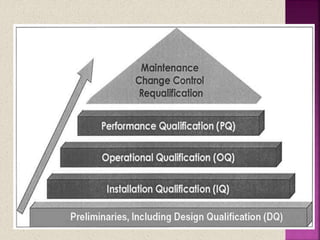
 DQ
 IQ
 OQ
 PQ
 Documentation
 Change control
 revalidation
 Equipment is the collective analytical
measurement instruments, assembled to
perform a mechanical process.
 Equipment qualification is the action of
proving that any equipment works
correctly and actually leads to accurate
and reliable results
 Qualification :Qualification is an act or
process to assure something complies
with some condition, standard, or specific
requirements
 It applies on one element of process to be
validated.
 Validation:proof document that the
process will consistently produce a
predetermine outcome
Easy maintenance of equipment and safety
to improve overall production reliability and availability
Control of product quality
Reduction of variation in results
Fewer interruptions of work
Lower repair costs
Identification of high maintenance cost
The goals for equipment qualification are:
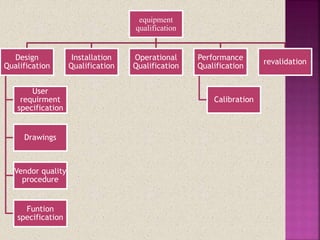
equipment
qualification
Design
Qualification
User
requirment
specification
Drawings
Vendor quality
procedure
Funtion
specification
Installation
Qualification
Operational
Qualification
Performance
Qualification
Calibration
revalidation
 Always written for a technical system
 Goal :
◦ To document the needs of the
manufacturing department.
◦ To generate a document detailing all
the GMP requirements that the
technical system has to fulfill
1.Equipment Design, Size and Location
Pharmaceutical companies are not directly involved
with the design and the construction of equipment but
they can contribute indirectly.
They can provide information on requirements and
feedback on existing equipment.
2.Location of equipment
Equipment should be placed in such a manner so that
it enables all parts requiring maintenance,
instrumentation calibration to be easily
accessible.
3. Equipment construction
The equipment surface should be inert with
regards to the API, critical utilities i.e. water,
compressed gas so on..
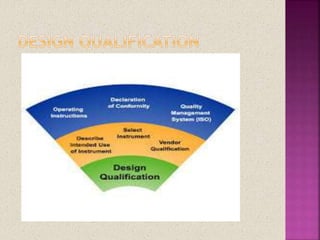
 "Design qualification (DQ) defines the functional
and operational specifications of the instrument
and details for the conscious decisions in the
selection of the supplier".
 Steps that should be considered in a design
qualification:
 Description of the analysis problem
 Description of the intended use of the equipment
 Description of the intended environment
Preliminary selection of the functional and
performance specifications
Preliminary selection of the supplier
Instrument tests (if the technique is new)
Final selection of the equipment
Preliminary selection of the
functional and performance
specifications
Preliminary selection of the supplier
Instrument tests (if the technique is
new)
Final selection of the equipment
 Definition:
 “The performance end documentation of
tests to ensure that equipment (such as
machines, measuring equipments) used in a
manufacturing process are appropriately
selected, correctly installed and work in
accordance with established specifications.”
 Aim:
 To check documentation against reality
 Verifies that the equipments are installed in
accordance with design specification,
manufacturer recommendation and cGMPs
 Confirms that critical instruments are
calibrated
 Pre-shipment inspection of equipment
and documentation included as part of IQ
 Pre-shipment inspection can be
performed along with vendor audits to
address issues such as software
development and quality assurance
plans, operational reports and specific
vendor/purchaser inspection reports.
Equipment management group
Support Groups
Plant Engineering Group
Content of IQ protocol
 Description
 History
 Fundamentals
 Purpose
 Attachments of IQ
 Results of test
 Acceptance criteria:
 General
 Specific
 Documentation
•Specification
Check completeness and current status of
documentation
 Check delivered equipment from manufacturer
Check if all parts of plant are according to their
specification
 Check the identity of all parts of the plant
Visual check of complete and craftsmanship
installation of all parts
 Material used are within specifications
 "Operational qualification (OQ) is the process of
demonstrating that an instrument will function
according to its operational specification in the
selected environment within the acceptance
criteria"
 The protocol must contain procedures to start up the
equipment according to the operating manuals.
 Process controls that are part of the equipment i.e.
Programmable Logic Controller (PLC) will be
qualified during the OQ. [computerized process
controls should be qualified in the computer
validation process.
 OQ implies that all functions and features
included with the system are operational.
 SOP for use, maintenance ,calibration and
cleaning of the plant must be developed
during the OQ process, as well as schedules
for maintenance and calibration.
 Any failure in this qualification is a
deviation and must be corrected.
 A conclusion is drawn regarding the
operation of equipment after the test
functions are checked and all data has
been analyzed.
 Following are the contents of equipment
operation qualification
1.Application S.O.P’s
2.Utilization List
3.Process Description
4.Test Instrument Utilized To Conduct Test
5.Test Instrument Calibration
6.Critical Parameters
7.Test Function (List)
8.Test Function Summaries
 The final section for equipment qualification
protocols is the performance qualification (PQ).
This is the process of demonstrating that an
instrument or piece of equipment consistently
performs according to a specification
appropriate for its routine use.
 PQ implies that factors such as loads, volumes
and other capacity and power-related issues
are not problematic throughout the specified
ranges. In general, test methods shall be
executed in the order presented in the
protocol.
PQ should always be performed
under conditions that are similar to
routine sample analysis.
PQ should be performed on a daily
basis or whenever the equipment is
being used.
In practice, PQ can mean system
suitability testing, where critical key
system performance characteristics
are measured and compared with
documented.
 To quickly locate any given document ,it
is mandatory to have implemented an
appropriate documentation system .
 In case of a fault in production inspection
,it become necessary to a find a
document within 15 to 20 min.
 All companies should test the reliability
of their documentation system using
internal audits.
 One aspect of a working documented
using the same document mentation
structure.
Change control is define in the document PI
006 as follows “A formal system by which
representative of appropriate disciplines
review proposed or actual change that
might affect a validation status .the
intent is to determine the need for action
that would ensure and document that the
system is maintained in a validated state”
 Requalification is Required for:
 significant change in batch size
 change in operating parameters
 component specifications have changed
 new accessories or components are
added to previously qualified equipment
 process changes that potentially impact
product effectiveness or quality
Autoclave is used for stem sterilization
 Advantage of steam
sterilisation(autoclave)
 More efficiency
 Easy to operate
 Cheap
 Disadvantage:
 Not used for thermolabile material
 Excessive pressure may cause explosion
 Leakage affect the stearilisation
 The following pieces of equipment should
be calibrated by removing or in situation .
Pressure Gauges
Timing Devices
Temperature Recording Devices
Verification of safety systems and Devices
Power source
 Cycle development :-
Placing Thermocouples
Placing biological indicators and chemical
indicators
• Empty cycle
• Minimum load
• Maximum load
 Temperature distribution
 Heat penetration
 Acceptance criteria of validation
D value
Z value
 Time required for 1 log ( or 90%) reuction
of microorganism population at base
temperature
 Determine the D value of N organism at
minimum 3 different temperature
 Construct a thermal death curve by
plotting the logarithm of the D value VS
temperature
Any change to the sterilization equipment
and related utilities should be evaluated
by a change control procedure.
Typical changes requiring revalidation:-
 Any changes in operating cycle(i.e.
temperature ,time ,chamber pressure
 Change in load configuration
 Change in sterilized materials
 Measure maintenance work on critical
instrument/elements utilities
 Berry I.R., and Nash R.A., “Pharmaceutical Process
validation”, second edition, revised and expanded;
Marcel Dekker series; 83-110.
 Agalloco J.A, Carleton F.A, “Validation of
Pharmaceutical Process”, Third Edition, 175,223.
 Willig Sidney H., “Good Manufacturing Practices for
Pharmaceuticals”, 5th edition, Marcel Dekker
Publication, Page No: 65-80
 Nally Joseph D. “Good Manufacturing Practices for
Pharmaceuticals”, 6th edition, Infoma Healthcare
Publication, Page No: 51-70
 Sharma P.P. “Validation in Pharmaceutical Industry”
Page No. : 119-150
 Haider Syed Imtiaz, “ Pharmaceutical Master
Validation Plan: The Ultimate Guide to FDA, GMP,
and GLP Compliance”
 www.fda.gov
 Wood, R.T; Journal of Parental drug association;
volume 34; 286-294
The journey of a thousand miles begins with a
single step…

Equipment qualification

  • 1.
    Presented By, Manisha Rajpurohit(14mph804) Prachi Sacklecha (14mph305) Sem:1;M.Pharm Validation in pharmaceutical manufacturing Guided By, Dr. Charmi kothari Department of pharmaceutical analysis
  • 2.
     Definition  Objectiveand goals  Equipment Qualification:  DQ  IQ  OQ  PQ  Documentation  Change control  revalidation
  • 3.
     Equipment isthe collective analytical measurement instruments, assembled to perform a mechanical process.  Equipment qualification is the action of proving that any equipment works correctly and actually leads to accurate and reliable results
  • 4.
     Qualification :Qualificationis an act or process to assure something complies with some condition, standard, or specific requirements  It applies on one element of process to be validated.  Validation:proof document that the process will consistently produce a predetermine outcome
  • 5.
    Easy maintenance ofequipment and safety to improve overall production reliability and availability Control of product quality Reduction of variation in results Fewer interruptions of work Lower repair costs Identification of high maintenance cost The goals for equipment qualification are:
  • 6.
  • 8.
     Always writtenfor a technical system  Goal : ◦ To document the needs of the manufacturing department. ◦ To generate a document detailing all the GMP requirements that the technical system has to fulfill 1.Equipment Design, Size and Location Pharmaceutical companies are not directly involved with the design and the construction of equipment but they can contribute indirectly. They can provide information on requirements and feedback on existing equipment.
  • 9.
    2.Location of equipment Equipmentshould be placed in such a manner so that it enables all parts requiring maintenance, instrumentation calibration to be easily accessible. 3. Equipment construction The equipment surface should be inert with regards to the API, critical utilities i.e. water, compressed gas so on..
  • 10.
     "Design qualification(DQ) defines the functional and operational specifications of the instrument and details for the conscious decisions in the selection of the supplier".  Steps that should be considered in a design qualification:  Description of the analysis problem  Description of the intended use of the equipment  Description of the intended environment Preliminary selection of the functional and performance specifications Preliminary selection of the supplier Instrument tests (if the technique is new) Final selection of the equipment
  • 11.
    Preliminary selection ofthe functional and performance specifications Preliminary selection of the supplier Instrument tests (if the technique is new) Final selection of the equipment
  • 13.
     Definition:  “Theperformance end documentation of tests to ensure that equipment (such as machines, measuring equipments) used in a manufacturing process are appropriately selected, correctly installed and work in accordance with established specifications.”  Aim:  To check documentation against reality  Verifies that the equipments are installed in accordance with design specification, manufacturer recommendation and cGMPs  Confirms that critical instruments are calibrated
  • 14.
     Pre-shipment inspectionof equipment and documentation included as part of IQ  Pre-shipment inspection can be performed along with vendor audits to address issues such as software development and quality assurance plans, operational reports and specific vendor/purchaser inspection reports.
  • 15.
    Equipment management group SupportGroups Plant Engineering Group
  • 16.
    Content of IQprotocol  Description  History  Fundamentals  Purpose  Attachments of IQ  Results of test  Acceptance criteria:  General  Specific  Documentation
  • 17.
    •Specification Check completeness andcurrent status of documentation  Check delivered equipment from manufacturer Check if all parts of plant are according to their specification  Check the identity of all parts of the plant Visual check of complete and craftsmanship installation of all parts  Material used are within specifications
  • 19.
     "Operational qualification(OQ) is the process of demonstrating that an instrument will function according to its operational specification in the selected environment within the acceptance criteria"  The protocol must contain procedures to start up the equipment according to the operating manuals.  Process controls that are part of the equipment i.e. Programmable Logic Controller (PLC) will be qualified during the OQ. [computerized process controls should be qualified in the computer validation process.
  • 20.
     OQ impliesthat all functions and features included with the system are operational.  SOP for use, maintenance ,calibration and cleaning of the plant must be developed during the OQ process, as well as schedules for maintenance and calibration.  Any failure in this qualification is a deviation and must be corrected.  A conclusion is drawn regarding the operation of equipment after the test functions are checked and all data has been analyzed.
  • 21.
     Following arethe contents of equipment operation qualification 1.Application S.O.P’s 2.Utilization List 3.Process Description 4.Test Instrument Utilized To Conduct Test 5.Test Instrument Calibration 6.Critical Parameters 7.Test Function (List) 8.Test Function Summaries
  • 23.
     The finalsection for equipment qualification protocols is the performance qualification (PQ). This is the process of demonstrating that an instrument or piece of equipment consistently performs according to a specification appropriate for its routine use.  PQ implies that factors such as loads, volumes and other capacity and power-related issues are not problematic throughout the specified ranges. In general, test methods shall be executed in the order presented in the protocol.
  • 24.
    PQ should alwaysbe performed under conditions that are similar to routine sample analysis. PQ should be performed on a daily basis or whenever the equipment is being used. In practice, PQ can mean system suitability testing, where critical key system performance characteristics are measured and compared with documented.
  • 26.
     To quicklylocate any given document ,it is mandatory to have implemented an appropriate documentation system .  In case of a fault in production inspection ,it become necessary to a find a document within 15 to 20 min.  All companies should test the reliability of their documentation system using internal audits.  One aspect of a working documented using the same document mentation structure.
  • 27.
    Change control isdefine in the document PI 006 as follows “A formal system by which representative of appropriate disciplines review proposed or actual change that might affect a validation status .the intent is to determine the need for action that would ensure and document that the system is maintained in a validated state”
  • 28.
     Requalification isRequired for:  significant change in batch size  change in operating parameters  component specifications have changed  new accessories or components are added to previously qualified equipment  process changes that potentially impact product effectiveness or quality
  • 30.
    Autoclave is usedfor stem sterilization  Advantage of steam sterilisation(autoclave)  More efficiency  Easy to operate  Cheap  Disadvantage:  Not used for thermolabile material  Excessive pressure may cause explosion  Leakage affect the stearilisation
  • 31.
     The followingpieces of equipment should be calibrated by removing or in situation . Pressure Gauges Timing Devices Temperature Recording Devices Verification of safety systems and Devices Power source
  • 32.
     Cycle development:- Placing Thermocouples Placing biological indicators and chemical indicators • Empty cycle • Minimum load • Maximum load
  • 34.
     Temperature distribution Heat penetration  Acceptance criteria of validation D value Z value
  • 35.
     Time requiredfor 1 log ( or 90%) reuction of microorganism population at base temperature
  • 36.
     Determine theD value of N organism at minimum 3 different temperature  Construct a thermal death curve by plotting the logarithm of the D value VS temperature
  • 37.
    Any change tothe sterilization equipment and related utilities should be evaluated by a change control procedure. Typical changes requiring revalidation:-  Any changes in operating cycle(i.e. temperature ,time ,chamber pressure  Change in load configuration  Change in sterilized materials  Measure maintenance work on critical instrument/elements utilities
  • 38.
     Berry I.R.,and Nash R.A., “Pharmaceutical Process validation”, second edition, revised and expanded; Marcel Dekker series; 83-110.  Agalloco J.A, Carleton F.A, “Validation of Pharmaceutical Process”, Third Edition, 175,223.  Willig Sidney H., “Good Manufacturing Practices for Pharmaceuticals”, 5th edition, Marcel Dekker Publication, Page No: 65-80  Nally Joseph D. “Good Manufacturing Practices for Pharmaceuticals”, 6th edition, Infoma Healthcare Publication, Page No: 51-70  Sharma P.P. “Validation in Pharmaceutical Industry” Page No. : 119-150
  • 39.
     Haider SyedImtiaz, “ Pharmaceutical Master Validation Plan: The Ultimate Guide to FDA, GMP, and GLP Compliance”  www.fda.gov  Wood, R.T; Journal of Parental drug association; volume 34; 286-294
  • 40.
    The journey ofa thousand miles begins with a single step…