“Make your mistakes on a small scale 
and our profits on a large one”. 
MRS.DARSHINI SWAPNA MD NAVEED 
Department of Pharmaceutics(PHD) PHARMACEUTICS 
MRCP(OU) 256212886048
 Introduction 
 Scale-up of parenterals 
2
 In the pilot plant, a formulae is transformed 
into a viable, robust product by the 
development of a reliable and practical method 
of manufacture that effect the orderly transition 
from laboratory to routine processing in a full – 
scale production facility. 
 So pilot plant is the miniature, intermediate 
plant between the laboratory scale and the 
production plant. 
3
 To evaluate the effect on the process of a large change 
in the scale of operation and to gather other data so 
that a good design of a larger unit may be made with a 
high probability of commercial success. 
 To produce trial lot quantities of the material in 
question so that its properties may be critically 
examined. 
 To find and examine all by – products or waste. These 
may not be seen in laboratory scale. By the use of pilot 
plant, it is possible to minimize the waste, hence better 
yield of prescribed dosage form. 
4
5
 The majority of the parenteral solutions are 
solutions requiring a variety of tankage, piping 
and ancillary equipment for liquid mixing, 
filteration, transfer and related activities. 
 The majority of the equipments are composed of 
300 series austenitic stainless steel, with 
tantalum or glass lined vessels employed for 
preparation of formulations sensitive to iron and 
other metal ions. 
 The vessels can be equipped with external 
jackets for heating and/or cooling and various 
types of agitators, depending upon the mixing 
requirements of the individual formulation. 
6
 Incoming goods are stored in special areas for Quarantine, 
Released and Rejected status. 
 A cold room is available for storage of temperature-sensitive 
products. Entrance into the warehouse and 
production areas is restricted to authorized personnel. 
 Sampling and weighing of the raw material is performed in 
a dedicated sampling area and a central weighing suite, 
respectively. 
 The route for final products is separated from the incoming 
goods; storage of final products is done in designated areas 
in the warehouse while they are awaiting shipment. 
 Several clothing and cleaning procedures in the controlled 
transport zone and production area ensure full quality 
compliance. 
 In addition, a technical area is located in between the 
production zone and the area for formulation 
development. 
 Here, the water for injection equipment is located, as well 
as the technical installation of the lyophilizer. 
7
8
To provide the control of microbial, pyrogen and 
particles controls over the production 
environment are essential. 
 Warehousing: 
All samples should be aseptically taken, which 
mandates unidirectional airflow and full 
operator gowning. 
These measures reduce the potential for 
contamination ingress into materials that are yet 
to receive any processing at any site. 
9
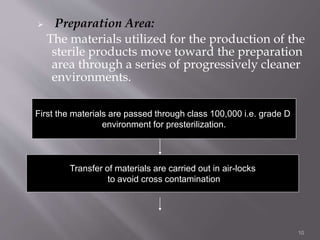
 Preparation Area: 
The materials utilized for the production of the 
sterile products move toward the preparation 
area through a series of progressively cleaner 
environments. 
10 
First the materials are passed through class 100,000 i.e. grade D 
environment for presterilization. 
Transfer of materials are carried out in air-locks 
to avoid cross contamination
11 
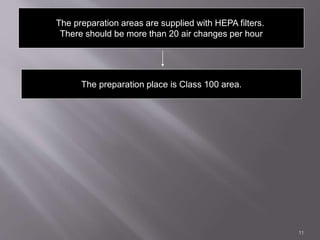
The preparation areas are supplied with HEPA filters. 
There should be more than 20 air changes per hour 
The preparation place is Class 100 area.
12
 Compounding area: 
The manufacture of parenterals is carried out in 
class 10,000 (Grade C) controlled environments 
in which class 100 unidirectional flow hoods 
are utilized to provide greater environmental 
control during material addition. 
These areas are designed to minimize the 
microbial, pyrogen, and particulate 
contamination to the formulation prior to 
sterilization. 
13
 Aseptic filling rooms: 
The filling of the formulations is performed in an Class 100 
environment. 
 Capping and Crimp sealing areas: 
The air supply in the capping line should be of Class 100 
 Corridors: 
They serve to interconnect the various rooms. Fill rooms, air 
locks and gowning rooms are assessed from the corridor. 
 Aseptic storage rooms. 
 Air-locks and pass-throughs: 
Air locks serve as a transition points between one environment 
and another. 
They are fitted with the UltraViolet lights, spray systems, or 
other devices that may be effectively utilized for 
decontamination of materials. 
14
 Solvent: 
The most widely used solvent used for 
parenteral production is water for injection. 
WFI is prepared by by distillation or reverse 
osmosis. Sterile water for injection is used as a 
vehicle for reconstitution of sterile solid 
products before administration and is 
terminally sterilized by autoclaving 
 Solubilizers: 
They are used to enhance and maintain the 
aqueous solubility of poorly water-soluble 
drugs. 
15
Solubilizing agents used in sterile products include: 
1. co-solvents: glycerine, ethanol, sorbitol, etc. 
2. Surface active agents: polysorbate 80, polysorbate 
20, lecithin. 
3. Complexing agents: cyclodextrins etc 
They act by reducing the dielectric constant 
properties of the solvent system, thereby reducing 
the electrical, conductance capabilities of the 
solvent and thus increase the solubility. 
 Antimicrobial preservative agents: 
16
 Buffers: 
They are used to maintain the pH level of a 
solution in the range that provides either 
maximum stability of the drug against 
hydrolytic degradation or maximum or 
optimal solubility of the drug in solution. 
 Antioxidants: 
Antioxidants function by reacting prefentially 
with molecular oxygen and minimizing or 
terminating the free the free radical auto-oxidation 
reaction. Examples phenol (0.065- 
0.5%), m-cresol (0.16-0.3%) etc. 
17
 Mixer 
 Homogenizer 
 Filteration assembly 
 Filling machinery 
18
19
20
21
 Steam sterilization 
 Dry-heat sterilization and depyrogenation 
 Gas and vapour sterilization 
 Radiation sterilization 
 Sterilization by filteration 
22
 In-process Testing: 
 End-product Testing: 
 Process simulations: 
Quality Assurance 
 Particulate matter 
 Pyrogen test 
 Stability test 
23
 Lachman L. The Theory and practice of 
industrial pharmacy. 3rd Edition. Varghese 
publication house. 
 www.google.com 
24
Thank You 
25

Pilot plantscaleupof parentrals

  • 1.
    “Make your mistakeson a small scale and our profits on a large one”. MRS.DARSHINI SWAPNA MD NAVEED Department of Pharmaceutics(PHD) PHARMACEUTICS MRCP(OU) 256212886048
  • 2.
     Introduction Scale-up of parenterals 2
  • 3.
     In thepilot plant, a formulae is transformed into a viable, robust product by the development of a reliable and practical method of manufacture that effect the orderly transition from laboratory to routine processing in a full – scale production facility.  So pilot plant is the miniature, intermediate plant between the laboratory scale and the production plant. 3
  • 4.
     To evaluatethe effect on the process of a large change in the scale of operation and to gather other data so that a good design of a larger unit may be made with a high probability of commercial success.  To produce trial lot quantities of the material in question so that its properties may be critically examined.  To find and examine all by – products or waste. These may not be seen in laboratory scale. By the use of pilot plant, it is possible to minimize the waste, hence better yield of prescribed dosage form. 4
  • 5.
  • 6.
     The majorityof the parenteral solutions are solutions requiring a variety of tankage, piping and ancillary equipment for liquid mixing, filteration, transfer and related activities.  The majority of the equipments are composed of 300 series austenitic stainless steel, with tantalum or glass lined vessels employed for preparation of formulations sensitive to iron and other metal ions.  The vessels can be equipped with external jackets for heating and/or cooling and various types of agitators, depending upon the mixing requirements of the individual formulation. 6
  • 7.
     Incoming goodsare stored in special areas for Quarantine, Released and Rejected status.  A cold room is available for storage of temperature-sensitive products. Entrance into the warehouse and production areas is restricted to authorized personnel.  Sampling and weighing of the raw material is performed in a dedicated sampling area and a central weighing suite, respectively.  The route for final products is separated from the incoming goods; storage of final products is done in designated areas in the warehouse while they are awaiting shipment.  Several clothing and cleaning procedures in the controlled transport zone and production area ensure full quality compliance.  In addition, a technical area is located in between the production zone and the area for formulation development.  Here, the water for injection equipment is located, as well as the technical installation of the lyophilizer. 7
  • 8.
  • 9.
    To provide thecontrol of microbial, pyrogen and particles controls over the production environment are essential.  Warehousing: All samples should be aseptically taken, which mandates unidirectional airflow and full operator gowning. These measures reduce the potential for contamination ingress into materials that are yet to receive any processing at any site. 9
  • 10.
     Preparation Area: The materials utilized for the production of the sterile products move toward the preparation area through a series of progressively cleaner environments. 10 First the materials are passed through class 100,000 i.e. grade D environment for presterilization. Transfer of materials are carried out in air-locks to avoid cross contamination
  • 11.
    11 The preparationareas are supplied with HEPA filters. There should be more than 20 air changes per hour The preparation place is Class 100 area.
  • 12.
  • 13.
     Compounding area: The manufacture of parenterals is carried out in class 10,000 (Grade C) controlled environments in which class 100 unidirectional flow hoods are utilized to provide greater environmental control during material addition. These areas are designed to minimize the microbial, pyrogen, and particulate contamination to the formulation prior to sterilization. 13
  • 14.
     Aseptic fillingrooms: The filling of the formulations is performed in an Class 100 environment.  Capping and Crimp sealing areas: The air supply in the capping line should be of Class 100  Corridors: They serve to interconnect the various rooms. Fill rooms, air locks and gowning rooms are assessed from the corridor.  Aseptic storage rooms.  Air-locks and pass-throughs: Air locks serve as a transition points between one environment and another. They are fitted with the UltraViolet lights, spray systems, or other devices that may be effectively utilized for decontamination of materials. 14
  • 15.
     Solvent: Themost widely used solvent used for parenteral production is water for injection. WFI is prepared by by distillation or reverse osmosis. Sterile water for injection is used as a vehicle for reconstitution of sterile solid products before administration and is terminally sterilized by autoclaving  Solubilizers: They are used to enhance and maintain the aqueous solubility of poorly water-soluble drugs. 15
  • 16.
    Solubilizing agents usedin sterile products include: 1. co-solvents: glycerine, ethanol, sorbitol, etc. 2. Surface active agents: polysorbate 80, polysorbate 20, lecithin. 3. Complexing agents: cyclodextrins etc They act by reducing the dielectric constant properties of the solvent system, thereby reducing the electrical, conductance capabilities of the solvent and thus increase the solubility.  Antimicrobial preservative agents: 16
  • 17.
     Buffers: Theyare used to maintain the pH level of a solution in the range that provides either maximum stability of the drug against hydrolytic degradation or maximum or optimal solubility of the drug in solution.  Antioxidants: Antioxidants function by reacting prefentially with molecular oxygen and minimizing or terminating the free the free radical auto-oxidation reaction. Examples phenol (0.065- 0.5%), m-cresol (0.16-0.3%) etc. 17
  • 18.
     Mixer Homogenizer  Filteration assembly  Filling machinery 18
  • 19.
  • 20.
  • 21.
  • 22.
     Steam sterilization  Dry-heat sterilization and depyrogenation  Gas and vapour sterilization  Radiation sterilization  Sterilization by filteration 22
  • 23.
     In-process Testing:  End-product Testing:  Process simulations: Quality Assurance  Particulate matter  Pyrogen test  Stability test 23
  • 24.
     Lachman L.The Theory and practice of industrial pharmacy. 3rd Edition. Varghese publication house.  www.google.com 24
  • 25.