Technology Transfer from
R&D to Production
P R E P A R E D B Y -
M R . D E E P A K V . S H A N B H A G
F I R S T Y E A R M . P H A R M S E M E S T E R 1 2 0 1 8 - 1 9
D E P A R T M E N T O F P H A R M A C E U T I C A L Q U A L I T Y A S S U R A N C E
BHARATI VIDYAPEETH COLLEGE OF PHARMACY, KOLHAPUR
1
Contents
Introduction to Technology Transfer.
Technology Transfer Team.
Stages involved in technology transfer.
Technology transfer from R&D to Production.
Conclusion.
References
2
Introduction to Technology Transfer
Transfer of technology is defined as “a logical procedure that controls
the transfer of any process together with its documentation and
professional expertise between development and manufacture or
between manufacture sites” .
Technology transfer is the process by which a developer of technology
makes its technology available to a commercial partner that will exploit
the technology.
 In pharmaceutical industry, “Technology Transfer” refers to the
processes of successful progress from drug discovery to product
development, clinical trials and ultimately full-scale commercialization.
3
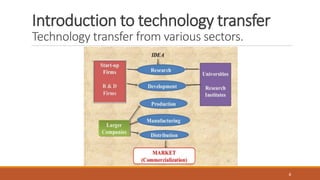
Introduction to technology transfer
Technology transfer from various sectors.
4
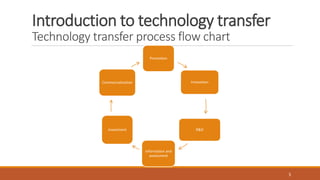
Introduction to technology transfer
Technology transfer process flow chart
Promotion
Innovation
R&D
Information and
assessment
investment
Commercialization
5
Introduction to technology transfer
Reasons for Technology transfer.
Due to lack of manufacturing capacity.
Due to lack of resources to launch product commercially.
Due to lack of marketing distribution and distribution capability.
Forming alliances with partners.
Forming alliances with partners with manufacturing capability.
Forming alliances with partners with marketing and distribution capability.
Exploitation in a different field of application.
List of institutes assisting in technology transfer-
-Asia Pacific Center for Transfer of Technology (APCTT)
-Technology Bureau for small enterprise(TBSE)
-National research and development co-operation.
6
Technology Transfer Team (TT team)
The technology transfer team consist of following-
R&D process technologist.
QA representative.
Production representative.
Engineering representative.
QC representative.
7
Technology Transfer Team (TT team)
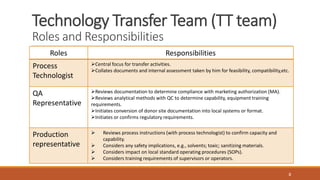
Roles and Responsibilities
Roles Responsibilities
Process
Technologist
Central focus for transfer activities.
Collates documents and internal assessment taken by him for feasibility, compatibility,etc.
QA
Representative
Reviews documentation to determine compliance with marketing authorization (MA).
Reviews analytical methods with QC to determine capability, equipment training
requirements.
Initiates conversion of donor site documentation into local systems or format.
Initiates or confirms regulatory requirements.
Production
representative
 Reviews process instructions (with process technologist) to confirm capacity and
capability.
 Considers any safety implications, e.g., solvents; toxic; sanitizing materials.
 Considers impact on local standard operating procedures (SOPs).
 Considers training requirements of supervisors or operators.
8
Technology Transfer Team (TT team)
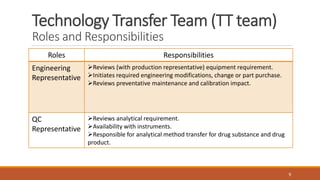
Roles and Responsibilities
Roles Responsibilities
Engineering
Representative
Reviews (with production representative) equipment requirement.
Initiates required engineering modifications, change or part purchase.
Reviews preventative maintenance and calibration impact.
QC
Representative
Reviews analytical requirement.
Availability with instruments.
Responsible for analytical method transfer for drug substance and drug
product.
9
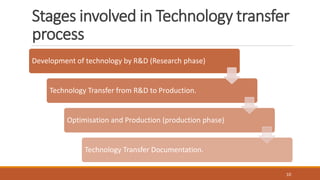
Stages involved in Technology transfer
process
Development of technology by R&D (Research phase)
Technology Transfer from R&D to Production.
Optimisation and Production (production phase)
Technology Transfer Documentation.
10
Technology transfer from R&D to Production
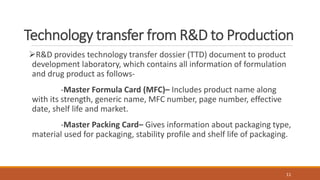
R&D provides technology transfer dossier (TTD) document to product
development laboratory, which contains all information of formulation
and drug product as follows-
-Master Formula Card (MFC)– Includes product name along
with its strength, generic name, MFC number, page number, effective
date, shelf life and market.
-Master Packing Card– Gives information about packaging type,
material used for packaging, stability profile and shelf life of packaging.
11
Technology transfer from R&D to Production
continued…
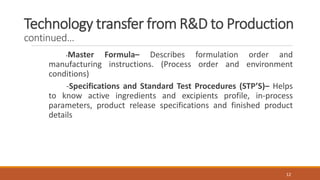
-Master Formula– Describes formulation order and
manufacturing instructions. (Process order and environment
conditions)
-Specifications and Standard Test Procedures (STP’S)– Helps
to know active ingredients and excipients profile, in-process
parameters, product release specifications and finished product
details
12
Technology transfer from R&D to Production
Roles and responsibilities
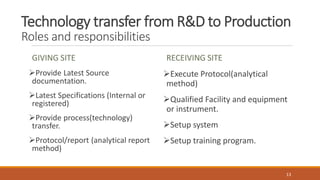
GIVING SITE
Provide Latest Source
documentation.
Latest Specifications (Internal or
registered)
Provide process(technology)
transfer.
Protocol/report (analytical report
method)
RECEIVING SITE
Execute Protocol(analytical
method)
Qualified Facility and equipment
or instrument.
Setup system
Setup training program.
13
Technology transfer from R&D to Production
Success of technology transfer
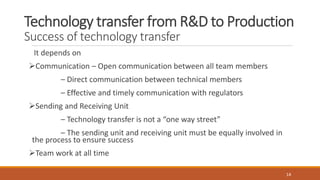
It depends on
Communication – Open communication between all team members
– Direct communication between technical members
– Effective and timely communication with regulators
Sending and Receiving Unit
– Technology transfer is not a “one way street”
– The sending unit and receiving unit must be equally involved in
the process to ensure success
Team work at all time
14
Technology transfer from R&D to Production
Checklist for technology transfer
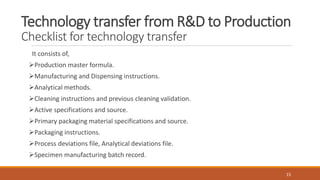
It consists of,
Production master formula.
Manufacturing and Dispensing instructions.
Analytical methods.
Cleaning instructions and previous cleaning validation.
Active specifications and source.
Primary packaging material specifications and source.
Packaging instructions.
Process deviations file, Analytical deviations file.
Specimen manufacturing batch record.
15
Conclusion
Technology transfer creates a bridge between the R&D and Production
as it helps in creating more efficient and safe medications.
This is systematic process with proper protocol which should be
followed by both the ends while a QA personnel should verify and
maintain the documentation included in these protocol.
Development, transfer, production and documentation are the phases
of technology transfer.
There are certain checklist materials which are followed during
technology transfer.
16
17
THANK YOU

Technology transfer from R&D to production

  • 1.
    Technology Transfer from R&Dto Production P R E P A R E D B Y - M R . D E E P A K V . S H A N B H A G F I R S T Y E A R M . P H A R M S E M E S T E R 1 2 0 1 8 - 1 9 D E P A R T M E N T O F P H A R M A C E U T I C A L Q U A L I T Y A S S U R A N C E BHARATI VIDYAPEETH COLLEGE OF PHARMACY, KOLHAPUR 1
  • 2.
    Contents Introduction to TechnologyTransfer. Technology Transfer Team. Stages involved in technology transfer. Technology transfer from R&D to Production. Conclusion. References 2
  • 3.
    Introduction to TechnologyTransfer Transfer of technology is defined as “a logical procedure that controls the transfer of any process together with its documentation and professional expertise between development and manufacture or between manufacture sites” . Technology transfer is the process by which a developer of technology makes its technology available to a commercial partner that will exploit the technology.  In pharmaceutical industry, “Technology Transfer” refers to the processes of successful progress from drug discovery to product development, clinical trials and ultimately full-scale commercialization. 3
  • 4.
    Introduction to technologytransfer Technology transfer from various sectors. 4
  • 5.
    Introduction to technologytransfer Technology transfer process flow chart Promotion Innovation R&D Information and assessment investment Commercialization 5
  • 6.
    Introduction to technologytransfer Reasons for Technology transfer. Due to lack of manufacturing capacity. Due to lack of resources to launch product commercially. Due to lack of marketing distribution and distribution capability. Forming alliances with partners. Forming alliances with partners with manufacturing capability. Forming alliances with partners with marketing and distribution capability. Exploitation in a different field of application. List of institutes assisting in technology transfer- -Asia Pacific Center for Transfer of Technology (APCTT) -Technology Bureau for small enterprise(TBSE) -National research and development co-operation. 6
  • 7.
    Technology Transfer Team(TT team) The technology transfer team consist of following- R&D process technologist. QA representative. Production representative. Engineering representative. QC representative. 7
  • 8.
    Technology Transfer Team(TT team) Roles and Responsibilities Roles Responsibilities Process Technologist Central focus for transfer activities. Collates documents and internal assessment taken by him for feasibility, compatibility,etc. QA Representative Reviews documentation to determine compliance with marketing authorization (MA). Reviews analytical methods with QC to determine capability, equipment training requirements. Initiates conversion of donor site documentation into local systems or format. Initiates or confirms regulatory requirements. Production representative  Reviews process instructions (with process technologist) to confirm capacity and capability.  Considers any safety implications, e.g., solvents; toxic; sanitizing materials.  Considers impact on local standard operating procedures (SOPs).  Considers training requirements of supervisors or operators. 8
  • 9.
    Technology Transfer Team(TT team) Roles and Responsibilities Roles Responsibilities Engineering Representative Reviews (with production representative) equipment requirement. Initiates required engineering modifications, change or part purchase. Reviews preventative maintenance and calibration impact. QC Representative Reviews analytical requirement. Availability with instruments. Responsible for analytical method transfer for drug substance and drug product. 9
  • 10.
    Stages involved inTechnology transfer process Development of technology by R&D (Research phase) Technology Transfer from R&D to Production. Optimisation and Production (production phase) Technology Transfer Documentation. 10
  • 11.
    Technology transfer fromR&D to Production R&D provides technology transfer dossier (TTD) document to product development laboratory, which contains all information of formulation and drug product as follows- -Master Formula Card (MFC)– Includes product name along with its strength, generic name, MFC number, page number, effective date, shelf life and market. -Master Packing Card– Gives information about packaging type, material used for packaging, stability profile and shelf life of packaging. 11
  • 12.
    Technology transfer fromR&D to Production continued… -Master Formula– Describes formulation order and manufacturing instructions. (Process order and environment conditions) -Specifications and Standard Test Procedures (STP’S)– Helps to know active ingredients and excipients profile, in-process parameters, product release specifications and finished product details 12
  • 13.
    Technology transfer fromR&D to Production Roles and responsibilities GIVING SITE Provide Latest Source documentation. Latest Specifications (Internal or registered) Provide process(technology) transfer. Protocol/report (analytical report method) RECEIVING SITE Execute Protocol(analytical method) Qualified Facility and equipment or instrument. Setup system Setup training program. 13
  • 14.
    Technology transfer fromR&D to Production Success of technology transfer It depends on Communication – Open communication between all team members – Direct communication between technical members – Effective and timely communication with regulators Sending and Receiving Unit – Technology transfer is not a “one way street” – The sending unit and receiving unit must be equally involved in the process to ensure success Team work at all time 14
  • 15.
    Technology transfer fromR&D to Production Checklist for technology transfer It consists of, Production master formula. Manufacturing and Dispensing instructions. Analytical methods. Cleaning instructions and previous cleaning validation. Active specifications and source. Primary packaging material specifications and source. Packaging instructions. Process deviations file, Analytical deviations file. Specimen manufacturing batch record. 15
  • 16.
    Conclusion Technology transfer createsa bridge between the R&D and Production as it helps in creating more efficient and safe medications. This is systematic process with proper protocol which should be followed by both the ends while a QA personnel should verify and maintain the documentation included in these protocol. Development, transfer, production and documentation are the phases of technology transfer. There are certain checklist materials which are followed during technology transfer. 16
  • 17.