SUPACSUPAC ((SScalecale UUpandpand PPostost
AApprovalpproval CChangeshanges))
GUIDELINES…GUIDELINES…
BY;
Sachinkumar B
1st
M.Pharma
Pharmaceutics.
SCP Mangalore
1
Content
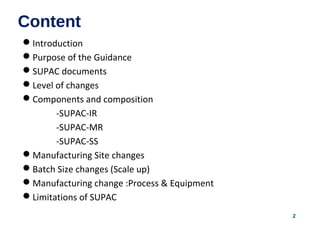
Introduction
Purpose of the Guidance
SUPAC documents
Level of changes
Components and composition
-SUPAC-IR
-SUPAC-MR
-SUPAC-SS
Manufacturing Site changes
Batch Size changes (Scale up)
Manufacturing change :Process & Equipment
Limitations of SUPAC
2
Introduction;
Control of changes in process, method, machine &
system is important part of GMP.
Some times we need to change the informations given to
the FDA in approved application.
These changes done after the FDA approval is called Post
Approval Changes.
The scale-up process and the changes made after
approval in the composition, manufacturing process,
manufacturing equipment, and change of site together known as
Scale-Up and Post approval Changes, or SUPAC.
3
Purpose of the guidance;
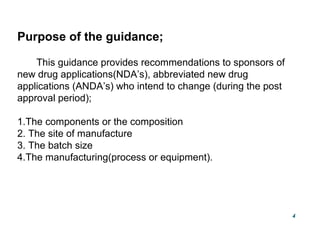
This guidance provides recommendations to sponsors of
new drug applications(NDA’s), abbreviated new drug
applications (ANDA’s) who intend to change (during the post
approval period);
1.The components or the composition
2. The site of manufacture
3. The batch size
4.The manufacturing(process or equipment).
4
What are SUPAC documents
 A series of documeissued by US FDA (CDER) to help
applicants with post-approval changes.nts
 Currently finalized SUPAC guidance are as below
 SUPAC-IR(immediate release) -Nov 1995.
 SUPAC-IR Ques and Answers- Feb 1997.
 PAC- ATLS(Analytical testing laboratories)- Apr 1998.
 SUPAC –MR(modified release)- Sep 1997.
 SUPAC SS(non sterile semisolid)- May 1997.
5
SUPACSUPAC
6
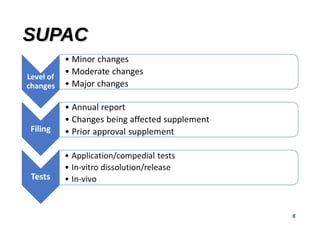
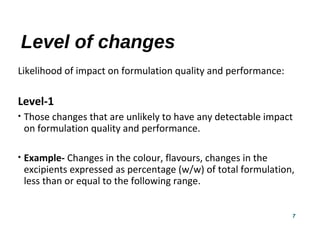
Level of changes
Likelihood of impact on formulation quality and performance:
Level-1
• Those changes that are unlikely to have any detectable impact
on formulation quality and performance.
• Example- Changes in the colour, flavours, changes in the
excipients expressed as percentage (w/w) of total formulation,
less than or equal to the following range.
7
8
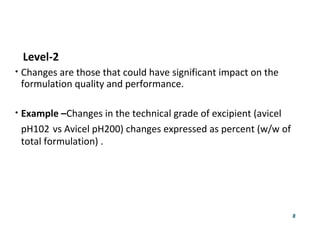
Level-2
• Changes are those that could have significant impact on the
formulation quality and performance.
• Example –Changes in the technical grade of excipient (avicel
pH102 vs Avicel pH200) changes expressed as percent (w/w of
total formulation) .
9
Level-3
• Changes are those that are likely to have significant impact on
formulation quality and performance.
• Example- any qualitative or quantitative excipient changes a
narrow therapeutic drug beyond the range for level 1 and all
other drug not meeting the dissolution criteria as Level 2.
10
These guidelines provide recommendation for the post approval
changes in:
• In component or composition
• The site of manufacture
• The scale up of manufacture
• The manufacturing(process and equipment)
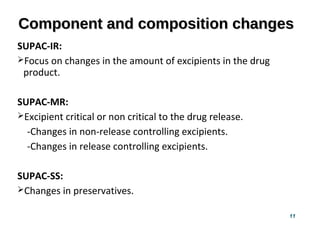
Component and composition changesComponent and composition changes
SUPAC-IR:
Focus on changes in the amount of excipients in the drug
product.
SUPAC-MR:
Excipient critical or non critical to the drug release.
-Changes in non-release controlling excipients.
-Changes in release controlling excipients.
SUPAC-SS:
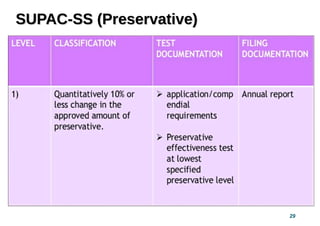
Changes in preservatives.
11
SUPAC-IR (Components andSUPAC-IR (Components and
CompositionComposition))
12
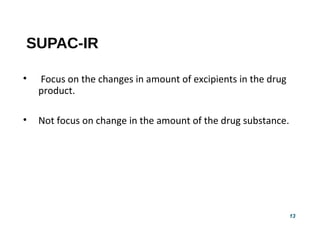
SUPAC-IR
• Focus on the changes in amount of excipients in the drug
product.
• Not focus on change in the amount of the drug substance.
13
14
15
16
SUPAC-MR (Components andSUPAC-MR (Components and
Composition)Composition)
17
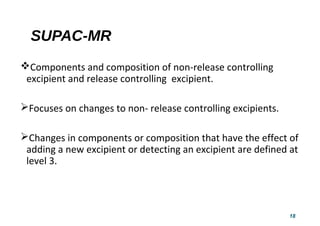
SUPAC-MR
Components and composition of non-release controlling
excipient and release controlling excipient.
Focuses on changes to non- release controlling excipients.
Changes in components or composition that have the effect of
adding a new excipient or detecting an excipient are defined at
level 3.
18
Non-release controlling excipient
LEVEL CLASSIFICATION TEST DOCUMENTATION FILING
1) Deletion or partial
deletion of an ingredient
-up to SUPAC-IR Level 1
excipient ranges.
Stability-
Application/compendi
al requirements.
Annual report
19
20
2) Change in
technical grade of
excipients
Up to SUPAC-IR
Level 2 excipient
ranges
Stability
application/compendia
l requirements.
 Multi-point
dissolution profiles
(15,30,45,60 &
120min) USP buffer
media at pH 4.5-7.5 for
extended release)
Three different media
(e.g., Water, 0.1N HCl,
and USP buffer media
at pH 4.5 and 6.8 for
delayed release)
•Prior approval
supplement.
•Annual report
21
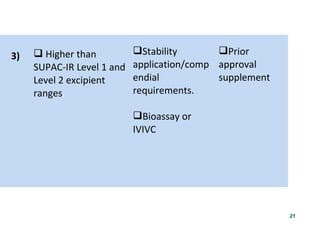
3)  Higher than
SUPAC-IR Level 1 and
Level 2 excipient
ranges.
Stability
application/comp
endial
requirements.
Bioassay or
IVIVC
Prior
approval
supplement
SUPAC-MR (release controllingSUPAC-MR (release controlling
excipient)excipient)
22
Level 2
23
24
SUPAC-SS (Components andSUPAC-SS (Components and
Composition)Composition)
SUPAC-SS
• for non-sterile semisolid dosage form including creams,
ointments, gels and lotions.
25
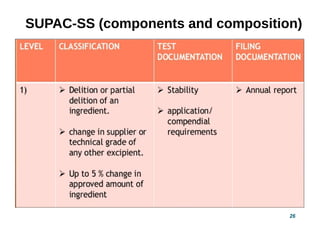
SUPAC-SS (components and composition)
26
Level-2
27
Level-3
3) change in approved
amount of ingredient.
Change in crystalline
form of ingredient
Stability
Application/c
ompedial
requirements
Prior
approval
supplement
28
SUPAC-SS (Preservative)SUPAC-SS (Preservative)
29
Level-2
30
Level-3
31
Site changesSite changes
It includes the changes in location of the site of
manufacturing facilities for both company owner and
contract manufacturer.
It does not include scale up.
32
Level-1
33
Level-2
34
Level-3
35
Batch Size Change (Scale UP)
Changes in the size of a batch from the pivotal/pilot scale bio-
batch material to larger production batches
No change in SOP, formulation and manufacturing procedures
or equipments used
All scale-up charges should be properly validated
The minimum batch size for the pivotal clinical trial batch or
bio-batch be at least 1,00,000 dosage units /100 kg or 10% of a
production batch, whichever is larger.
36
LEVEL 1 CHANGES
Test documentation
Chemistry documentation
• None beyond application/compendial product release
requirements.
• Notification of the change and submission of the updated
executed batch records.
Other documentation remains same as non release controlling
37
LEVEL 2 CHANGES
 This category includes process changes involving adjustments
of equipment operating conditions such as mixing times and
operating speeds outside of original approved application
ranges.
Other documentation remains same as non-release controlling
excipient
38
LEVEL 3 CHANGES
This category includes change in the type of process used in
the manufacture of the product, such as change from wet
granulation to direct compression of dry powder.
Other documentation remains same as non-release controlling
excipient.
39
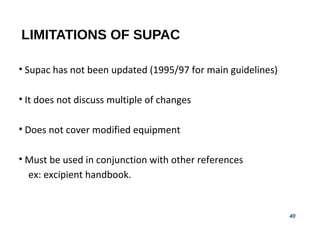
LIMITATIONS OF SUPAC
• Supac has not been updated (1995/97 for main guidelines)
• It does not discuss multiple of changes
• Does not cover modified equipment
• Must be used in conjunction with other references
ex: excipient handbook.
40
REFERENCES:REFERENCES:
1. Lachman leon and Schwartz .B. Joseph Pharmaceutical
dosage forms: Tablets. Vol 3, edition 2. P.P 1-74.
2. Savant D.A. Pharma Pathway Industrial and applied
pharmacy: 8th
edition. 2.308-23.
3. Nash R.A, Wachter A.H. Pharmaceutical Process Validation:
3rd
edition. 705-46.
41
ThankYouThankYou
42

Supac

  • 1.
    SUPACSUPAC ((SScalecale UUpandpandPPostost AApprovalpproval CChangeshanges)) GUIDELINES…GUIDELINES… BY; Sachinkumar B 1st M.Pharma Pharmaceutics. SCP Mangalore 1
  • 2.
    Content Introduction Purpose of theGuidance SUPAC documents Level of changes Components and composition -SUPAC-IR -SUPAC-MR -SUPAC-SS Manufacturing Site changes Batch Size changes (Scale up) Manufacturing change :Process & Equipment Limitations of SUPAC 2
  • 3.
    Introduction; Control of changesin process, method, machine & system is important part of GMP. Some times we need to change the informations given to the FDA in approved application. These changes done after the FDA approval is called Post Approval Changes. The scale-up process and the changes made after approval in the composition, manufacturing process, manufacturing equipment, and change of site together known as Scale-Up and Post approval Changes, or SUPAC. 3
  • 4.
    Purpose of theguidance; This guidance provides recommendations to sponsors of new drug applications(NDA’s), abbreviated new drug applications (ANDA’s) who intend to change (during the post approval period); 1.The components or the composition 2. The site of manufacture 3. The batch size 4.The manufacturing(process or equipment). 4
  • 5.
    What are SUPACdocuments  A series of documeissued by US FDA (CDER) to help applicants with post-approval changes.nts  Currently finalized SUPAC guidance are as below  SUPAC-IR(immediate release) -Nov 1995.  SUPAC-IR Ques and Answers- Feb 1997.  PAC- ATLS(Analytical testing laboratories)- Apr 1998.  SUPAC –MR(modified release)- Sep 1997.  SUPAC SS(non sterile semisolid)- May 1997. 5
  • 6.
  • 7.
    Level of changes Likelihoodof impact on formulation quality and performance: Level-1 • Those changes that are unlikely to have any detectable impact on formulation quality and performance. • Example- Changes in the colour, flavours, changes in the excipients expressed as percentage (w/w) of total formulation, less than or equal to the following range. 7
  • 8.
    8 Level-2 • Changes arethose that could have significant impact on the formulation quality and performance. • Example –Changes in the technical grade of excipient (avicel pH102 vs Avicel pH200) changes expressed as percent (w/w of total formulation) .
  • 9.
    9 Level-3 • Changes arethose that are likely to have significant impact on formulation quality and performance. • Example- any qualitative or quantitative excipient changes a narrow therapeutic drug beyond the range for level 1 and all other drug not meeting the dissolution criteria as Level 2.
  • 10.
    10 These guidelines providerecommendation for the post approval changes in: • In component or composition • The site of manufacture • The scale up of manufacture • The manufacturing(process and equipment)
  • 11.
    Component and compositionchangesComponent and composition changes SUPAC-IR: Focus on changes in the amount of excipients in the drug product. SUPAC-MR: Excipient critical or non critical to the drug release. -Changes in non-release controlling excipients. -Changes in release controlling excipients. SUPAC-SS: Changes in preservatives. 11
  • 12.
    SUPAC-IR (Components andSUPAC-IR(Components and CompositionComposition)) 12
  • 13.
    SUPAC-IR • Focus onthe changes in amount of excipients in the drug product. • Not focus on change in the amount of the drug substance. 13
  • 14.
  • 15.
  • 16.
  • 17.
    SUPAC-MR (Components andSUPAC-MR(Components and Composition)Composition) 17
  • 18.
    SUPAC-MR Components and compositionof non-release controlling excipient and release controlling excipient. Focuses on changes to non- release controlling excipients. Changes in components or composition that have the effect of adding a new excipient or detecting an excipient are defined at level 3. 18
  • 19.
    Non-release controlling excipient LEVELCLASSIFICATION TEST DOCUMENTATION FILING 1) Deletion or partial deletion of an ingredient -up to SUPAC-IR Level 1 excipient ranges. Stability- Application/compendi al requirements. Annual report 19
  • 20.
    20 2) Change in technicalgrade of excipients Up to SUPAC-IR Level 2 excipient ranges Stability application/compendia l requirements.  Multi-point dissolution profiles (15,30,45,60 & 120min) USP buffer media at pH 4.5-7.5 for extended release) Three different media (e.g., Water, 0.1N HCl, and USP buffer media at pH 4.5 and 6.8 for delayed release) •Prior approval supplement. •Annual report
  • 21.
    21 3)  Higherthan SUPAC-IR Level 1 and Level 2 excipient ranges. Stability application/comp endial requirements. Bioassay or IVIVC Prior approval supplement
  • 22.
    SUPAC-MR (release controllingSUPAC-MR(release controlling excipient)excipient) 22
  • 23.
  • 24.
    24 SUPAC-SS (Components andSUPAC-SS(Components and Composition)Composition)
  • 25.
    SUPAC-SS • for non-sterilesemisolid dosage form including creams, ointments, gels and lotions. 25
  • 26.
    SUPAC-SS (components andcomposition) 26
  • 27.
  • 28.
    Level-3 3) change inapproved amount of ingredient. Change in crystalline form of ingredient Stability Application/c ompedial requirements Prior approval supplement 28
  • 29.
  • 30.
  • 31.
  • 32.
    Site changesSite changes Itincludes the changes in location of the site of manufacturing facilities for both company owner and contract manufacturer. It does not include scale up. 32
  • 33.
  • 34.
  • 35.
  • 36.
    Batch Size Change(Scale UP) Changes in the size of a batch from the pivotal/pilot scale bio- batch material to larger production batches No change in SOP, formulation and manufacturing procedures or equipments used All scale-up charges should be properly validated The minimum batch size for the pivotal clinical trial batch or bio-batch be at least 1,00,000 dosage units /100 kg or 10% of a production batch, whichever is larger. 36
  • 37.
    LEVEL 1 CHANGES Testdocumentation Chemistry documentation • None beyond application/compendial product release requirements. • Notification of the change and submission of the updated executed batch records. Other documentation remains same as non release controlling 37
  • 38.
    LEVEL 2 CHANGES This category includes process changes involving adjustments of equipment operating conditions such as mixing times and operating speeds outside of original approved application ranges. Other documentation remains same as non-release controlling excipient 38
  • 39.
    LEVEL 3 CHANGES Thiscategory includes change in the type of process used in the manufacture of the product, such as change from wet granulation to direct compression of dry powder. Other documentation remains same as non-release controlling excipient. 39
  • 40.
    LIMITATIONS OF SUPAC •Supac has not been updated (1995/97 for main guidelines) • It does not discuss multiple of changes • Does not cover modified equipment • Must be used in conjunction with other references ex: excipient handbook. 40
  • 41.
    REFERENCES:REFERENCES: 1. Lachman leonand Schwartz .B. Joseph Pharmaceutical dosage forms: Tablets. Vol 3, edition 2. P.P 1-74. 2. Savant D.A. Pharma Pathway Industrial and applied pharmacy: 8th edition. 2.308-23. 3. Nash R.A, Wachter A.H. Pharmaceutical Process Validation: 3rd edition. 705-46. 41
  • 42.