



PILOT PLANT SCALE-UP CONSIDERATION
FOR SOLID DOSAGE FORM
Submitted By-
Anoothi Bain
M. Pharm 1st sem.
Department of Pharmaceutical Sciences
Dr. Harisingh Gour University, Sagar (M.P)
(a central university)
 Introduction
 Application of pilot plant
 Scale-up of Solid Dosage form
• Material handling
• Chemical weighing
• Blending
• Granulation
• Drying
• Reduction in particle size
• Granulation handling & Feed systems
 References
D. R. Chandravanshi
 Pilot Plant:-
“Defined as a part of pharmaceutical industry
where a lab scale formula is transformed into
viable product by the development of liable
practical procedure for manufacture”.
 Scale-up:-
“The art of designing of prototype using the
data obtained from the pilot plant model”.
D. R. Chandravanshi
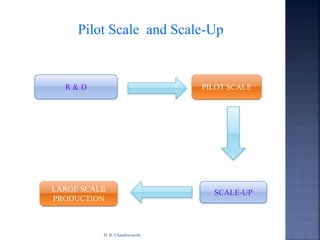
Pilot Scale and Scale-Up
R & D PILOT SCALE
SCALE-UPLARGE SCALE
PRODUCTION
D. R. Chandravanshi
 It plays important role in technological evaluation
scale-up and transfer activities of new product.
 Evaluating the results of laboratory studies and
making product ,process corrections and
improvements.
 It is used to examine the formula to determine its
ability to withstand batch scale and process
modification.
 Evaluation and validation for process and
equipments.
 To provide master manufacturing formula with
instructions for manufacturing procedure.
D. R. Chandravanshi
 The primary responsibility of pilot plant is to ensure
that newly formulated dosage form should be
efficiently, economically and consistently reproducible
on a large scale production.
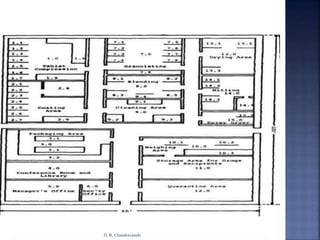
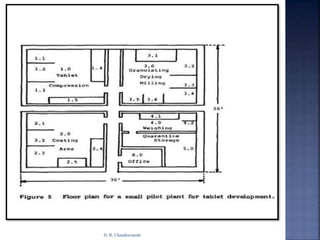
 The design and construction of pharmaceutical pilot
plant for product development should incorporate
necessary features to facilitate maintenance and
cleanliness.
 Pilot plant should be located on the ground floor to
expedite the delivery and shipment of supplies .
D. R. Chandravanshi
D. R. Chandravanshi
D. R. Chandravanshi
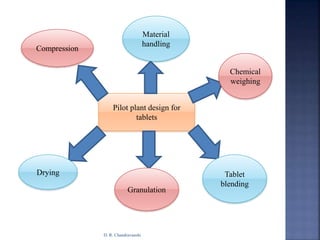
Pilot plant design for
tablets
Material
handling
Chemical
weighing
Granulation
Tablet
blending
Drying
Compression
D. R. Chandravanshi
 Primary concerns:-Achieving reliable flow and
maintaining blend uniformity.
 Segregation leads to poor product uniformity.
 Handling system:-
 Must deliver the accurate amount of the ingredient.
 Material loss should be less.
 There should be no cross contamination
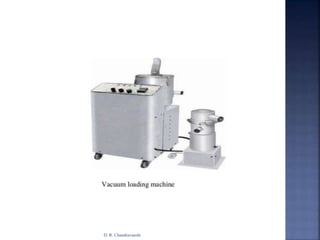
 More sophisticated methods of handling materials
such as vaccum loading systems, metring pumps ,
screw feed system.
 If a system is used to transfer materials for more than
one product steps must be taken to prevent cross
contamination. D. R. Chandravanshi
D. R. Chandravanshi
 This is important step in the manufacturing process
because of possibilities for cross contamination
and misbranded products due to incorrect
quantities .
 Central weighing department is adopted by many
companies to service all the processing areas:-
 Avoidance of duplicating weighing facilities
 Lower labor cost.
D. R. Chandravanshi
 A chemical weighing should be designed to
provide supervision, checkers, proper weighing
equipment, lightning, dust collections, adequate
sanitation.
 Sinks and drain boards should be located to
facilitate frequent cleaning of measuring
equipments.
 High potency drugs such as steroids and alkaloids
should be weighed separately with absolute filters
to avoid cross contamination.
 Balances scales and meters should be specified and
calibrated.
D. R. Chandravanshi
 Powders which are to be used for granulating prior
to tableting must be blended well for proper drug
distribution.
 Inadequate blending could result in drug content
uniformity variation, especially when the tablet
and capsule is small and drug content is very low.
 Ingredients should be lumps free ,otherwise it will
cause flow problems.
 Screening and milling of the ingredients is
performed to make process more reproducible and
reliable.
D. R. Chandravanshi
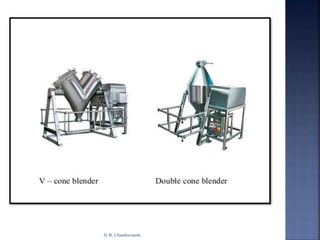
 Equipments used for blending are:-
 V-blender
 Double cone blender
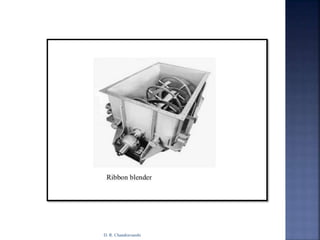
 Ribbon blender
 Bin blender
 Orbiting screw blender and high intensity mixers
 Scale up considerations
 Time of blending
 Blending load
 Size of blender
D. R. Chandravanshi
D. R. Chandravanshi
D. R. Chandravanshi
 Granulation is a process by which the small
particles are converted into large agglomerates
called granules.
 Reasons for granulation:-
o To impart good flow properties to the material
o To increase the apparent density of powders.
o To uniform the particle size distribution.
o Uniform dispersion of active ingredient.
 Types:-
o Wet granulation
o Dry granulation(slugging)
o Dry compaction
D. R. Chandravanshi
 A small amount of potent active ingredient can be
dispersed most effectively in a carrier granulation
when the drug is dissolved in granulating solution
and added during granulation process.
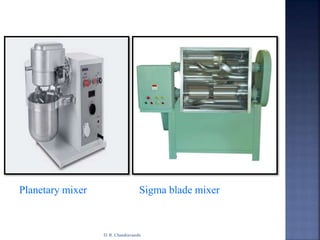
 Traditionally Wet granulation is carried out using:-
 Sigma blade mixer
 Heavy-duty planetary mixer
D. R. Chandravanshi
Planetary mixer Sigma blade mixer
D. R. Chandravanshi
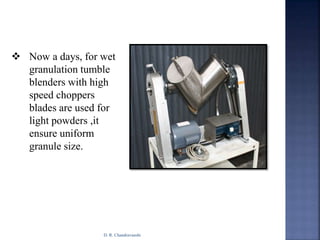
 Now a days, for wet
granulation tumble
blenders with high
speed choppers
blades are used for
light powders ,it
ensure uniform
granule size.
D. R. Chandravanshi
 Use of binders:-
Binders are used in tablet formulations to make powders
more compressible and to produce tablet more resistant to
breakage during handling.
 Sometimes the binding agent imparts viscosity to the
granulating solution due to this transfer of fluid becomes
difficult ,this problem is overcome by adding granulating
agents if it occurs in scale up process.
 To avoid this problem in formulation stage, we will disperse
binding agent in the dry powder prior to granulating
 When granulating mass is having dough like
consistency then it will be subdivide into more granular
and porus mass to facilitate drying, this is performed
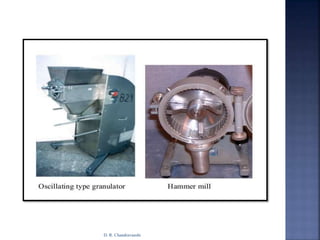
by passing it through a oscillating granulator or
hammer mill with large screen.
D. R. Chandravanshi
D. R. Chandravanshi
 A dry powder blend that cannot be directly compressible because
of poor flow or compression properties may processed using
slugging operation.
 This is done on a tablet press designed for slugging ,which
operates at pressure of about 15 tons, compared with normal tablet
press which operates at pressure of 4 tons or less.
 Slugs range in diameter is 1inch for easily slugged material.
 After compression ,the slugs are broken down using hammer mill
or oscillating granulator to obtain uniform granule size.
 During scale –up operation ,the pilot plant scientist should pay
attention to the forces used for slugging operation, diameter of
punches , sizing and screening operation should be optimized
because it affects the particle size distribution.
D. R. Chandravanshi
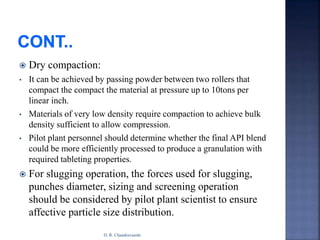
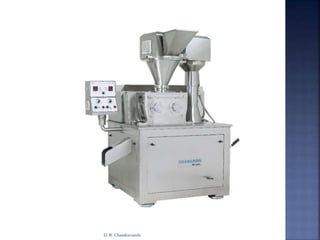
 Dry compaction:
• It can be achieved by passing powder between two rollers that
compact the compact the material at pressure up to 10tons per
linear inch.
• Materials of very low density require compaction to achieve bulk
density sufficient to allow compression.
• Pilot plant personnel should determine whether the final API blend
could be more efficiently processed to produce a granulation with
required tableting properties.
 For slugging operation, the forces used for slugging,
punches diameter, sizing and screening operation
should be considered by pilot plant scientist to ensure
affective particle size distribution.
D. R. Chandravanshi
D. R. Chandravanshi
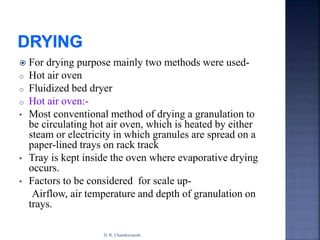
 For drying purpose mainly two methods were used-
o Hot air oven
o Fluidized bed dryer
o Hot air oven:-
• Most conventional method of drying a granulation to
be circulating hot air oven, which is heated by either
steam or electricity in which granules are spread on a
paper-lined trays on rack track
• Tray is kept inside the oven where evaporative drying
occurs.
• Factors to be considered for scale up-
Airflow, air temperature and depth of granulation on
trays.
D. R. Chandravanshi
• If granulation bed is too deep or too dense then
drying will be inefficient.
• Drying time at specified temperatures and airflow
rates must be established for each product.
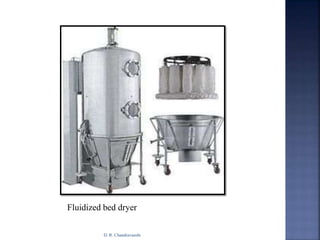
 Fluidized bed dryer:-
• Fluidized bed ryers is an best alternative method of
Drying.
• The important factor considered as part of scale up
fluidized bed dryer are optimum loads, rate of
airflow, inlet air temperature and humidity.
D. R. Chandravanshi
Fluidized bed dryer
D. R. Chandravanshi
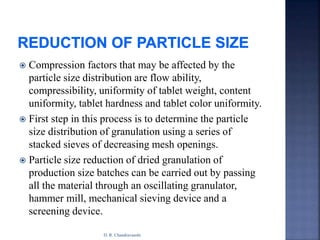
 Compression factors that may be affected by the
particle size distribution are flow ability,
compressibility, uniformity of tablet weight, content
uniformity, tablet hardness and tablet color uniformity.
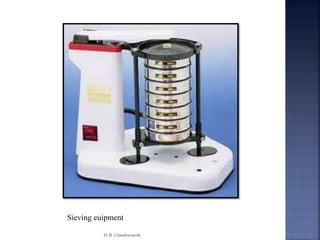
 First step in this process is to determine the particle
size distribution of granulation using a series of
stacked sieves of decreasing mesh openings.
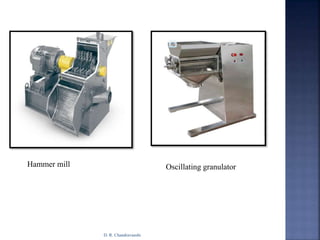
 Particle size reduction of dried granulation of
production size batches can be carried out by passing
all the material through an oscillating granulator,
hammer mill, mechanical sieving device and a
screening device.
D. R. Chandravanshi
Oscillating granulatorHammer mill
D. R. Chandravanshi
Sieving euipment
D. R. Chandravanshi
 Lachman and liberman “The theory and practice of
industrial pharmacy ” fourth edition 2013,CBS
publisher and distributors,961-971
D. R. Chandravanshi
Pilot Plant Techniques for SOLID dosage forms

Pilot Plant Techniques for SOLID dosage forms

  • 1.
    PILOT PLANT SCALE-UPCONSIDERATION FOR SOLID DOSAGE FORM Submitted By- Anoothi Bain M. Pharm 1st sem. Department of Pharmaceutical Sciences Dr. Harisingh Gour University, Sagar (M.P) (a central university)
  • 2.
     Introduction  Applicationof pilot plant  Scale-up of Solid Dosage form • Material handling • Chemical weighing • Blending • Granulation • Drying • Reduction in particle size • Granulation handling & Feed systems  References D. R. Chandravanshi
  • 3.
     Pilot Plant:- “Definedas a part of pharmaceutical industry where a lab scale formula is transformed into viable product by the development of liable practical procedure for manufacture”.  Scale-up:- “The art of designing of prototype using the data obtained from the pilot plant model”. D. R. Chandravanshi
  • 4.
    Pilot Scale andScale-Up R & D PILOT SCALE SCALE-UPLARGE SCALE PRODUCTION D. R. Chandravanshi
  • 5.
     It playsimportant role in technological evaluation scale-up and transfer activities of new product.  Evaluating the results of laboratory studies and making product ,process corrections and improvements.  It is used to examine the formula to determine its ability to withstand batch scale and process modification.  Evaluation and validation for process and equipments.  To provide master manufacturing formula with instructions for manufacturing procedure. D. R. Chandravanshi
  • 7.
     The primaryresponsibility of pilot plant is to ensure that newly formulated dosage form should be efficiently, economically and consistently reproducible on a large scale production.  The design and construction of pharmaceutical pilot plant for product development should incorporate necessary features to facilitate maintenance and cleanliness.  Pilot plant should be located on the ground floor to expedite the delivery and shipment of supplies . D. R. Chandravanshi
  • 8.
  • 9.
  • 10.
    Pilot plant designfor tablets Material handling Chemical weighing Granulation Tablet blending Drying Compression D. R. Chandravanshi
  • 11.
     Primary concerns:-Achievingreliable flow and maintaining blend uniformity.  Segregation leads to poor product uniformity.  Handling system:-  Must deliver the accurate amount of the ingredient.  Material loss should be less.  There should be no cross contamination  More sophisticated methods of handling materials such as vaccum loading systems, metring pumps , screw feed system.  If a system is used to transfer materials for more than one product steps must be taken to prevent cross contamination. D. R. Chandravanshi
  • 12.
  • 13.
     This isimportant step in the manufacturing process because of possibilities for cross contamination and misbranded products due to incorrect quantities .  Central weighing department is adopted by many companies to service all the processing areas:-  Avoidance of duplicating weighing facilities  Lower labor cost. D. R. Chandravanshi
  • 14.
     A chemicalweighing should be designed to provide supervision, checkers, proper weighing equipment, lightning, dust collections, adequate sanitation.  Sinks and drain boards should be located to facilitate frequent cleaning of measuring equipments.  High potency drugs such as steroids and alkaloids should be weighed separately with absolute filters to avoid cross contamination.  Balances scales and meters should be specified and calibrated. D. R. Chandravanshi
  • 15.
     Powders whichare to be used for granulating prior to tableting must be blended well for proper drug distribution.  Inadequate blending could result in drug content uniformity variation, especially when the tablet and capsule is small and drug content is very low.  Ingredients should be lumps free ,otherwise it will cause flow problems.  Screening and milling of the ingredients is performed to make process more reproducible and reliable. D. R. Chandravanshi
  • 16.
     Equipments usedfor blending are:-  V-blender  Double cone blender  Ribbon blender  Bin blender  Orbiting screw blender and high intensity mixers  Scale up considerations  Time of blending  Blending load  Size of blender D. R. Chandravanshi
  • 17.
  • 18.
  • 19.
     Granulation isa process by which the small particles are converted into large agglomerates called granules.  Reasons for granulation:- o To impart good flow properties to the material o To increase the apparent density of powders. o To uniform the particle size distribution. o Uniform dispersion of active ingredient.  Types:- o Wet granulation o Dry granulation(slugging) o Dry compaction D. R. Chandravanshi
  • 20.
     A smallamount of potent active ingredient can be dispersed most effectively in a carrier granulation when the drug is dissolved in granulating solution and added during granulation process.  Traditionally Wet granulation is carried out using:-  Sigma blade mixer  Heavy-duty planetary mixer D. R. Chandravanshi
  • 21.
    Planetary mixer Sigmablade mixer D. R. Chandravanshi
  • 22.
     Now adays, for wet granulation tumble blenders with high speed choppers blades are used for light powders ,it ensure uniform granule size. D. R. Chandravanshi
  • 23.
     Use ofbinders:- Binders are used in tablet formulations to make powders more compressible and to produce tablet more resistant to breakage during handling.  Sometimes the binding agent imparts viscosity to the granulating solution due to this transfer of fluid becomes difficult ,this problem is overcome by adding granulating agents if it occurs in scale up process.  To avoid this problem in formulation stage, we will disperse binding agent in the dry powder prior to granulating  When granulating mass is having dough like consistency then it will be subdivide into more granular and porus mass to facilitate drying, this is performed by passing it through a oscillating granulator or hammer mill with large screen. D. R. Chandravanshi
  • 24.
  • 25.
     A drypowder blend that cannot be directly compressible because of poor flow or compression properties may processed using slugging operation.  This is done on a tablet press designed for slugging ,which operates at pressure of about 15 tons, compared with normal tablet press which operates at pressure of 4 tons or less.  Slugs range in diameter is 1inch for easily slugged material.  After compression ,the slugs are broken down using hammer mill or oscillating granulator to obtain uniform granule size.  During scale –up operation ,the pilot plant scientist should pay attention to the forces used for slugging operation, diameter of punches , sizing and screening operation should be optimized because it affects the particle size distribution. D. R. Chandravanshi
  • 26.
     Dry compaction: •It can be achieved by passing powder between two rollers that compact the compact the material at pressure up to 10tons per linear inch. • Materials of very low density require compaction to achieve bulk density sufficient to allow compression. • Pilot plant personnel should determine whether the final API blend could be more efficiently processed to produce a granulation with required tableting properties.  For slugging operation, the forces used for slugging, punches diameter, sizing and screening operation should be considered by pilot plant scientist to ensure affective particle size distribution. D. R. Chandravanshi
  • 27.
  • 28.
     For dryingpurpose mainly two methods were used- o Hot air oven o Fluidized bed dryer o Hot air oven:- • Most conventional method of drying a granulation to be circulating hot air oven, which is heated by either steam or electricity in which granules are spread on a paper-lined trays on rack track • Tray is kept inside the oven where evaporative drying occurs. • Factors to be considered for scale up- Airflow, air temperature and depth of granulation on trays. D. R. Chandravanshi
  • 29.
    • If granulationbed is too deep or too dense then drying will be inefficient. • Drying time at specified temperatures and airflow rates must be established for each product.  Fluidized bed dryer:- • Fluidized bed ryers is an best alternative method of Drying. • The important factor considered as part of scale up fluidized bed dryer are optimum loads, rate of airflow, inlet air temperature and humidity. D. R. Chandravanshi
  • 30.
    Fluidized bed dryer D.R. Chandravanshi
  • 31.
     Compression factorsthat may be affected by the particle size distribution are flow ability, compressibility, uniformity of tablet weight, content uniformity, tablet hardness and tablet color uniformity.  First step in this process is to determine the particle size distribution of granulation using a series of stacked sieves of decreasing mesh openings.  Particle size reduction of dried granulation of production size batches can be carried out by passing all the material through an oscillating granulator, hammer mill, mechanical sieving device and a screening device. D. R. Chandravanshi
  • 32.
  • 33.
  • 34.
     Lachman andliberman “The theory and practice of industrial pharmacy ” fourth edition 2013,CBS publisher and distributors,961-971 D. R. Chandravanshi