Different Types of Forces
Bodies Subject to an Number
         of Forces
       Chapter 12 & 13
Resultant Force
• The resultant force (FR ) is the vector sum
  of all forces exerted on a body.
• Forces are vector quantities having
  magnitude and direction.
• FR = F1 + F2
• Force vector addition follows the same
  rules as velocity vector addition.
Different Types of Forces
• The different types of forces are:
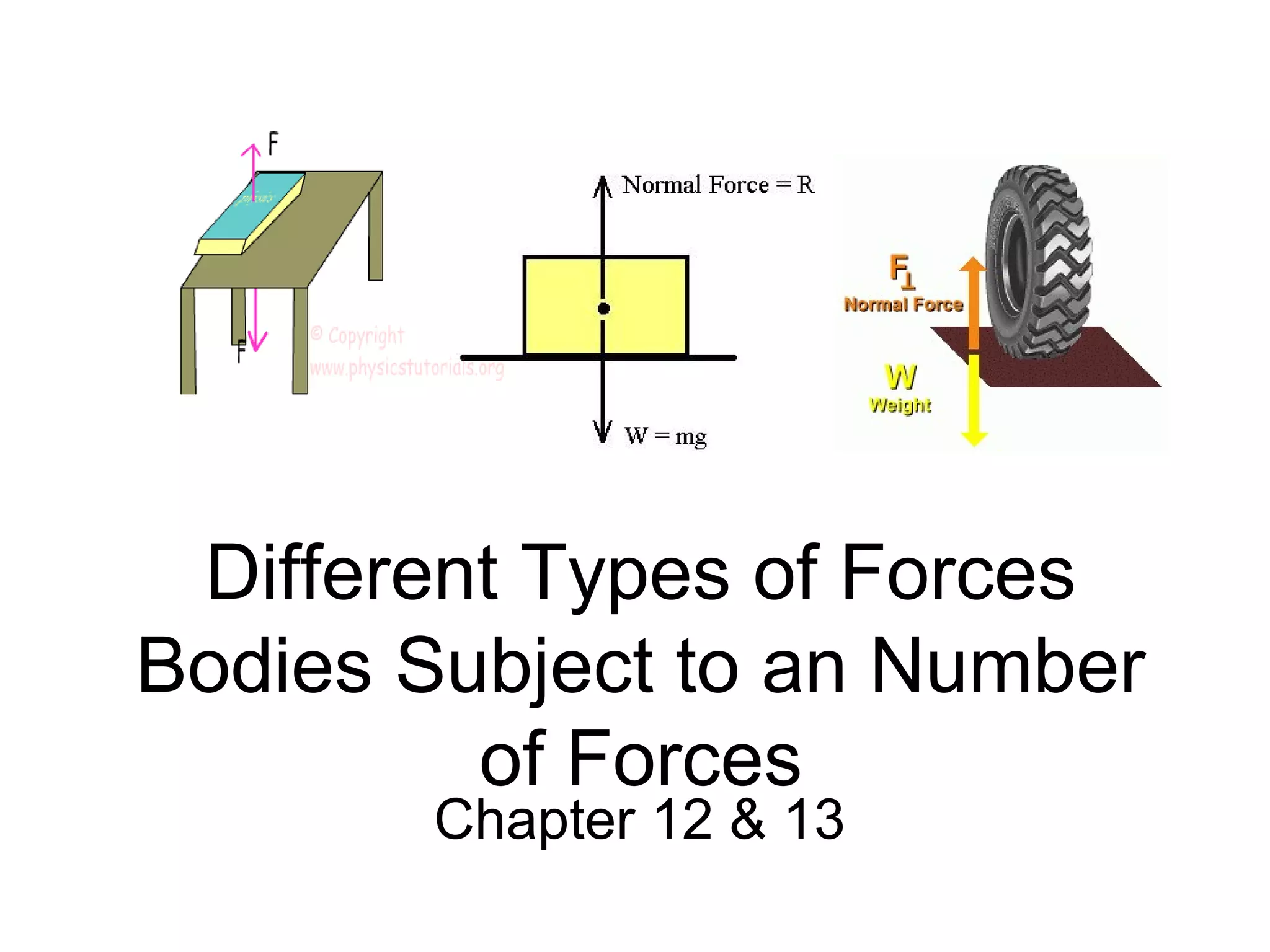
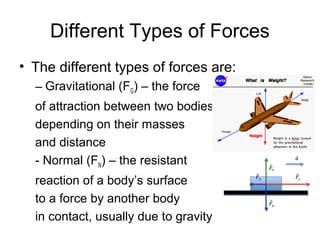
  – Gravitational (FG) – the force
  of attraction between two bodies
  depending on their masses
  and distance
  - Normal (FN) – the resistant
  reaction of a body’s surface
  to a force by another body
  in contact, usually due to gravity
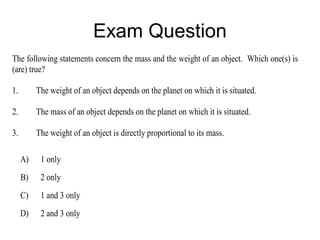
Exam Question
The following statements concern the mass and the weight of an object. Which one(s) is
(are) true?

1.        The weight of an object depends on the planet on which it is situated.

2.        The mass of an object depends on the planet on which it is situated.

3.        The weight of an object is directly proportional to its mass.

     A)    1 only
     B)    2 only
     C)    1 and 3 only
     D)    2 and 3 only
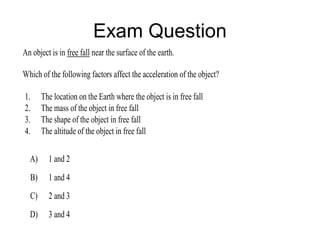
Exam Question
An object is in free fall near the surface of the earth.

Which of the following factors affect the acceleration of the object?

1.     The location on the Earth where the object is in free fall
2.     The mass of the object in free fall
3.     The shape of the object in free fall
4.     The altitude of the object in free fall

  A)     1 and 2
  B)     1 and 4
  C)     2 and 3
  D)     3 and 4
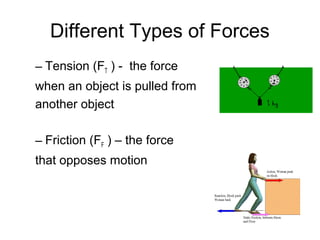
Different Types of Forces
– Tension (FT ) - the force
when an object is pulled from
another object

– Friction (FF ) – the force
that opposes motion
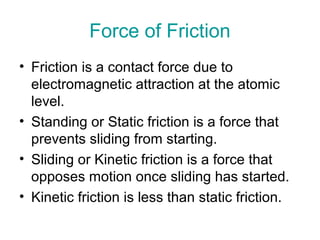
Force of Friction
• Friction is a contact force due to
  electromagnetic attraction at the atomic
  level.
• Standing or Static friction is a force that
  prevents sliding from starting.
• Sliding or Kinetic friction is a force that
  opposes motion once sliding has started.
• Kinetic friction is less than static friction.
Friction Force Equation
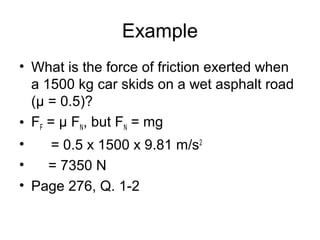
Example
• What is the force of friction exerted when
  a 1500 kg car skids on a wet asphalt road
  (μ = 0.5)?
• FF = μ FN, but FN = mg
•   = 0.5 x 1500 x 9.81 m/s2
•   = 7350 N
• Page 276, Q. 1-2
Activity
• Page 289, Q. 1,2
• Page 292, Q. 1,2
• Coefficient of Friction – Running Shoe Lab
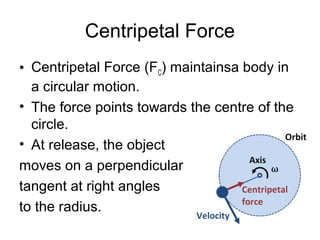
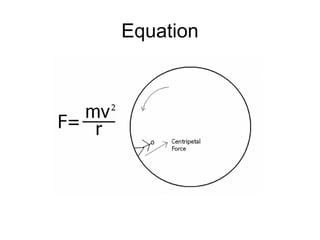
Centripetal Force
• Centripetal Force (FC) maintainsa body in
  a circular motion.
• The force points towards the centre of the
  circle.
• At release, the object
moves on a perpendicular
tangent at right angles
to the radius.
Equation
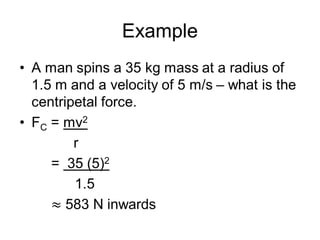
Example
Activity
• Page 281, Q. 1-2
• Page 286, Q. 1-4
Equilibrium
• A body is in a state of static equilibrium
  when the resultant force exerted on the
  object is zero and the object is stationary.
• A body is in a state of dynamic equilibrium
  when the resultant force is zero and the
  object is moving at constant velocity.
• A resultant force of zero means that the
  total of its components (x & y) are zero.
Equilibrant Force
• The equilibrant force (FEQ) is the force that
  cancels out the effect of an unbalanced
  force and results in a net force of zero.
• FEQ = -FR
• The resultant force and equilibrant forces
  are opposite vectors, meaning that they
  have the same magnitude and are parallel
  but in opposite directions.
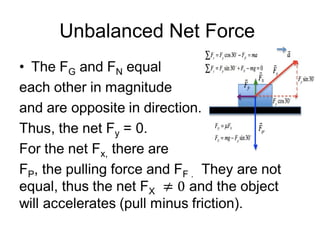
Unbalanced Net Force
Inclined Plane
• An inclined plane is a plane (flat) surface
  set an angle to the horizontal.
• An object on a inclined plane is only
  subject to the force due to gravity.
• The x,y axes are rotated to be parallel to
  the slope of the inclined plane.
• Thus, the normal force (FN) rises at 90°
  from the slope of the inclined plane.
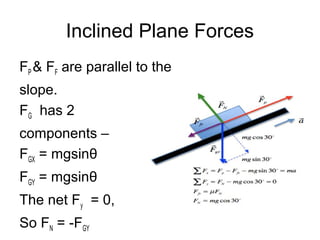
Inclined Plane Forces
FP & FF are parallel to the
slope.
FG has 2
components –
FGX = mgsinθ
FGY = mgsinθ
The net Fy = 0,
So FN = -FGY
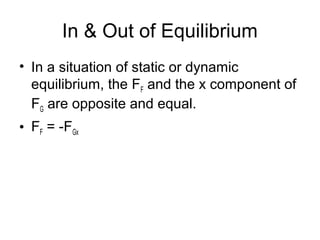
In & Out of Equilibrium
• In a situation of static or dynamic
  equilibrium, the FF and the x component of
  FG are opposite and equal.
• FF = -FGx
Activity
• Page 298, Q. 1-4
• Page 302, Q. 1- 4
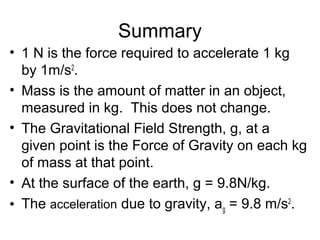
Summary
• 1 N is the force required to accelerate 1 kg
  by 1m/s2.
• Mass is the amount of matter in an object,
  measured in kg. This does not change.
• The Gravitational Field Strength, g, at a
  given point is the Force of Gravity on each kg
  of mass at that point.
• At the surface of the earth, g = 9.8N/kg.
• The acceleration due to gravity, ag = 9.8 m/s2.
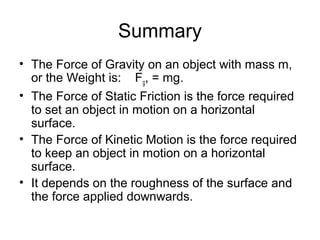
Summary
• The Force of Gravity on an object with mass m,
  or the Weight is: Fg, = mg.
• The Force of Static Friction is the force required
  to set an object in motion on a horizontal
  surface.
• The Force of Kinetic Motion is the force required
  to keep an object in motion on a horizontal
  surface.
• It depends on the roughness of the surface and
  the force applied downwards.
Summary
• The Coefficient of Friction, μ = Ff
                 FN
Where FF is the Force of Friction
And FN is the Normal Force or weight.

Physics 504 Chapter 12 & 13 Different Types of Forces

  • 1.
    Different Types ofForces Bodies Subject to an Number of Forces Chapter 12 & 13
  • 2.
    Resultant Force • Theresultant force (FR ) is the vector sum of all forces exerted on a body. • Forces are vector quantities having magnitude and direction. • FR = F1 + F2 • Force vector addition follows the same rules as velocity vector addition.
  • 3.
    Different Types ofForces • The different types of forces are: – Gravitational (FG) – the force of attraction between two bodies depending on their masses and distance - Normal (FN) – the resistant reaction of a body’s surface to a force by another body in contact, usually due to gravity
  • 4.
    Exam Question The followingstatements concern the mass and the weight of an object. Which one(s) is (are) true? 1. The weight of an object depends on the planet on which it is situated. 2. The mass of an object depends on the planet on which it is situated. 3. The weight of an object is directly proportional to its mass. A) 1 only B) 2 only C) 1 and 3 only D) 2 and 3 only
  • 5.
    Exam Question An objectis in free fall near the surface of the earth. Which of the following factors affect the acceleration of the object? 1. The location on the Earth where the object is in free fall 2. The mass of the object in free fall 3. The shape of the object in free fall 4. The altitude of the object in free fall A) 1 and 2 B) 1 and 4 C) 2 and 3 D) 3 and 4
  • 6.
    Different Types ofForces – Tension (FT ) - the force when an object is pulled from another object – Friction (FF ) – the force that opposes motion
  • 7.
    Force of Friction •Friction is a contact force due to electromagnetic attraction at the atomic level. • Standing or Static friction is a force that prevents sliding from starting. • Sliding or Kinetic friction is a force that opposes motion once sliding has started. • Kinetic friction is less than static friction.
  • 8.
  • 9.
    Example • What isthe force of friction exerted when a 1500 kg car skids on a wet asphalt road (μ = 0.5)? • FF = μ FN, but FN = mg • = 0.5 x 1500 x 9.81 m/s2 • = 7350 N • Page 276, Q. 1-2
  • 10.
    Activity • Page 289,Q. 1,2 • Page 292, Q. 1,2 • Coefficient of Friction – Running Shoe Lab
  • 11.
    Centripetal Force • CentripetalForce (FC) maintainsa body in a circular motion. • The force points towards the centre of the circle. • At release, the object moves on a perpendicular tangent at right angles to the radius.
  • 12.
  • 13.
  • 14.
    Activity • Page 281,Q. 1-2 • Page 286, Q. 1-4
  • 15.
    Equilibrium • A bodyis in a state of static equilibrium when the resultant force exerted on the object is zero and the object is stationary. • A body is in a state of dynamic equilibrium when the resultant force is zero and the object is moving at constant velocity. • A resultant force of zero means that the total of its components (x & y) are zero.
  • 16.
    Equilibrant Force • Theequilibrant force (FEQ) is the force that cancels out the effect of an unbalanced force and results in a net force of zero. • FEQ = -FR • The resultant force and equilibrant forces are opposite vectors, meaning that they have the same magnitude and are parallel but in opposite directions.
  • 17.
  • 18.
    Inclined Plane • Aninclined plane is a plane (flat) surface set an angle to the horizontal. • An object on a inclined plane is only subject to the force due to gravity. • The x,y axes are rotated to be parallel to the slope of the inclined plane. • Thus, the normal force (FN) rises at 90° from the slope of the inclined plane.
  • 19.
    Inclined Plane Forces FP& FF are parallel to the slope. FG has 2 components – FGX = mgsinθ FGY = mgsinθ The net Fy = 0, So FN = -FGY
  • 20.
    In & Outof Equilibrium • In a situation of static or dynamic equilibrium, the FF and the x component of FG are opposite and equal. • FF = -FGx
  • 21.
    Activity • Page 298,Q. 1-4 • Page 302, Q. 1- 4
  • 22.
    Summary • 1 Nis the force required to accelerate 1 kg by 1m/s2. • Mass is the amount of matter in an object, measured in kg. This does not change. • The Gravitational Field Strength, g, at a given point is the Force of Gravity on each kg of mass at that point. • At the surface of the earth, g = 9.8N/kg. • The acceleration due to gravity, ag = 9.8 m/s2.
  • 23.
    Summary • The Forceof Gravity on an object with mass m, or the Weight is: Fg, = mg. • The Force of Static Friction is the force required to set an object in motion on a horizontal surface. • The Force of Kinetic Motion is the force required to keep an object in motion on a horizontal surface. • It depends on the roughness of the surface and the force applied downwards.
  • 24.
    Summary • The Coefficientof Friction, μ = Ff FN Where FF is the Force of Friction And FN is the Normal Force or weight.