Forces on an incline
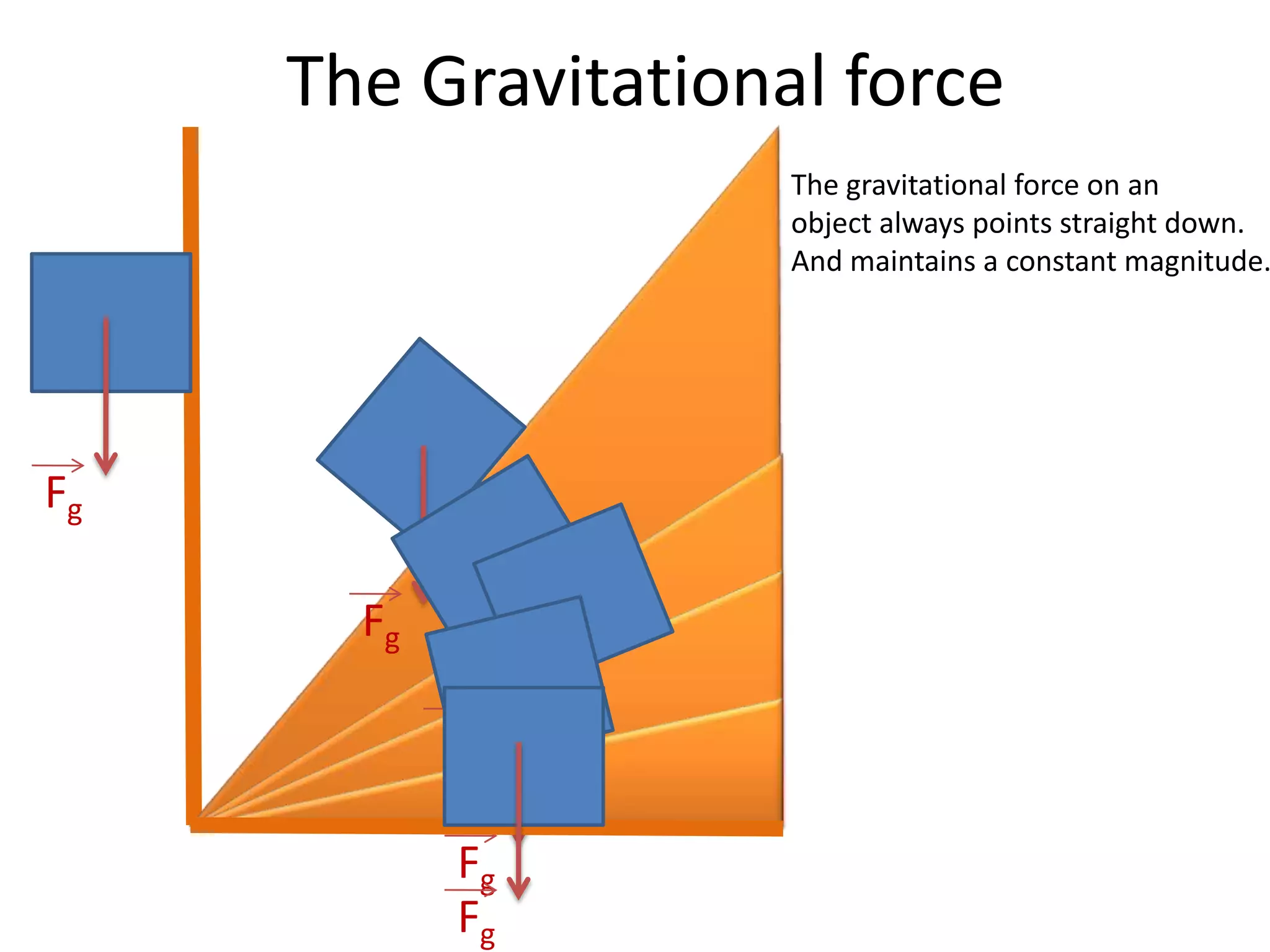
The Gravitational forceThe gravitational force on an object always points straight down.And maintains a constant magnitude.FgFgFgFgFgFg
The Normal ForceThe normal force on an object always points perpendicular  (normal to) the surface of contact.And decreases in magnitudeas the inclines angle increases.FN = 0NFNFNFNFN
Why does the Normal Force change, but gravity doesn’t?The Gravitational Force on the object is created by the mass of the object and the mass of the Earth itself.  The angle of the incline has nothing to do with the Gravitational Force.The Normal Force, however, is a reactionary force from the incline’s surface on the object.  As the object press more on the surface the normal force increases. If the pressing for decreases, so does the normal force.Basically the Gravitational Force wants the object to fall straight down, but the incline’s surface gets in the way, and a Normal Force is produced.  The strength of the Normal Force depends on how well the incline can oppose the Gravitational Force .
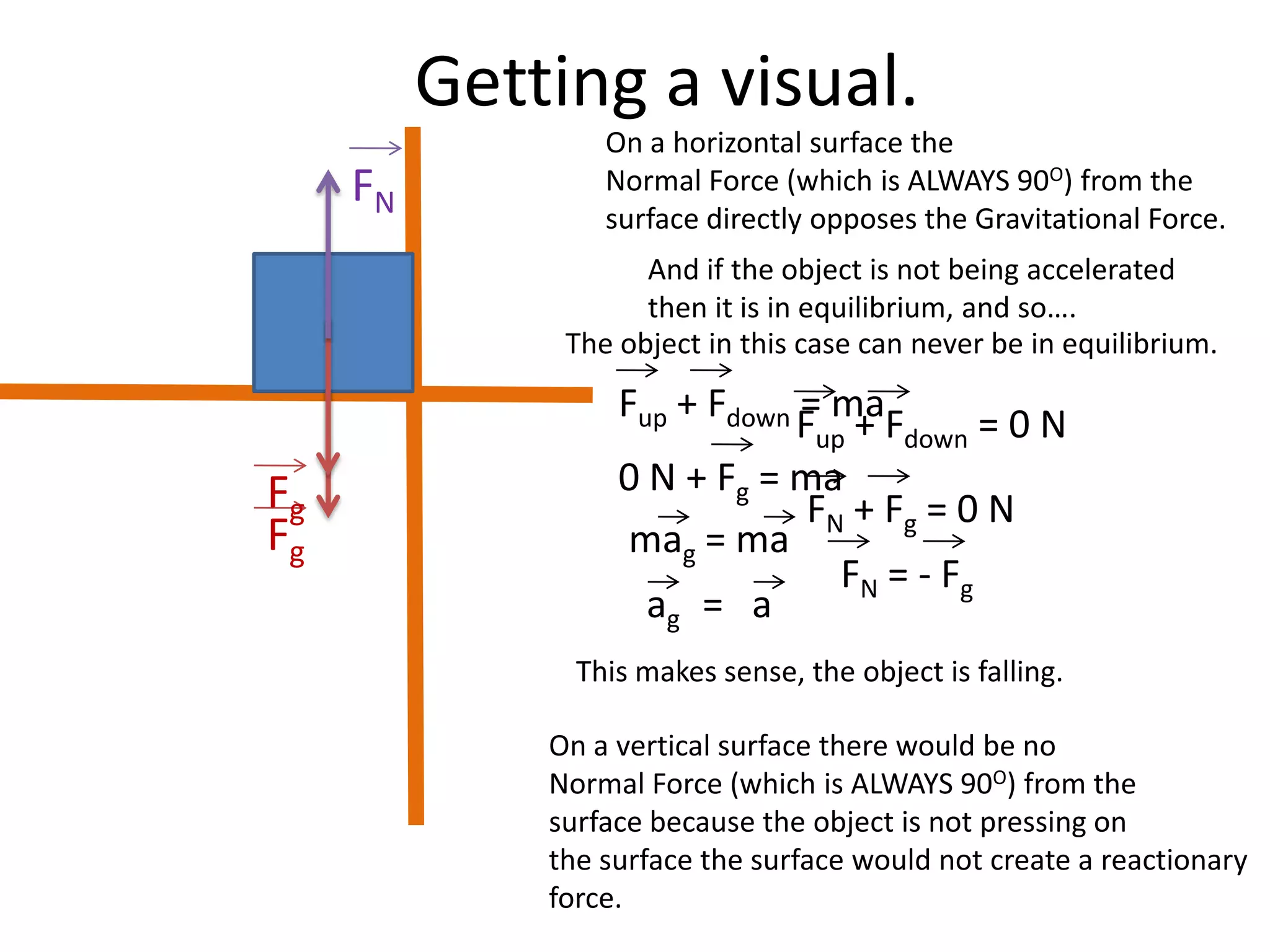
Getting a visual.On a horizontal surface the Normal Force (which is ALWAYS 90O) from the surface directly opposes the Gravitational Force.And if the object is not being accelerated then it is in equilibrium, and so….The object in this case can never be in equilibrium.Fup + Fdown = 0 NFup + Fdown = maFgFgFN + Fg = 0 NFN = - FgThis makes sense, the object is falling.On a vertical surface there would be no  Normal Force (which is ALWAYS 90O) from the surface because the object is not pressing on the surface the surface would not create a reactionary force.FN0 N + Fg = mamag = ma   ag   =   a
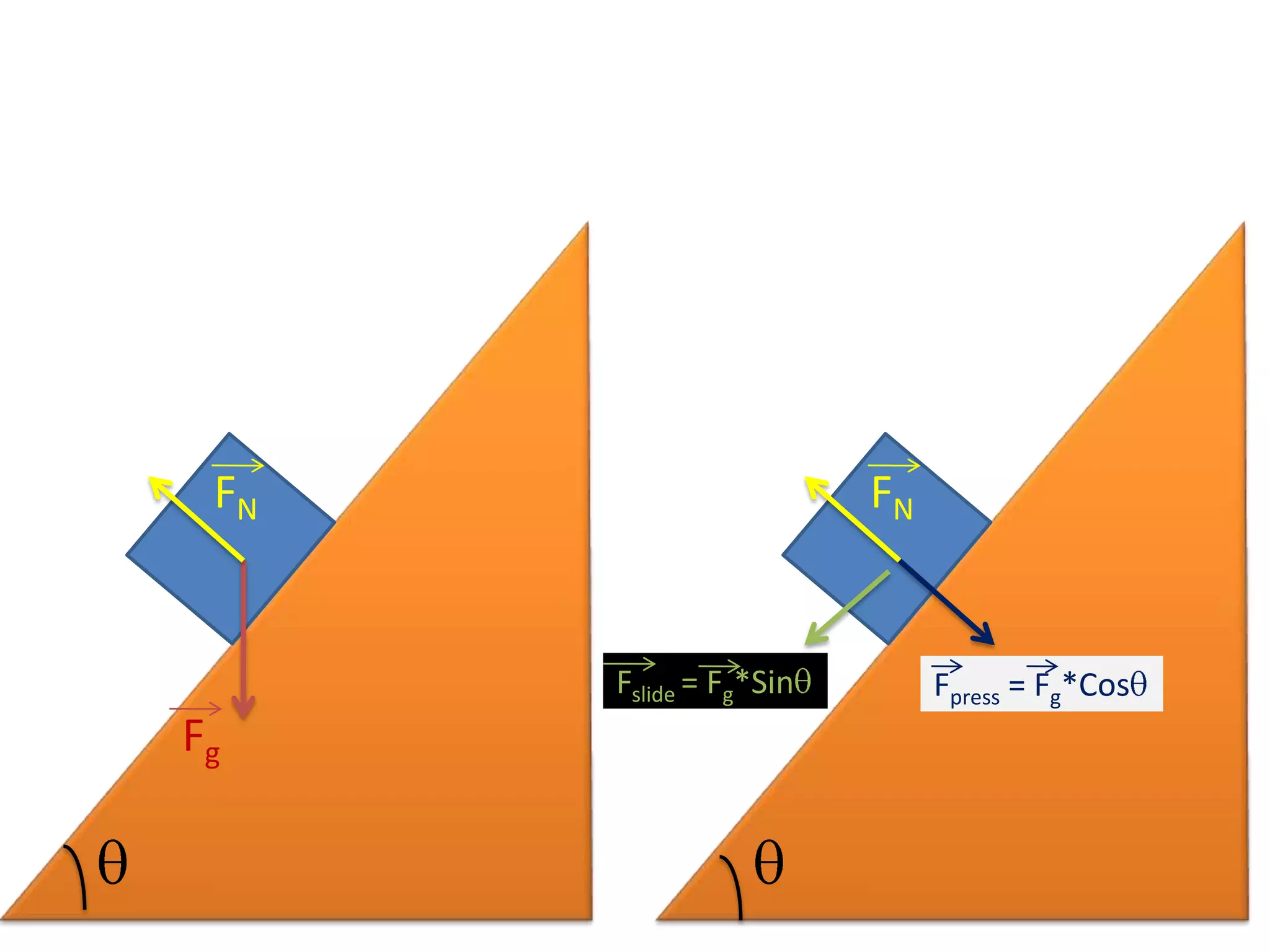
If the object is placed on an incline who has an angle between 0O and 90O, then the Normal Force opposes a component of the Gravitational Force, not all of it.FNFgIn this case the Gravitational Force is trying to do two things…FpressPress the object against the surface of the        incline (Fpress)2)  Slide the object along the surface of the        incline (Fslide)FslideFslideSo we can often think of the F.D.B. for an object on an incline as this.q
YY’X’FNqFgXqq
Y’X’FNFgFpressFslide = Fg*SinqFslideqFpress = Fg*CosqFN = - Fpress
FNFgFNFslide = Fg*SinqFpress = Fg*Cosqqq
The Friction ForceVVIf the object is in motion the Kinetic Friction Force on an object always points along the surface of contact, but in the opposite direction of object’s motion if it is moving (Kinetic Friction), and if the object is at rest then friction (Static Friction) opposes the direction that the object is “trying” to move in.FrickFrick
Which way will friction go, and what type is it?VV10 kg10 kgFrickFrickFricsFricsRestingResting
Forces of a rough inclineThe force on a rough incline are the same as a smooth,  with the addition of friction.The gravitational force on the object is still trying to do two things, so we will still work with it’s components.Now we can sayFfrictionFNFgFpressFN = - FpressFgsin(q) + FNm= maFslideFslide + Ffriction = maFgsin(q) +[FgCos(q)]mk = maFgsin(q) +[FgCos(q)]ms = 0 Nq

Forces on an Incline

  • 1.
  • 2.
    The Gravitational forceThegravitational force on an object always points straight down.And maintains a constant magnitude.FgFgFgFgFgFg
  • 3.
    The Normal ForceThenormal force on an object always points perpendicular (normal to) the surface of contact.And decreases in magnitudeas the inclines angle increases.FN = 0NFNFNFNFN
  • 4.
    Why does theNormal Force change, but gravity doesn’t?The Gravitational Force on the object is created by the mass of the object and the mass of the Earth itself. The angle of the incline has nothing to do with the Gravitational Force.The Normal Force, however, is a reactionary force from the incline’s surface on the object. As the object press more on the surface the normal force increases. If the pressing for decreases, so does the normal force.Basically the Gravitational Force wants the object to fall straight down, but the incline’s surface gets in the way, and a Normal Force is produced. The strength of the Normal Force depends on how well the incline can oppose the Gravitational Force .
  • 5.
    Getting a visual.Ona horizontal surface the Normal Force (which is ALWAYS 90O) from the surface directly opposes the Gravitational Force.And if the object is not being accelerated then it is in equilibrium, and so….The object in this case can never be in equilibrium.Fup + Fdown = 0 NFup + Fdown = maFgFgFN + Fg = 0 NFN = - FgThis makes sense, the object is falling.On a vertical surface there would be no Normal Force (which is ALWAYS 90O) from the surface because the object is not pressing on the surface the surface would not create a reactionary force.FN0 N + Fg = mamag = ma ag = a
  • 6.
    If the objectis placed on an incline who has an angle between 0O and 90O, then the Normal Force opposes a component of the Gravitational Force, not all of it.FNFgIn this case the Gravitational Force is trying to do two things…FpressPress the object against the surface of the incline (Fpress)2) Slide the object along the surface of the incline (Fslide)FslideFslideSo we can often think of the F.D.B. for an object on an incline as this.q
  • 7.
  • 8.
  • 9.
  • 10.
    The Friction ForceVVIfthe object is in motion the Kinetic Friction Force on an object always points along the surface of contact, but in the opposite direction of object’s motion if it is moving (Kinetic Friction), and if the object is at rest then friction (Static Friction) opposes the direction that the object is “trying” to move in.FrickFrick
  • 11.
    Which way willfriction go, and what type is it?VV10 kg10 kgFrickFrickFricsFricsRestingResting
  • 12.
    Forces of arough inclineThe force on a rough incline are the same as a smooth, with the addition of friction.The gravitational force on the object is still trying to do two things, so we will still work with it’s components.Now we can sayFfrictionFNFgFpressFN = - FpressFgsin(q) + FNm= maFslideFslide + Ffriction = maFgsin(q) +[FgCos(q)]mk = maFgsin(q) +[FgCos(q)]ms = 0 Nq