Thompson and Rutherford
Objectives:
 4.5 Analyze the behaviour of
cathode rays.
 4.7 Analyze Thomson’s atomic
model.
 4.8 Analyze Rutherford’s atomic
Model
J.J. Thomson’s Atomic Model
-
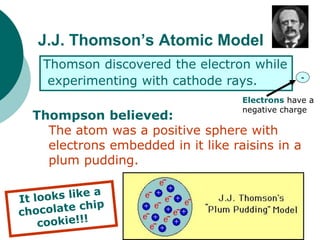
Thomson discovered the electron while
experimenting with cathode rays.
Electrons have a
negative charge
Thompson believed:
The atom was a positive sphere with
electrons embedded in it like raisins in a
plum pudding.
Cathode Rays
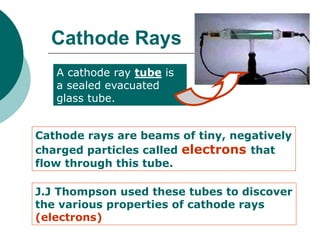
Cathode rays are beams of tiny, negatively
charged particles called electrons that
flow through this tube.
A cathode ray tube is
a sealed evacuated
glass tube.
J.J Thompson used these tubes to discover
the various properties of cathode rays
(electrons)
Properties Of Cathode Rays
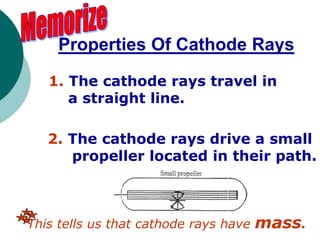
1. The cathode rays travel in
a straight line.
2. The cathode rays drive a small
propeller located in their path.
This tells us that cathode rays have mass.
Properties Of Cathode Rays
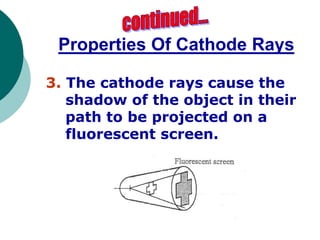
3. The cathode rays cause the
shadow of the object in their
path to be projected on a
fluorescent screen.
Properties Of Cathode Rays
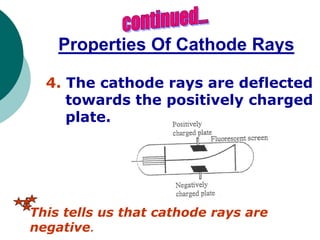
4. The cathode rays are deflected
towards the positively charged
plate.
This tells us that cathode rays are
negative.
Which of the properties about cathode rays
tell us that they are in fact negative?
Which of the properties about cathode rays
tell us that they have mass?
The cathode rays are deflected
towards the positively charged
plate.
The cathode rays drive a small
propeller located in their path.
Draw Thompson’s atomic model.
What did J.J Thompson use to find the
properties of electrons
The cathode ray tube and cathode
rays
-
-
-
-
-
-
-
-
-
Positive sphere with electrons embedded in it
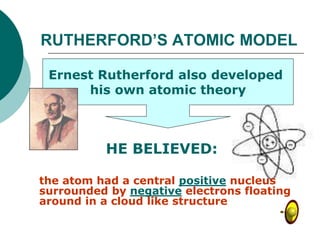
RUTHERFORD’S ATOMIC MODEL
HE BELIEVED:
the atom had a central positive nucleus
surrounded by negative electrons floating
around in a cloud like structure
Ernest Rutherford also developed
his own atomic theory
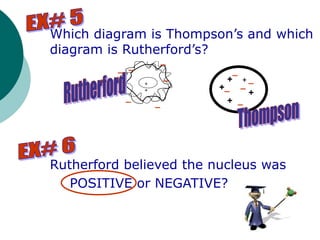
++
+
_
_
_
_
_
_
_
_
_
__+
+
+
+
_
Which diagram is Thompson’s and which
diagram is Rutherford’s?
Rutherford believed the nucleus was
POSITIVE or NEGATIVE?
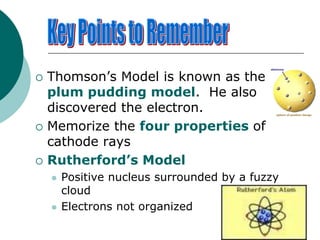
 Thomson’s Model is known as the
plum pudding model. He also
discovered the electron.
 Memorize the four properties of
cathode rays
 Rutherford’s Model
 Positive nucleus surrounded by a fuzzy
cloud
 Electrons not organized
Activities
 Worksheet # 6
References
 Science Quest – Grenier, Daigle, Rheaume – 1998,
Cheneliere
 Student Study Guide: Physical Science 416-436(MEQ)
 Doc Brown’s Chemistry Clinic
(http://www.wpbschoolhouse.btinternet.co.uk/page04/
4_71atom.htm)
 Atom: The Incredible World
(http://library.thinkquest.org/19662/low/eng/exp-
rutherford.html)
 cwx.prenhall.com/.../ medialib/blb0202.html
 www.sci.tamucc.edu/.../ genchem/atomic/page6.htm
 library.thinkquest.org/ 3471/physics_genesis_b..
 Animation Factory
 Google Images

Thompson & Rutherford

  • 1.
    Thompson and Rutherford Objectives: 4.5 Analyze the behaviour of cathode rays.  4.7 Analyze Thomson’s atomic model.  4.8 Analyze Rutherford’s atomic Model
  • 2.
    J.J. Thomson’s AtomicModel - Thomson discovered the electron while experimenting with cathode rays. Electrons have a negative charge Thompson believed: The atom was a positive sphere with electrons embedded in it like raisins in a plum pudding.
  • 3.
    Cathode Rays Cathode raysare beams of tiny, negatively charged particles called electrons that flow through this tube. A cathode ray tube is a sealed evacuated glass tube. J.J Thompson used these tubes to discover the various properties of cathode rays (electrons)
  • 4.
    Properties Of CathodeRays 1. The cathode rays travel in a straight line. 2. The cathode rays drive a small propeller located in their path. This tells us that cathode rays have mass.
  • 5.
    Properties Of CathodeRays 3. The cathode rays cause the shadow of the object in their path to be projected on a fluorescent screen.
  • 6.
    Properties Of CathodeRays 4. The cathode rays are deflected towards the positively charged plate. This tells us that cathode rays are negative.
  • 7.
    Which of theproperties about cathode rays tell us that they are in fact negative? Which of the properties about cathode rays tell us that they have mass? The cathode rays are deflected towards the positively charged plate. The cathode rays drive a small propeller located in their path.
  • 8.
    Draw Thompson’s atomicmodel. What did J.J Thompson use to find the properties of electrons The cathode ray tube and cathode rays - - - - - - - - - Positive sphere with electrons embedded in it
  • 9.
    RUTHERFORD’S ATOMIC MODEL HEBELIEVED: the atom had a central positive nucleus surrounded by negative electrons floating around in a cloud like structure Ernest Rutherford also developed his own atomic theory
  • 10.
    ++ + _ _ _ _ _ _ _ _ _ __+ + + + _ Which diagram isThompson’s and which diagram is Rutherford’s? Rutherford believed the nucleus was POSITIVE or NEGATIVE?
  • 11.
     Thomson’s Modelis known as the plum pudding model. He also discovered the electron.  Memorize the four properties of cathode rays  Rutherford’s Model  Positive nucleus surrounded by a fuzzy cloud  Electrons not organized
  • 12.
  • 13.
    References  Science Quest– Grenier, Daigle, Rheaume – 1998, Cheneliere  Student Study Guide: Physical Science 416-436(MEQ)  Doc Brown’s Chemistry Clinic (http://www.wpbschoolhouse.btinternet.co.uk/page04/ 4_71atom.htm)  Atom: The Incredible World (http://library.thinkquest.org/19662/low/eng/exp- rutherford.html)  cwx.prenhall.com/.../ medialib/blb0202.html  www.sci.tamucc.edu/.../ genchem/atomic/page6.htm  library.thinkquest.org/ 3471/physics_genesis_b..  Animation Factory  Google Images