Manufacturing
Technical Objects
Chapter 12
Guiding Controls
 Guiding is a Mechanical Function
performed by any component that controls
the motion of moving parts.
 E.g. The mechanical function of a hinge is
guiding.
 A Guiding Component or Control is a
component whose mechanical function is
to guide the motion of moving parts.
 E.g. What is the guiding component for the
drawer? The wood slats.
431
Types of Guiding
 Translational Guiding ensures the straight
translational motion of a moving part.
 E.g. a vertical window groove guides motion
 Rotational Guiding ensures the rotational motion
of a moving part.
 E.g. a bicycle wheel hub guides motion
 Helical Guiding ensures the translation motion of
a moving part while it rotates about the same
axis.
 E.g. threaded shank in a vice guides motion
431
Degrees of Freedom of Movement
 The Degrees of Freedom are the set of
independent movements that are possible
for a given part in a technical object.
 E.g. A door can only rotate around the
hinges – 1 degree freedom
 E.g. A manual transmission gear shift
moves forward/back and left/right – 2
degrees of freedom
428
Technical Drawing: Projections
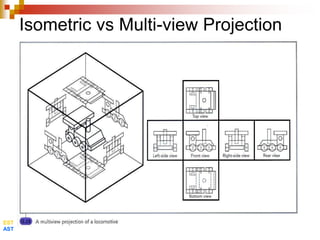
 A projection is the representation of a
three-dimensional object on a two-
dimensional surface.
 The most commonly used projections
are:
1. Isometric: the 3 dimensions of the object
in a single drawing.
2. Multiview: 3 views with greater detail
and no distortion: Top, Front, Side
EST
AST
Isometric vs Multi-view Projection

EST
AST
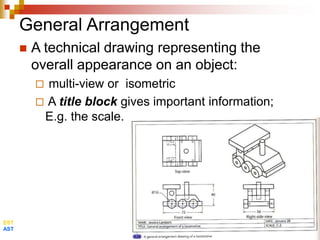
General Arrangement
 A technical drawing representing the
overall appearance on an object:
 multi-view or isometric
 A title block gives important information;
E.g. the scale.
EST
AST
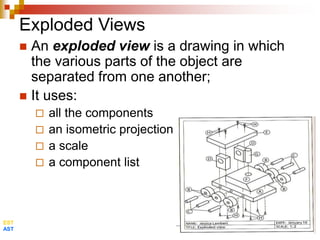
Exploded Views
 An exploded view is a drawing in which
the various parts of the object are
separated from one another;
 It uses:
 all the components
 an isometric projection
 a scale
 a component list
EST
AST
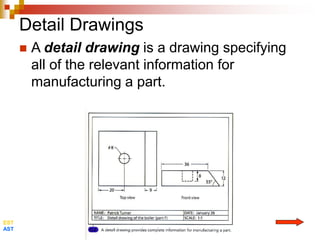
Detail Drawings
 A detail drawing is a drawing specifying
all of the relevant information for
manufacturing a part.
EST
AST
Dimensional Tolerance
 An indicator of the maximum acceptable
difference between a specified
measurement and the actual
measurement on the finished object.
 Part of a Detail Drawing
 E.g. 50 mm 2 mm
50 mm + 2 mm = 52 mm = Maximum
50 mm – 2 mm = 48 mm = Minimum
EST
AST
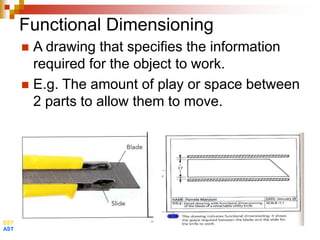
Functional Dimensioning
 A drawing that specifies the information
required for the object to work.
 E.g. The amount of play or space between
2 parts to allow them to move.
EST
AST
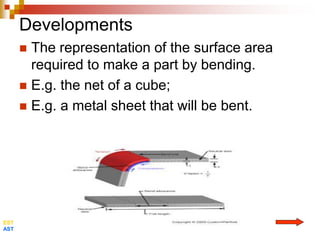
Developments
 The representation of the surface area
required to make a part by bending.
 E.g. the net of a cube;
 E.g. a metal sheet that will be bent.
EST
AST
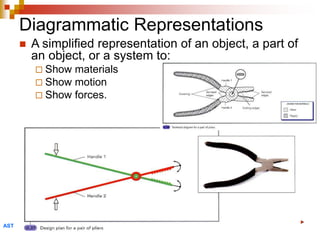
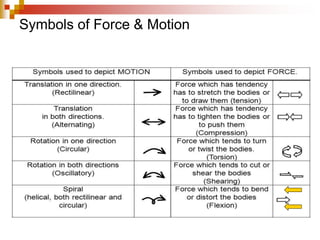
Diagrammatic Representations
 A simplified representation of an object, a part of
an object, or a system to:
 Show materials
 Show motion
 Show forces.
AST
Symbols of Force & Motion
AST
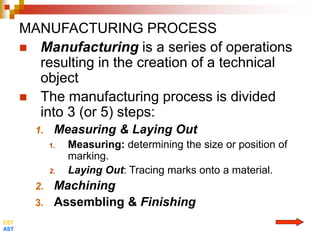
MANUFACTURING PROCESS
 Manufacturing is a series of operations
resulting in the creation of a technical
object
 The manufacturing process is divided
into 3 (or 5) steps:
1. Measuring & Laying Out
1. Measuring: determining the size or position of
marking.
2. Laying Out: Tracing marks onto a material.
2. Machining
3. Assembling & Finishing
EST
AST
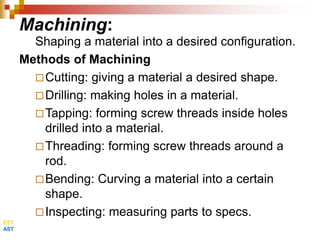
Machining:
Shaping a material into a desired configuration.
Methods of Machining
Cutting: giving a material a desired shape.
Drilling: making holes in a material.
Tapping: forming screw threads inside holes
drilled into a material.
Threading: forming screw threads around a
rod.
Bending: Curving a material into a certain
shape.
Inspecting: measuring parts to specs.
EST
AST
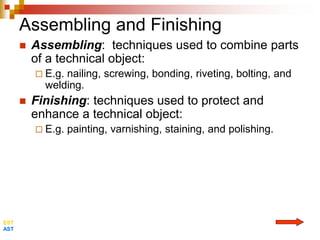
Assembling and Finishing
 Assembling: techniques used to combine parts
of a technical object:
 E.g. nailing, screwing, bonding, riveting, bolting, and
welding.
 Finishing: techniques used to protect and
enhance a technical object:
 E.g. painting, varnishing, staining, and polishing.
EST
AST
Checkup
 Observatory: The Environment
Page 419, Questions 7 to 10
Page 420, Questions 11 to 14

Technical Drawing & Assembly.ppt

  • 1.
  • 2.
    Guiding Controls  Guidingis a Mechanical Function performed by any component that controls the motion of moving parts.  E.g. The mechanical function of a hinge is guiding.  A Guiding Component or Control is a component whose mechanical function is to guide the motion of moving parts.  E.g. What is the guiding component for the drawer? The wood slats. 431
  • 3.
    Types of Guiding Translational Guiding ensures the straight translational motion of a moving part.  E.g. a vertical window groove guides motion  Rotational Guiding ensures the rotational motion of a moving part.  E.g. a bicycle wheel hub guides motion  Helical Guiding ensures the translation motion of a moving part while it rotates about the same axis.  E.g. threaded shank in a vice guides motion 431
  • 4.
    Degrees of Freedomof Movement  The Degrees of Freedom are the set of independent movements that are possible for a given part in a technical object.  E.g. A door can only rotate around the hinges – 1 degree freedom  E.g. A manual transmission gear shift moves forward/back and left/right – 2 degrees of freedom 428
  • 5.
    Technical Drawing: Projections A projection is the representation of a three-dimensional object on a two- dimensional surface.  The most commonly used projections are: 1. Isometric: the 3 dimensions of the object in a single drawing. 2. Multiview: 3 views with greater detail and no distortion: Top, Front, Side EST AST
  • 6.
    Isometric vs Multi-viewProjection  EST AST
  • 7.
    General Arrangement  Atechnical drawing representing the overall appearance on an object:  multi-view or isometric  A title block gives important information; E.g. the scale. EST AST
  • 8.
    Exploded Views  Anexploded view is a drawing in which the various parts of the object are separated from one another;  It uses:  all the components  an isometric projection  a scale  a component list EST AST
  • 9.
    Detail Drawings  Adetail drawing is a drawing specifying all of the relevant information for manufacturing a part. EST AST
  • 10.
    Dimensional Tolerance  Anindicator of the maximum acceptable difference between a specified measurement and the actual measurement on the finished object.  Part of a Detail Drawing  E.g. 50 mm 2 mm 50 mm + 2 mm = 52 mm = Maximum 50 mm – 2 mm = 48 mm = Minimum EST AST
  • 11.
    Functional Dimensioning  Adrawing that specifies the information required for the object to work.  E.g. The amount of play or space between 2 parts to allow them to move. EST AST
  • 12.
    Developments  The representationof the surface area required to make a part by bending.  E.g. the net of a cube;  E.g. a metal sheet that will be bent. EST AST
  • 13.
    Diagrammatic Representations  Asimplified representation of an object, a part of an object, or a system to:  Show materials  Show motion  Show forces. AST
  • 14.
    Symbols of Force& Motion AST
  • 15.
    MANUFACTURING PROCESS  Manufacturingis a series of operations resulting in the creation of a technical object  The manufacturing process is divided into 3 (or 5) steps: 1. Measuring & Laying Out 1. Measuring: determining the size or position of marking. 2. Laying Out: Tracing marks onto a material. 2. Machining 3. Assembling & Finishing EST AST
  • 16.
    Machining: Shaping a materialinto a desired configuration. Methods of Machining Cutting: giving a material a desired shape. Drilling: making holes in a material. Tapping: forming screw threads inside holes drilled into a material. Threading: forming screw threads around a rod. Bending: Curving a material into a certain shape. Inspecting: measuring parts to specs. EST AST
  • 17.
    Assembling and Finishing Assembling: techniques used to combine parts of a technical object:  E.g. nailing, screwing, bonding, riveting, bolting, and welding.  Finishing: techniques used to protect and enhance a technical object:  E.g. painting, varnishing, staining, and polishing. EST AST
  • 18.
    Checkup  Observatory: TheEnvironment Page 419, Questions 7 to 10 Page 420, Questions 11 to 14