INDUCED
MAGNETISM
HOW TO MAKE A
MAGNET?
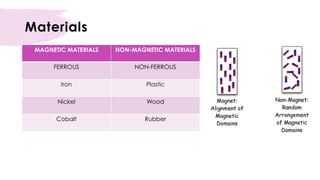
Materials
MAGNETIC MATERIALS NON-MAGNETIC MATERIALS
FERROUS NON-FERROUS
Iron Plastic
Nickel Wood
Cobalt Rubber
Induced magnetism
The side of the material facing the magnet will become
the opposite pole as the magnet
An induced magnet only becomes a magnet when it is
placed in a magnetic field.
The induced magnetism is quickly lost when the magnet
is removed from the magnetic field.
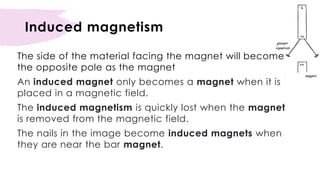
The nails in the image become induced magnets when
they are near the bar magnet.
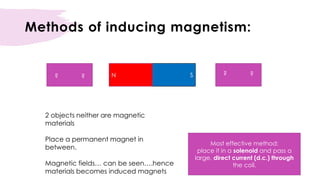
2 objects neither are magnetic
materials
Place a permanent magnet in
between.
Magnetic fields… can be seen….hence
materials becomes induced magnets
Methods of inducing magnetism:
Most effective method:
place it in a solenoid and pass a
large, direct current (d.c.) through
the coil.
S
N
?
? ?
?
Methods of
demagnetisation:
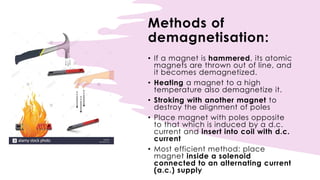
• If a magnet is hammered, its atomic
magnets are thrown out of line, and
it becomes demagnetized.
• Heating a magnet to a high
temperature also demagnetize it.
• Stroking with another magnet to
destroy the alignment of poles
• Place magnet with poles opposite
to that which is induced by a d.c.
current and insert into coil with d.c.
current
• Most efficient method: place
magnet inside a solenoid
connected to an alternating current
(a.c.) supply
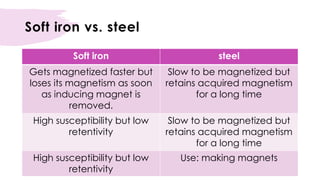
Soft iron vs. steel
Soft iron steel
Gets magnetized faster but
loses its magnetism as soon
as inducing magnet is
removed.
Slow to be magnetized but
retains acquired magnetism
for a long time
High susceptibility but low
retentivity
Slow to be magnetized but
retains acquired magnetism
for a long time
High susceptibility but low
retentivity
Use: making magnets
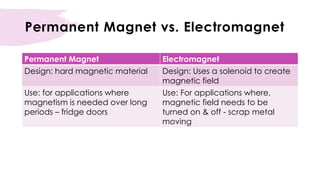
Permanent Magnet vs. Electromagnet
Permanent Magnet Electromagnet
Design: hard magnetic material Design: Uses a solenoid to create
magnetic field
Use: for applications where
magnetism is needed over long
periods – fridge doors
Use: For applications where,
magnetic field needs to be
turned on & off - scrap metal
moving

1 induced magnetism

  • 1.
  • 2.
    Materials MAGNETIC MATERIALS NON-MAGNETICMATERIALS FERROUS NON-FERROUS Iron Plastic Nickel Wood Cobalt Rubber
  • 3.
    Induced magnetism The sideof the material facing the magnet will become the opposite pole as the magnet An induced magnet only becomes a magnet when it is placed in a magnetic field. The induced magnetism is quickly lost when the magnet is removed from the magnetic field. The nails in the image become induced magnets when they are near the bar magnet.
  • 4.
    2 objects neitherare magnetic materials Place a permanent magnet in between. Magnetic fields… can be seen….hence materials becomes induced magnets Methods of inducing magnetism: Most effective method: place it in a solenoid and pass a large, direct current (d.c.) through the coil. S N ? ? ? ?
  • 5.
    Methods of demagnetisation: • Ifa magnet is hammered, its atomic magnets are thrown out of line, and it becomes demagnetized. • Heating a magnet to a high temperature also demagnetize it. • Stroking with another magnet to destroy the alignment of poles • Place magnet with poles opposite to that which is induced by a d.c. current and insert into coil with d.c. current • Most efficient method: place magnet inside a solenoid connected to an alternating current (a.c.) supply
  • 6.
    Soft iron vs.steel Soft iron steel Gets magnetized faster but loses its magnetism as soon as inducing magnet is removed. Slow to be magnetized but retains acquired magnetism for a long time High susceptibility but low retentivity Slow to be magnetized but retains acquired magnetism for a long time High susceptibility but low retentivity Use: making magnets
  • 7.
    Permanent Magnet vs.Electromagnet Permanent Magnet Electromagnet Design: hard magnetic material Design: Uses a solenoid to create magnetic field Use: for applications where magnetism is needed over long periods – fridge doors Use: For applications where, magnetic field needs to be turned on & off - scrap metal moving