www.PinoyBIX.org
Presents:
Electric Charge and Electric Field
credit: Giancoli Physics
Chapter 16
Electric Charge and
Electric Field
Units of Chapter 16
• Static Electricity; Electric Charge and Its
Conservation
• Electric Charge in the Atom
• Insulators and Conductors
• Induced Charge; the Electroscope
• Coulomb’s Law
• Solving Problems Involving Coulomb’s Law and
Vectors
• The Electric Field
Units of Chapter 16
• Field Lines
• Electric Fields and Conductors
• Gauss’s Law
• Electric Forces in Molecular Biology: DNA
Structure and Replication
• Photocopy Machines and Computer
Printers Use Electrostatics
16.1 Static Electricity; Electric Charge
and Its Conservation
Objects can be charged by rubbing
16.1 Static Electricity;
Electric Charge and Its
Conservation
Charge comes in two
types, positive and
negative; like charges
repel and opposite
charges attract
16.1 Static Electricity; Electric Charge
and Its Conservation
Electric charge is conserved – the
arithmetic sum of the total charge cannot
change in any interaction.
16.2 Electric Charge in the Atom
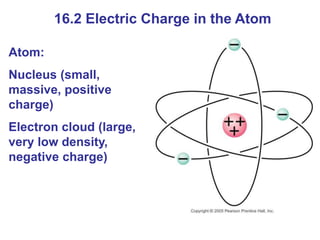
Atom:
Nucleus (small,
massive, positive
charge)
Electron cloud (large,
very low density,
negative charge)
16.2 Electric Charge in the Atom
Atom is electrically neutral.
Rubbing charges objects by moving electrons
from one to the other.
16.2 Electric Charge in the Atom
Polar molecule: neutral overall, but charge not
evenly distributed
16.3 Insulators and Conductors
Conductor:
Charge flows freely
Metals
Insulator:
Almost no charge flows
Most other materials
Some materials are semiconductors.
16.4 Induced Charge; the Electroscope
Metal objects can be charged by conduction:
16.4 Induced Charge; the Electroscope
They can also be charged by induction:
16.4 Induced Charge; the Electroscope
Nonconductors won’t become charged by
conduction or induction, but will experience
charge separation:
16.4 Induced Charge; the Electroscope
The electroscope
can be used for
detecting charge:
16.4 Induced Charge; the Electroscope
The electroscope can be charged either by
conduction or by induction.
16.4 Induced Charge; the Electroscope
The charged electroscope can then be used to
determine the sign of an unknown charge.
16.5 Coulomb’s Law
Experiment shows that the electric force
between two charges is proportional to the
product of the charges and inversely
proportional to the distance between them.
16.5 Coulomb’s Law
Coulomb’s law:
(16-1)
This equation gives the magnitude of
the force.
16.5 Coulomb’s Law
The force is along the line connecting the
charges, and is attractive if the charges are
opposite, and repulsive if they are the same.
16.5 Coulomb’s Law
Unit of charge: coulomb, C
The proportionality constant in Coulomb’s
law is then:
Charges produced by rubbing are
typically around a microcoulomb:
16.5 Coulomb’s Law
Charge on the electron:
Electric charge is quantized in units
of the electron charge.
16.5 Coulomb’s Law
The proportionality constant k can also be
written in terms of , the permittivity of free
space:
(16-2)
16.5 Coulomb’s Law
Coulomb’s law strictly applies only to point charges.
Superposition: for multiple point charges, the forces
on each charge from every other charge can be
calculated and then added as vectors.
16.6 Solving Problems Involving
Coulomb’s Law and Vectors
The net force on a charge is the vector
sum of all the forces acting on it.
16.6 Solving Problems Involving
Coulomb’s Law and Vectors
Vector addition review:
16.7 The Electric Field
The electric field is the
force on a small charge,
divided by the charge:
(16-3)
16.7 The Electric Field
For a point charge:
(16-4a)
(16-4b)
16.7 The Electric Field
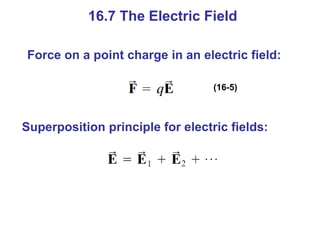
Force on a point charge in an electric field:
(16-5)
Superposition principle for electric fields:
16.7 The Electric Field
Problem solving in electrostatics: electric
forces and electric fields
1. Draw a diagram; show all charges, with
signs, and electric fields and forces with
directions
2. Calculate forces using Coulomb’s law
3. Add forces vectorially to get result
16.8 Field Lines
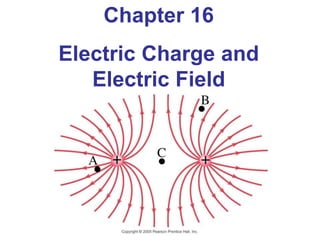
The electric field can be represented by field
lines. These lines start on a positive charge
and end on a negative charge.
16.8 Field Lines
The number of field lines starting (ending)
on a positive (negative) charge is
proportional to the magnitude of the charge.
The electric field is stronger where the field
lines are closer together.
16.8 Field Lines
Electric dipole: two equal charges, opposite in
sign:
16.8 Field Lines
The electric field between
two closely spaced,
oppositely charged parallel
plates is constant.
16.8 Field Lines
Summary of field lines:
1. Field lines indicate the direction of the
field; the field is tangent to the line.
2. The magnitude of the field is proportional
to the density of the lines.
3. Field lines start on positive charges and
end on negative charges; the number is
proportional to the magnitude of the
charge.
16.9 Electric Fields and Conductors
The static electric field inside a conductor is
zero – if it were not, the charges would move.
The net charge on a conductor is on its
surface.
16.9 Electric Fields and Conductors
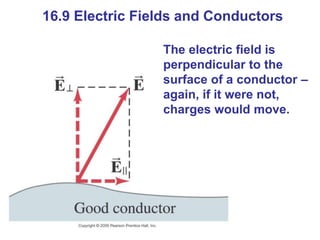
The electric field is
perpendicular to the
surface of a conductor –
again, if it were not,
charges would move.
16.10 Gauss’s Law
Electric flux:
(16-7)
Electric flux through an
area is proportional to
the total number of field
lines crossing the area.
16.10 Gauss’s Law
Flux through a closed surface:
16.10 Gauss’s Law
The net number of field lines through the
surface is proportional to the charge
enclosed, and also to the flux, giving
Gauss’s law:
(16-9)
This can be used to find the electric field
in situations with a high degree of
symmetry.
16.11 Electric Forces in Molecular
Biology: DNA Structure and Replication
Molecular biology is the
study of the structure and
functioning of the living cell
at the molecular level.
The DNA molecule is a
double helix:
16.11 Electric Forces in Molecular
Biology: DNA Structure and Replication
The A-T and G-C
nucleotide bases
attract each other
through
electrostatic
forces.
16.11 Electric Forces in Molecular
Biology: DNA Structure and Replication
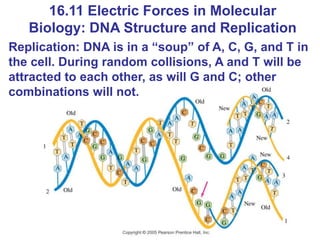
Replication: DNA is in a “soup” of A, C, G, and T in
the cell. During random collisions, A and T will be
attracted to each other, as will G and C; other
combinations will not.
16.12 Photocopy Machines and
Computer Printers Use Electrostatics
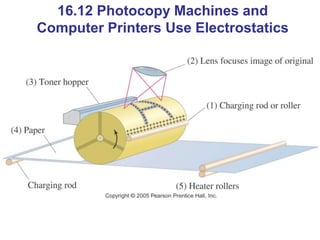
Photocopy machine:
• drum is charged positively
• image is focused on drum
• only black areas stay charged and
therefore attract toner particles
• image is transferred to paper and sealed by
heat
16.12 Photocopy Machines and
Computer Printers Use Electrostatics
16.12 Photocopy Machines and
Computer Printers Use Electrostatics
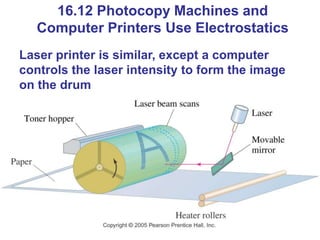
Laser printer is similar, except a computer
controls the laser intensity to form the image
on the drum
• Two kinds of electric charge – positive and
negative
• Charge is conserved
• Charge on electron:
• Conductors: electrons free to move
• Insulators: nonconductors
Summary of Chapter 16
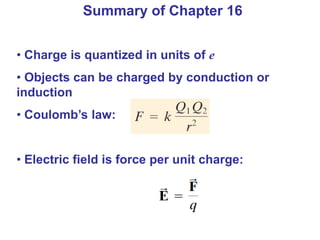
• Charge is quantized in units of e
• Objects can be charged by conduction or
induction
• Coulomb’s law:
• Electric field is force per unit charge:
Summary of Chapter 16
• Electric field of a point charge:
• Electric field can be represented by electric
field lines
• Static electric field inside conductor is zero;
surface field is perpendicular to surface
• Electric flux:
• Gauss’s law:
Online Notes and Presentations
www.PinoyBIX.org
Visit:

Electric Charge and Electric Field Lecture

  • 1.
    www.PinoyBIX.org Presents: Electric Charge andElectric Field credit: Giancoli Physics
  • 2.
    Chapter 16 Electric Chargeand Electric Field
  • 3.
    Units of Chapter16 • Static Electricity; Electric Charge and Its Conservation • Electric Charge in the Atom • Insulators and Conductors • Induced Charge; the Electroscope • Coulomb’s Law • Solving Problems Involving Coulomb’s Law and Vectors • The Electric Field
  • 4.
    Units of Chapter16 • Field Lines • Electric Fields and Conductors • Gauss’s Law • Electric Forces in Molecular Biology: DNA Structure and Replication • Photocopy Machines and Computer Printers Use Electrostatics
  • 5.
    16.1 Static Electricity;Electric Charge and Its Conservation Objects can be charged by rubbing
  • 6.
    16.1 Static Electricity; ElectricCharge and Its Conservation Charge comes in two types, positive and negative; like charges repel and opposite charges attract
  • 7.
    16.1 Static Electricity;Electric Charge and Its Conservation Electric charge is conserved – the arithmetic sum of the total charge cannot change in any interaction.
  • 8.
    16.2 Electric Chargein the Atom Atom: Nucleus (small, massive, positive charge) Electron cloud (large, very low density, negative charge)
  • 9.
    16.2 Electric Chargein the Atom Atom is electrically neutral. Rubbing charges objects by moving electrons from one to the other.
  • 10.
    16.2 Electric Chargein the Atom Polar molecule: neutral overall, but charge not evenly distributed
  • 11.
    16.3 Insulators andConductors Conductor: Charge flows freely Metals Insulator: Almost no charge flows Most other materials Some materials are semiconductors.
  • 12.
    16.4 Induced Charge;the Electroscope Metal objects can be charged by conduction:
  • 13.
    16.4 Induced Charge;the Electroscope They can also be charged by induction:
  • 14.
    16.4 Induced Charge;the Electroscope Nonconductors won’t become charged by conduction or induction, but will experience charge separation:
  • 15.
    16.4 Induced Charge;the Electroscope The electroscope can be used for detecting charge:
  • 16.
    16.4 Induced Charge;the Electroscope The electroscope can be charged either by conduction or by induction.
  • 17.
    16.4 Induced Charge;the Electroscope The charged electroscope can then be used to determine the sign of an unknown charge.
  • 18.
    16.5 Coulomb’s Law Experimentshows that the electric force between two charges is proportional to the product of the charges and inversely proportional to the distance between them.
  • 19.
    16.5 Coulomb’s Law Coulomb’slaw: (16-1) This equation gives the magnitude of the force.
  • 20.
    16.5 Coulomb’s Law Theforce is along the line connecting the charges, and is attractive if the charges are opposite, and repulsive if they are the same.
  • 21.
    16.5 Coulomb’s Law Unitof charge: coulomb, C The proportionality constant in Coulomb’s law is then: Charges produced by rubbing are typically around a microcoulomb:
  • 22.
    16.5 Coulomb’s Law Chargeon the electron: Electric charge is quantized in units of the electron charge.
  • 23.
    16.5 Coulomb’s Law Theproportionality constant k can also be written in terms of , the permittivity of free space: (16-2)
  • 24.
    16.5 Coulomb’s Law Coulomb’slaw strictly applies only to point charges. Superposition: for multiple point charges, the forces on each charge from every other charge can be calculated and then added as vectors.
  • 25.
    16.6 Solving ProblemsInvolving Coulomb’s Law and Vectors The net force on a charge is the vector sum of all the forces acting on it.
  • 26.
    16.6 Solving ProblemsInvolving Coulomb’s Law and Vectors Vector addition review:
  • 27.
    16.7 The ElectricField The electric field is the force on a small charge, divided by the charge: (16-3)
  • 28.
    16.7 The ElectricField For a point charge: (16-4a) (16-4b)
  • 29.
    16.7 The ElectricField Force on a point charge in an electric field: (16-5) Superposition principle for electric fields:
  • 30.
    16.7 The ElectricField Problem solving in electrostatics: electric forces and electric fields 1. Draw a diagram; show all charges, with signs, and electric fields and forces with directions 2. Calculate forces using Coulomb’s law 3. Add forces vectorially to get result
  • 31.
    16.8 Field Lines Theelectric field can be represented by field lines. These lines start on a positive charge and end on a negative charge.
  • 32.
    16.8 Field Lines Thenumber of field lines starting (ending) on a positive (negative) charge is proportional to the magnitude of the charge. The electric field is stronger where the field lines are closer together.
  • 33.
    16.8 Field Lines Electricdipole: two equal charges, opposite in sign:
  • 34.
    16.8 Field Lines Theelectric field between two closely spaced, oppositely charged parallel plates is constant.
  • 35.
    16.8 Field Lines Summaryof field lines: 1. Field lines indicate the direction of the field; the field is tangent to the line. 2. The magnitude of the field is proportional to the density of the lines. 3. Field lines start on positive charges and end on negative charges; the number is proportional to the magnitude of the charge.
  • 36.
    16.9 Electric Fieldsand Conductors The static electric field inside a conductor is zero – if it were not, the charges would move. The net charge on a conductor is on its surface.
  • 37.
    16.9 Electric Fieldsand Conductors The electric field is perpendicular to the surface of a conductor – again, if it were not, charges would move.
  • 38.
    16.10 Gauss’s Law Electricflux: (16-7) Electric flux through an area is proportional to the total number of field lines crossing the area.
  • 39.
    16.10 Gauss’s Law Fluxthrough a closed surface:
  • 40.
    16.10 Gauss’s Law Thenet number of field lines through the surface is proportional to the charge enclosed, and also to the flux, giving Gauss’s law: (16-9) This can be used to find the electric field in situations with a high degree of symmetry.
  • 41.
    16.11 Electric Forcesin Molecular Biology: DNA Structure and Replication Molecular biology is the study of the structure and functioning of the living cell at the molecular level. The DNA molecule is a double helix:
  • 42.
    16.11 Electric Forcesin Molecular Biology: DNA Structure and Replication The A-T and G-C nucleotide bases attract each other through electrostatic forces.
  • 43.
    16.11 Electric Forcesin Molecular Biology: DNA Structure and Replication Replication: DNA is in a “soup” of A, C, G, and T in the cell. During random collisions, A and T will be attracted to each other, as will G and C; other combinations will not.
  • 44.
    16.12 Photocopy Machinesand Computer Printers Use Electrostatics Photocopy machine: • drum is charged positively • image is focused on drum • only black areas stay charged and therefore attract toner particles • image is transferred to paper and sealed by heat
  • 45.
    16.12 Photocopy Machinesand Computer Printers Use Electrostatics
  • 46.
    16.12 Photocopy Machinesand Computer Printers Use Electrostatics Laser printer is similar, except a computer controls the laser intensity to form the image on the drum
  • 47.
    • Two kindsof electric charge – positive and negative • Charge is conserved • Charge on electron: • Conductors: electrons free to move • Insulators: nonconductors Summary of Chapter 16
  • 48.
    Summary of Chapter16 • Charge is quantized in units of e • Objects can be charged by conduction or induction • Coulomb’s law: • Electric field is force per unit charge:
  • 49.
    Summary of Chapter16 • Electric field of a point charge: • Electric field can be represented by electric field lines • Static electric field inside conductor is zero; surface field is perpendicular to surface • Electric flux: • Gauss’s law:
  • 50.
    Online Notes andPresentations www.PinoyBIX.org Visit: