Comparing Translational
and Rotational Motion
Discover the fundamental relationships between linear and angular
motion in mechanics. We'll explore how objects move in straight lines
and in circles, and the mathematical connections between these two
types of motion.
by ANGELIQUE TOLENTINO DEL ROSARIO
What is Translational Motion?
Translational motion occurs when an object moves from
one location to another along a straight path.
This is the simplest form of motion we observe in everyday life.
Linear Displacement
Change in position measured in meters (m)
Linear Velocity
Rate of change in position (m/s)
Linear Acceleration
Rate of change in velocity (m/s²)
What is Rotational Motion?
Rotational motion describes movement around a fixed axis.
Objects follow a circular path rather than a straight line.
Angular Displacement
Change in angle measured in radians (rad)
Angular Velocity
Rate of change in angle (rad/s)
Angular Acceleration
Rate of change in angular velocity (rad/s²)
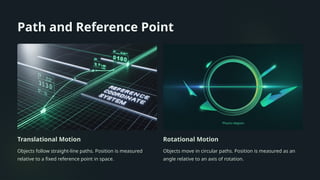
Path and Reference Point
Translational Motion
Objects follow straight-line paths. Position is measured
relative to a fixed reference point in space.
Rotational Motion
Objects move in circular paths. Position is measured as an
angle relative to an axis of rotation.
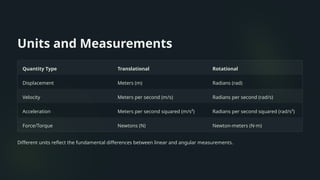
Units and Measurements
Quantity Type Translational Rotational
Displacement Meters (m) Radians (rad)
Velocity Meters per second (m/s) Radians per second (rad/s)
Acceleration Meters per second squared (m/s²) Radians per second squared (rad/s²)
Force/Torque Newtons (N) Newton-meters (N·m)
Different units reflect the fundamental differences between linear and angular measurements.
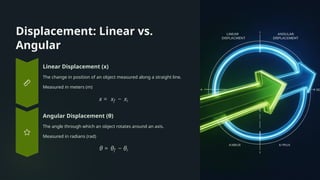
Displacement: Linear vs.
Angular
Linear Displacement (x)
The change in position of an object measured along a straight line.
Measured in meters (m)
Angular Displacement (θ)
The angle through which an object rotates around an axis.
Measured in radians (rad)
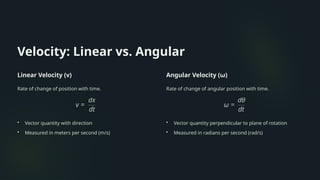
Velocity: Linear vs. Angular
Linear Velocity (v)
Rate of change of position with time.
• Vector quantity with direction
• Measured in meters per second (m/s)
Angular Velocity (ω)
Rate of change of angular position with time.
• Vector quantity perpendicular to plane of rotation
• Measured in radians per second (rad/s)
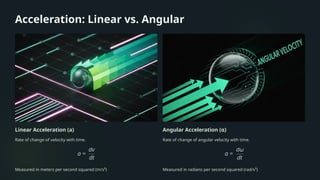
Acceleration: Linear vs. Angular
Linear Acceleration (a)
Rate of change of velocity with time.
Measured in meters per second squared (m/s²)
Angular Acceleration (α)
Rate of change of angular velocity with time.
Measured in radians per second squared (rad/s²)
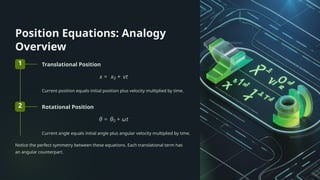
Position Equations: Analogy
Overview
1 Translational Position
Current position equals initial position plus velocity multiplied by time.
2 Rotational Position
Current angle equals initial angle plus angular velocity multiplied by time.
Notice the perfect symmetry between these equations. Each translational term has
an angular counterpart.
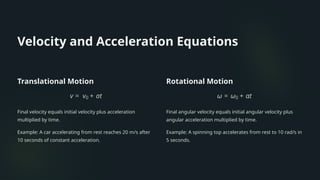
Velocity and Acceleration Equations
Translational Motion
Final velocity equals initial velocity plus acceleration
multiplied by time.
Example: A car accelerating from rest reaches 20 m/s after
10 seconds of constant acceleration.
Rotational Motion
Final angular velocity equals initial angular velocity plus
angular acceleration multiplied by time.
Example: A spinning top accelerates from rest to 10 rad/s in
5 seconds.
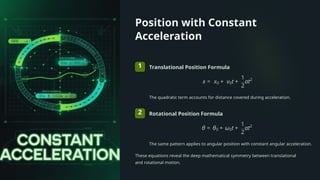
Position with Constant
Acceleration
1 Translational Position Formula
The quadratic term accounts for distance covered during acceleration.
2 Rotational Position Formula
The same pattern applies to angular position with constant angular acceleration.
These equations reveal the deep mathematical symmetry between translational
and rotational motion.
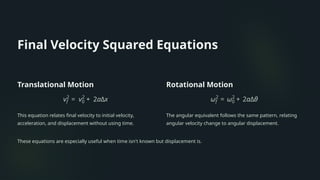
Final Velocity Squared Equations
Translational Motion
This equation relates final velocity to initial velocity,
acceleration, and displacement without using time.
Rotational Motion
The angular equivalent follows the same pattern, relating
angular velocity change to angular displacement.
These equations are especially useful when time isn't known but displacement is.
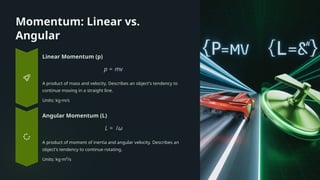
Momentum: Linear vs.
Angular
Linear Momentum (p)
A product of mass and velocity. Describes an object's tendency to
continue moving in a straight line.
Units: kg·m/s
Angular Momentum (L)
A product of moment of inertia and angular velocity. Describes an
object's tendency to continue rotating.
Units: kg·m²/s
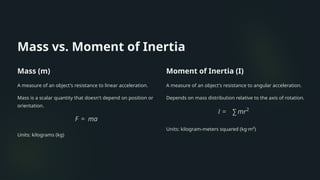
Mass vs. Moment of Inertia
Mass (m)
A measure of an object's resistance to linear acceleration.
Mass is a scalar quantity that doesn't depend on position or
orientation.
Units: kilograms (kg)
Moment of Inertia (I)
A measure of an object's resistance to angular acceleration.
Depends on mass distribution relative to the axis of rotation.
Units: kilogram-meters squared (kg·m²)
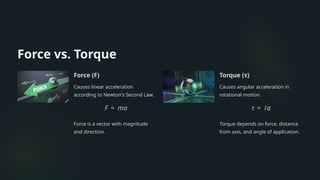
Force vs. Torque
Force (F)
Causes linear acceleration
according to Newton's Second Law.
Force is a vector with magnitude
and direction.
Torque (τ)
Causes angular acceleration in
rotational motion.
Torque depends on force, distance
from axis, and angle of application.
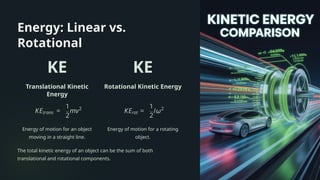
Energy: Linear vs.
Rotational
KE
Translational Kinetic
Energy
Energy of motion for an object
moving in a straight line.
KE
Rotational Kinetic Energy
Energy of motion for a rotating
object.
The total kinetic energy of an object can be the sum of both
translational and rotational components.
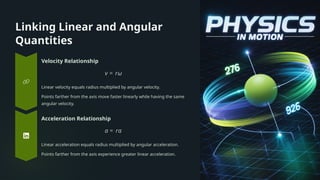
Linking Linear and Angular
Quantities
Velocity Relationship
Linear velocity equals radius multiplied by angular velocity.
Points farther from the axis move faster linearly while having the same
angular velocity.
Acceleration Relationship
Linear acceleration equals radius multiplied by angular acceleration.
Points farther from the axis experience greater linear acceleration.
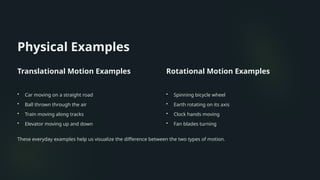
Physical Examples
Translational Motion Examples
• Car moving on a straight road
• Ball thrown through the air
• Train moving along tracks
• Elevator moving up and down
Rotational Motion Examples
• Spinning bicycle wheel
• Earth rotating on its axis
• Clock hands moving
• Fan blades turning
These everyday examples help us visualize the difference between the two types of motion.
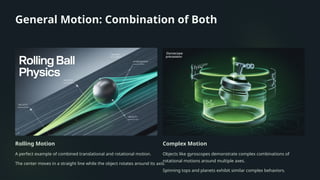
General Motion: Combination of Both
Rolling Motion
A perfect example of combined translational and rotational motion.
The center moves in a straight line while the object rotates around its axis.
Complex Motion
Objects like gyroscopes demonstrate complex combinations of
rotational motions around multiple axes.
Spinning tops and planets exhibit similar complex behaviors.
Summary and Key Takeaways
Mathematical Parallels
Each linear quantity has an angular
counterpart with the same
mathematical structure.
Interconnected
Relationships
Linear and angular quantities are
connected through the radius: v = rω
and a = rα.
Equation Patterns
Rotational motion equations mirror
translational forms, replacing x with
θ, v with ω, and a with α.
Practical Applications
Understanding these parallels
simplifies problem-solving in
mechanics and engineering.

Comparing Translational and Rotational Motion.pptx

  • 1.
    Comparing Translational and RotationalMotion Discover the fundamental relationships between linear and angular motion in mechanics. We'll explore how objects move in straight lines and in circles, and the mathematical connections between these two types of motion. by ANGELIQUE TOLENTINO DEL ROSARIO
  • 2.
    What is TranslationalMotion? Translational motion occurs when an object moves from one location to another along a straight path. This is the simplest form of motion we observe in everyday life. Linear Displacement Change in position measured in meters (m) Linear Velocity Rate of change in position (m/s) Linear Acceleration Rate of change in velocity (m/s²)
  • 3.
    What is RotationalMotion? Rotational motion describes movement around a fixed axis. Objects follow a circular path rather than a straight line. Angular Displacement Change in angle measured in radians (rad) Angular Velocity Rate of change in angle (rad/s) Angular Acceleration Rate of change in angular velocity (rad/s²)
  • 4.
    Path and ReferencePoint Translational Motion Objects follow straight-line paths. Position is measured relative to a fixed reference point in space. Rotational Motion Objects move in circular paths. Position is measured as an angle relative to an axis of rotation.
  • 5.
    Units and Measurements QuantityType Translational Rotational Displacement Meters (m) Radians (rad) Velocity Meters per second (m/s) Radians per second (rad/s) Acceleration Meters per second squared (m/s²) Radians per second squared (rad/s²) Force/Torque Newtons (N) Newton-meters (N·m) Different units reflect the fundamental differences between linear and angular measurements.
  • 6.
    Displacement: Linear vs. Angular LinearDisplacement (x) The change in position of an object measured along a straight line. Measured in meters (m) Angular Displacement (θ) The angle through which an object rotates around an axis. Measured in radians (rad)
  • 7.
    Velocity: Linear vs.Angular Linear Velocity (v) Rate of change of position with time. • Vector quantity with direction • Measured in meters per second (m/s) Angular Velocity (ω) Rate of change of angular position with time. • Vector quantity perpendicular to plane of rotation • Measured in radians per second (rad/s)
  • 8.
    Acceleration: Linear vs.Angular Linear Acceleration (a) Rate of change of velocity with time. Measured in meters per second squared (m/s²) Angular Acceleration (α) Rate of change of angular velocity with time. Measured in radians per second squared (rad/s²)
  • 9.
    Position Equations: Analogy Overview 1Translational Position Current position equals initial position plus velocity multiplied by time. 2 Rotational Position Current angle equals initial angle plus angular velocity multiplied by time. Notice the perfect symmetry between these equations. Each translational term has an angular counterpart.
  • 10.
    Velocity and AccelerationEquations Translational Motion Final velocity equals initial velocity plus acceleration multiplied by time. Example: A car accelerating from rest reaches 20 m/s after 10 seconds of constant acceleration. Rotational Motion Final angular velocity equals initial angular velocity plus angular acceleration multiplied by time. Example: A spinning top accelerates from rest to 10 rad/s in 5 seconds.
  • 11.
    Position with Constant Acceleration 1Translational Position Formula The quadratic term accounts for distance covered during acceleration. 2 Rotational Position Formula The same pattern applies to angular position with constant angular acceleration. These equations reveal the deep mathematical symmetry between translational and rotational motion.
  • 12.
    Final Velocity SquaredEquations Translational Motion This equation relates final velocity to initial velocity, acceleration, and displacement without using time. Rotational Motion The angular equivalent follows the same pattern, relating angular velocity change to angular displacement. These equations are especially useful when time isn't known but displacement is.
  • 13.
    Momentum: Linear vs. Angular LinearMomentum (p) A product of mass and velocity. Describes an object's tendency to continue moving in a straight line. Units: kg·m/s Angular Momentum (L) A product of moment of inertia and angular velocity. Describes an object's tendency to continue rotating. Units: kg·m²/s
  • 14.
    Mass vs. Momentof Inertia Mass (m) A measure of an object's resistance to linear acceleration. Mass is a scalar quantity that doesn't depend on position or orientation. Units: kilograms (kg) Moment of Inertia (I) A measure of an object's resistance to angular acceleration. Depends on mass distribution relative to the axis of rotation. Units: kilogram-meters squared (kg·m²)
  • 15.
    Force vs. Torque Force(F) Causes linear acceleration according to Newton's Second Law. Force is a vector with magnitude and direction. Torque (τ) Causes angular acceleration in rotational motion. Torque depends on force, distance from axis, and angle of application.
  • 16.
    Energy: Linear vs. Rotational KE TranslationalKinetic Energy Energy of motion for an object moving in a straight line. KE Rotational Kinetic Energy Energy of motion for a rotating object. The total kinetic energy of an object can be the sum of both translational and rotational components.
  • 17.
    Linking Linear andAngular Quantities Velocity Relationship Linear velocity equals radius multiplied by angular velocity. Points farther from the axis move faster linearly while having the same angular velocity. Acceleration Relationship Linear acceleration equals radius multiplied by angular acceleration. Points farther from the axis experience greater linear acceleration.
  • 18.
    Physical Examples Translational MotionExamples • Car moving on a straight road • Ball thrown through the air • Train moving along tracks • Elevator moving up and down Rotational Motion Examples • Spinning bicycle wheel • Earth rotating on its axis • Clock hands moving • Fan blades turning These everyday examples help us visualize the difference between the two types of motion.
  • 19.
    General Motion: Combinationof Both Rolling Motion A perfect example of combined translational and rotational motion. The center moves in a straight line while the object rotates around its axis. Complex Motion Objects like gyroscopes demonstrate complex combinations of rotational motions around multiple axes. Spinning tops and planets exhibit similar complex behaviors.
  • 20.
    Summary and KeyTakeaways Mathematical Parallels Each linear quantity has an angular counterpart with the same mathematical structure. Interconnected Relationships Linear and angular quantities are connected through the radius: v = rω and a = rα. Equation Patterns Rotational motion equations mirror translational forms, replacing x with θ, v with ω, and a with α. Practical Applications Understanding these parallels simplifies problem-solving in mechanics and engineering.