Bohr – Rutherford Atomic
Model
Objectives:
4.9 To describe the simplified atomic
model currently in use (Bohr-
Rutherford)
 Bohr & Rutherford combined their
theories to create the current
simplified atomic model
 The atom is made up of three sub-
atomic particles:
 Protons
 Electrons
 Neutrons
Bohr – Rutherford Atomic
Model:
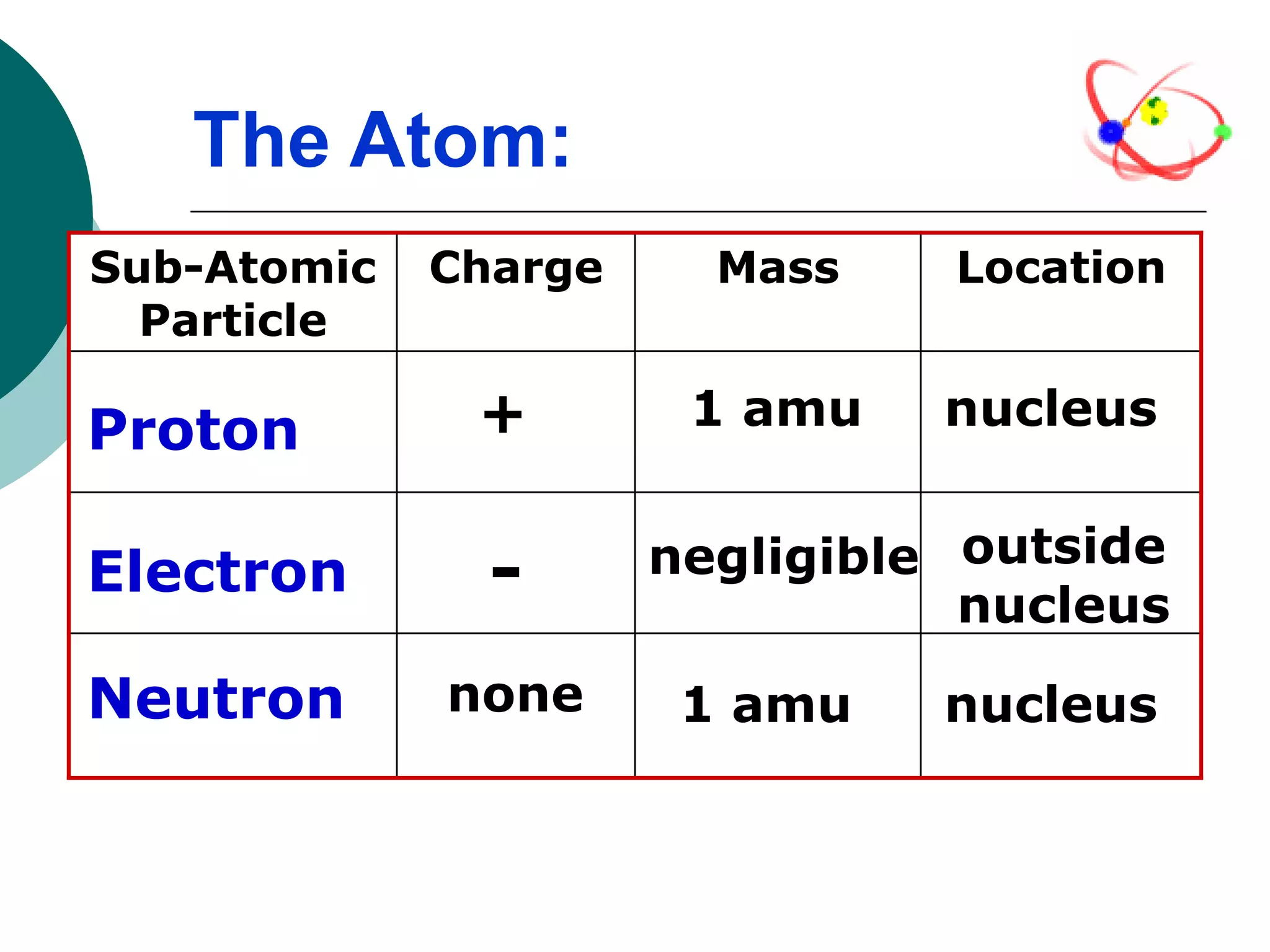
The Atom:
Sub-Atomic
Particle
Charge Mass Location
Proton
Electron
Neutron
+
-
none
1 amu
negligible
1 amu
nucleus
outside
nucleus
nucleus
education.jlab.org/ qa/atom_model.html
The Atom:
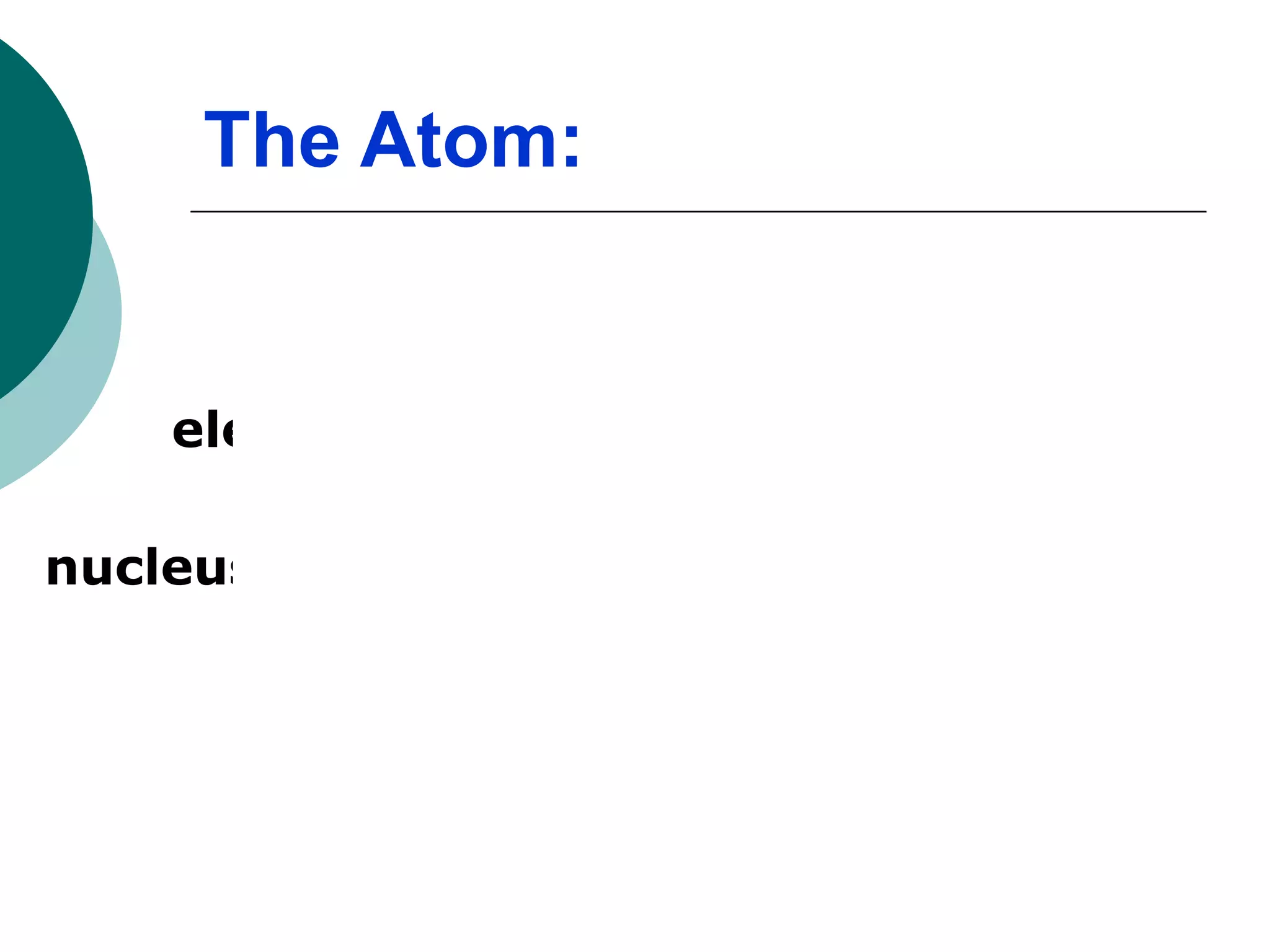
nucleus
electron neutron
proton
Nucleus:
 Contains protons & neutrons
 Overall positive charge (+)
 Contains nearly all mass (dense)
Electrons:
 Located outside
nucleus
 Easily moved, lost
or gained
 Negative charge (-)
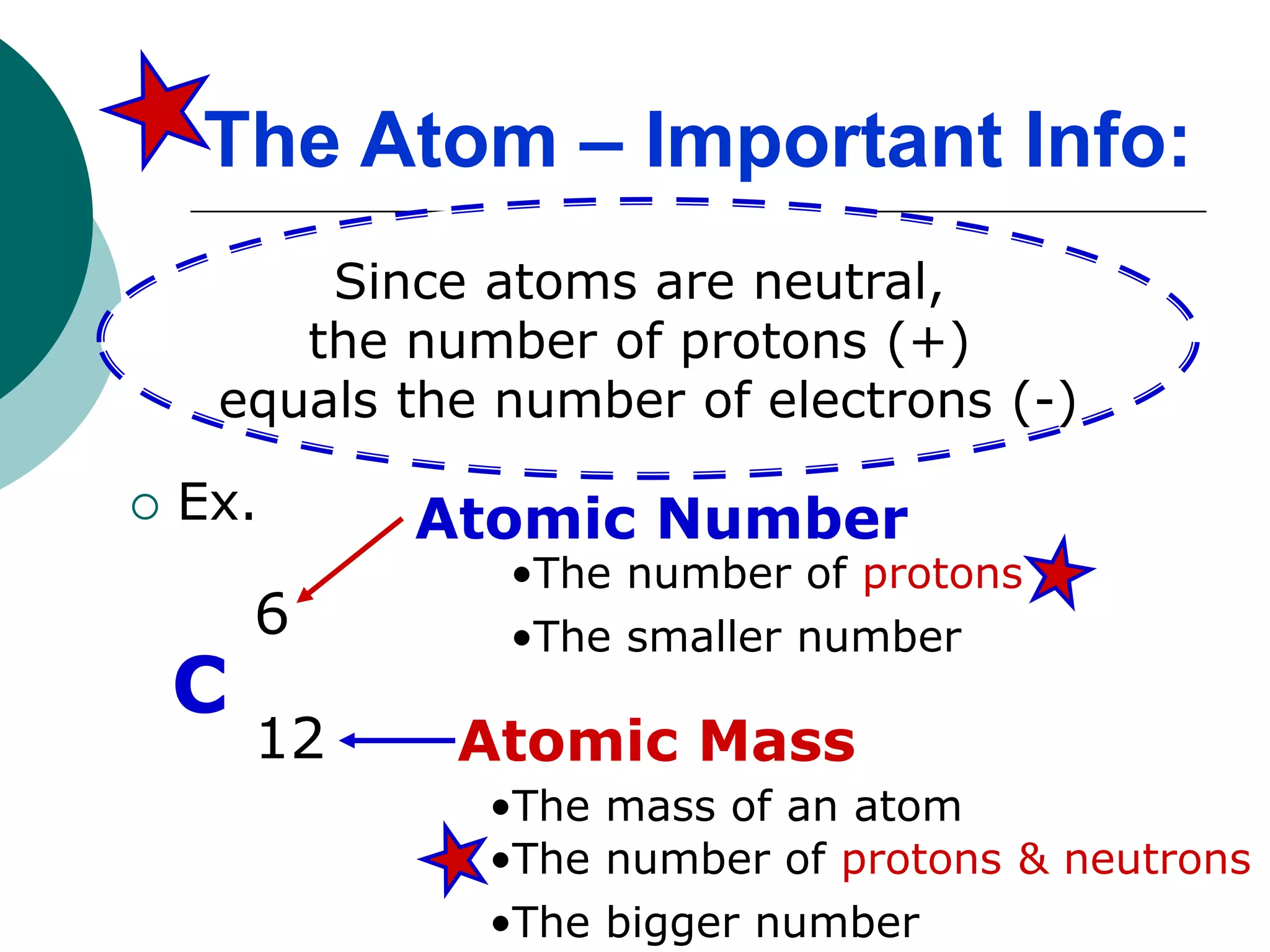
 Every atom has a symbol & two
numbers associated with it.
 Ex.
The Atom – Important Info:
C
12
6
Atomic Mass
Atomic Number
•The mass of an atom
•The bigger number
•The number of protons & neutrons
•The number of protons
•The smaller number
Since atoms are neutral,
the number of protons (+)
equals the number of electrons (-)
For the following atom, state the…
i) atomic mass
ii) atomic number
iii) # of protons
iv) # of electrons
v) # of neutrons
O
16
8
16
8
8
8
16 – 8 = 8
For the following atom, state the…
i) atomic mass
ii) atomic number
iii) # of protons
iv) # of electrons
v) # of neutrons
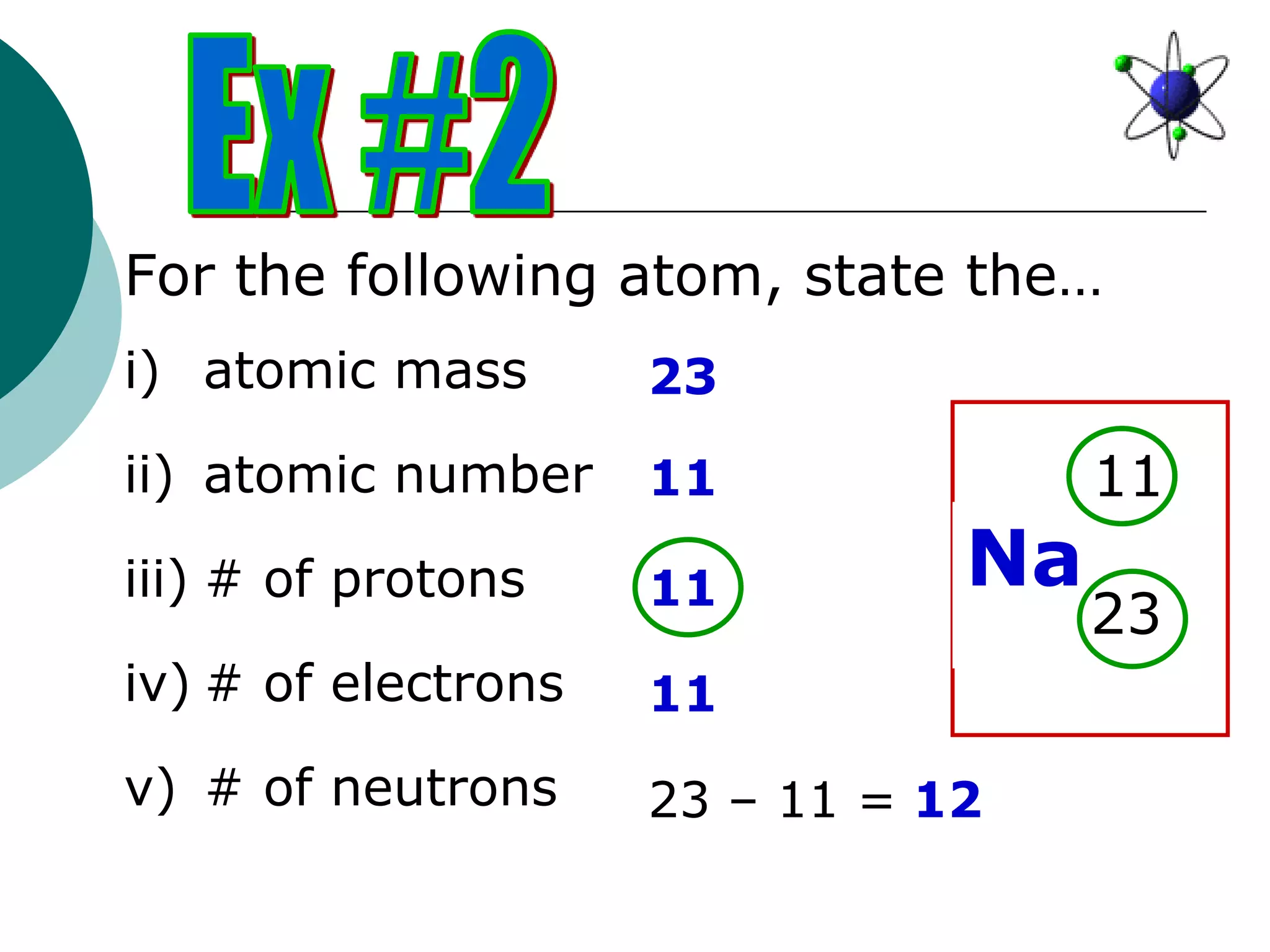
Na
23
11
23
11
11
11
23 – 11 = 12
For the following atom, state the…
i) atomic mass
ii) atomic number
iii) # of protons
iv) # of electrons
v) # of neutrons
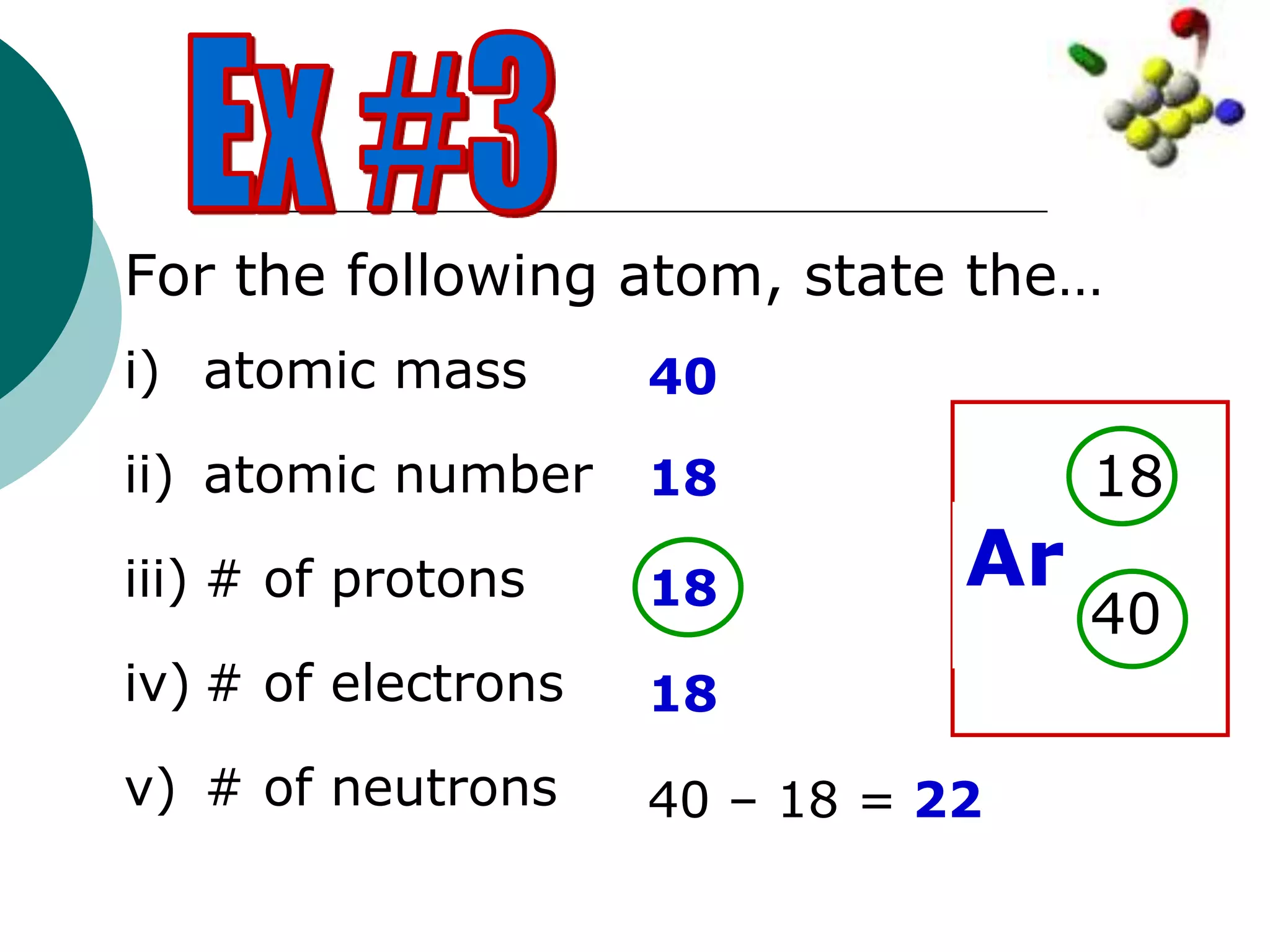
Ar
40
18
40
18
18
18
40 – 18 = 22
Cu
64
29
64
29
29
29
64 – 29 = 35
For the following atom, state the…
i) atomic mass
ii) atomic number
iii) # of protons
iv) # of electrons
v) # of neutrons
For the following atom, which
statement is TRUE?
P 31
15
A) The atomic number is 31.
B) The atom has 15 neutrons.
C) The atom has 16 electrons.
D) The atom has 15 protons & 15 electrons.
Given a neutral atom, which statement
is TRUE?
A) An atom always has the same number of
electrons as neutrons.
B) Electrons & neutrons are found in the
nucleus.
C) The atomic number states the number of
neutrons.
D) An atom always has the same number of
electrons as protons.
 Atoms are made up of:
 Protons
 Electrons
 Neutrons
 Protons & Neutrons are located in
the nucleus
 Electrons are located outside the
nucleus
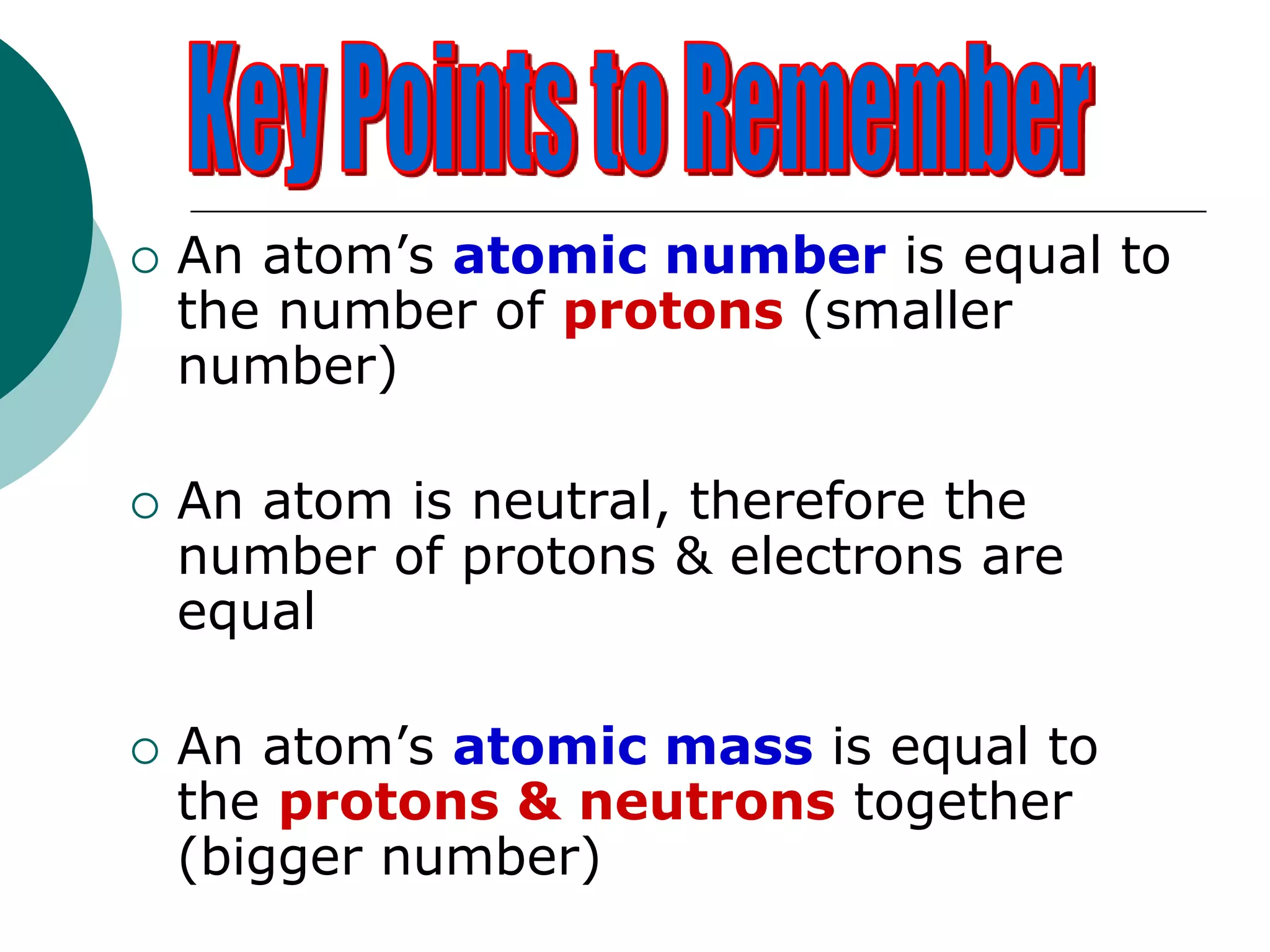
 An atom’s atomic number is equal to
the number of protons (smaller
number)
 An atom is neutral, therefore the
number of protons & electrons are
equal
 An atom’s atomic mass is equal to
the protons & neutrons together
(bigger number)
Activities:
 Physical Science Worksheet #7
Once you’ve
completed the
worksheet, continue
with the rest of the
lesson
 Recall, in the Bohr-Rutherford atomic
model, electrons are located outside
the nucleus
 Electrons are organized into:
 Electron shells or
 Energy levels or
 Orbitals
Electrons:
Be familiar with
all the terms,
especially the
first two
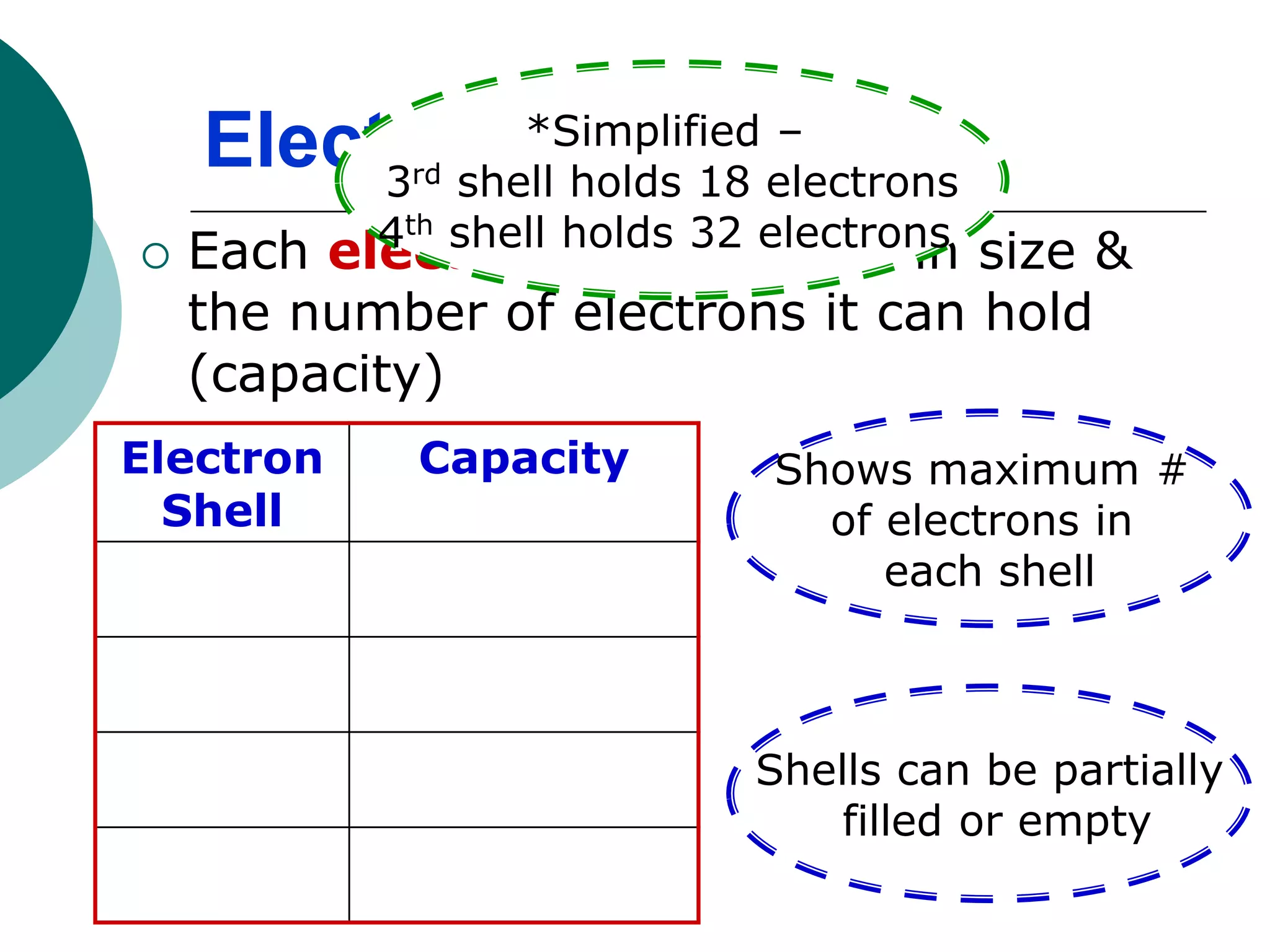
 Each electron shell differs in size &
the number of electrons it can hold
(capacity)
Electrons:
Electron
Shell
Capacity
1st 2 electrons
2nd 8 electrons
3rd 8 electrons*
4th 2 electrons*
Shows maximum #
of electrons in
each shell
Shells can be partially
filled or empty
*Simplified –
3rd shell holds 18 electrons
4th shell holds 32 electrons
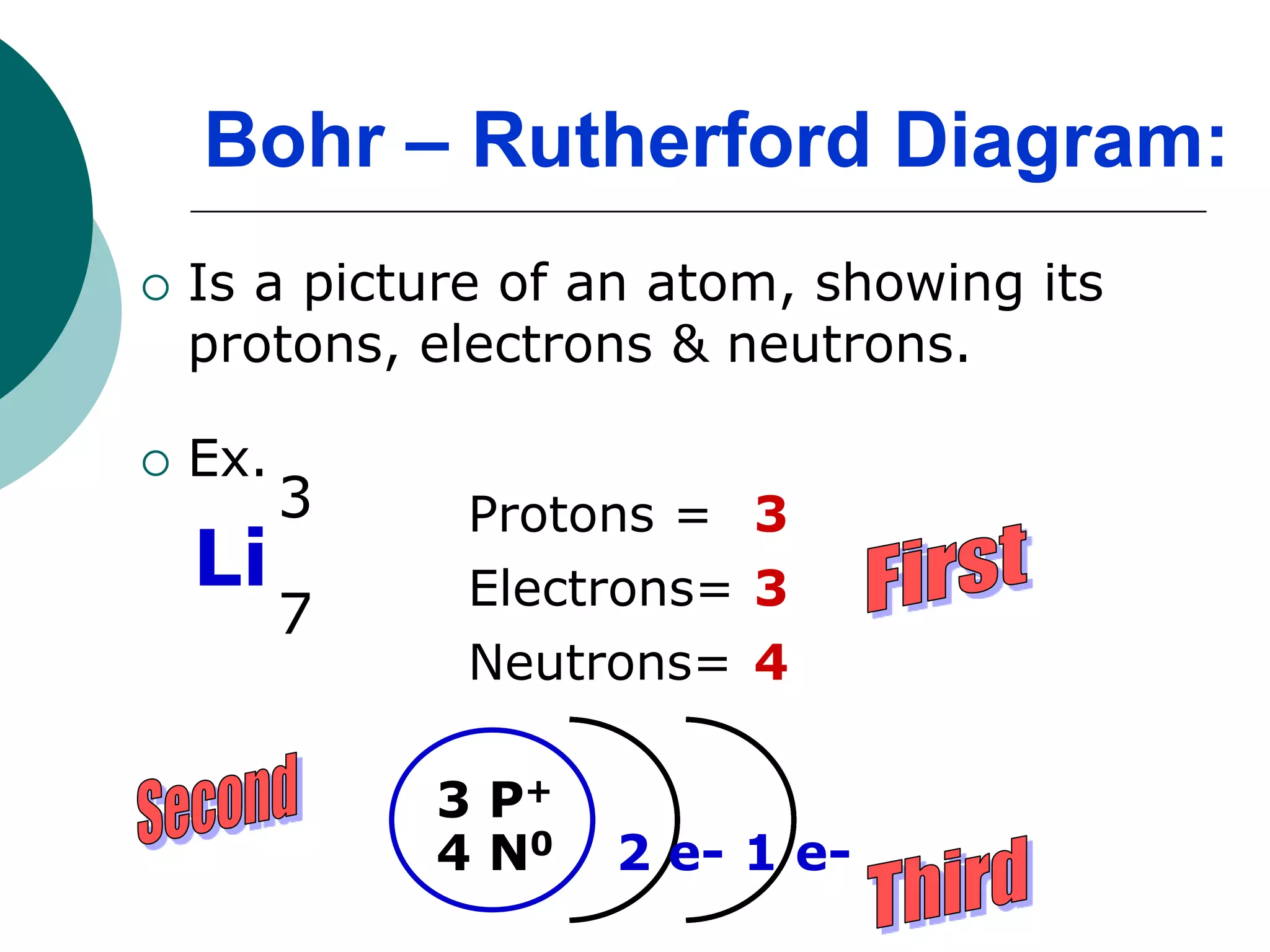
 Is a picture of an atom, showing its
protons, electrons & neutrons.
 Ex.
Bohr – Rutherford Diagram:
Protons =
Electrons=
Neutrons=
3
3
4
3 P+
4 N0 2 e- 1 e-
Li
7
3
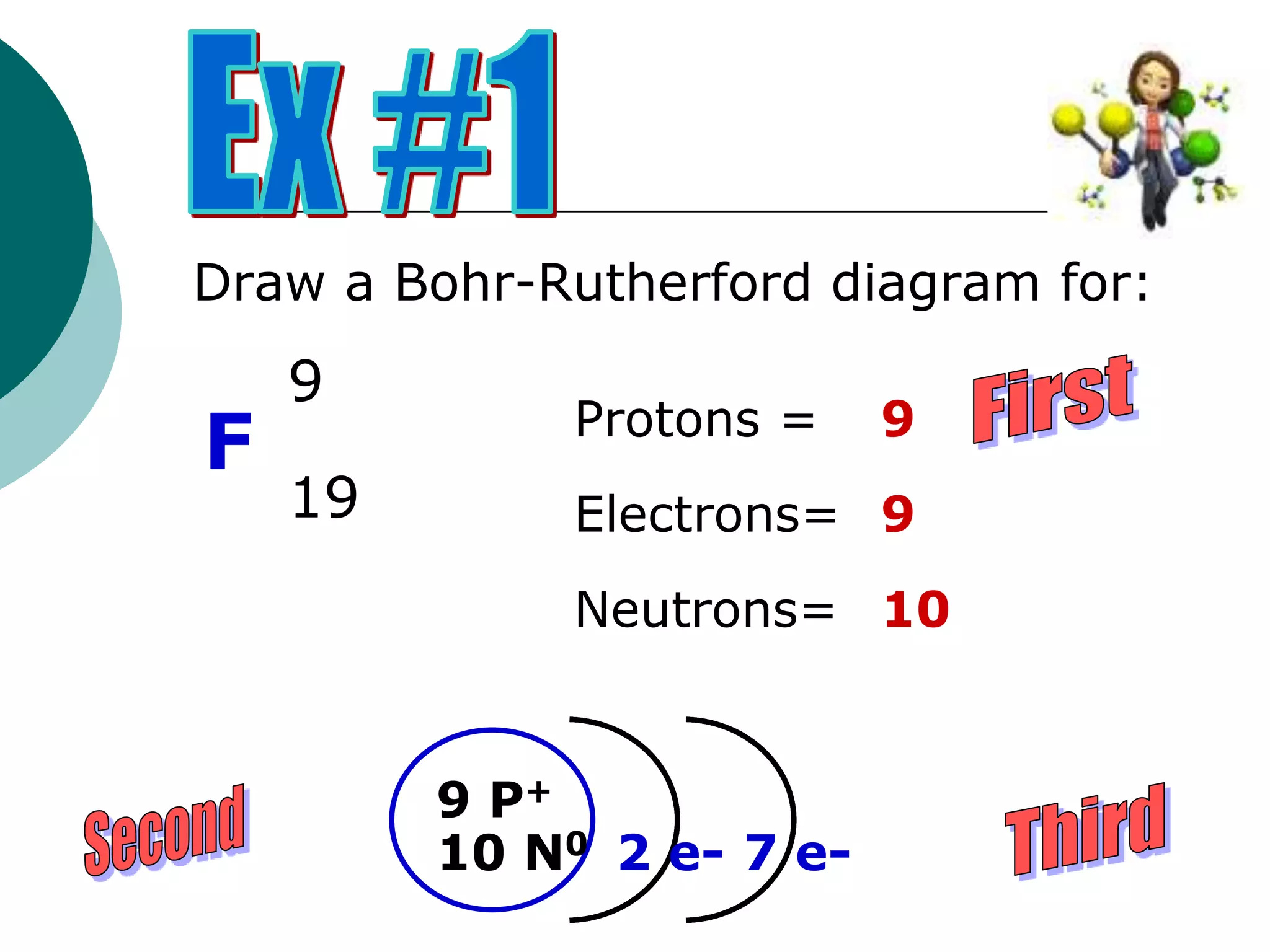
Draw a Bohr-Rutherford diagram for:
Protons =
Electrons=
Neutrons=
9
9
10
9 P+
10 N0 2 e- 7 e-
F
19
9
Draw a Bohr-Rutherford diagram for:
Protons =
Electrons=
Neutrons=
5
5
6
5 P+
6 N0 2 e- 3 e-
B
11
5
Draw a Bohr-Rutherford diagram for:
Protons =
Electrons=
Neutrons=
12
12
12
12 P+
12 N0 2 e- 8 e-
Mg
24
12
2 e-
Draw a Bohr-Rutherford diagram for:
Protons =
Electrons=
Neutrons=
19
19
20
19 P+
20 N0 2 e- 8 e-
K
39
19
8 e- 1 e-
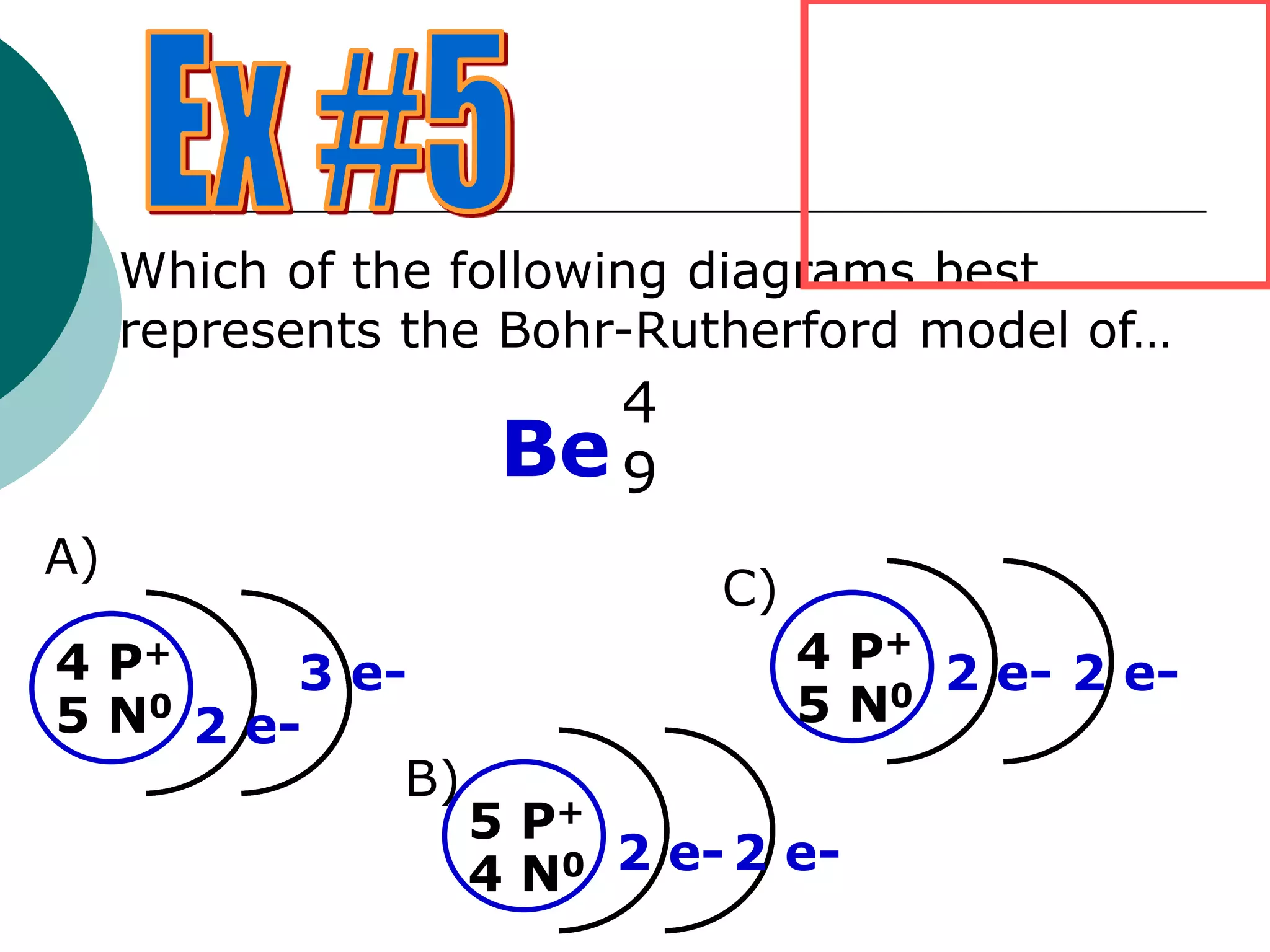
Be9
4
Which of the following diagrams best
represents the Bohr-Rutherford model of…
A)
4 P+
5 N0
2 e-
3 e-
B)
5 P+
4 N0 2 e- 2 e-
C)
4 P+
5 N0
2 e- 2 e-
Draw a Bohr-Rutherford diagram for
each of the following atoms:
P
31
15
N
14
7
Al
27
13
15 P+
16 N0
2 e-
8 e-
5 e-
7 P+
7 N0
2 e-
5 e- 13 P+
14 N0
2 e-
8 e-
3 e-
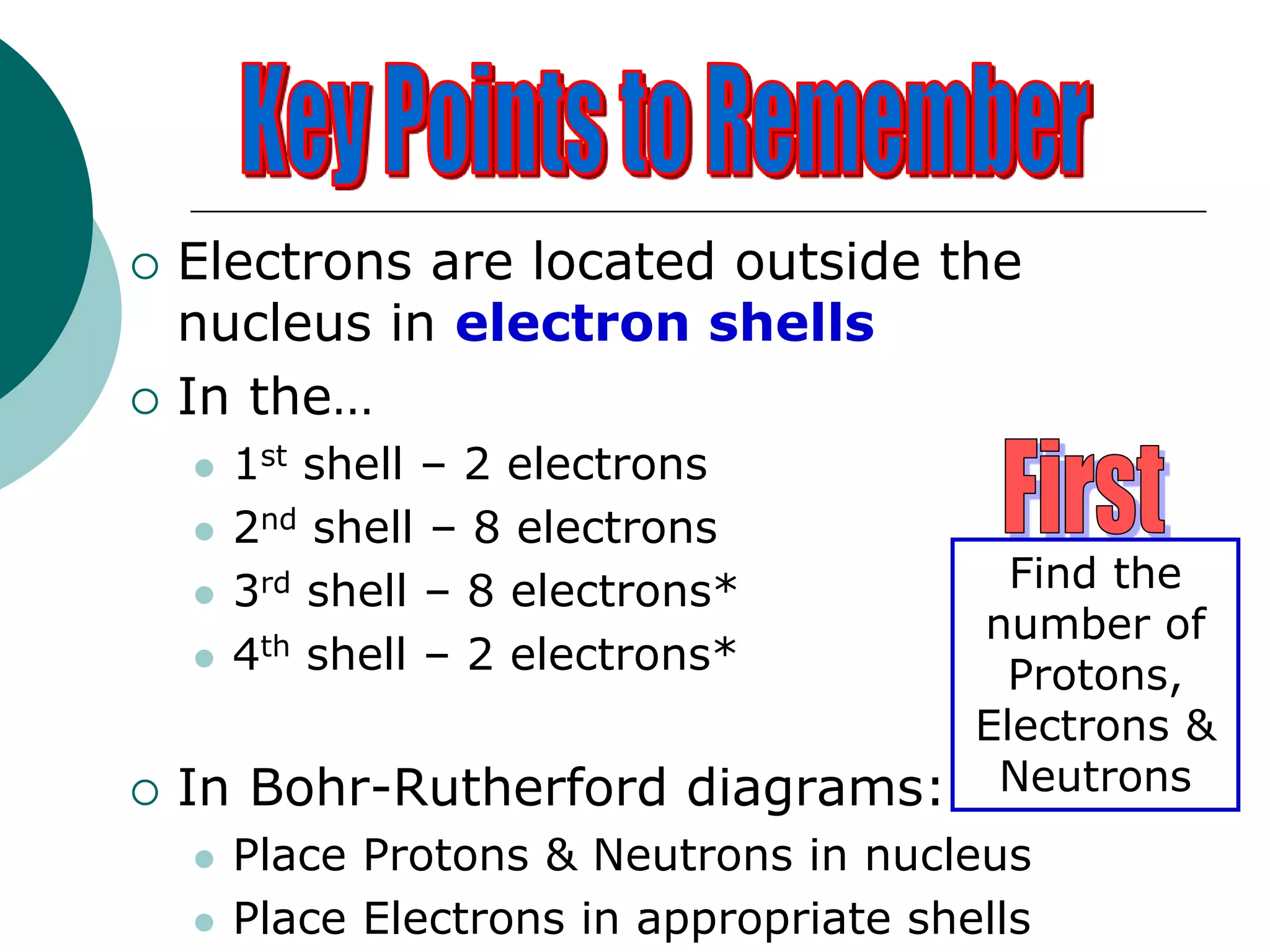
 Electrons are located outside the
nucleus in electron shells
 In the…
 1st shell – 2 electrons
 2nd shell – 8 electrons
 3rd shell – 8 electrons*
 4th shell – 2 electrons*
 In Bohr-Rutherford diagrams:
 Place Protons & Neutrons in nucleus
 Place Electrons in appropriate shells
Find the
number of
Protons,
Electrons &
Neutrons
Activities:
 Physical Science Worksheet #8
References
 Student Study Guide – Physical
Science 416/436 - MEQ
 Science Quest – Grenier, Daigle,
Rheaume – 1998, Cheneliere
 Google Images
 Animation Factory

Bohr Rutherford Atomic Model

  • 1.
    Bohr – RutherfordAtomic Model Objectives: 4.9 To describe the simplified atomic model currently in use (Bohr- Rutherford)
  • 2.
     Bohr &Rutherford combined their theories to create the current simplified atomic model  The atom is made up of three sub- atomic particles:  Protons  Electrons  Neutrons Bohr – Rutherford Atomic Model:
  • 3.
    The Atom: Sub-Atomic Particle Charge MassLocation Proton Electron Neutron + - none 1 amu negligible 1 amu nucleus outside nucleus nucleus
  • 4.
  • 5.
    Nucleus:  Contains protons& neutrons  Overall positive charge (+)  Contains nearly all mass (dense) Electrons:  Located outside nucleus  Easily moved, lost or gained  Negative charge (-)
  • 6.
     Every atomhas a symbol & two numbers associated with it.  Ex. The Atom – Important Info: C 12 6 Atomic Mass Atomic Number •The mass of an atom •The bigger number •The number of protons & neutrons •The number of protons •The smaller number Since atoms are neutral, the number of protons (+) equals the number of electrons (-)
  • 7.
    For the followingatom, state the… i) atomic mass ii) atomic number iii) # of protons iv) # of electrons v) # of neutrons O 16 8 16 8 8 8 16 – 8 = 8
  • 8.
    For the followingatom, state the… i) atomic mass ii) atomic number iii) # of protons iv) # of electrons v) # of neutrons Na 23 11 23 11 11 11 23 – 11 = 12
  • 9.
    For the followingatom, state the… i) atomic mass ii) atomic number iii) # of protons iv) # of electrons v) # of neutrons Ar 40 18 40 18 18 18 40 – 18 = 22
  • 10.
    Cu 64 29 64 29 29 29 64 – 29= 35 For the following atom, state the… i) atomic mass ii) atomic number iii) # of protons iv) # of electrons v) # of neutrons
  • 11.
    For the followingatom, which statement is TRUE? P 31 15 A) The atomic number is 31. B) The atom has 15 neutrons. C) The atom has 16 electrons. D) The atom has 15 protons & 15 electrons.
  • 12.
    Given a neutralatom, which statement is TRUE? A) An atom always has the same number of electrons as neutrons. B) Electrons & neutrons are found in the nucleus. C) The atomic number states the number of neutrons. D) An atom always has the same number of electrons as protons.
  • 13.
     Atoms aremade up of:  Protons  Electrons  Neutrons  Protons & Neutrons are located in the nucleus  Electrons are located outside the nucleus
  • 14.
     An atom’satomic number is equal to the number of protons (smaller number)  An atom is neutral, therefore the number of protons & electrons are equal  An atom’s atomic mass is equal to the protons & neutrons together (bigger number)
  • 15.
    Activities:  Physical ScienceWorksheet #7 Once you’ve completed the worksheet, continue with the rest of the lesson
  • 16.
     Recall, inthe Bohr-Rutherford atomic model, electrons are located outside the nucleus  Electrons are organized into:  Electron shells or  Energy levels or  Orbitals Electrons: Be familiar with all the terms, especially the first two
  • 17.
     Each electronshell differs in size & the number of electrons it can hold (capacity) Electrons: Electron Shell Capacity 1st 2 electrons 2nd 8 electrons 3rd 8 electrons* 4th 2 electrons* Shows maximum # of electrons in each shell Shells can be partially filled or empty *Simplified – 3rd shell holds 18 electrons 4th shell holds 32 electrons
  • 18.
     Is apicture of an atom, showing its protons, electrons & neutrons.  Ex. Bohr – Rutherford Diagram: Protons = Electrons= Neutrons= 3 3 4 3 P+ 4 N0 2 e- 1 e- Li 7 3
  • 19.
    Draw a Bohr-Rutherforddiagram for: Protons = Electrons= Neutrons= 9 9 10 9 P+ 10 N0 2 e- 7 e- F 19 9
  • 20.
    Draw a Bohr-Rutherforddiagram for: Protons = Electrons= Neutrons= 5 5 6 5 P+ 6 N0 2 e- 3 e- B 11 5
  • 21.
    Draw a Bohr-Rutherforddiagram for: Protons = Electrons= Neutrons= 12 12 12 12 P+ 12 N0 2 e- 8 e- Mg 24 12 2 e-
  • 22.
    Draw a Bohr-Rutherforddiagram for: Protons = Electrons= Neutrons= 19 19 20 19 P+ 20 N0 2 e- 8 e- K 39 19 8 e- 1 e-
  • 23.
    Be9 4 Which of thefollowing diagrams best represents the Bohr-Rutherford model of… A) 4 P+ 5 N0 2 e- 3 e- B) 5 P+ 4 N0 2 e- 2 e- C) 4 P+ 5 N0 2 e- 2 e-
  • 24.
    Draw a Bohr-Rutherforddiagram for each of the following atoms: P 31 15 N 14 7 Al 27 13 15 P+ 16 N0 2 e- 8 e- 5 e- 7 P+ 7 N0 2 e- 5 e- 13 P+ 14 N0 2 e- 8 e- 3 e-
  • 25.
     Electrons arelocated outside the nucleus in electron shells  In the…  1st shell – 2 electrons  2nd shell – 8 electrons  3rd shell – 8 electrons*  4th shell – 2 electrons*  In Bohr-Rutherford diagrams:  Place Protons & Neutrons in nucleus  Place Electrons in appropriate shells Find the number of Protons, Electrons & Neutrons
  • 26.
  • 27.
    References  Student StudyGuide – Physical Science 416/436 - MEQ  Science Quest – Grenier, Daigle, Rheaume – 1998, Cheneliere  Google Images  Animation Factory